- HR:+91-879-9184-787
- Sales:+91-908-163-7774


The rise of no-code AI tools is empowering individuals and businesses to create artificial intelligence solutions without the need for complex coding skills. These tools democratize access to AI by enabling users, whether they are entrepreneurs, small business owners, or even non-technical users, to build and deploy AI applications with ease. Whether you’re looking to create AI chatbots, automate tasks, or develop predictive models, no-code AI platforms allow you to leverage the power of artificial intelligence without having to write a single line of code.
In 2025, the availability and capability of no-code AI tools have grown significantly, providing users with more options than ever before. These platforms are not only cost-effective but also reduce the time needed to build and deploy AI applications, giving businesses the ability to innovate faster and stay ahead of the competition.
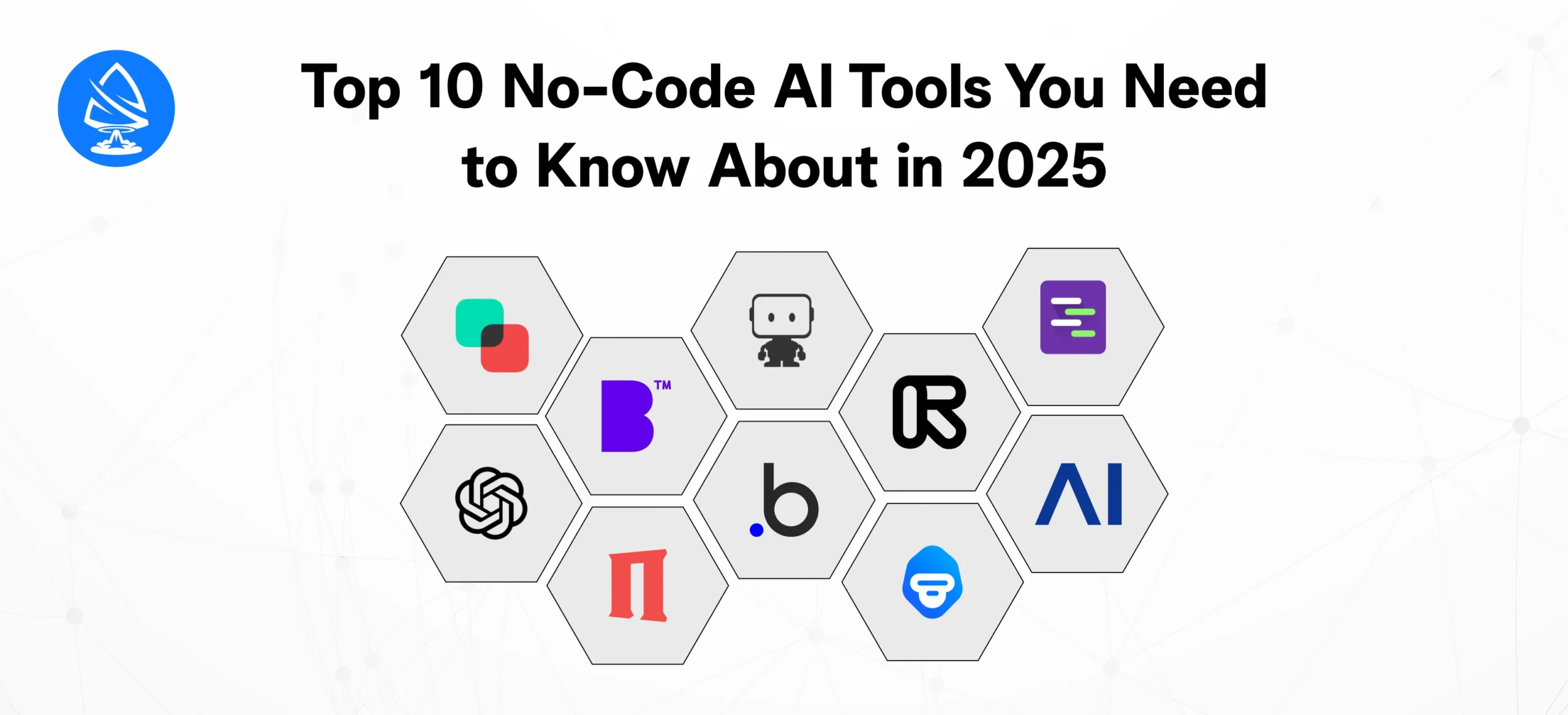
In this blog post, we will introduce you to the top 10 no-code AI tools you need to know about in 2025. We will cover what each tool offers, its key features, and the industries where they are most useful, helping you find the best solution to suit your needs.
No-Code AI refers to a category of artificial intelligence (AI) platforms and tools that allow users to build, deploy, and integrate AI models and applications without needing to write a single line of code. These platforms are designed to make AI accessible to non-technical users, such as business owners, marketers, and entrepreneurs, who may not have experience in programming or data science.
In traditional AI development, building an AI model involves complex processes, including data collection, cleaning, feature engineering, model training, and deployment, all of which require advanced knowledge of programming languages, machine learning algorithms, and data science concepts. With no-code AI, the process is simplified, and users can accomplish these tasks through intuitive visual interfaces that require little to no technical expertise.
No-code AI tools provide a set of pre-built models, templates, and automation features that make it easy for users to implement AI into their applications, products, or services. These platforms often use drag-and-drop functionalities, graphical user interfaces (GUIs), and simple configuration steps to streamline AI integration, enabling businesses to leverage AI without the need for specialized development teams.
You may also want to know How To Build an AI App
No-code AI platforms are built on the premise of abstracting complex AI tasks into manageable and understandable components. Here’s how they typically work:
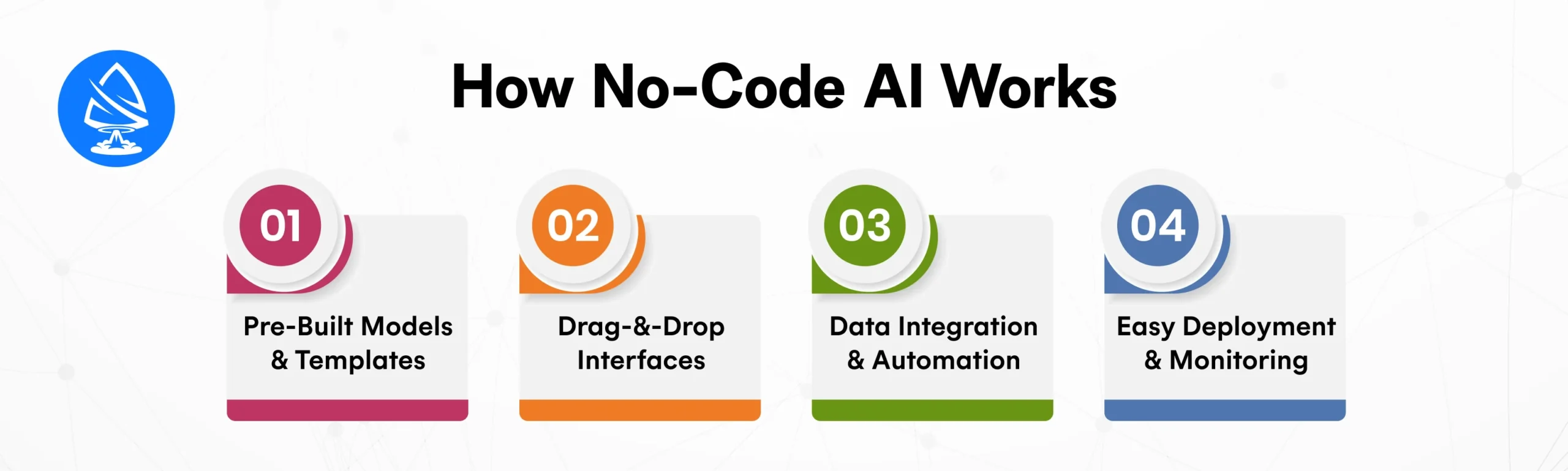
No-code AI platforms often come with pre-trained models and templates designed to handle specific tasks. These models can be used for a variety of applications, such as:
These pre-built models are ready to be deployed and can be customized to fit specific business needs without requiring any coding or data science expertise.
One of the most powerful features of no-code AI tools is their drag-and-drop interface. Users can simply drag components such as datasets, models, and workflows into their workspace, adjusting them as needed to create the desired application. This user-friendly interface eliminates the need to write code and simplifies the development process.
For example, when creating a predictive model, a user might upload a dataset and then select a pre-built model. They can then modify the settings or configure the model’s parameters without writing any code, and the platform will automatically handle the training and validation.
No-code AI platforms allow users to integrate various data sources such as CRM systems, databases, spreadsheets, and cloud services. Users can set up automated workflows that allow AI to interact with these data sources in real-time, providing valuable insights or automating tasks like email marketing or customer segmentation.
Example: A business might integrate customer data from a CRM into a no-code AI tool, use the tool to analyze customer behavior, and automate personalized email campaigns based on the analysis.
Once the AI model is configured, no-code platforms make it easy to deploy the AI solution to various environments, such as websites, mobile apps, or cloud services. Some platforms even offer automatic deployment features, where the model is deployed directly to the web or cloud with just a click of a button.
Moreover, no-code AI tools typically include monitoring and evaluation features that track the performance of the model, enabling users to understand how well the AI is performing and make adjustments as necessary.
Lobe is one of the most user-friendly no-code AI tools, offering a drag-and-drop interface for training machine learning models. It is perfect for beginners who want to experiment with AI and machine learning models, and it doesn’t require any coding skills. You can train models to classify images, recognize objects, and more, all with a simple interface.
Best For: Image and video classification, beginner AI developers, and small businesses looking for visual AI solutions.
OpenAI’s ChatGPT can be integrated into various no-code platforms to create intelligent chatbots. By using no-code tools like Zapier or Integromat, businesses can integrate ChatGPT into their websites, customer service systems, or e-commerce platforms without writing any code.
Best For: Customer support automation, lead generation, and content creation.
AI Builder is a no-code AI platform within Microsoft Power Automate that allows users to integrate AI capabilities into workflows. This platform offers pre-built models for text recognition, object detection, and sentiment analysis, allowing businesses to automate processes with AI-powered workflows.
Best For: Workflow automation, sentiment analysis, document processing.
Peltarion is a no-code AI platform that enables users to build and deploy machine learning models for real-time applications. It allows businesses to develop predictive models for operations, customer behavior, and even product development without requiring extensive machine learning knowledge.
Best For: Businesses looking to integrate predictive analytics into operations.
DataRobot is a robust no-code AI platform focused on automating the machine learning pipeline. It allows businesses to create AI models using their data with minimal effort. DataRobot helps users automate data preprocessing, model building, and model deployment.
Best For: Business intelligence, predictive analytics, and data-driven decision-making.
Bubble is a popular no-code platform that allows users to build fully functional web apps with AI capabilities. It integrates with AI APIs, including OpenAI and Google AI, making it easy to build AI-powered apps like chatbots, recommendation engines, and more.
Best For: Web app development, AI-driven web services, startups.
Runway ML is a no-code AI tool designed for creatives, providing a platform to create AI-powered multimedia applications. It allows users to generate realistic videos and images using AI, and even train models for custom creative projects.
Best For: Creative professionals, content creators, and multimedia production.
MonkeyLearn is a no-code machine learning platform designed to help businesses analyze and extract insights from text data. It’s ideal for sentiment analysis, keyword extraction, and classifying text data from customer reviews, surveys, and support tickets.
Best For: Text analytics, sentiment analysis, and customer feedback analysis.
Cognigy.AI is a no-code AI agent builder that focuses on building AI-powered conversational agents, or chatbots. These bots are designed to handle customer service inquiries, automate workflows, and engage users across multiple platforms like websites, messaging apps, and voice assistants.
Best For: Customer support automation, conversational agents, chatbot development.
Tars is a no-code chatbot builder that focuses on creating chatbots for lead generation, customer support, and engagement. It enables users to design chatbots using a drag-and-drop interface, allowing businesses to enhance customer experience through AI-driven conversations.
Best For: Lead generation, customer engagement, and support chatbots.
You may also want to know AI Builder Tools
The rise of no-code AI platforms has brought several key benefits to businesses looking to leverage AI without the need for specialized technical expertise. Here are the main advantages of no-code AI:
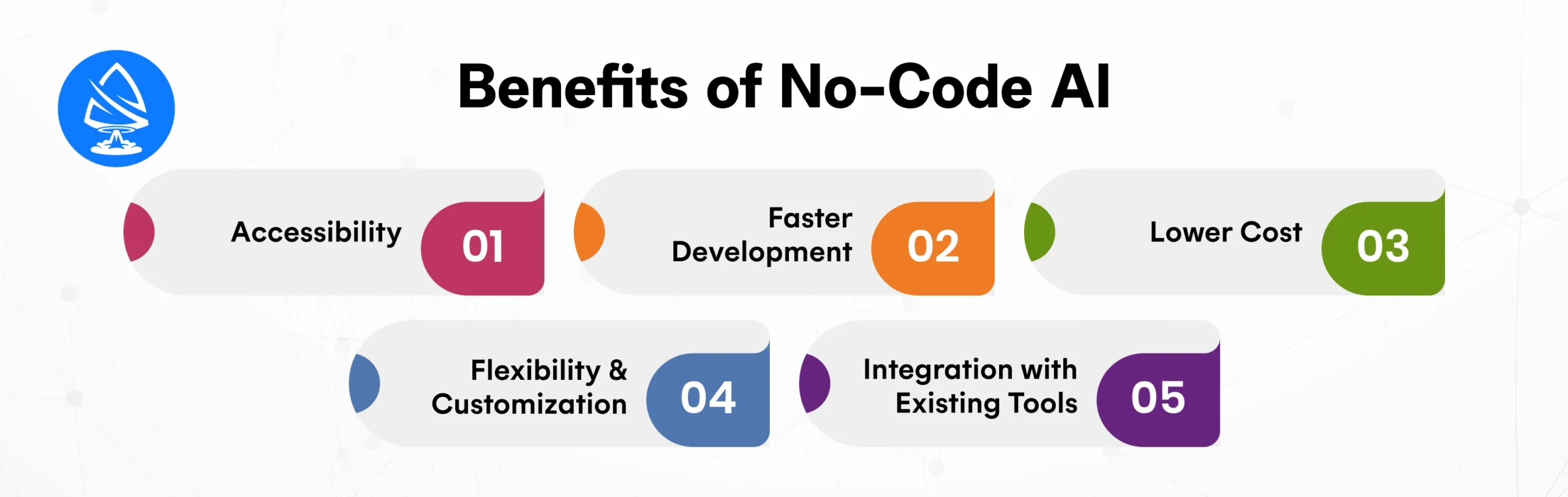
No-code AI makes it possible for non-technical users to create and deploy AI solutions, empowering people without programming knowledge to integrate AI into their workflows. This democratization of AI opens doors for small business owners, marketers, and entrepreneurs who otherwise wouldn’t have access to AI tools.
With no-code AI platforms, the development process is much faster. By removing the need for manual coding, users can deploy AI models and applications quickly, allowing businesses to act on opportunities or insights in real-time.
Traditional AI development often requires hiring data scientists, machine learning engineers, and other experts, which can be costly. No-code AI tools reduce the need for specialized talent, making AI more affordable and accessible to businesses of all sizes.
Many no-code AI platforms allow for a high degree of customization, enabling businesses to tailor AI solutions to their specific needs. You can adjust models, tweak workflows, and refine performance based on your requirements.
No-code AI platforms are often designed to easily integrate with other business tools, such as CRM systems, email marketing platforms, and social media accounts. This allows businesses to implement AI directly into their existing workflows.
While no-code AI offers many benefits, there are some challenges to consider:
While no-code AI platforms are powerful, they may not provide the flexibility required for more complex or highly specialized tasks. Customizing deep learning models or tackling highly niche use cases may still require technical expertise.
The simplicity of no-code AI platforms can lead to the over-simplification of complex problems. Businesses may not fully understand the underlying AI models, which could lead to misinterpretation of results or failure to account for key factors in model performance.
Many no-code AI platforms store data on cloud servers, which could raise concerns about data security and privacy. Businesses should ensure they comply with relevant privacy regulations, such as GDPR, when using these tools.
The no-code AI revolution is opening doors for businesses of all sizes to take advantage of artificial intelligence without the need for a team of developers. Whether you’re looking to automate processes, enhance customer engagement, or integrate machine learning into your services, no-code AI tools offer an accessible and effective solution.
By utilizing AI tools like Tars, MonkeyLearn, or Runway ML, you can quickly create powerful applications that deliver value to your business. As AI continues to evolve, these platforms will only become more sophisticated, providing even greater opportunities for innovation and efficiency.
Ready to explore no-code AI for your business? Use our AI App Cost Calculator to discover how these tools can help you streamline processes and drive growth.
1. What is no-code AI?
No-code AI refers to platforms that allow users to build and deploy AI models without writing any code. These platforms use a visual interface for model creation, enabling users without programming skills to integrate AI into their applications.
2. Can I build a chatbot with no-code AI tools?
Yes, many no-code AI tools like Tars and Cognigy.AI specialize in building AI-driven chatbots for customer service, lead generation, and engagement.
3. Do no-code AI platforms require coding knowledge?
No, no-code AI platforms are designed for users without coding knowledge. They offer drag-and-drop interfaces and pre-built AI models, making it easy to implement AI features.
4. Are no-code AI platforms scalable?
Yes, many no-code AI platforms like Peltarion and DataRobot are scalable and can be used by both small businesses and large enterprises.
5. What industries benefit the most from no-code AI?
Industries like e-commerce, healthcare, customer service, marketing, and finance benefit the most from no-code AI tools for tasks such as predictive analytics, content generation, and customer support.
6. How does no-code AI compare to low-code AI platforms?
No-code AI platforms are designed for non-technical users and offer simple, visual interfaces. Low-code platforms allow more customization through minimal coding but still simplify the process of app development and integration.
7. Can I integrate AI models into my existing app without coding?
Yes, most no-code AI platforms offer integration options with your existing app using APIs, enabling you to incorporate AI capabilities like predictive analytics or chatbot functions.
8. Are there free no-code AI tools?
Yes, several free no-code AI tools like MonkeyLearn and Runway ML offer basic functionalities with limited features, making them ideal for experimentation or small projects.

Artoon Solutions
Artoon Solutions is a technology company that specializes in providing a wide range of IT services, including web and mobile app development, game development, and web application development. They offer custom software solutions to clients across various industries and are known for their expertise in technologies such as React.js, Angular, Node.js, and others. The company focuses on delivering high-quality, innovative solutions tailored to meet the specific needs of their clients.
 For business inquiries only