In an increasingly digitized world, cybersecurity threats are growing in complexity and frequency. Traditional rule-based security systems are no longer sufficient to protect sensitive data, networks, and applications from sophisticated cyberattacks. Enter AI in cybersecurity, a transformative technology that leverages machine learning, deep learning, and advanced analytics to detect, prevent, and respond to threats in real-time.
AI-driven security solutions provide proactive defense mechanisms, enabling organizations to anticipate attacks, identify anomalies, and mitigate risks faster than human analysts alone. From basic signature-based detection to advanced deep learning models capable of recognizing zero-day attacks, the evolution of AI in cybersecurity reflects the need for more intelligent, adaptive, and scalable security systems.
This blog explores the journey of AI in cybersecurity, highlighting key advancements, applications, and future trends. By understanding how AI has evolved from rule-based systems to deep learning-driven frameworks, businesses can make informed decisions about investing in AI security solutions, partnering with an artificial intelligence development company in USA, and building robust defenses against ever-evolving cyber threats.
What is AI in Cybersecurity?
AI in cybersecurity refers to the application of artificial intelligence technologies to protect digital systems, networks, and data from cyber threats. Unlike traditional cybersecurity methods that rely on predefined rules and manual monitoring, AI leverages machine learning, deep learning, and advanced analytics to detect anomalies, predict potential threats, and respond to incidents in real-time.
At its core, AI in cybersecurity enables systems to learn from data, recognize patterns, and make informed decisions autonomously or with minimal human intervention. This makes it particularly effective against sophisticated and evolving cyberattacks that may bypass rule-based defenses.
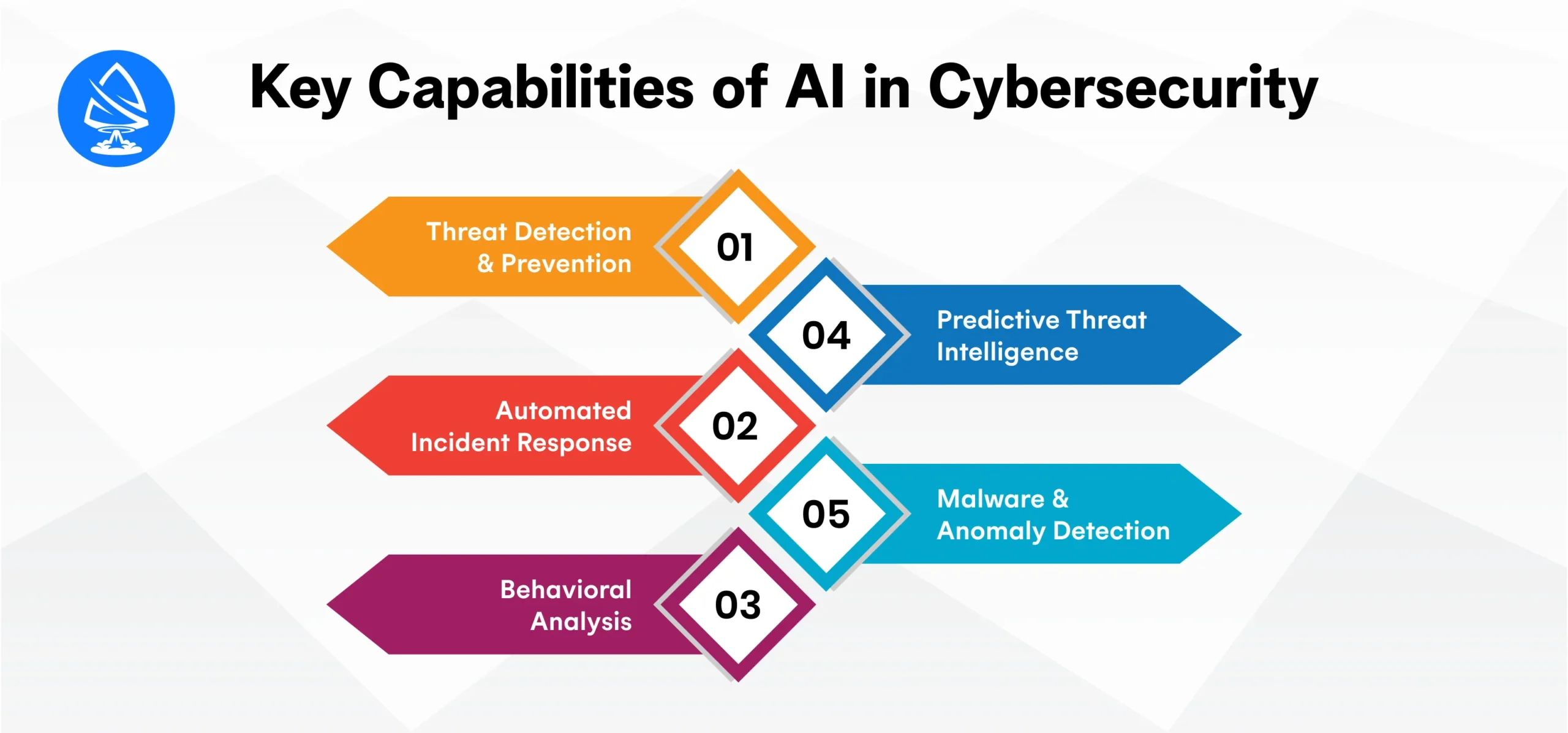
Key Capabilities of AI in Cybersecurity
Threat Detection and Prevention
AI analyzes network traffic, system logs, and user behavior to identify abnormal activities that could indicate cyberattacks. This proactive approach allows businesses to prevent breaches before they occur.
Example: AI can detect unusual login attempts from a foreign IP address, flagging potential account compromise in real-time.
Automated Incident Response
AI can respond to detected threats automatically by isolating compromised systems, blocking malicious traffic, or alerting security teams, reducing the time between detection and mitigation.
Example: In a ransomware attack, AI can immediately quarantine affected files and prevent the malware from spreading across the network.
Behavioral Analysis
By monitoring user and system behavior over time, AI identifies deviations that may signal insider threats, fraud, or compromised credentials.
Example: An AI system can detect if an employee suddenly accesses sensitive files at unusual hours, triggering an investigation.
Predictive Threat Intelligence
AI analyzes historical and real-time data to predict potential vulnerabilities and attack vectors, enabling proactive defense strategies.
Example: AI-driven threat intelligence can forecast phishing campaigns targeting a company based on emerging patterns.
Malware and Anomaly Detection
Machine learning models can classify unknown malware and detect previously unseen threats by recognizing patterns in code or network behavior.
Example: AI can identify a new malware variant attempting to exploit a zero-day vulnerability, even if it hasn’t been seen before.
Initially, cybersecurity relied heavily on rule-based systems, also known as signature-based detection. These systems operated on predefined rules and known threat signatures.
Characteristics of Rule-Based Systems:
Detect only known threats
Depend on frequent manual updates
Limited ability to adapt to new attack vectors
Example: Antivirus software that identifies malware by matching it against a database of known virus signatures.
Limitations:
Ineffective against zero-day attacks or unknown malware
High dependence on human analysts for updates and monitoring
Struggled to handle complex, multi-stage attacks
The Shift to AI-Powered Cybersecurity
With the rise of sophisticated attacks, AI began to play a critical role in enhancing cybersecurity. Machine learning algorithms allowed systems to learn from historical data and detect anomalies beyond simple rule-matching.
Advancements Introduced:
Behavioral Analysis – Monitoring user and system behaviors to detect unusual activity.
Anomaly Detection – Identifying deviations from normal patterns that may indicate threats.
Predictive Analytics – Anticipating potential attacks based on historical trends.
Example: An enterprise network uses AI in network security to flag unusual login attempts from foreign locations, even if no known malware is detected.
Benefits:
Real-time threat detection
Reduced reliance on manual updates
Enhanced adaptability to evolving cyber threats
Deep Learning and Advanced AI in Cybersecurity
The next leap in cybersecurity involved deep learning models, which can process complex, high-dimensional data and recognize subtle patterns indicative of cyber threats. Deep learning enables:
Detection of zero-day attacks
Identification of spear-phishing emails or sophisticated malware
Automated triaging and threat prioritization
Example: AI security solutions using deep learning can scan millions of network events and detect malware variants that traditional signature-based systems would miss.
Key Technologies:
Neural Networks for Pattern Recognition
Natural Language Processing (NLP) for analyzing malicious emails or communications
Reinforcement Learning for adaptive threat mitigation strategies
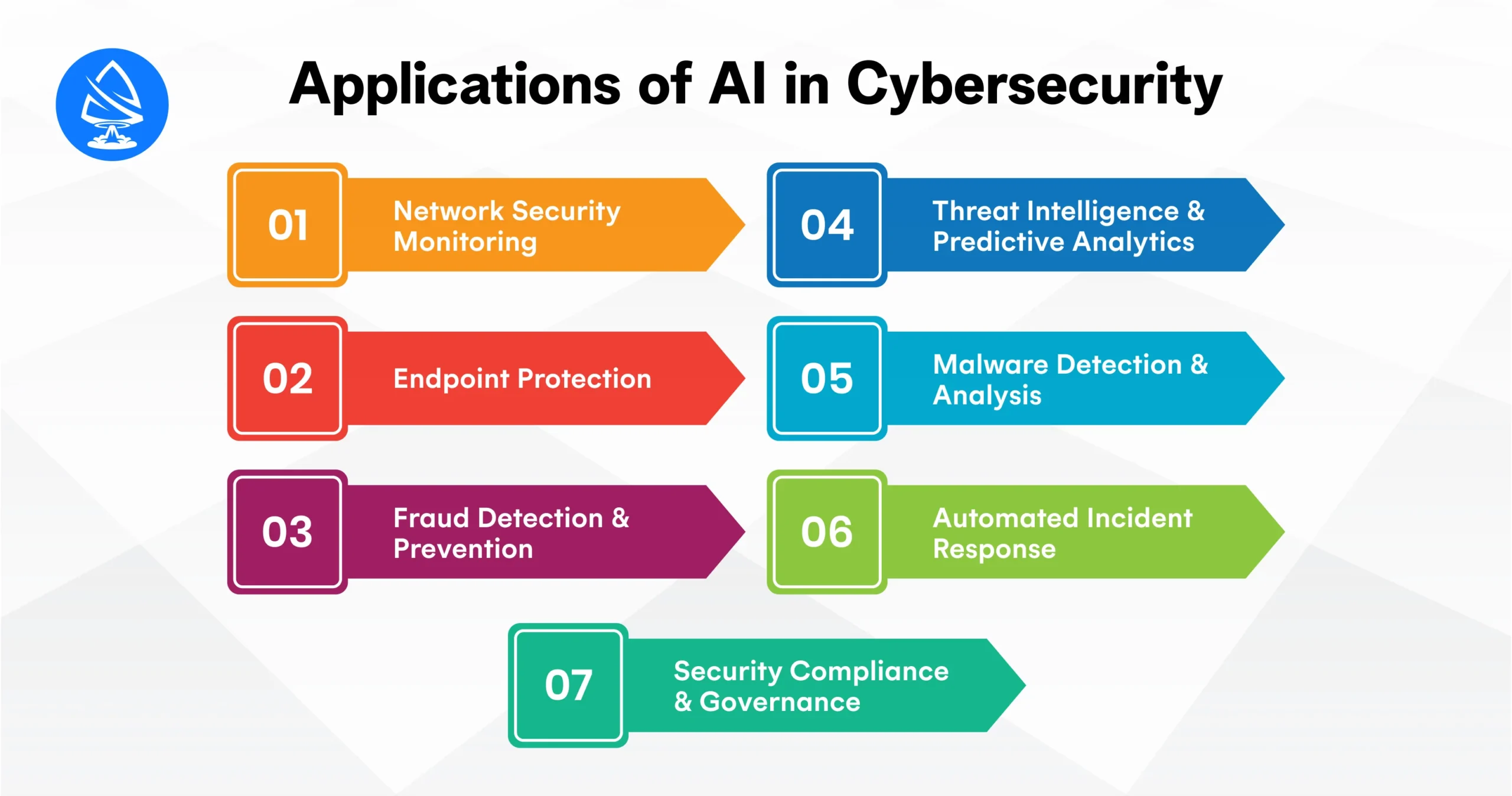
Applications of AI in Cybersecurity
The integration of AI in cybersecurity has revolutionized how organizations protect their digital assets, detect threats, and respond to incidents. By leveraging machine learning, deep learning, and predictive analytics, AI enables automated, intelligent, and real-time security solutions across multiple domains. Here’s a detailed exploration of the key applications of AI in cybersecurity:
1. Network Security Monitoring
AI-powered systems continuously monitor network traffic, looking for anomalies and suspicious patterns that may indicate cyberattacks. Traditional methods often rely on static rules, which can be bypassed, whereas AI adapts and learns from emerging threats.
Functions:
Detect unusual access attempts or traffic spikes
Identify potential intrusion or malware activity
Monitor internal and external network communications in real-time
Example: A corporate network uses AI to detect a series of failed login attempts from an unfamiliar IP range, automatically triggering alerts and blocking access to prevent unauthorized entry.
Benefits:
Faster detection of threats
Reduced manual monitoring workload
Enhanced protection against zero-day attacks
2. Endpoint Protection
Endpoints such as laptops, servers, and IoT devices are common targets for cyberattacks. AI enhances endpoint security by analyzing behavioral patterns and identifying abnormal activities.
Functions:
Detect suspicious file modifications or software installations
Identify malware and ransomware variants
Automatically isolate compromised devices
Example: AI security solutions on employee laptops can detect ransomware encrypting files and automatically halt the process before it spreads.
Benefits:
Proactive threat mitigation
Reduced risk of lateral movement across networks
Continuous endpoint monitoring without manual intervention
3. Fraud Detection and Prevention
AI in cybersecurity is particularly effective in detecting financial fraud, analyzing transaction patterns, and identifying anomalies in real-time.
Functions:
Monitor credit card and banking transactions
Identify unusual patterns indicative of fraud
Provide predictive insights for proactive risk management
Example: A banking institution uses AI algorithms to flag suspicious transactions, such as a large overseas purchase that deviates from a customer’s usual behavior, preventing potential financial loss.
Benefits:
Reduced fraudulent activity
Improved customer trust and compliance
Faster detection of suspicious transactions
4. Threat Intelligence and Predictive Analytics
AI gathers and analyzes threat intelligence from multiple sources to anticipate potential attacks. Predictive models identify vulnerabilities before attackers exploit them.
Functions:
Aggregate threat data from open-source feeds, dark web, and internal logs
Predict attack trends based on historical data
Provide actionable intelligence to security teams
Example: AI security companies use predictive analytics to forecast phishing campaigns targeting specific industries, enabling proactive defense and employee training.
Benefits:
Anticipates attacks before they occur
Enhances proactive cybersecurity measures
Optimizes resource allocation for security teams
5. Malware Detection and Analysis
Machine learning and deep learning models allow AI to detect and classify malware, including previously unknown variants, by analyzing behavior rather than relying solely on known signatures.
Functions:
Behavioral analysis of files and programs
Real-time scanning for anomalies in system operations
Automated classification of malicious software
Example: An enterprise AI security solution detects a new malware strain attempting to exploit a zero-day vulnerability, quarantines it, and updates threat intelligence for all systems.
Benefits:
Identifies new and evolving threats
Reduces reliance on manual malware research
Improves response speed and containment
6. Automated Incident Response
AI enables automated response to detected security incidents, reducing response time and minimizing damage.
Functions:
Isolate compromised systems automatically
Block malicious IP addresses or suspicious traffic
Trigger alerts and reports for security teams
Example: During a phishing attack, AI detects suspicious emails, blocks delivery, and alerts the IT team, preventing employees from interacting with malicious content.
Benefits:
Faster threat containment
Reduces the workload on security analysts
Improves overall incident response efficiency
7. Security Compliance and Governance
AI helps organizations monitor compliance with cybersecurity policies and regulatory requirements, providing real-time auditing and reporting.
Functions:
Monitor user activity and access rights
Ensure adherence to GDPR, HIPAA, or PCI DSS standards
Detect policy violations and potential risks
Example: A healthcare organization uses AI security systems to continuously monitor access to patient data, ensuring compliance with HIPAA regulations.
Benefits:
Reduces risk of non-compliance penalties
Enhances governance and accountability
Provides detailed audit trails for regulatory purposes
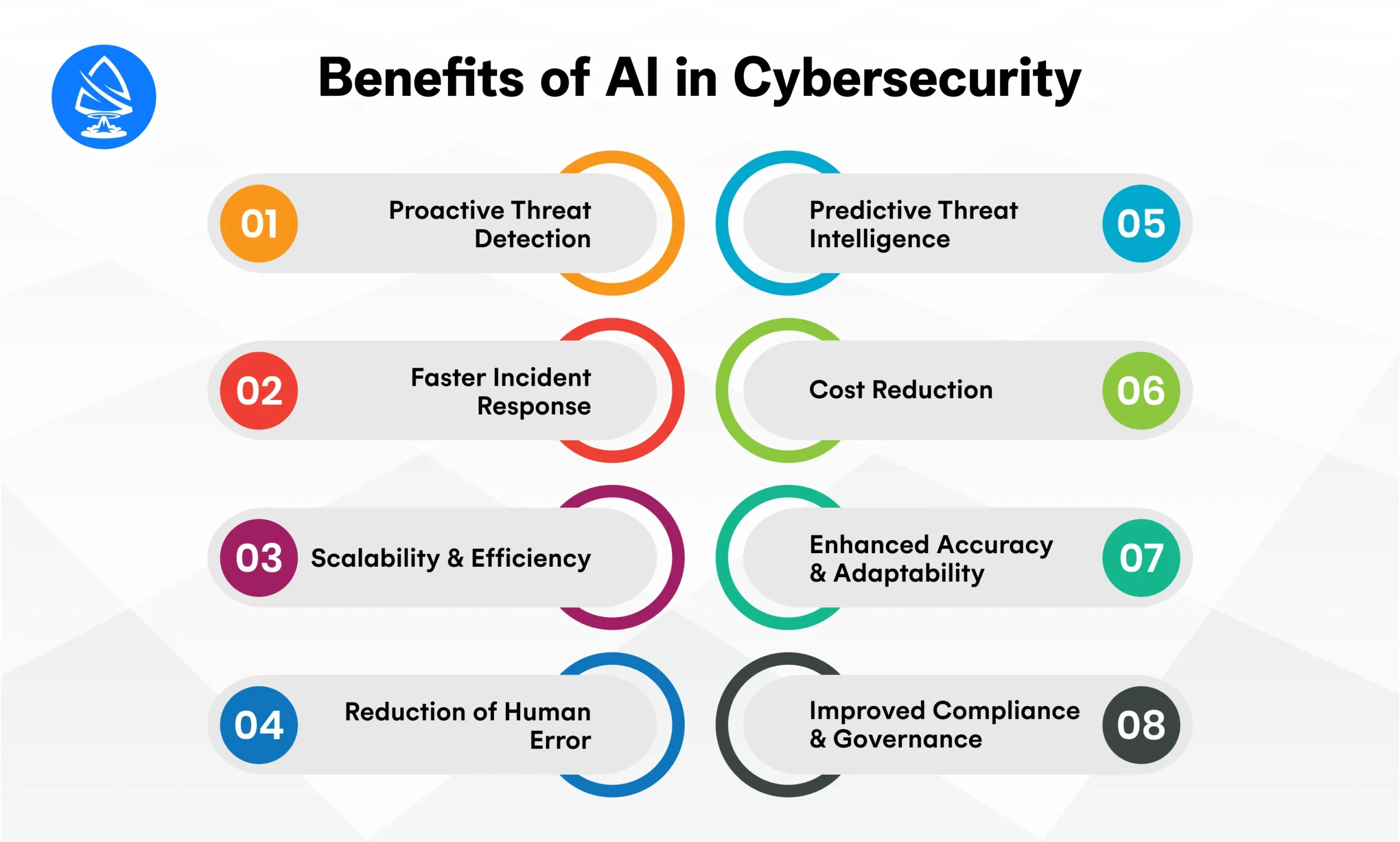
The integration of AI in cybersecurity offers transformative advantages that go beyond traditional security measures. By leveraging machine learning, deep learning, and advanced analytics, AI enables organizations to proactively detect, prevent, and respond to cyber threats with unmatched efficiency. Here’s a detailed look at the key benefits:
1. Proactive Threat Detection
AI systems continuously analyze network traffic, system logs, and user behavior to identify potential threats before they can cause damage. Unlike rule-based security, which only reacts to known threats, AI can recognize anomalies and patterns indicative of novel attacks.
Example: AI detects unusual login attempts from multiple locations, signaling a potential account takeover attempt.
Benefit: Reduces breaches and mitigates risks in real-time, enhancing overall security posture.
2. Faster Incident Response
AI-powered systems can automate response actions, significantly reducing the time between detection and remediation.
Functions:
Isolate compromised endpoints
Block suspicious IP addresses
Alert security teams with actionable insights
Example: In the event of a ransomware attack, AI can quarantine infected files immediately, preventing lateral movement across the network.
Benefit: Minimizes operational disruption and damage caused by cyberattacks.
3. Scalability and Efficiency
AI can process and analyze massive amounts of data from multiple sources simultaneously, something human teams cannot achieve efficiently.
Example: Monitoring millions of user transactions for fraud or anomalies across global branches of a financial institution.
Benefit: Ensures real-time threat detection and protection at enterprise scale without exponential increases in security staff.
4. Reduction of Human Error
Manual monitoring and analysis are prone to errors and oversight, especially when handling high volumes of data. AI reduces these risks by providing consistent and accurate analysis.
Example: AI systems can detect subtle deviations in network traffic that might be overlooked by human analysts.
Benefit: Improves accuracy in identifying threats and reduces false positives.
5. Predictive Threat Intelligence
AI can anticipate future threats using predictive analytics, analyzing historical attack patterns, emerging trends, and behavioral anomalies.
Example: Predicting phishing campaigns targeting a specific industry based on previous attack data.
Benefit: Enables proactive measures, reducing the likelihood of successful cyberattacks.
6. Cost Reduction
By automating repetitive monitoring, detection, and incident response tasks, AI reduces reliance on large security teams.
Example: Automated malware scanning and anomaly detection reduce the need for 24/7 human monitoring.
Benefit: Lower operational costs while improving overall security effectiveness.
7. Enhanced Accuracy and Adaptability
AI systems continuously learn from new threats and feedback, allowing them to adapt to evolving attack techniques.
Example: Deep learning models detect previously unknown malware variants by analyzing behavioral patterns rather than relying solely on signature databases.
AI can monitor regulatory compliance automatically, ensuring adherence to standards such as GDPR, HIPAA, or PCI DSS.
Functions:
Track user activity and data access
Generate compliance reports
Detect policy violations
Example: Healthcare organizations can use AI to monitor access to patient records, ensuring compliance with HIPAA requirements.
Benefit: Reduces risk of penalties and improves accountability.
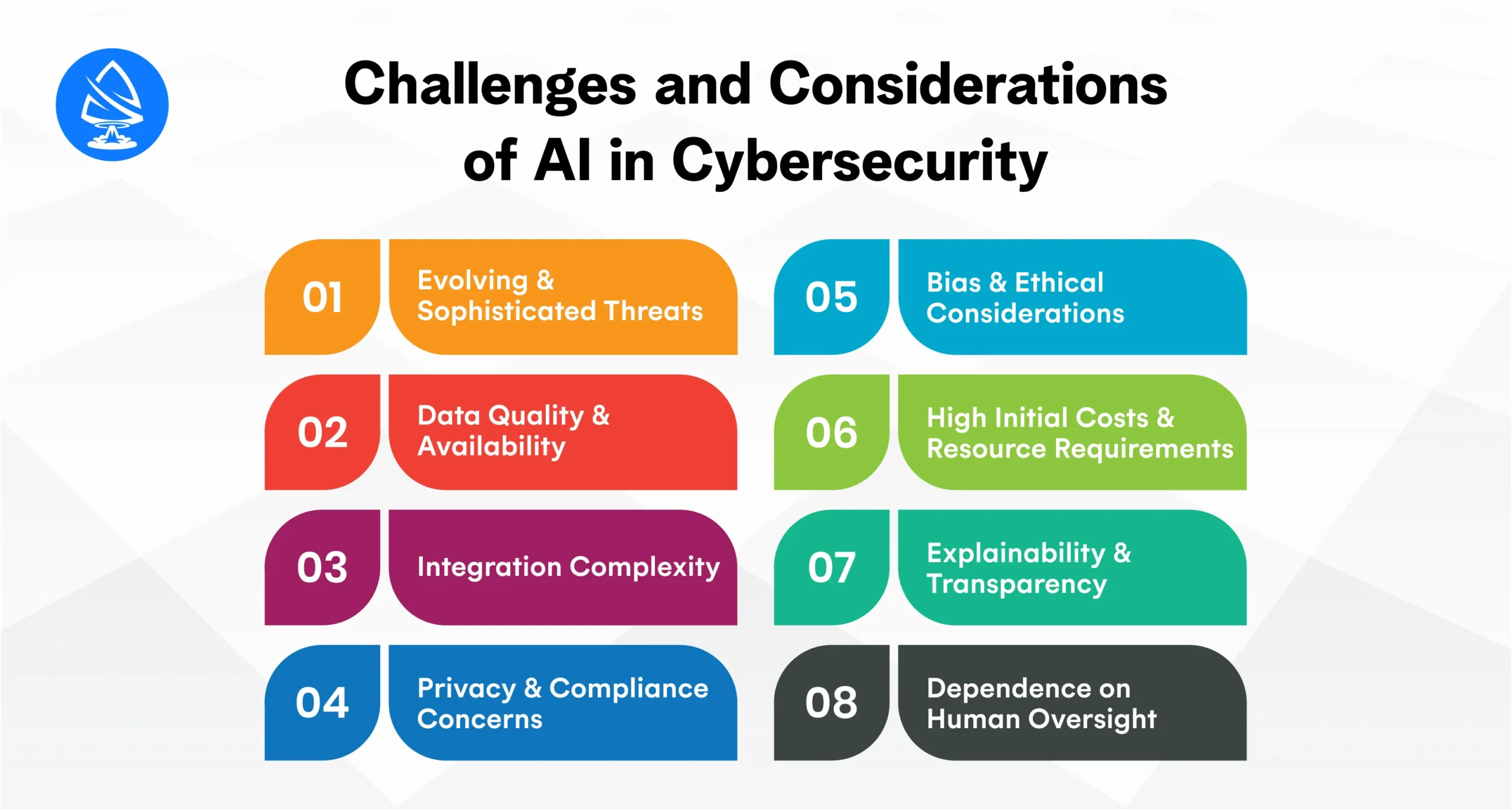
Challenges and Considerations of AI in Cybersecurity
While AI in cybersecurity offers transformative benefits, implementing and managing AI-driven security systems comes with its own set of challenges. Organizations must carefully address these considerations to maximize effectiveness while mitigating potential risks. Below is a detailed exploration of the main challenges and considerations:
1. Evolving and Sophisticated Threats
Cyber threats are constantly changing, with attackers developing new techniques to bypass AI-driven defenses. AI models trained on historical data may struggle to detect completely novel or highly sophisticated attacks.
Example: Advanced persistent threats (APTs) or zero-day exploits may evade detection if AI systems haven’t encountered similar patterns before.
Consideration: Continuous model updates and integration of threat intelligence feeds are critical to ensure AI systems remain effective against evolving threats.
2. Data Quality and Availability
AI systems rely on large volumes of high-quality data for training and real-time analysis. Poor-quality, incomplete, or biased data can degrade AI performance and lead to inaccurate threat detection.
Example: If network logs contain missing or inconsistent information, anomaly detection algorithms may generate false positives or miss actual threats.
Consideration: Implement rigorous data validation, cleansing, and aggregation procedures to maintain accurate and reliable input for AI models.
3. Integration Complexity
Integrating AI cybersecurity solutions with existing IT infrastructure, legacy systems, and enterprise applications can be technically challenging. Issues include compatibility, data exchange, and workflow orchestration.
Example: A company may struggle to integrate AI threat detection with an older firewall or SIEM system.
Consideration: Plan phased integration, use standardized APIs, and leverage middleware platforms to ensure seamless connectivity.
4. Privacy and Compliance Concerns
AI systems often process sensitive and personally identifiable information, raising privacy and regulatory compliance challenges. Mismanagement can lead to data breaches or legal penalties.
Example: AI monitoring employee behavior or processing patient records must comply with GDPR or HIPAA standards.
Consideration: Implement strict access controls, encryption, anonymization, and compliance checks throughout AI workflows.
5. Bias and Ethical Considerations
AI models can inadvertently inherit biases from training data, leading to unfair or discriminatory outcomes in threat detection and response. Ethical concerns also arise around automated decision-making.
Example: AI might disproportionately flag certain user groups as suspicious based on biased historical data.
Consideration: Regularly audit AI outputs, apply fairness algorithms, and establish ethical guidelines for AI deployment.
6. High Initial Costs and Resource Requirements
Deploying AI cybersecurity systems can be resource-intensive, requiring:
Skilled personnel for setup and maintenance
Investment in hardware or cloud infrastructure
Costs associated with ongoing model training and updates
Consideration: Start with high-priority use cases or pilot projects to evaluate ROI before scaling enterprise-wide.
7. Explainability and Transparency
Many AI systems, particularly deep learning models, function as “black boxes”, making it difficult to understand why a particular decision or alert was generated.
Example: Security analysts may find it challenging to justify automated responses to management or regulators if the reasoning is unclear.
Consideration: Implement explainable AI (XAI) approaches to provide transparency and support decision-making processes.
8. Dependence on Human Oversight
Although AI can automate detection and response, human expertise is still critical for interpreting alerts, handling complex incidents, and validating AI-driven decisions. Over-reliance on AI may result in oversight of nuanced threats.
Consideration: Combine AI automation with skilled cybersecurity teams to ensure effective threat management.
Future Trends in AI Cybersecurity
Autonomous Cyber Defense – AI systems capable of responding to threats without human intervention
Integration with IoT Security – Protecting connected devices from cyber threats
Generative AI in Security Testing – Simulating attacks to strengthen defenses
Explainable AI (XAI) – Transparent AI models to ensure accountability and trust
Example: AI cybersecurity companies are exploring generative AI to simulate phishing attacks, enabling organizations to train employees and refine defense mechanisms.
Conclusion
The evolution of AI in cybersecurity from rule-based systems to advanced deep learning models has transformed the way businesses protect their digital assets. By leveraging AI technologies, organizations can detect threats proactively, respond faster, and gain valuable insights to improve their overall security posture. While challenges such as integration complexity, privacy, and evolving threats exist, AI-powered cybersecurity solutions provide unparalleled scalability, accuracy, and efficiency.
As cyber threats continue to grow, investing in AI cybersecurity companies and AI security solutions becomes essential for enterprises aiming to safeguard sensitive data and maintain trust.
Ready to secure your business with cutting-edge AI in cybersecurity? Use our Cost Calculator to explore AI security solutions tailored for your enterprise.
Frequently Asked Questions
1. What is AI in cybersecurity?
AI in cybersecurity refers to the use of artificial intelligence technologies to detect, prevent, and respond to cyber threats.
2. How does AI improve threat detection?
AI analyzes large datasets, recognizes anomalies, and identifies patterns indicative of attacks faster than traditional systems.
3. Can AI detect zero-day attacks?
Yes, deep learning models can identify previously unknown threats based on behavioral patterns and anomalies.
4. What industries benefit most from AI in cybersecurity?
Finance, healthcare, e-commerce, critical infrastructure, and technology companies benefit significantly.
5. Are AI security solutions fully autonomous?
Some AI systems are autonomous, but most work best when combined with human oversight for critical decisions.
6. What are the limitations of AI in cybersecurity?
Challenges include data privacy concerns, evolving threats, complex integration, and high initial costs.
7. How do AI cybersecurity companies support businesses?
They provide AI security solutions, monitoring, threat intelligence, and incident response systems tailored to enterprise needs.
8. Is AI cybersecurity scalable?
Yes, AI systems can handle massive amounts of network traffic and user data, making them highly scalable.
Written By :
Artoon Solutions
Artoon Solutions is a technology company that specializes in providing a wide range of IT services, including web and mobile app development, game development, and web application development. They offer custom software solutions to clients across various industries and are known for their expertise in technologies such as React.js, Angular, Node.js, and others. The company focuses on delivering high-quality, innovative solutions tailored to meet the specific needs of their clients.