- HR:+91-879-9184-787
- Sales:+91-908-163-7774


Artificial Intelligence (AI) is revolutionizing the financial sector, reshaping how banks, investment firms, and financial institutions operate, manage risks, and serve their customers. From automated credit scoring to fraud detection and personalized financial planning, AI in finance is driving efficiency, security, and innovation like never before.
By 2030, AI is projected to contribute over $1.2 trillion annually to the banking and financial services industry (BFSI). The technology is not just optimizing existing processes; it’s redefining the very nature of banking by empowering data-driven decision-making, real-time risk management, and hyper-personalized customer experiences.
In this blog, we’ll explore the impact of AI in the financial sector banking, its applications, benefits, challenges, and future potential, helping businesses and professionals understand why adopting AI is no longer a choice but a necessity.
Artificial Intelligence (AI) in financial services refers to the integration of intelligent technologies such as machine learning (ML), natural language processing (NLP), deep learning, and predictive analytics into banking, investment, insurance, and financial management systems. The goal is to enable financial institutions to automate operations, detect fraud, manage risk, enhance decision-making, and provide personalized customer experiences.
AI acts as a digital brain that continuously learns from massive amounts of financial data, identifies patterns, and makes predictions or decisions without direct human intervention. In essence, it allows banks and financial companies to process information faster, make smarter strategic choices, and serve customers more efficiently.
At its core, AI in financial services is about using intelligent systems to perform tasks that traditionally required human intelligence, such as analyzing complex data, assessing risks, recognizing anomalies, and communicating with customers.
The financial industry operates on data, precision, and trust, and AI amplifies all three by introducing automation, accuracy, and predictive capabilities.
You may also want to know AI Advantages
AI in the financial sector combines multiple technologies working together to create intelligent, scalable systems.
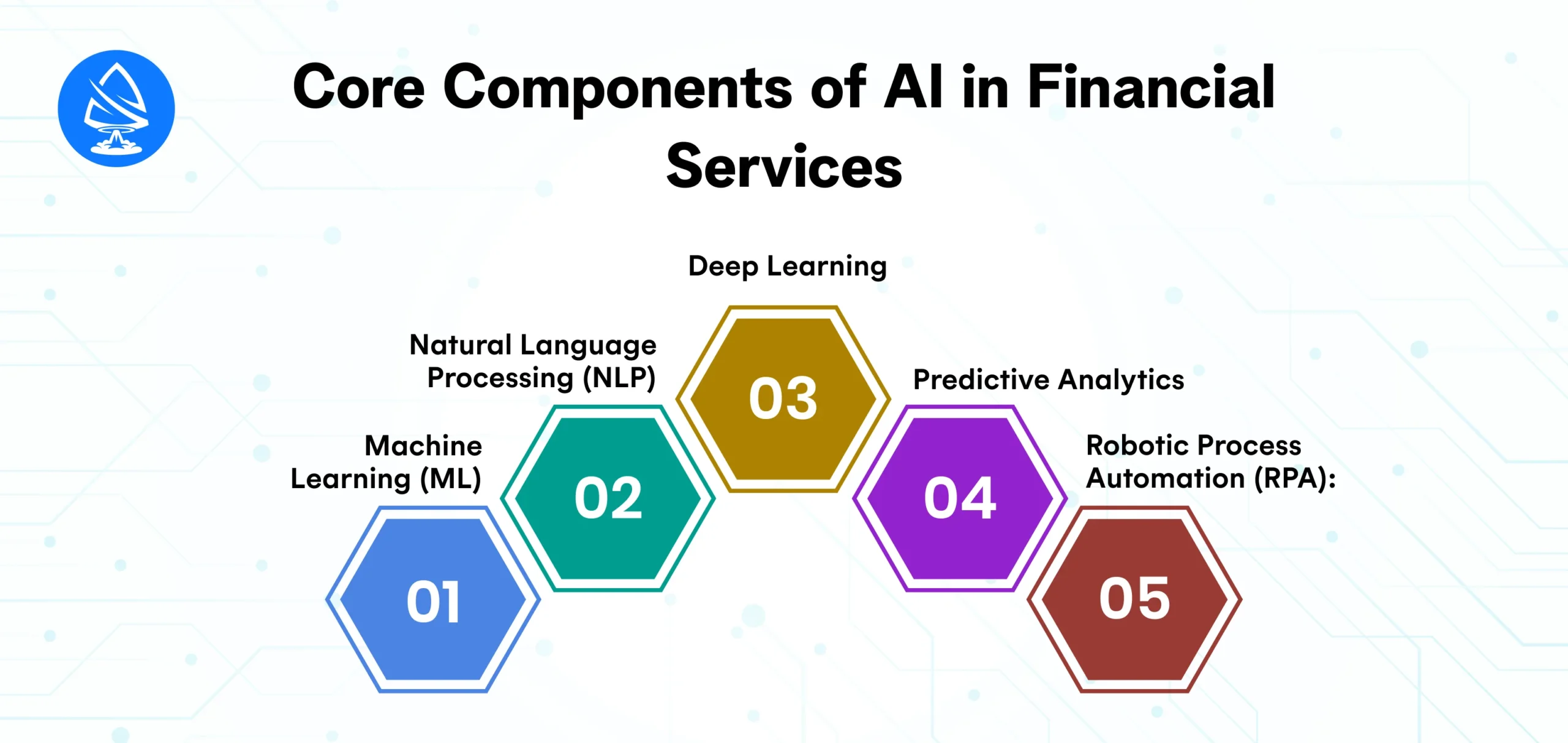
Machine learning models learn from historical financial data and improve decision accuracy over time.
NLP allows AI systems to understand and respond to human language.
Deep learning uses neural networks to process complex financial data such as images, voice, and text.
Predictive analytics uses AI models to forecast future outcomes based on data trends.
RPA automates repetitive, rule-based tasks like form processing or data migration.
The financial industry is one of the earliest and most enthusiastic adopters of AI. The integration of AI in finance is driven by three major needs: efficiency, accuracy, and trust.
Stat Snapshot:
AI has countless real-world applications in banking and finance. Let’s explore the most impactful ones that are reshaping the industry.
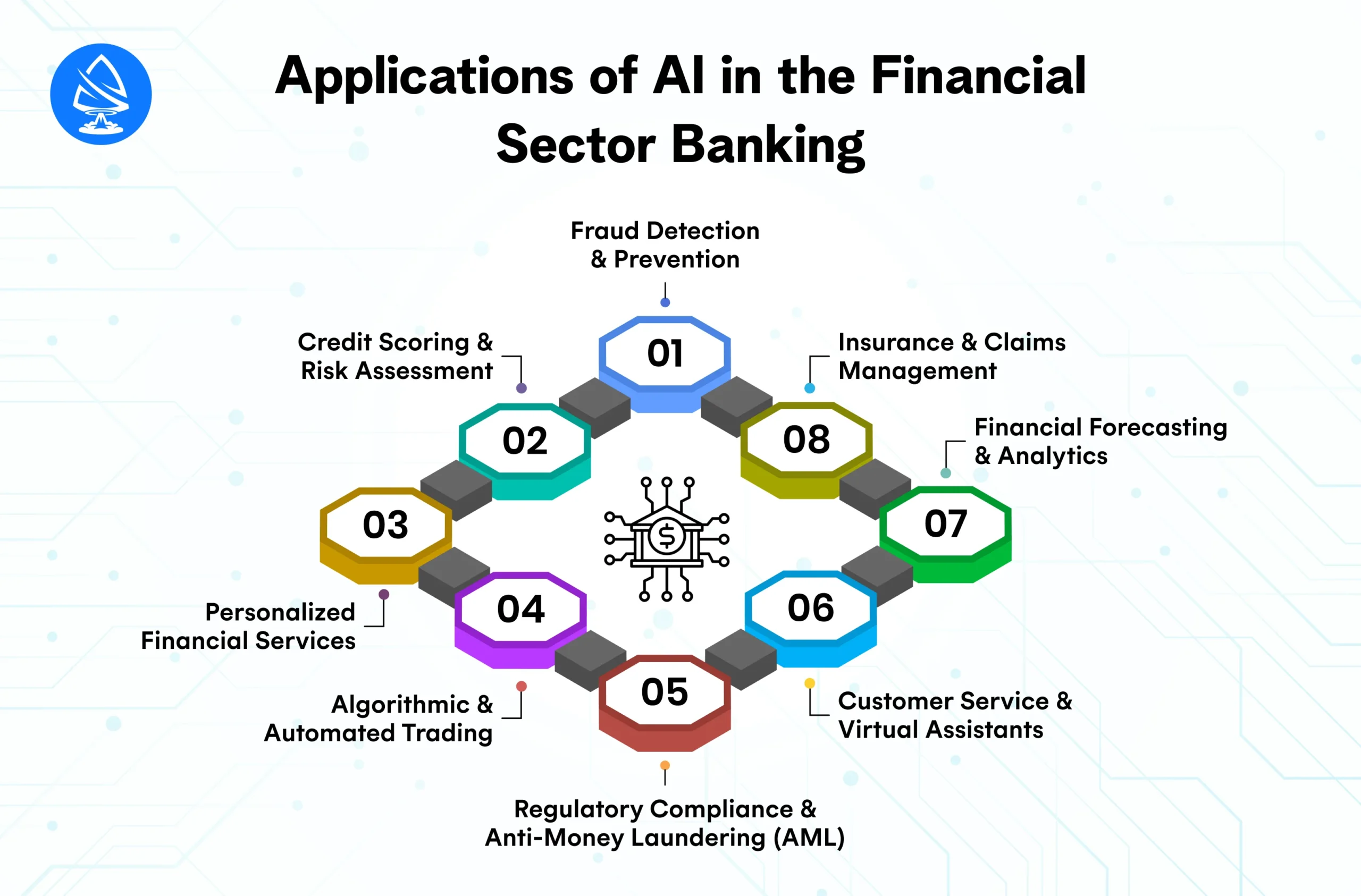
Fraud remains a significant threat in financial services, but AI algorithms have drastically improved detection accuracy and response times.
Example: Mastercard’s Decision Intelligence AI analyzes each transaction’s context, amount, location, and customer history to assess fraud probability in milliseconds.
Impact: Reduced false positives, improved security, and enhanced customer trust.
Traditional credit scoring models rely heavily on static financial data, but AI-driven credit scoring uses dynamic variables like transaction history, social behavior, and real-time income data.
Example: Upstart, an AI-powered lending platform, uses over 1,600 data points for credit evaluation, reducing loan default rates by 75%.
Impact: Fairer lending practices and broader financial inclusion.
AI enables hyper-personalization, tailoring products and services to each customer’s unique financial profile.
Example: Bank of America’s Erica AI assistant has handled over 1 billion customer interactions, offering personalized tips and financial updates.
Impact: Stronger customer relationships and improved satisfaction rates.
In investment banking, AI’s predictive power revolutionizes trading and portfolio management.
Example: Goldman Sachs uses AI-driven algorithms for predictive trading, helping analysts process massive datasets faster than human teams ever could.
Impact: Data-backed investment strategies and reduced human error in trading decisions.
Regulatory compliance is one of the most expensive and time-consuming areas of finance. AI automates compliance monitoring, reducing both cost and error.
Example: HSBC uses AI and machine learning to monitor billions of transactions for potential money-laundering activities.
Impact: Reduced compliance burden and enhanced transparency.
AI-driven chatbots and voice assistants are redefining customer engagement in banking.
Example: Capital One’s Eno chatbot handles 70% of customer queries instantly, reducing call center load dramatically.
Impact: 24/7 support availability and improved service efficiency.
AI excels at forecasting financial trends, enabling smarter business decisions.
Example: Morgan Stanley’s Next Best Action AI tool provides advisors with real-time insights to help clients make informed investment decisions.
Impact: Informed decision-making and improved return on investment.
AI is transforming InsurTech, improving claims handling, underwriting, and customer onboarding.
Example: Lemonade Insurance uses AI to approve 30% of claims instantly, cutting operational costs and boosting customer satisfaction.
Impact: Efficient claims processing and reduced fraud losses.
You may also want to know about AI Chips
The financial sector is one of the biggest beneficiaries of artificial intelligence (AI) innovation. With the explosion of data, increasing competition, and growing customer expectations, banks, insurance companies, and investment firms are leveraging AI to streamline operations, enhance decision-making, mitigate risks, and deliver personalized experiences.
AI’s impact on the financial sector extends far beyond automation; it empowers institutions to operate intelligently, adapt to real-time changes, and anticipate future market trends. Below, we explore in detail the key benefits of AI in the financial sector that are transforming how the industry functions.
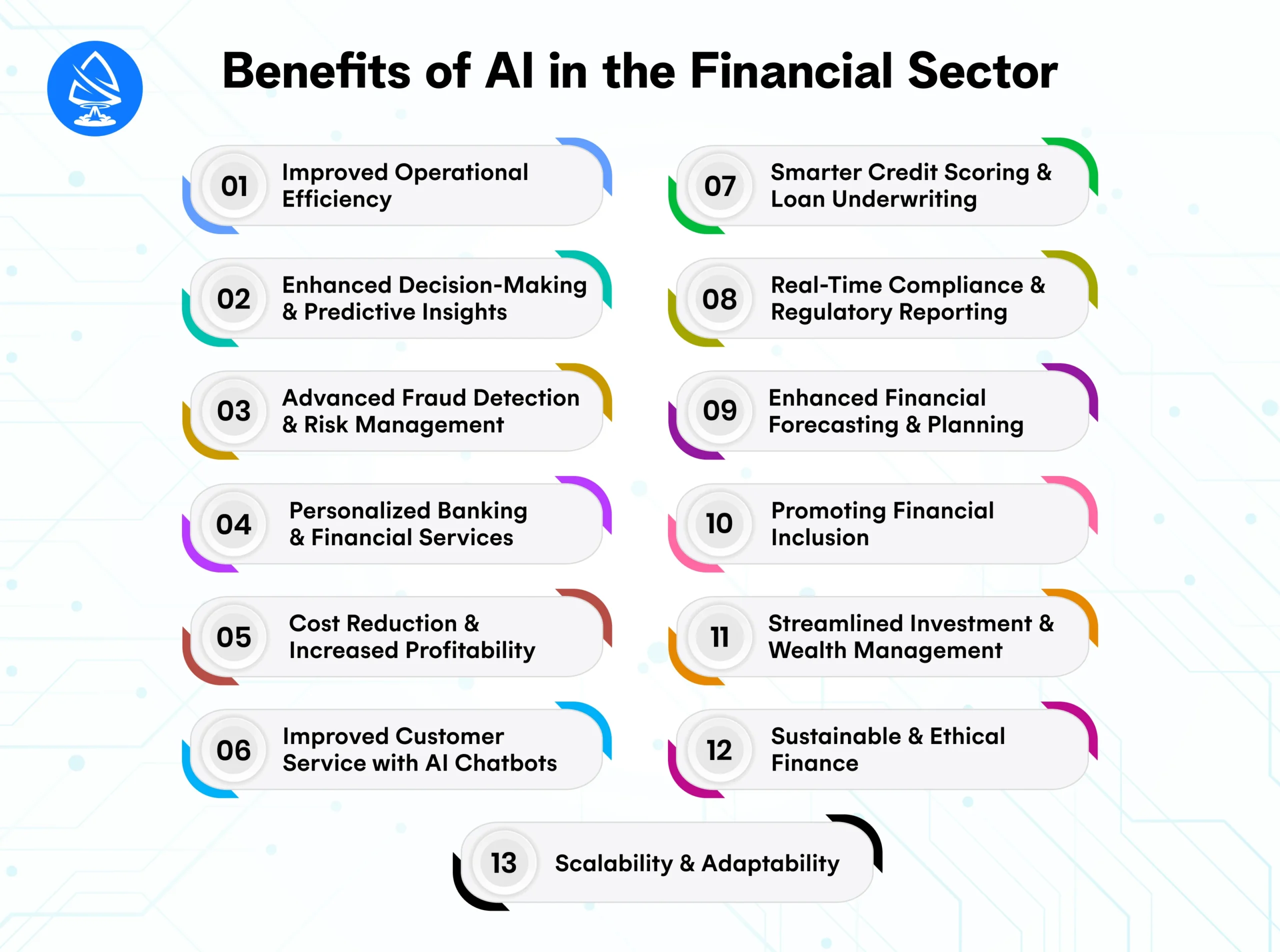
One of the most immediate benefits of AI in finance is process automation. Financial institutions handle millions of transactions daily, many of which involve repetitive, rule-based tasks.
Example: JPMorgan’s COiN (Contract Intelligence) system automates document review, saving the company over 360,000 hours annually.
In finance, every decision from approving a loan to executing a trade depends on accurate data analysis. AI provides real-time insights and predictive analytics that empower faster, data-driven decisions.
Example: Investment firms use AI-driven analytics to predict market movements and identify profitable trading opportunities in real time.
Fraud is a major concern in the financial industry. Traditional methods often react after a breach, while AI systems detect anomalies in real time, preventing fraud before it happens.
Example: Mastercard’s Decision Intelligence uses AI to analyze transaction patterns in milliseconds, reducing false declines and detecting suspicious activity instantly.
Customers today expect personalized and convenient financial experiences, similar to those offered by e-commerce platforms. AI enables hyper-personalization by analyzing customer data, preferences, and behavior.
Example: Bank of America’s Erica, an AI-powered virtual assistant, helps customers check balances, monitor transactions, and receive spending insights, all customized to individual financial habits.
AI-driven automation significantly lowers operational costs while improving efficiency across business functions.
Example: AI chatbots handle thousands of customer queries at a fraction of the cost of traditional call centers.
AI chatbots and virtual assistants have become the frontline of customer interaction in modern banking. They offer instant, 24/7 support, improving accessibility and satisfaction.
Example: Capital One’s chatbot Eno handles over 70% of basic customer requests instantly, reducing the pressure on customer service teams.
Traditional credit scoring methods often rely on limited historical data, overlooking deserving borrowers. AI revolutionizes this by analyzing non-traditional data points, offering a more accurate risk profile.
Example: FinTech platform Upstart uses AI to assess credit risk, reducing loan default rates by up to 75% and approving more qualified applicants.
The financial industry operates under strict regulations, and compliance management is both complex and costly. AI simplifies this by automating regulatory monitoring, data collection, and report generation.
Example: HSBC uses AI-powered AML (Anti-Money Laundering) tools to detect suspicious patterns, improving compliance accuracy and reducing manual intervention.
AI’s ability to process massive data sets in real time enables accurate financial forecasting and long-term planning.
Example: Morgan Stanley’s Next Best Action AI provides advisors with data-driven insights to guide clients on investments and portfolio adjustments.
AI plays a crucial role in extending financial services to unbanked and underbanked populations around the world.
Example: FinTech startups in Africa and Asia use AI to approve microloans for individuals with no formal banking history, driving inclusion.
AI-powered robo-advisors are changing how people invest and manage wealth.
Example: Platforms like Wealthfront and Betterment use AI to manage portfolios for millions of users, offering customized investment advice with minimal fees.
AI contributes to sustainable finance by helping institutions monitor and evaluate the environmental and social impact of investments.
Example: BlackRock uses AI to evaluate ESG data points for responsible investing, ensuring alignment with sustainability principles.
AI enables financial institutions to scale operations effortlessly. Whether handling a million transactions or launching in a new market, AI’s automation and cloud integration make scaling seamless.
Despite its potential, AI in finance faces hurdles:
Solution: Partnering with an expert AI app development company in USA helps financial organizations overcome these challenges with scalable, compliant, and customized solutions.
By 2030, AI will be at the core of financial ecosystems, powering everything from customer onboarding to wealth management.
Outlook: Financial institutions that invest in AI today will not only improve performance but also gain a sustainable competitive edge in the rapidly evolving digital economy.
The impact of AI in the financial sector is nothing short of transformative. By combining automation, predictive analytics, and personalized services, AI empowers financial institutions to operate smarter, faster, and safer. As we move toward 2030, AI will redefine how banking works, from decision-making to customer engagement and compliance.
The future of finance is AI-driven, data-powered, and customer-focused. Businesses that embrace this transformation now will set themselves apart in an increasingly competitive global market.
Ready to transform your financial operations with AI? Use our AI App Cost Calculator to estimate your investment and collaborate with a leading AI app development company in USA to build secure, intelligent, and future-ready financial solutions.
1. How is AI transforming the financial sector?
AI automates tasks, enhances fraud detection, and delivers personalized financial services through advanced analytics.
2. What are common AI applications in banking?
Credit scoring, customer service chatbots, risk management, and algorithmic trading are major use cases.
3. Can small banks adopt AI solutions?
Yes. Cloud-based AI tools and development partners make adoption affordable for smaller institutions.
4. How does AI prevent financial fraud?
AI detects anomalies in transactions and user behavior to identify and stop fraudulent activity instantly.
5. What are the main challenges of AI in finance?
Data privacy, algorithm bias, high costs, and integration with legacy systems.
6. Will AI replace human bankers?
No. AI augments human decision-making, enabling staff to focus on higher-value strategic roles.
7. What’s the future of AI in banking?
AI will enable fully autonomous, data-driven, and customer-centric financial ecosystems.
8. How can businesses start with AI in finance?
Partner with a trusted AI app developer or AI app development company in USA to create scalable, compliant financial AI solutions.

Artoon Solutions
Artoon Solutions is a technology company that specializes in providing a wide range of IT services, including web and mobile app development, game development, and web application development. They offer custom software solutions to clients across various industries and are known for their expertise in technologies such as React.js, Angular, Node.js, and others. The company focuses on delivering high-quality, innovative solutions tailored to meet the specific needs of their clients.
 For business inquiries only