- HR:+91-879-9184-787
- Sales:+91-908-163-7774


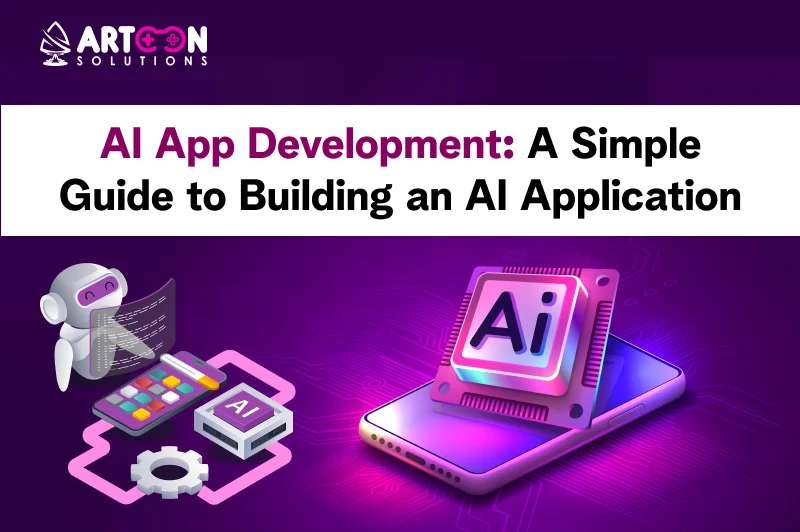
Artificial Intelligence (AI) is redefining how businesses operate, interact with customers, and innovate. From chatbots that enhance customer support to predictive analytics that forecast trends, AI applications are shaping the future of digital transformation.
Whether you’re a small business owner looking to automate workflows or a tech entrepreneur building a next-gen product, understanding how to build an AI app is essential. The global AI market is projected to reach $1.8 trillion by 2030, signaling an enormous opportunity for enterprises ready to harness its power.
This comprehensive guide will walk you through every step from ideation to deployment, helping you understand the fundamentals of AI app development. Along the way, we’ll cover tools, frameworks, challenges, and best practices used by the top AI app development company in USA to build scalable, intelligent applications.
An AI application is a software program that uses artificial intelligence algorithms such as machine learning (ML), natural language processing (NLP), and computer vision to perform tasks that traditionally require human intelligence.
These apps learn, adapt, and improve over time by analyzing data patterns, making predictions, and automating decisions without explicit programming.
In essence, AI apps bridge human intuition with data-driven intelligence, enabling faster decisions and higher productivity.
In today’s digital economy, AI app development isn’t just a trend; it’s a strategic necessity for businesses that want to stay relevant, efficient, and competitive. Artificial Intelligence empowers applications to analyze data, learn patterns, and make intelligent decisions with minimal human intervention, creating experiences that are faster, smarter, and more personalized.
Whether you run a startup, an established enterprise, or an eCommerce store, the decision to build an AI app can transform your operations and open new revenue opportunities. Let’s explore in depth why building an AI-powered application is a profitable investment for 2025 and beyond.

One of the biggest advantages of AI apps is process automation, handling repetitive, time-consuming tasks that previously required manual effort. AI enables businesses to work smarter by automating operations like:
This not only reduces operational expenses but also frees up employees to focus on higher-value tasks.
Example: A logistics company implemented an AI app to automate route planning and package sorting. The result? A 35% reduction in human errors and 25% savings on labor costs.
Outcome: Faster execution, higher efficiency, and measurable cost reduction.
Every business generates tons of data, but without AI, most of it goes unused. AI applications extract actionable insights from raw data, allowing organizations to make faster and more informed decisions.
By leveraging machine learning models and predictive analytics, AI apps can:
Example: An AI-powered sales analytics app can predict which leads are most likely to convert based on past interactions, helping sales teams prioritize effectively.
Outcome: Better decisions backed by real-time, intelligent insights.
AI applications can analyze user behavior and preferences to deliver hyper-personalized experiences, the kind customers expect in 2025.
From product recommendations and tailored marketing campaigns to adaptive learning platforms, personalization powered by AI enhances customer engagement and satisfaction.
Example: Netflix’s recommendation engine uses AI to analyze viewing history and suggest personalized content. This alone drives over 80% of total user watch time.
Outcome: Increased engagement, customer retention, and lifetime value.
In an AI-driven world, innovation determines survival. Companies that build AI apps early gain a significant edge over competitors who rely on traditional systems.
By integrating AI capabilities like predictive analytics, image recognition, or natural language processing (NLP), you can deliver unique features that stand out in crowded markets.
Example: A healthcare startup built an AI app that detects early signs of skin cancer from uploaded images, offering users instant, affordable diagnostics that clinics couldn’t match.
Outcome: Differentiation, market leadership, and brand credibility.
AI chatbots and virtual assistants provide 24/7 customer support, reducing wait times and improving satisfaction. They can understand queries, resolve issues instantly, and escalate complex cases to human agents when needed.
Beyond support, AI-driven sentiment analysis helps businesses measure customer mood and improve service quality.
Example: An eCommerce retailer deployed an AI chatbot for post-purchase queries. This reduced customer service tickets by 45% and improved response time to under 5 seconds.
Outcome: Smoother customer journeys and higher brand loyalty.
AI apps not only respond to existing data but also predict future outcomes using machine learning algorithms.
This is especially valuable in sectors like:
Example: A retail AI app predicted top-selling products for the upcoming quarter, allowing the company to optimize inventory levels, cutting surplus stock costs by 20%.
Outcome: Smarter forecasting and sustainable profitability.
Human error can cost businesses millions. AI-powered systems excel at precision, consistency, and repeatability, performing complex computations or validations without fatigue.
This makes AI apps ideal for high-risk environments such as:
Example: A fintech firm used an AI fraud detection app that analyzed thousands of transactions per second, catching suspicious activity 40% faster than human auditors.
Outcome: Enhanced accuracy, compliance, and reduced risk exposure.
You may also want to know AI for Enterprise
Building an AI application involves a structured approach that combines data, algorithms, and user-centric design. Below is a simple yet practical roadmap followed by top AI app developers worldwide.

Every successful AI app begins with a clear problem statement.
Ask yourself:
Example: An eCommerce business might use AI to recommend personalized products or detect fraudulent transactions in real time.
Tip: Focus on value-driven AI use cases that align with your business objectives.
AI isn’t one-size-fits-all. You must select the appropriate AI technique based on your app’s goal.
Example: Netflix uses machine learning + deep learning for personalized recommendations, saving the company billions annually by reducing churn.
AI thrives on data quality, not quantity. Gather clean, relevant, and well-structured datasets to train your model.
Example: A fintech company collects transaction data to train its fraud detection AI. The model learns what legitimate vs. suspicious behavior looks like.
Choosing the right tools and platforms determines the scalability and performance of your app.
Tip: For small businesses, no-code AI tools like Google AutoML or Hugging Face Transformers make model creation easier.
Once your data and framework are ready, it’s time to train your model.
Example: A retail app uses ML algorithms to predict user buying behavior. After 50 training iterations, the model reaches 94% accuracy.
After training, integrate your AI model with your app’s frontend and backend systems.
Example: An insurance app integrates an AI chatbot to automate claim filing and processing, cutting customer service time by 60%.
Testing ensures your AI app performs consistently and adapts to real-world conditions.
Tip: Use MLOps pipelines to automate model updates, monitoring, and retraining.
Once tested, deploy your AI app on your preferred platform: web, mobile, or cloud.
Example: A logistics firm deploys its AI app on AWS to analyze delivery routes in real time, saving 25% in fuel costs.
Artificial Intelligence (AI) has evolved from a futuristic concept into a core business enabler across industries. Today, AI applications are at the heart of how organizations automate operations, make data-driven decisions, and enhance user experiences. Whether it’s predicting consumer behavior, streamlining logistics, or delivering personalized customer journeys, AI is reshaping every sector.
Below, we’ll explore the top real-world use cases of AI applications that are driving measurable results for businesses in 2025 and beyond.

AI-powered chatbots and voice assistants have revolutionized customer service by offering 24/7 support and faster resolution times. They handle common queries, resolve complaints, and even process transactions without human intervention.
Use Case Insight: A telecom company deployed an AI chatbot that resolved 70% of support tickets autonomously, reducing customer wait times by 60%.
Personalization is one of AI’s strongest applications. Businesses use AI to analyze user behavior, preferences, and purchase history to deliver tailored experiences.
Use Case Insight: Personalized recommendations account for 35% of Amazon’s total revenue, a testament to AI’s impact on sales growth.
Predictive analytics is a game-changer for organizations seeking to forecast future trends, demand, and risks. AI applications use data modeling and statistical algorithms to make proactive business decisions.
Use Case Insight: A retail chain used AI-driven forecasting to predict demand spikes and reduced inventory waste by 30%.
The financial sector relies heavily on AI for real-time fraud detection and prevention. AI systems continuously analyze massive datasets to detect unusual patterns and flag potentially fraudulent transactions.
Use Case Insight: AI-powered fraud detection reduced fraudulent credit card transactions by 40% in major U.S. banks in 2024.
AI image recognition allows machines to interpret, analyze, and understand images or videos, powering innovations across healthcare, retail, and security.
Use Case Insight: An AI system achieved 99% accuracy in identifying lung cancer from X-rays, surpassing human radiologists.
AI helps businesses analyze customer emotions through sentiment analysis, enabling them to understand public perception and feedback across social platforms.
Use Case Insight: An AI-driven social media tool helped a brand identify negative feedback patterns early, preventing a PR crisis and saving millions in revenue.
AI applications in manufacturing help businesses predict equipment failures before they occur, saving costs and minimizing downtime.
Use Case Insight: AI-based predictive maintenance reduced production downtime by 25% in global manufacturing plants.
AI is transforming healthcare with predictive diagnostics, drug discovery, and robotic surgeries. Machine learning helps doctors diagnose diseases faster and more accurately.
Use Case Insight: AI diagnostic tools cut breast cancer misdiagnosis rates by 12%, improving patient survival rates.
AI applications are powering smart marketing campaigns and sales automation, helping businesses reach the right customers with the right message.
Use Case Insight: An eCommerce company used AI-driven ad targeting to boost campaign ROI by 45% within three months.
AI-powered cybersecurity systems detect and neutralize threats faster than traditional methods.
Use Case Insight: AI-based cybersecurity tools can detect threats 10x faster than manual systems, drastically reducing the risk of data breaches.
You may also want to know the Future of AI
| Category | Tool/Platform | Use Case |
| Frameworks | TensorFlow, PyTorch | ML model building |
| NLP APIs | OpenAI GPT, Google Dialogflow | Conversational AI |
| Vision APIs | Google Vision, AWS Rekognition | Image/video analysis |
| No-Code AI | Lobe, Teachable Machine | Quick model creation |
| MLOps Tools | MLflow, Kubeflow | Model lifecycle management |
| Cloud AI | Azure AI, AWS SageMaker, Google Vertex AI | Enterprise-scale deployment |
Tip: Combine a cloud platform with a robust framework for scalability and cost-effectiveness.
The cost depends on complexity, features, and infrastructure.
| AI App Type | Estimated Cost Range |
| Simple AI Chatbot | $10,000 – $25,000 |
| Predictive Analytics App | $25,000 – $60,000 |
| Computer Vision App | $40,000 – $90,000 |
| Enterprise AI Platform | $100,000+ |
Pro Tip: Use a Cost Calculator to estimate expenses based on your requirements and development scope.
AI apps handle sensitive data compliance with GDPR and HIPAA is critical.
Poor-quality data leads to inaccurate results. Continuous training is vital.
Legacy systems often lack compatibility with AI APIs.
AI infrastructure and talent can be costly for startups.
AI bias can affect fairness in hiring, credit scoring, or healthcare outcomes.
Solution: Partner with an experienced AI app development company in USA to mitigate these challenges.
AI is evolving rapidly, and the next decade will see exponential growth in:
Prediction: By 2030, 70% of digital interactions will be powered by AI-driven apps.
AI app development isn’t just about technology; it’s about building smarter, adaptive, and future-ready businesses. By integrating AI into your processes, you can achieve faster decision-making, lower costs, and higher customer satisfaction.
As AI continues to evolve, organizations that invest early will lead the next wave of digital innovation.
Ready to build your AI-powered app?
Collaborate with a leading AI app development company in USA to design and deploy scalable, intelligent solutions tailored to your business.
Use our AI App Cost Calculator today to estimate your AI app development cost and start your journey toward smarter innovation!
1. What is AI app development?
AI app development is the process of creating intelligent applications that use data and algorithms to learn, automate, and make decisions.
2. How long does it take to build an AI app?
On average, it takes 3 to 6 months, depending on complexity and data preparation.
3. Can I build an AI app without coding?
Yes, tools like Lobe, Teachable Machine, and Google AutoML allow no-code AI model creation.
4. What is the best platform to build an AI app?
Google AI Studio, Azure AI, and AWS SageMaker are top platforms for enterprise-grade AI app development.
5. How does AI benefit small businesses?
AI reduces costs, improves customer service, and automates repetitive workflows.
5. What programming languages are used for AI?
Python, R, and JavaScript are the most popular languages for AI app development.
7. Is AI app development expensive?
Costs vary, but cloud-based AI tools and pre-trained models can significantly lower expenses.
8. Who can help me build a custom AI app?
Partner with an experienced AI app development company in USA that offers end-to-end AI consulting and deployment services.

Artoon Solutions
Artoon Solutions is a technology company that specializes in providing a wide range of IT services, including web and mobile app development, game development, and web application development. They offer custom software solutions to clients across various industries and are known for their expertise in technologies such as React.js, Angular, Node.js, and others. The company focuses on delivering high-quality, innovative solutions tailored to meet the specific needs of their clients.
 For business inquiries only