- HR:+91-879-9184-787
- Sales:+91-908-163-7774


AI has revolutionised tech, with ChatGPT vs Bard as key players in AI-driven conversations. Both offer human-like text generation but have unique strengths in NLP. As AI adoption grows, understanding the strengths of ChatGPT and Bard is key for customer service, content, and automation.
This blog compares ChatGPT vs Bard, covering their AI capabilities, features, performance, and real-world industry impact.
ChatGPT, developed by OpenAI, is one of the most widely recognised conversational AI models. Powered by the GPT-3, ChatGPT is capable of understanding and generating human-like responses in natural language. The platform is trained on vast amounts of text data and can answer questions, generate content, and simulate conversations with impressive fluency.
Example: Many businesses use ChatGPT-powered chatbots to handle customer inquiries, automate content creation, or assist with technical support in real-time.
Bard, developed by Google, is another AI-driven conversational model designed to generate text and assist with a wide range of tasks. While Bard shares similarities with ChatGPT, it is rooted in Google’s LaMDA, which is specifically trained for dialogue-based conversations. Bard focuses on delivering high-quality, informative responses, particularly in relation to Google Search and related services.
Example: Businesses may use Bard for knowledge-based tasks, content generation, and integrating real-time data into their virtual assistants or automated systems.
You may also want to know AI Myths
While both ChatGPT vs Bard are powerful conversational AIs, they are designed with different core objectives, which leads to several notable differences in their AI capabilities. Let’s break down these differences across several key categories.
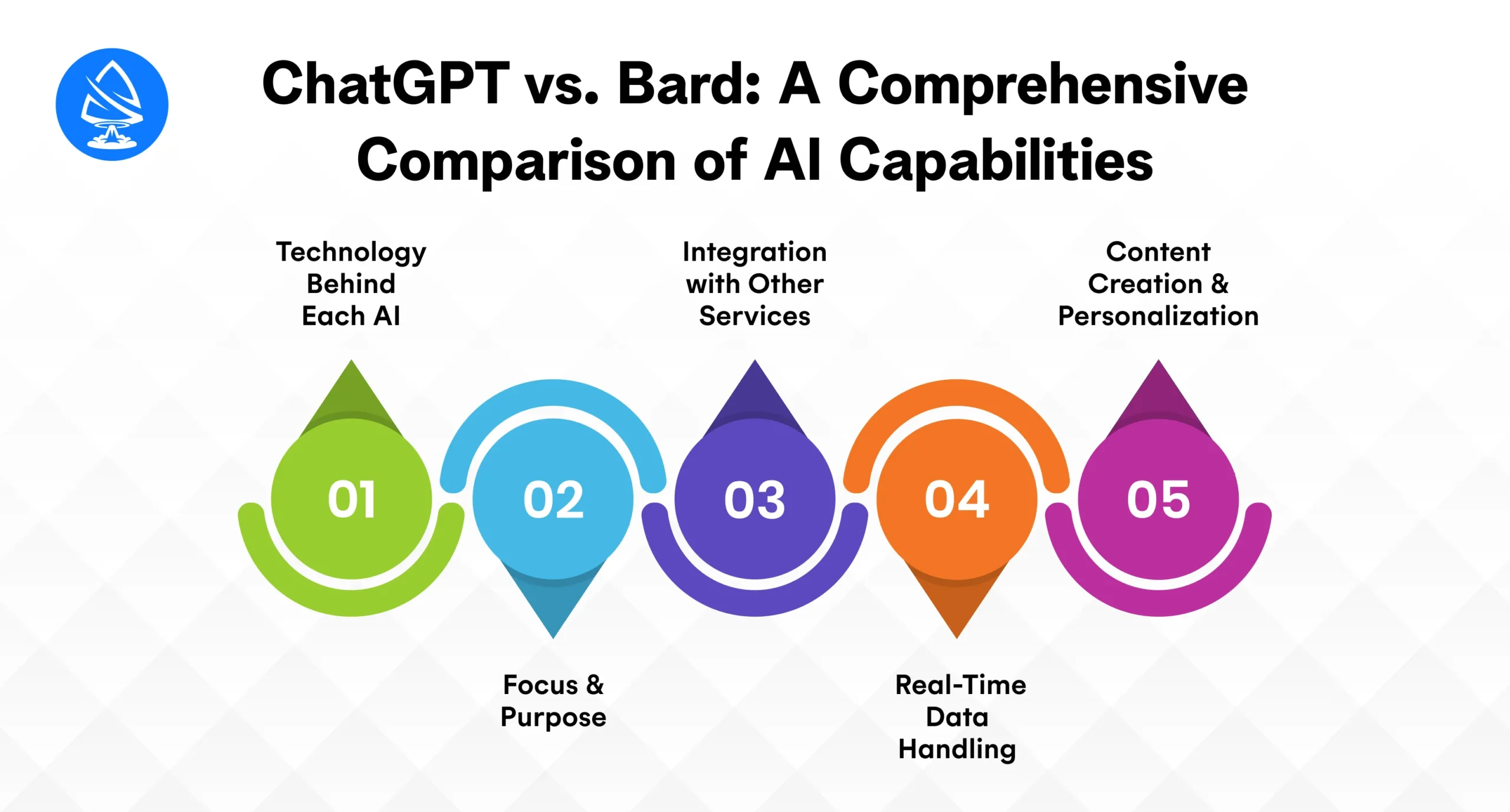
Takeaway: While both are state-of-the-art, ChatGPT’s GPT architecture is known for its language generation, whereas Bard is optimised for dialogue and search-based interactions.
Takeaway: ChatGPT is better suited for general conversational tasks and creative content, while Bard excels in delivering search-oriented, fact-based information.
Takeaway: Bard’s integration with Google’s suite of services makes it a better fit for businesses that rely heavily on real-time information and research, while ChatGPT’s versatility allows it to be integrated into a wider variety of applications.
Takeaway: For businesses requiring the most current information, Bard is more suitable due to its real-time search capabilities, while ChatGPT may be better suited for scenarios where real-time data is not a priority.
Takeaway: ChatGPT is the better choice for businesses needing creative content generation, while Bard shines when it comes to research-based, informative writing.
You may also want to know about AI Art Creation
Both ChatGPT vs Bard represent cutting-edge AI technologies that can offer businesses substantial benefits across a variety of applications. AI systems like ChatGPT vs Bard enhance customer service, content, and decision-making, optimising business operations. Let’s explore how businesses can leverage them.
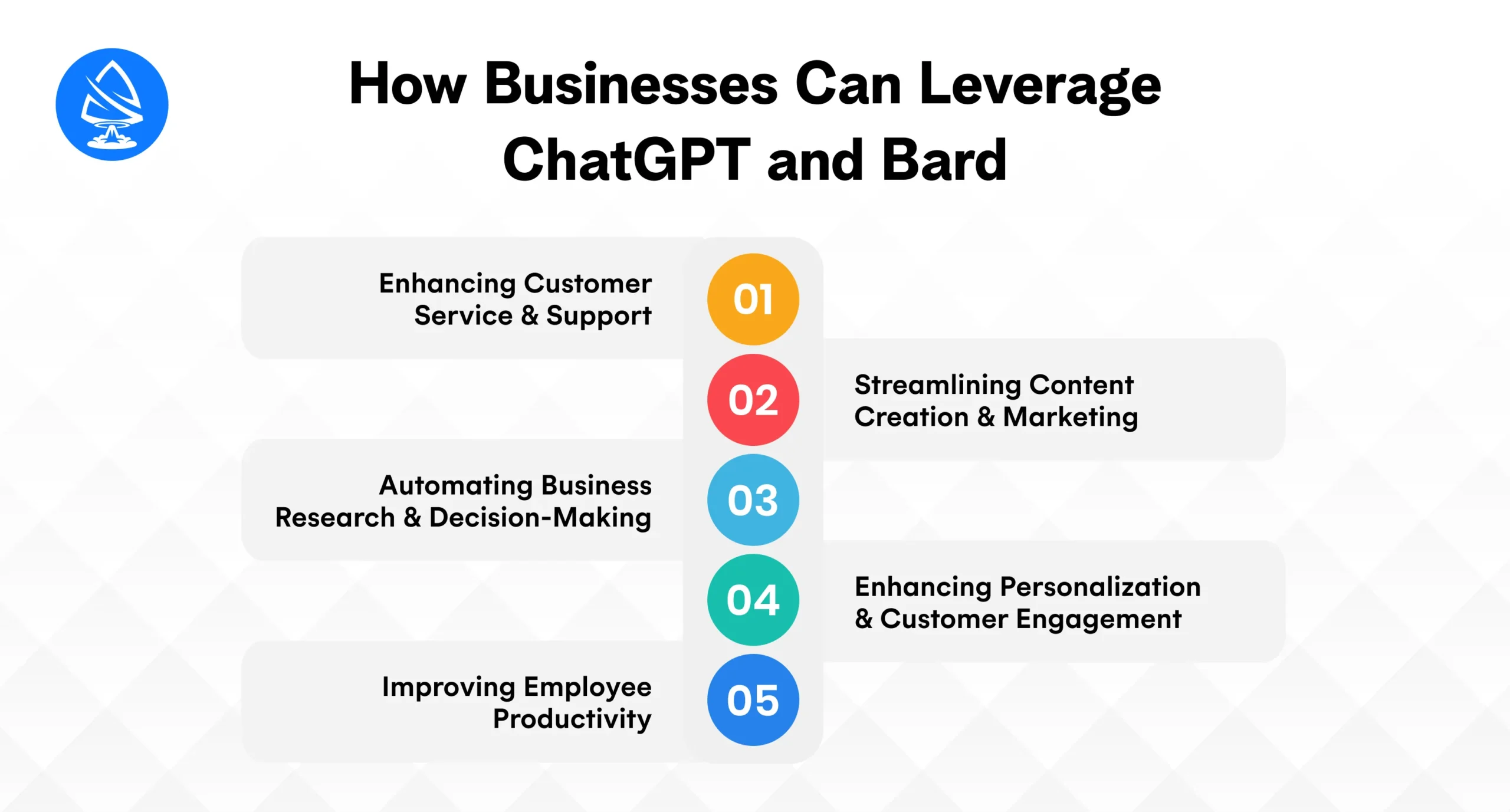
ChatGPT automates customer support by answering FAQs, troubleshooting issues, and handling complex queries, providing 24/7 service.
Example: E-commerce platforms use ChatGPT to assist customers with finding products, answering questions about product features, and processing returns or refunds.
Bard excels at providing fact-based, real-time responses, especially when integrating with Google’s search engine. This makes Bard ideal for customer service applications where access to the latest data and accurate information is essential.
Example: A customer contacting a travel agency can ask Bard for real-time flight schedules, availability, or changes in travel restrictions, ensuring they get the most relevant and up-to-date information.
ChatGPT is a powerful tool for generating creative content. It writes blog posts, social media content, and product descriptions, helping businesses maintain a consistent online presence.
Example: A company in the fashion industry could use ChatGPT to create weekly blog posts discussing trends, styling tips, or product highlights, helping them attract more traffic to their website.
Bard, on the other hand, is ideal for generating content based on search queries and providing highly relevant information. With its access to real-time web data, Bard excels at creating SEO-driven content that aligns with what users are searching for.
Example: A tech company could use Bard to write a comprehensive guide on the latest industry trends, integrating real-time data from news articles, blogs, and other sources, ensuring that the content is relevant and timely.
ChatGPT can be a valuable tool for businesses that need quick access to information. It can summarise lengthy reports, research papers, or articles, enabling decision-makers to get the gist of complex data without having to read through everything manually.
Example: A business in the finance sector might use ChatGPT to generate concise reports based on quarterly earnings, investor feedback, and stock performance, allowing executives to make timely, informed decisions.
Given Bard’s integration with Google’s search engine, it can provide businesses with real-time insights and data-driven answers for decision-making. Whether it’s tracking competitors, market trends, or consumer sentiment, Bard excels at fetching the latest information.
Example: A marketing team could use Bard to gather the latest consumer sentiment on a particular brand, allowing them to adjust their strategy in real time based on public opinion.
ChatGPT excels at creating personalised interactions, whether it’s through chatbots or virtual assistants. It can use customer data, past interactions, and preferences to provide tailored responses, making it a great tool for enhancing customer engagement.
Example: An online retailer could use ChatGPT to engage customers in real-time on their website, offering product suggestions based on the user’s browsing history and preferences.
Bard integrates with Google, offering real-time data and personalised experiences based on current trends and news. It can provide recommendations and information relevant to users, adding a layer of real-time, dynamic personalisation.
Example: A travel agency could use Bard to suggest destinations, flight options, and local events based on real-time data, giving users personalised travel experiences.
ChatGPT can be used internally to automate repetitive tasks, such as drafting reports, creating content, or summarising meeting notes. This allows employees to focus on higher-level tasks and strategic decision-making.
Example: A marketing team could use ChatGPT to generate initial drafts for blogs, social media posts, or product descriptions, reducing the time spent on content creation.
Bard pulls real-time data, helping employees stay updated on trends, news, and research without manual searches. This capability can significantly improve productivity by providing quick access to the latest information.
Example: A sales team could use Bard to gather the latest information on competitor products and pricing, giving them an edge when negotiating with clients.
Both ChatGPT vs Bard offer remarkable capabilities in AI-driven communication and content generation, but each shines in different areas. ChatGPT excels in creative tasks and conversations, while Bard focuses on real-time information retrieval and research. Understanding the strengths and limitations of each can help businesses make the best decision based on their unique needs.
If you’re looking to implement AI in your business, consulting with an AI app development company in USA can help you tailor the right solution for your needs. Use our cost calculator to estimate the potential benefits and cost savings of incorporating AI into your operations.
1. What is the main difference between ChatGPT and Bard?
ChatGPT excels in conversations and content generation, while Bard is optimised for real-time search and integrates with Google.
2. Can ChatGPT access real-time data?
No, ChatGPT does not have access to real-time data. It relies on a dataset it was trained on, which can sometimes make its responses outdated.
3. What are the use cases for ChatGPT?
ChatGPT is ideal for content creation, customer service, chatbots, automated responses, and creative writing tasks.
4. What are the use cases for Bard?
Bard is better suited for research, knowledge sharing, answering search queries, and generating informative content based on real-time web data.
5. Which AI is better for content generation?
ChatGPT excels at content generation, especially for creative content like blogs, articles, and social media posts.
6. Can Bard create personalised content?
Bard can create content, but it is primarily focused on delivering factual, knowledge-based responses rather than personalised, creative content.
7. Is Bard more accurate than ChatGPT?
Bard can provide more up-to-date and accurate information in real-time, as it integrates with Google Search. ChatGPT, however, provides highly coherent and relevant responses based on its trained data.

Artoon Solutions
Artoon Solutions is a technology company that specializes in providing a wide range of IT services, including web and mobile app development, game development, and web application development. They offer custom software solutions to clients across various industries and are known for their expertise in technologies such as React.js, Angular, Node.js, and others. The company focuses on delivering high-quality, innovative solutions tailored to meet the specific needs of their clients.
 For business inquiries only