- HR:+91-879-9184-787
- Sales:+91-908-163-7774


Creating high-quality copy at scale has become one of the biggest challenges for modern businesses. From websites and landing pages to ads, emails, product descriptions, and social media, brands are expected to produce consistent, engaging content faster than ever. Traditional copywriting, while powerful, often struggles to keep up with this demand due to time constraints, cost, and the need for constant experimentation.
This is where AI in Copywriting is reshaping the content landscape. Powered by advances in natural language processing and generative AI, modern copywriting tools can draft, optimize, personalize, and test content in minutes instead of days. Businesses are no longer asking if they should use AI for copywriting, but how to use it effectively without sacrificing brand voice or quality.
For founders, CTOs, product managers, and enterprise decision-makers, AI copywriting represents a strategic advantage, reducing content costs, accelerating go-to-market timelines, and improving conversion performance. In this guide, we’ll explore what AI in copywriting is, how it works, real-world use cases, leading solutions and tools, benefits, challenges, and best practices for successful implementation.
What Is Copywriting? Copywriting is the strategic practice of writing persuasive and purpose-driven content designed to influence reader behavior and drive a specific action. That action could be making a purchase, signing up for a service, clicking a button, downloading a resource, or engaging with a brand. Unlike general content writing, copywriting is outcome-focused and closely tied to business and marketing goals.
Below are the key sub-points that explain copywriting in detail.
Copywriting is written with a clear objective in mind.
Core goals include:
Every line of copy is crafted to move the reader closer to an action.
Effective copywriting leverages human psychology to influence decisions.
Key elements include:
This persuasive aspect is what differentiates copywriting from informational content.
Copywriting is applied wherever businesses communicate with customers.
Common formats include:
Each channel requires a tailored copywriting approach.
Copywriting helps define and maintain a consistent brand voice.
Why this matters:
Strong copy reinforces how a brand sounds and feels to its audience.
Copywriting blends creative writing with strategic thinking.
It requires:
This balance makes copywriting both an art and a science.
Modern copywriting is heavily influenced by data and results.
Key aspects include:
Performance data guides continuous improvement.
Copywriting underpins nearly all digital marketing efforts.
Business impact:
Without strong copywriting, even the best products struggle to communicate value.
You may also want to know AI in Trend Analysis
What Is AI in Copywriting? AI in copywriting refers to the use of artificial intelligence, primarily natural language processing (NLP) and generative AI models, to create, optimize, and personalize written content automatically. Instead of writing copy entirely from scratch, AI systems assist or automate the process by generating human-like text based on prompts, data, and predefined goals. This approach is widely known as AI copywriting, copywriting AI, or copywriting artificial intelligence.
Below are the key sub-points that explain AI in copywriting in detail.
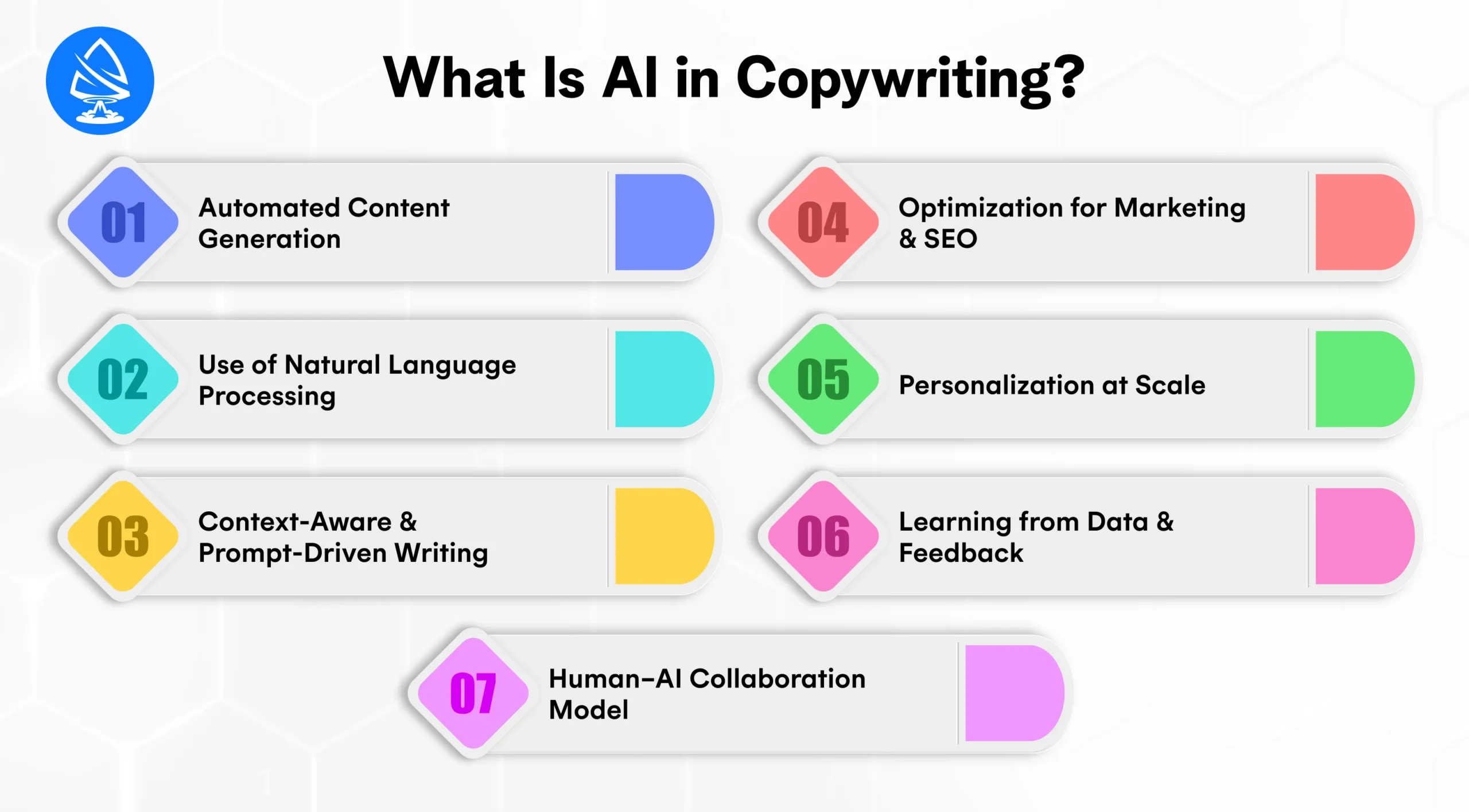
AI in copywriting can generate text instantly based on user instructions.
What it can create:
This dramatically reduces the time required for first drafts.
AI copywriting tools rely on NLP to understand language structure, tone, and intent.
How NLP helps:
This is the core technology behind modern AI copywriting software.
AI generates copy based on the context provided by the user.
Examples of context inputs:
Better prompts lead to higher-quality AI-generated copy.
AI in copywriting is often used to optimize content performance.
What AI can optimize:
This makes AI for copywriting especially valuable in digital marketing.
AI enables personalized copy for different users or segments.
How this works:
Personalization improves engagement and conversion rates.
AI copywriting tools improve over time using training data and user feedback.
How this helps:
This adaptive learning is a key advantage of AI copywriting over static templates.
AI in copywriting is designed to assist, not replace, human writers.
How teams use it:
This collaboration delivers the best results.
Why AI is transforming copywriting comes down to speed, scale, and data-driven precision. As digital channels multiply and customer expectations rise, traditional copywriting alone can no longer meet the demand for fast, personalized, and performance-optimized content. AI bridges this gap by augmenting human creativity with automation and intelligence. Below are the key reasons driving this transformation, explained with clear sub-points.
Modern businesses must produce content across dozens of channels simultaneously.
Why AI matters:
This scalability is a core reason AI in Copywriting adoption is accelerating.
Speed is critical in competitive digital markets.
Why AI matters:
This agility gives businesses a measurable competitive edge.
Traditional copywriting often relies on intuition and experience alone.
Why AI matters:
This shifts copywriting from guesswork to evidence-based optimization.
Customers expect messaging tailored to their needs, behavior, and context.
Why AI matters:
Personalization is one of the strongest drivers of AI in Copywriting.
Hiring large content teams or agencies can be expensive and slow.
Why AI matters:
This efficiency makes AI copywriting attractive to both startups and enterprises.
Maintaining a consistent brand voice across channels is challenging.
Why AI matters:
Consistency strengthens brand trust and recognition.
AI copywriting systems improve over time as they process more data.
Why AI matters:
This makes AI in copywriting a continuously evolving capability.
AI does not eliminate the need for human copywriters.
Why AI matters:
The result is a collaborative human–AI workflow.
How AI in Copywriting works is best understood as a structured, prompt-driven pipeline that turns intent and data into persuasive, on-brand text, then continuously improves it using feedback and performance signals. Below is a clear, step-by-step explanation with sub-points.
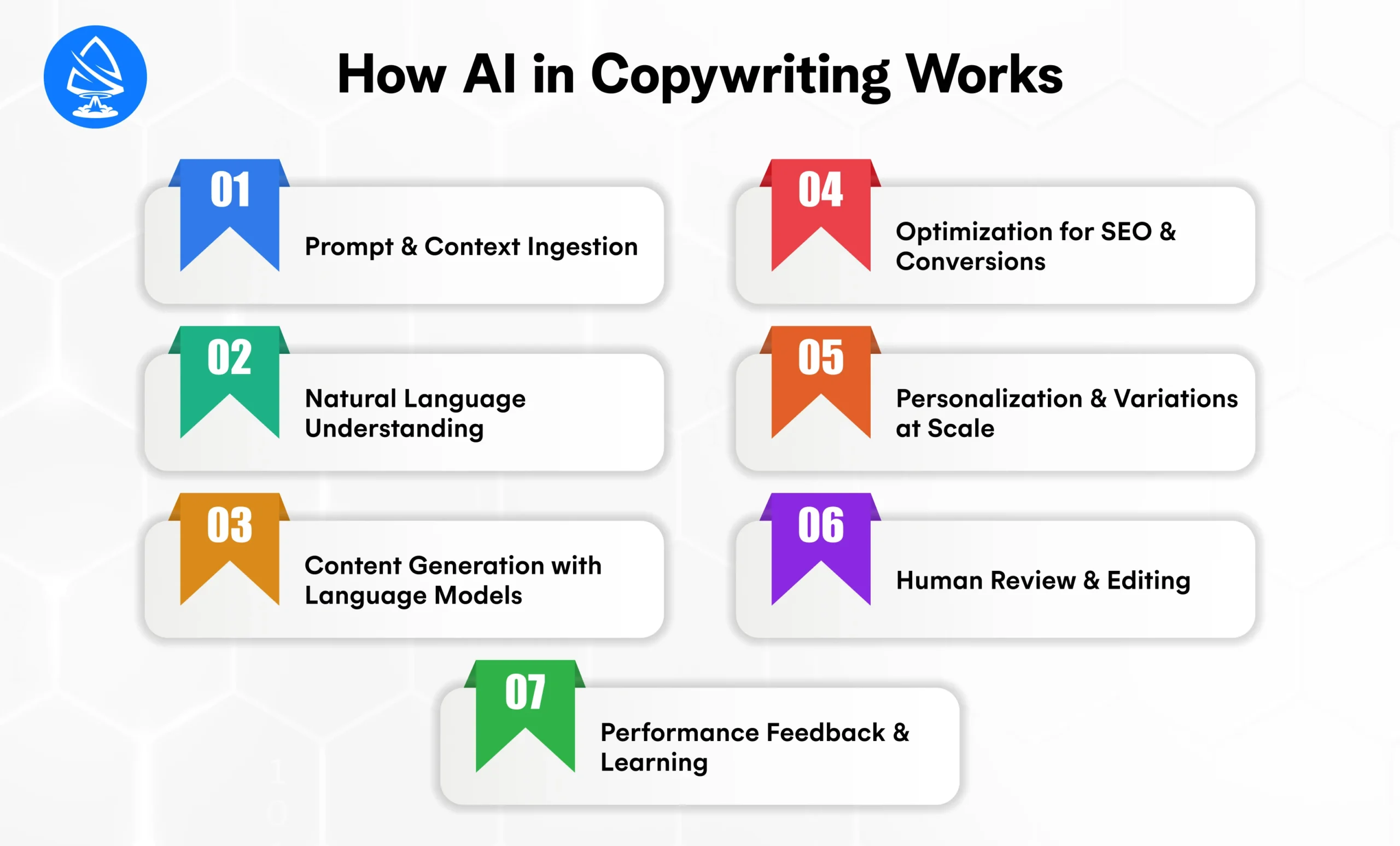
AI copywriting starts with inputs that define what to write and how to write it.
Typical inputs include:
Clear prompts are essential for high-quality AI in Copywriting outputs.
The AI interprets the prompt using NLP to understand intent, structure, and constraints.
What happens:
This ensures relevance before generation begins.
Generative models produce human-like text based on learned patterns from large datasets.
What the model does:
This is the core engine behind AI copywriting and copywriting AI tools.
AI refines copy to meet performance goals.
Optimization includes:
This makes AI for copywriting especially effective for marketing use cases.
AI generates multiple versions tailored to segments or channels.
How it works:
Personalization at scale is a major advantage of AI in Copywriting.
Humans refine AI drafts to ensure accuracy, brand fit, and originality.
What teams do:
This collaboration delivers the best results.
AI improves by using outcomes and feedback.
Signals used:
Continuous learning boosts effectiveness over time.
AI helps generate:
This accelerates website launches and A/B testing.
AI generates multiple ad variations for:
Marketers can test dozens of variations quickly using the best AI for copywriting tools.
AI assists with:
This improves open rates and engagement.
AI creates scalable, SEO-friendly descriptions with a consistent tone.
Benefits include:
AI generates captions, hooks, and post ideas optimized for each platform.
AI drafts:
This improves sales team productivity.
Many organizations work with an AI app development company to build custom copywriting solutions integrated into internal workflows.
These tools cover multiple content types and tones.
Common capabilities:
They are often marketed as the best AI copywriting tools.
Designed to:
These tools are widely used in content marketing.
Options include:
These are ideal for experimentation and small teams.
Custom-built tools integrated with:
These are often delivered through custom AI development services.
The benefits of AI in Copywriting extend across speed, scale, personalization, and performance. By combining automation with data-driven intelligence, AI helps teams produce high-quality copy faster while improving consistency and ROI. Below are the key benefits explained with clear sub-points.
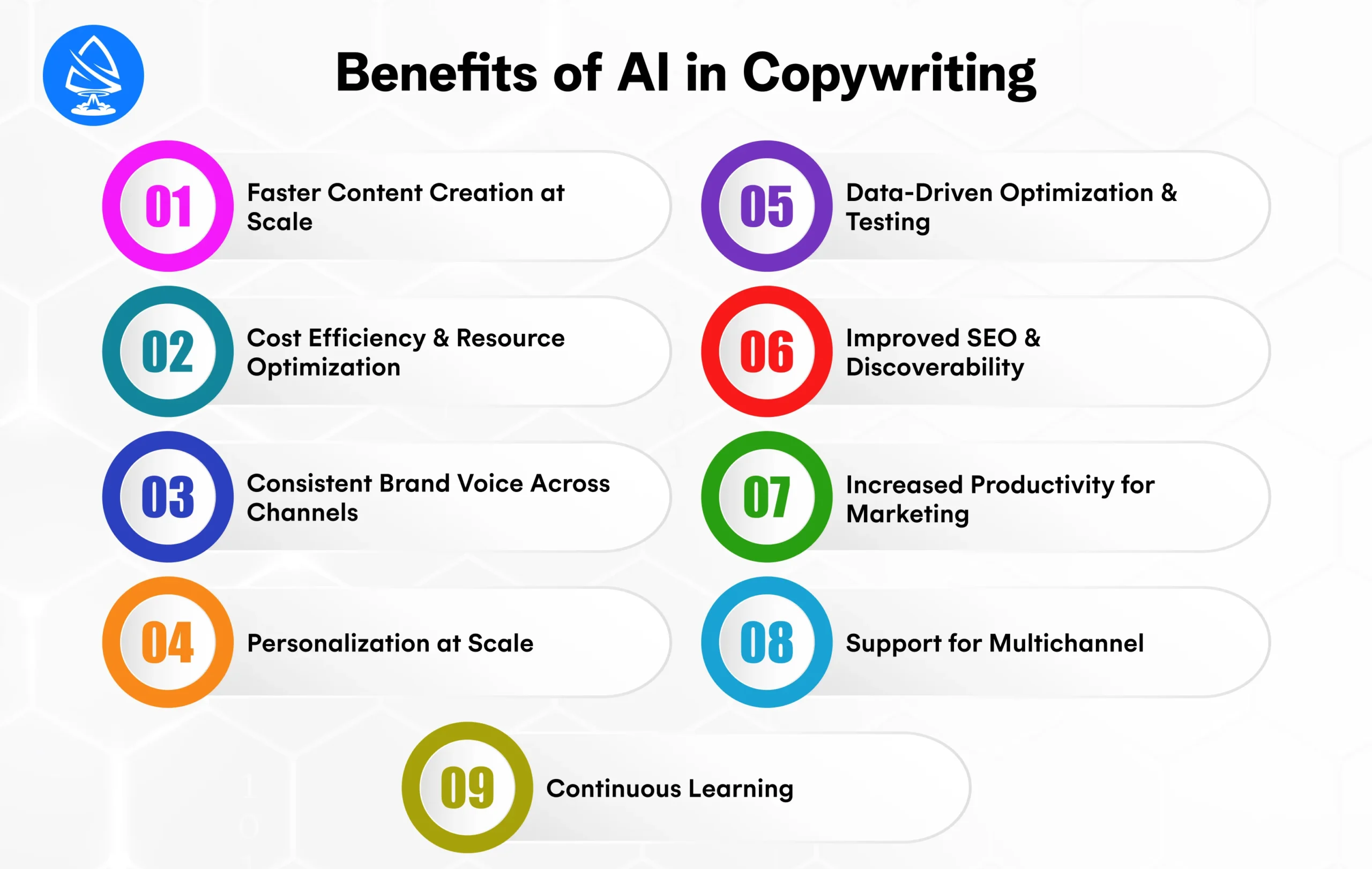
AI dramatically reduces the time required to create copy.
How this helps:
Speed is one of the most immediate benefits of AI in Copywriting.
AI lowers the cost of producing large volumes of copy.
How this helps:
This efficiency benefits startups and enterprises alike.
AI can be trained on brand guidelines and examples.
How this helps:
Consistency is difficult to achieve manually at scale. AI makes it manageable.
AI enables tailored messaging for different audiences without manual rewrites.
How this helps:
Personalization is a core driver of modern AI in Copywriting adoption.
AI generates and tests multiple copy variations efficiently.
How this helps:
This shifts copywriting from intuition-led to evidence-led.
AI assists with keyword-aware content creation.
How this helps:
When guided correctly, AI supports strong organic performance.
AI acts as a force multiplier for teams.
How this helps:
Teams can focus on strategy and execution instead of drafting.
AI adapts copy to different formats and platforms.
How this helps:
This flexibility is essential in omnichannel marketing.
AI improves as it processes more feedback and results.
How this helps:
This makes AI in copywriting a long-term capability, not a one-off tool.
You may also want to know AI in Web3
| Aspect | Human Copywriting | AI Copywriting |
| Speed | Moderate | Very fast |
| Creativity | High | Assisted |
| Scalability | Limited | High |
| Cost | Higher | Lower |
| Personalization | Manual | Automated |
The most effective strategy is AI + human collaboration.
While the advantages are compelling, AI in Copywriting also comes with important limitations that businesses must address to ensure quality, accuracy, and brand integrity. AI works best as an assistant, not a replacement for human judgment. Below are the key challenges explained in detail with clear sub-points.
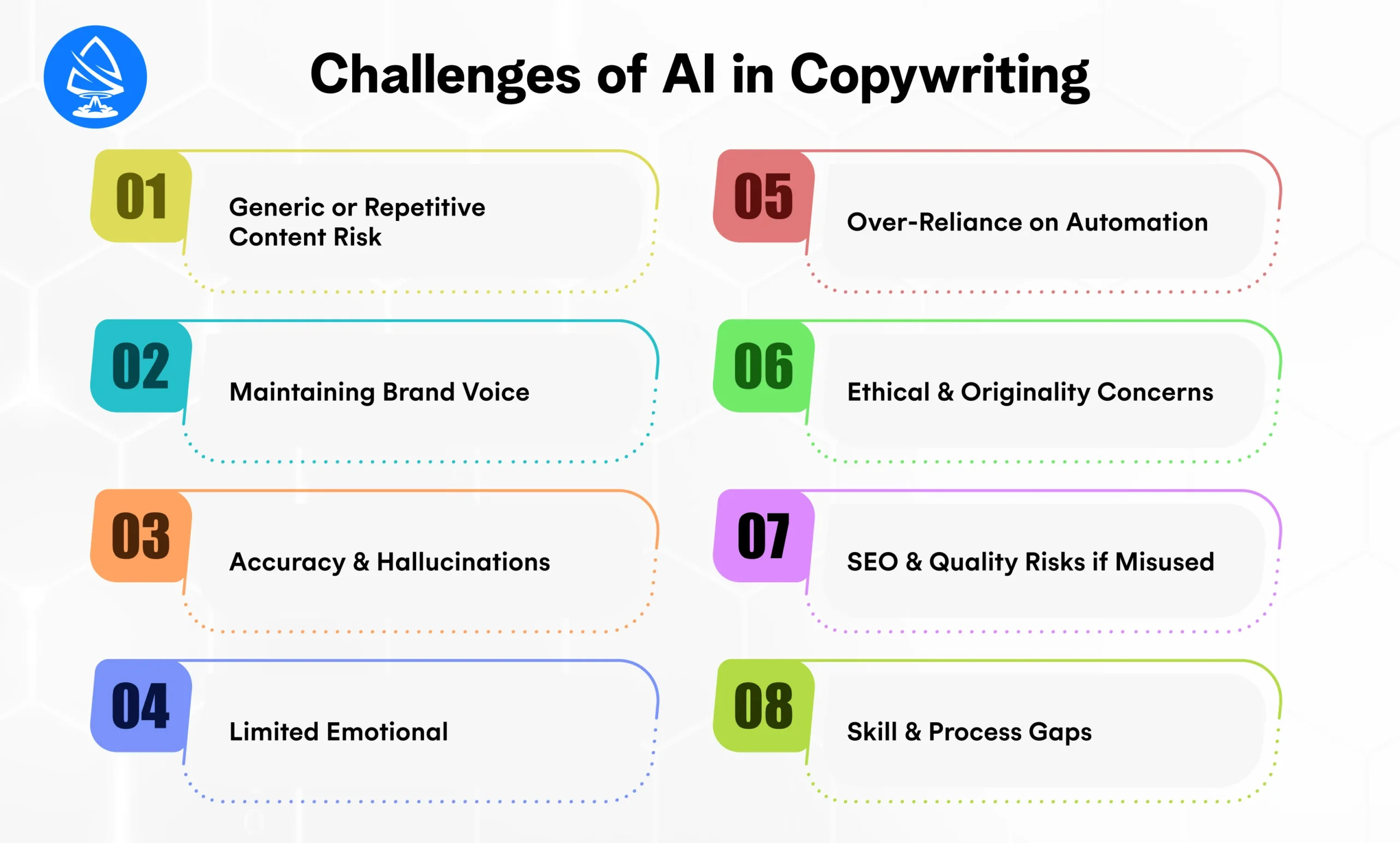
AI models are trained on large datasets and may generate content that sounds generic if not guided properly.
Why this is a challenge:
Strong prompts and human editing are essential to overcome this.
Every brand has a unique voice that AI may struggle to replicate consistently.
Why this is a challenge:
Without oversight, AI in Copywriting can dilute brand identity.
AI can produce content that sounds confident but is factually incorrect.
Why this is a challenge:
Fact-checking and review processes are non-negotiable.
AI lacks true human understanding of emotions, humor, and cultural context.
Why this is a challenge:
Human insight is critical for nuance-heavy copy.
Teams may become too dependent on AI-generated copy.
Why this is a challenge:
AI should support creativity, not replace it.
AI-generated content raises questions around originality and ethics.
Why this is a challenge:
Responsible use safeguards brand reputation.
Improper use of AI can negatively impact search performance.
Why this is a challenge:
Quality-first strategies are essential for sustainable SEO.
Effective AI copywriting still requires skilled users.
Why this is a challenge:
Successful AI in Copywriting depends on people as much as technology.
Implementing AI in Copywriting successfully requires a clear strategy that blends automation with human creativity, governance, and measurable outcomes. Organizations that treat AI as a capability rather than a quick fix see better quality, higher adoption, and stronger ROI. Below are the key sub-points that define a successful implementation.
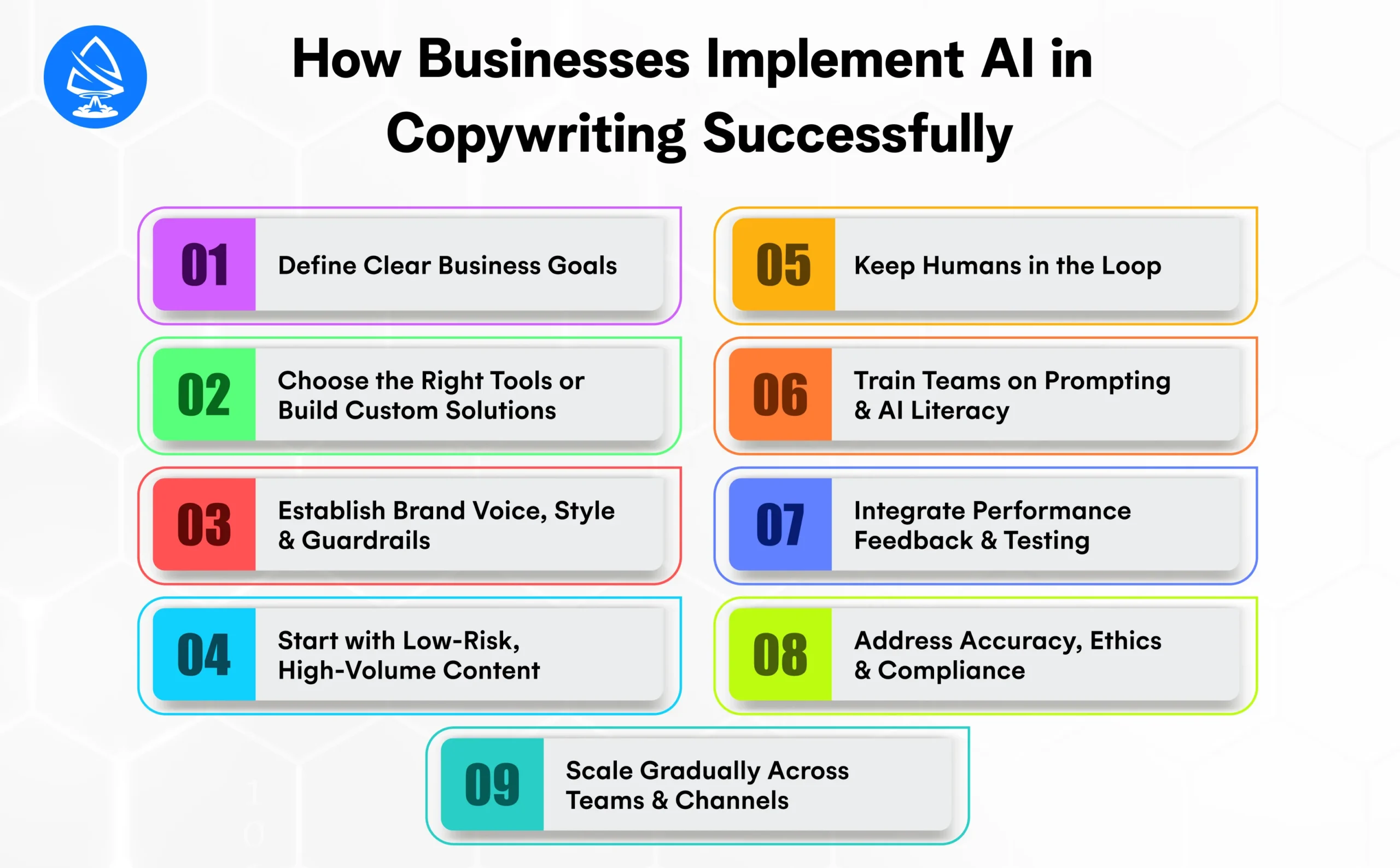
Successful adoption starts with clarity on why AI copywriting is needed.
What businesses do:
Clear objectives ensure AI in Copywriting delivers tangible value.
Not all AI copywriting needs are the same.
What businesses do:
Many teams partner with an Artificial Intelligence Development company to tailor workflows to their stack.
Brand consistency is critical to success.
What businesses do:
These guardrails help AI in Copywriting stay on-brand across channels.
Teams begin where AI can add value quickly with minimal risk.
Common starting points:
Early wins build confidence and adoption.
AI performs best when paired with human judgment.
What businesses do:
This hybrid model balances speed with quality.
Quality outputs depend on quality inputs.
What businesses do:
Upskilling maximizes the value of AI in Copywriting.
AI copywriting improves with data.
What businesses do:
Data-driven iteration drives continuous improvement.
Responsible use protects brand trust.
What businesses do:
Governance ensures sustainable adoption.
Once validated, businesses expand usage strategically.
What businesses do:
For deeper customization, enterprises often leverage artificial intelligence development services or hire AI developers to extend capabilities.
AI in Copywriting is not about replacing human creativity; it’s about amplifying it. By handling repetitive drafting, variation generation, and optimization tasks, AI frees writers, marketers, and product teams to focus on strategy, storytelling, and innovation. Businesses that embrace AI copywriting gain speed, scalability, and a measurable competitive edge in content-driven markets.
For decision-makers, the key is responsible adoption: combining AI efficiency with human judgment, brand understanding, and ethical oversight. When implemented thoughtfully, AI copywriting becomes a powerful growth engine across marketing, sales, and product communication.
If you’re evaluating AI copywriting tools or planning a custom solution and want clarity on cost and scope, use our AI App Cost Calculator to estimate your investment and take the next step toward smarter, faster content creation.
1. What is AI in copywriting?
It uses AI to generate and optimize marketing and sales content.
2. Is AI copywriting better than human writing?
It’s faster and scalable, but best used alongside humans.
3. Are AI copywriting tools SEO-friendly?
Yes, when used with proper SEO guidance.
4. Can AI maintain brand voice?
Yes, with training and prompts.
5. Is AI copywriting free?
Some tools offer limited free plans.
6. Is AI copywriting safe for businesses?
Yes, with review and governance.
7. What industries benefit most?
Ecommerce, SaaS, marketing, media, and startups.

Artoon Solutions
Artoon Solutions is a technology company that specializes in providing a wide range of IT services, including web and mobile app development, game development, and web application development. They offer custom software solutions to clients across various industries and are known for their expertise in technologies such as React.js, Angular, Node.js, and others. The company focuses on delivering high-quality, innovative solutions tailored to meet the specific needs of their clients.
 For business inquiries only