- HR:+91-879-9184-787
- Sales:+91-908-163-7774


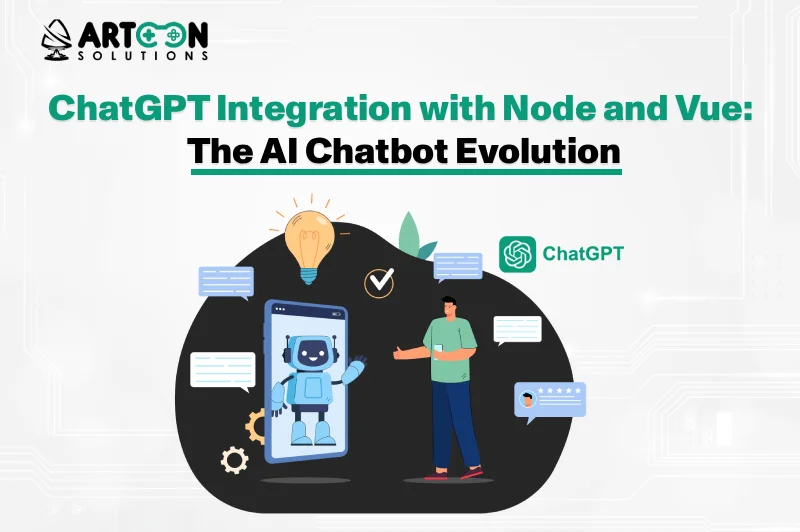
In just a few short years, AI chatbots have evolved from basic, rule-based responders into intelligent, context-aware assistants capable of holding human-like conversations. At the heart of this evolution lies ChatGPT, OpenAI’s groundbreaking conversational model that has redefined how businesses interact with customers.
Whether you’re a tech professional, startup founder, or small business owner, integrating ChatGPT into your web application opens new opportunities from automating support to personalizing customer experiences and driving engagement around the clock.
But here’s the key: ChatGPT integration with Node.js and Vue.js isn’t just about adding an AI chat window. It’s about building a smart, scalable, and interactive system where your backend (Node) and frontend (Vue) seamlessly communicate with OpenAI’s APIs to deliver real-time, intelligent responses.
In this blog, we’ll explore how ChatGPT integration works with Node and Vue, its benefits, implementation steps, use cases, and how businesses with the support of an experienced AI development company in USA can leverage it to lead the AI chatbot evolution in 2025 and beyond.
ChatGPT Integration refers to connecting OpenAI’s ChatGPT API to your existing applications, allowing users to interact with an AI-driven chatbot directly within your web or mobile app.
Instead of relying on static FAQs or pre-scripted answers, ChatGPT integration enables:
At a technical level, ChatGPT integration involves three components:
Together, they form a real-time, conversational interface, whether it’s embedded on your website, SaaS product, or customer support system.
Combining Node.js and Vue.js for ChatGPT integration offers several advantages:
You may also want to know the AI CRM Assistant
Integrating ChatGPT into business applications isn’t just a technical upgrade; it’s a strategic move that revolutionizes how companies interact with customers, manage workflows, and scale operations. From automating customer support to personalizing marketing campaigns, ChatGPT offers an array of transformative benefits that directly impact efficiency, engagement, and profitability.
Here’s a detailed breakdown of the key benefits of ChatGPT integration for businesses in 2025 and beyond:

One of the most significant advantages of ChatGPT integration is providing round-the-clock customer support without the need for a large team. Businesses can serve global customers across different time zones, ensuring that queries are answered instantly, day or night.
Example: An eCommerce company can integrate ChatGPT into its website to automatically answer product availability questions, assist in returns, and recommend alternatives, all without human involvement.
Business Impact: Reduced support costs, faster resolution times, and a consistent customer experience 24/7.
Modern consumers expect personalized experiences. ChatGPT excels at using contextual understanding and historical data to tailor responses for each user.
Example: A SaaS business integrating ChatGPT into its platform can offer customized onboarding, feature recommendations, or tutorials based on the user’s behavior.
Business Impact: Higher user retention, improved engagement, and stronger customer relationships through personalization.
ChatGPT reduces the operational burden on businesses by automating repetitive and labor-intensive tasks. Instead of maintaining large teams for customer support, onboarding, or information management, AI handles these tasks efficiently.
Example: A logistics company using ChatGPT integration can automate shipment tracking and status updates for customers, cutting down on inbound calls and emails.
Business Impact: Lower operational costs and higher employee productivity.
ChatGPT can act as an intelligent sales assistant, guiding website visitors, capturing leads, and even nurturing them through personalized conversations.
Example: A financial services website can use ChatGPT to engage visitors, assess their investment goals, and recommend suitable plans, all while collecting user details for follow-up.
Business Impact: Increased lead quality, faster conversions, and higher ROI on marketing efforts.
Beyond customer-facing roles, ChatGPT also enhances internal workflows through automation and intelligent insights.
Example: An enterprise team can integrate ChatGPT into its internal dashboard to generate summaries of sales reports or automatically respond to internal FAQs.
Business Impact: Simplified internal processes and significant time savings across departments.
Language barriers can hinder business growth. ChatGPT’s multilingual capabilities allow companies to communicate effectively with international customers in their native languages.
Example: A travel agency with customers in Europe, Asia, and South America can use ChatGPT to assist users in Spanish, French, and Japanese, simultaneously offering consistent multilingual support.
Business Impact: Expanded global footprint and stronger brand presence across diverse markets.
ChatGPT doesn’t just communicate, it learns. Businesses can integrate ChatGPT to gather valuable customer insights and analytics from conversations, helping improve products, services, and strategies.
Example: A software company uses ChatGPT to monitor customer feedback from chatbot interactions and identify recurring issues with a feature, helping improve its next update.
Business Impact: Enhanced decision-making through real-time feedback and analytics.
Unlike human teams that require expansion as demand increases, ChatGPT scales effortlessly. Whether your business is handling 10 users or 10,000, AI ensures smooth, uninterrupted performance.
Example: An eCommerce site during Black Friday can handle thousands of simultaneous customer chats without lag, something traditional systems would struggle with.
Business Impact: Cost-effective scalability that supports business growth without adding infrastructure overhead.
ChatGPT can be integrated into nearly any platform, website, CRM, mobile apps, or even social media chat interfaces, making it a universal AI assistant for your business.
Example: A real estate company integrates ChatGPT with its CRM via API to handle initial client inquiries, schedule property viewings, and update records automatically.
Business Impact: Unified automation across platforms for better productivity and workflow continuity.
Unlike human agents with varying communication styles, ChatGPT maintains a consistent tone and voice, ensuring your brand’s personality remains intact across all interactions.
Example: A healthcare startup uses ChatGPT to maintain a reassuring, empathetic tone in all patient interactions, reinforcing trust and credibility.
Business Impact: Stronger brand identity and customer loyalty through consistent communication.
You may also want to know Enterprise AI Software
Let’s walk through a simplified implementation process for integrating ChatGPT into a full-stack Node.js + Vue.js application.
cd chatgpt-integration
npm init -y
npm install express cors dotenv openai
Create a .env file and add your OpenAI API key:
OPENAI_API_KEY=your_openai_api_key_here
import express from “express”;
dotenv.config();
const app = express();
const port = 5000;
app.use(cors());
app.use(express.json());
const openai = new OpenAI({
apiKey: process.env.OPENAI_API_KEY,
});
app.post(“/api/chat”, async (req, res) => {
try {
const { message } = req.body;
const response = await openai.chat.completions.create({
model: “gpt-4”,
messages: [{ role: “user”, content: message }],
});
res.json({ reply: response.choices[0].message.content });
} catch (error) {
res.status(500).json({ error: error.message });
}
});
app.listen(port, () => console.log(`Server running on port ${port}`));
Your backend is now ready to handle user messages and fetch AI responses.
vue create chatgpt-frontend
cd chatgpt-frontend
npm install axios
<div class=”chat-container”>
<h1>AI Chatbot</h1>
<div class=”chat-box”>
<div v-for=”msg in messages” :key=”msg.id” class=”message”>
<p><strong>{{ msg.sender }}:</strong> {{ msg.text }}</p>
</div>
</div>
<input v-model=”input” @keyup.enter=”sendMessage” placeholder=”Type your message…” />
</div>
</template>
<script>
import axios from “axios”;
export default {
data() {
return {
input: “”,
messages: [],
};
},
methods: {
async sendMessage() {
if (!this.input) return;
this.messages.push({ sender: “You”, text: this.input });
const userMessage = this.input;
this.input = “”;
const response = await axios.post(“http://localhost:5000/api/chat”, {
message: userMessage,
});
this.messages.push({ sender: “AI”, text: response.data.reply });
}, },
};
</script>
Backend: node server.js
Frontend: npm run serve
You now have a working ChatGPT chatbot built with Node.js (backend) and Vue.js (frontend).
Once your basic integration works, you can enhance it with advanced capabilities:
Maintain conversation history by storing messages in the backend. This allows the chatbot to understand multi-turn conversations.
Integrate JWT-based authentication to personalize conversations for each logged-in user.
Use WebSockets for live streaming of AI responses for more dynamic, real-time conversations.
Integrate Speech-to-Text APIs for voice input and Text-to-Speech for audible replies.
Add animations, emojis, and avatar-based designs to make your chatbot visually appealing and engaging.
Automate support queries for retail, banking, healthcare, or SaaS platforms.
Offer in-app assistance guiding users through setup processes or product features.
Integrate ChatGPT for tutoring, homework help, or e-learning question-answer sessions.
Enable product discovery and recommendation engines powered by AI.
Assist writers or marketers in generating articles, ads, or social media captions.
While ChatGPT integration offers immense opportunities for businesses, from automated support to real-time personalization, implementing it effectively requires overcoming several technical, ethical, and operational challenges. These hurdles can impact performance, scalability, accuracy, and user trust if not managed properly.
Let’s explore in detail the key challenges businesses face during ChatGPT integration, along with insights on how to address them strategically.

One of the most common challenges in ChatGPT integration is balancing API usage and cost. OpenAI’s ChatGPT APIs operate on a token-based pricing model, meaning that the more users interact, the more tokens are consumed.
Example: A SaaS app with thousands of daily users sees a significant cost increase due to multiple ChatGPT API calls for each user session.
Pro Tip: Businesses can collaborate with an AI app development company in the USA to set up scalable architectures that optimize API usage while controlling costs.
Handling customer data securely is crucial when integrating AI systems like ChatGPT, especially for industries such as finance, healthcare, or e-commerce. Since AI chatbots process sensitive user data, ensuring data protection and compliance becomes a top priority.
Example: A healthcare chatbot using ChatGPT must ensure patient data never leaves the secure server environment.
Pro Tip: Always integrate ChatGPT under a compliance-first architecture with built-in monitoring, logging, and auditing features.
A key challenge with ChatGPT is its stateless nature, meaning it doesn’t inherently remember previous user interactions unless you supply the conversation history with each API call. This can make maintaining multi-turn conversations complex.
Example: A user asks, “What was the discount you mentioned earlier?” and the chatbot fails to recall the previous context because earlier prompts were truncated.
Pro Tip: Combining OpenAI’s GPT API with your own backend memory logic ensures a more human-like conversational flow.
While ChatGPT provides highly intelligent answers, it occasionally produces inaccurate, misleading, or fabricated information. Businesses relying heavily on AI-generated content must ensure factual correctness and credibility.
Example: A financial chatbot providing incorrect investment advice could lead to legal and reputational risks.
Pro Tip: Integrating ChatGPT with a knowledge base or verified dataset ensures factual reliability.
AI systems can unintentionally inherit biases from the data they were trained on, leading to unfair, offensive, or discriminatory responses. This poses ethical challenges in maintaining brand reputation and user trust.
Example: A recruitment platform chatbot could unintentionally favor certain job candidates based on biased wording in its dataset.
Pro Tip: Businesses should develop ethical AI guidelines and adopt transparent communication to build user confidence in their chatbot.
By 2030, AI chatbots are expected to handle 80% of routine business interactions, enabling companies to:
The ChatGPT-Node-Vue stack will remain a preferred choice for developers due to its flexibility, scalability, and performance, making it ideal for modern AI applications that evolve alongside technology.
The combination of ChatGPT, Node.js, and Vue.js represents the next phase in intelligent app development, where businesses move beyond static interfaces to create interactive, conversational digital experiences.
By integrating ChatGPT, companies can automate customer service, improve engagement, and personalize interactions, all while reducing operational costs and scaling effortlessly.
However, successful implementation requires the right technical expertise and strategic planning.
Ready to build your own ChatGPT-powered app?
Partner with an expert AI app development company in USA that specializes in ChatGPT integration services. Use our AI ChatGPT Cost Calculator to estimate your project budget and take the first step toward building your next-gen AI chatbot solution today.
1. What is ChatGPT Integration?
It’s the process of connecting OpenAI’s ChatGPT API with web or mobile apps to enable conversational AI experiences.
2. Why use Node.js for ChatGPT integration?
Node’s asynchronous nature makes it ideal for handling multiple simultaneous API calls efficiently.
3. Can I integrate ChatGPT into an existing Vue project?
Yes. You can easily add a chat component and link it to a Node backend that communicates with OpenAI.
4. Is ChatGPT integration expensive?
OpenAI charges based on token usage. For cost optimization, developers can use caching or fine-tuned, smaller models.
5. Can ChatGPT remember past conversations?
Yes, if you store chat histories and send them as context during each new API call.
6. Is ChatGPT integration secure?
Yes. Using environment variables and server-side API calls ensures sensitive API keys remain protected.
7. What industries can benefit most?
E-commerce, SaaS, healthcare, education, finance, and customer service can benefit from AI-driven chatbots.
8. Can I customize ChatGPT responses for my brand?
Absolutely! With prompt engineering and fine-tuning, you can align tone, style, and knowledge with your brand voice.

Artoon Solutions
Artoon Solutions is a technology company that specializes in providing a wide range of IT services, including web and mobile app development, game development, and web application development. They offer custom software solutions to clients across various industries and are known for their expertise in technologies such as React.js, Angular, Node.js, and others. The company focuses on delivering high-quality, innovative solutions tailored to meet the specific needs of their clients.
 For business inquiries only