- HR:+91-879-9184-787
- Sales:+91-908-163-7774


Artificial Intelligence is no longer a futuristic concept reserved for big tech giants. Today, it is a practical, results-driven technology that helps businesses automate processes, uncover insights, reduce costs, and unlock new revenue streams. From predictive analytics and generative AI to intelligent automation and personalization, the AI Consulting Service is transforming how companies operate and compete.
However, the real challenge for most organizations is not whether to adopt AI, but how to do it correctly. Choosing the right AI Consulting Service or AI consulting partner can be the difference between a successful AI-driven transformation and an expensive experiment that delivers little value. For USA-based tech leaders, founders, and small business owners, this decision carries strategic, financial, and operational implications.
This guide is designed to help you make an informed decision. You will learn what AI consulting really involves, how to evaluate an AI consulting company, what questions to ask, red flags to avoid, and how to align AI initiatives with your business goals. Whether you are exploring AI for the first time or scaling existing initiatives, this comprehensive guide will give you clarity and confidence.
An AI Consulting Service is a professional service that helps organizations strategically plan, adopt, implement, and scale artificial intelligence solutions to solve real business problems. Instead of offering generic software, AI consultants focus on understanding a company’s objectives, data landscape, and operational challenges, then recommend and build AI-driven solutions that deliver measurable business value. The goal of an AI consulting service is not just to introduce AI, but to ensure it is practical, secure, scalable, and aligned with long-term business strategy.
AI consulting services typically support businesses at every stage of their AI journey, from early exploration and feasibility analysis to full-scale deployment and continuous optimization. They combine business consulting with deep technical expertise in machine learning, data science, and advanced AI technologies, helping organizations reduce risk, control costs, and accelerate time to value.
AI consulting covers a broad range of services designed to turn AI from a concept into a working, value-generating system. The core areas usually include the following:
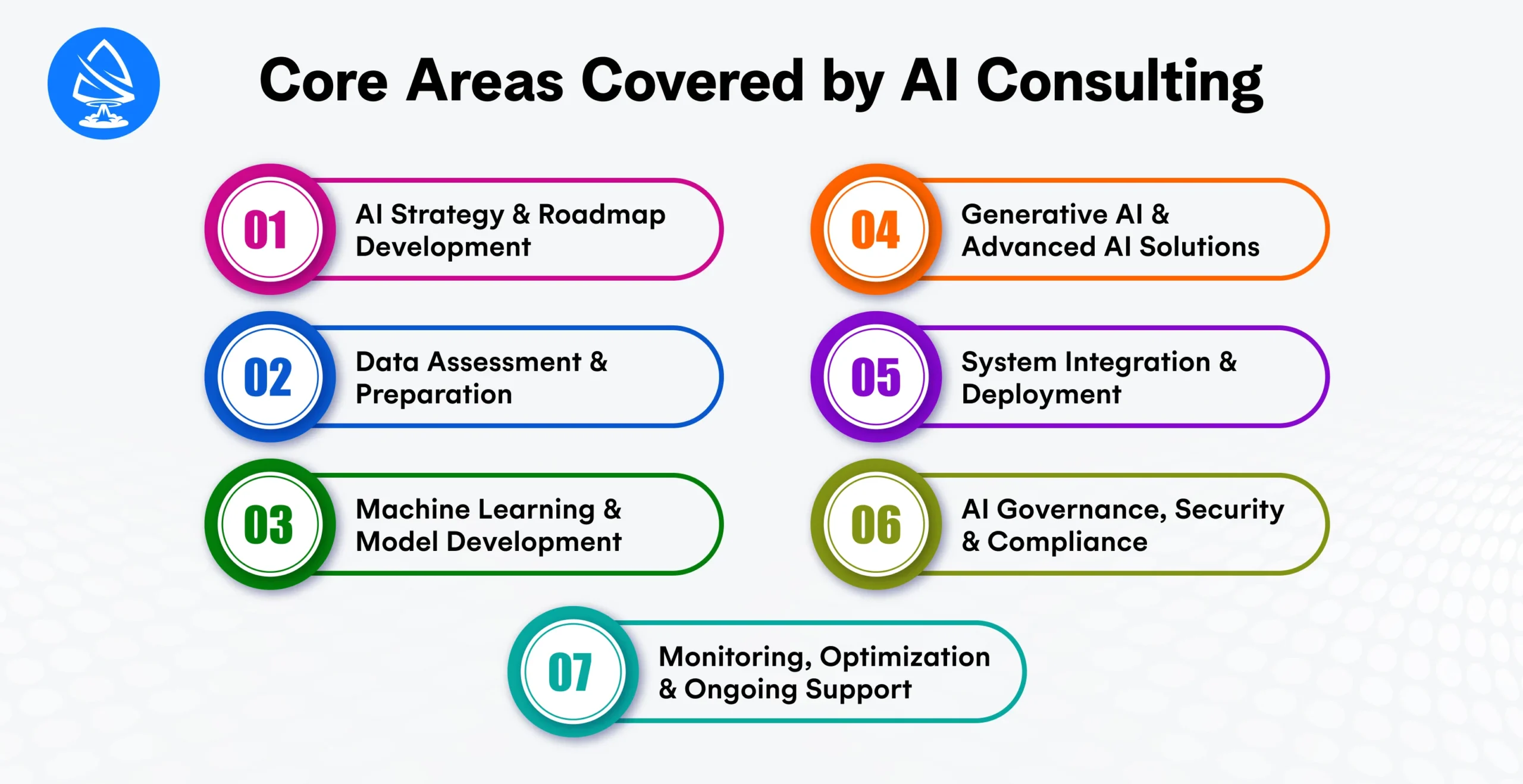
Consultants work with leadership teams to identify high-impact AI use cases, define success metrics, estimate ROI, and create a phased AI roadmap. This ensures AI initiatives align with business goals rather than being driven by hype or experimentation.
Since AI systems rely heavily on data, consultants evaluate data availability, quality, structure, and security. They help clean, organize, and prepare data pipelines so AI models can perform accurately and reliably.
AI consulting services include designing, training, and validating machine learning models for tasks such as prediction, classification, recommendation, and anomaly detection. This may involve traditional ML, deep learning, or hybrid approaches depending on the use case.
Many AI consultants now specialize in generative AI solutions such as chatbots, virtual assistants, content generation systems, and AI copilots. These solutions help businesses automate communication, enhance productivity, and improve user experiences.
Consultants ensure AI solutions integrate smoothly with existing systems like CRMs, ERPs, mobile apps, and cloud platforms. They also handle deployment, scalability, and performance optimization in real-world environments.
Responsible AI is a critical part of consulting. This includes managing data privacy, ensuring regulatory compliance, reducing bias, improving transparency, and implementing ethical AI practices.
After deployment, AI consulting services continue to monitor model performance, retrain models with new data, and optimize systems to maintain accuracy, reliability, and business impact over time.
Together, these core areas ensure that AI consulting delivers sustainable, real-world value rather than isolated or short-lived AI experiments.
AI adoption is growing rapidly, but many projects fail due to poor planning, lack of quality data, or misaligned expectations. This is where ai in consulting plays a crucial role.
For startups and SMBs in the USA, AI consulting services provide enterprise-level expertise without long-term hiring commitments.
You may also want to know about AI as a Service
AI consulting is not a single, one-size-fits-all service. Different businesses are at different stages of AI maturity, and each stage requires a specific type of expertise. Understanding the main types of AI consulting services will help you choose the right partner and investment model based on your goals, budget, and technical readiness.
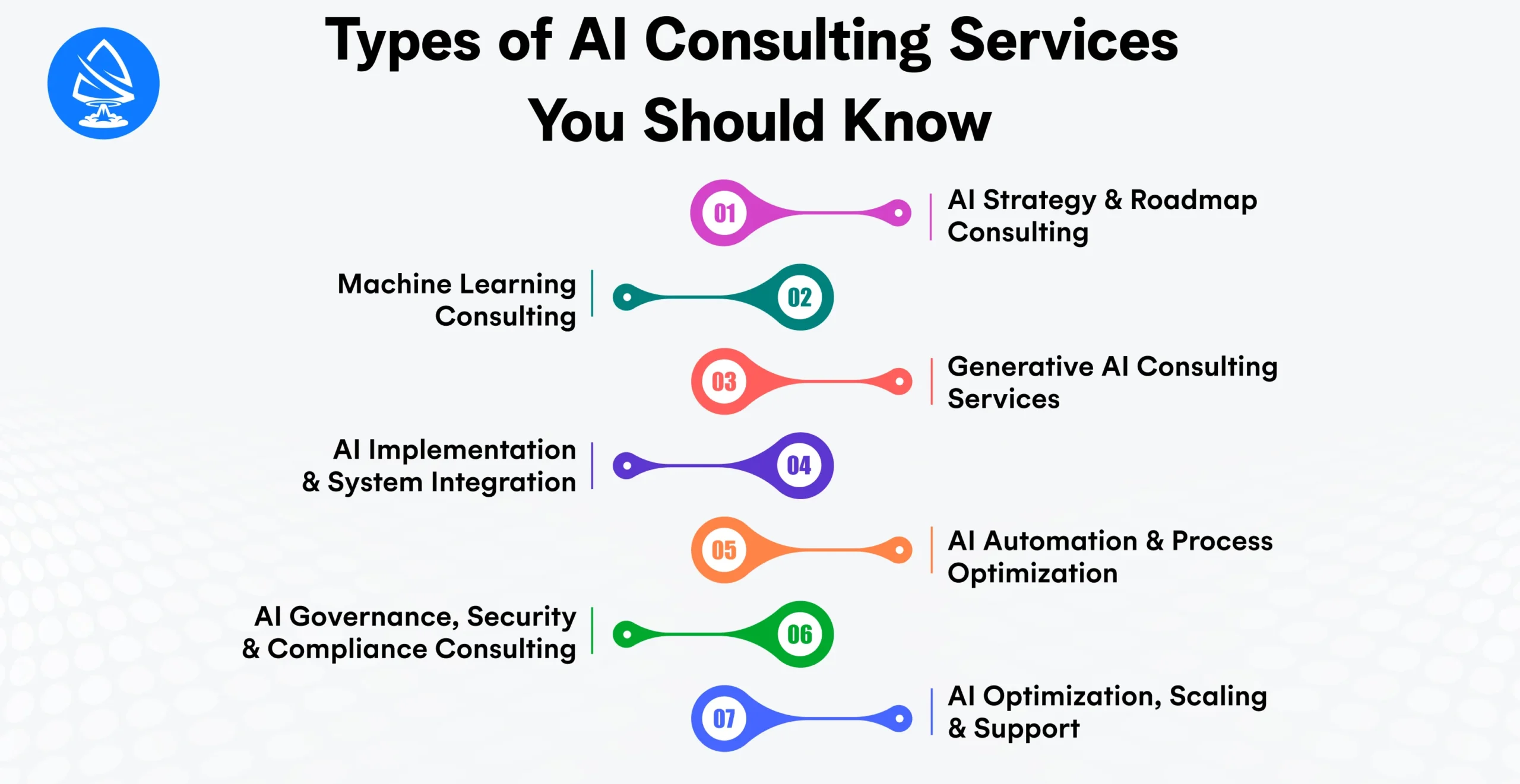
This type of consulting is ideal for organizations that are new to AI or unsure where to start. Consultants focus on understanding business objectives, identifying high-impact AI use cases, assessing feasibility, and estimating ROI. The outcome is a clear AI strategy and roadmap that outlines priorities, timelines, risks, and expected benefits, ensuring AI initiatives align with long-term business goals.
Machine learning consulting services focus on building predictive and analytical models that learn from data. These services include forecasting, recommendation systems, fraud detection, demand planning, customer segmentation, and anomaly detection. Machine learning consulting companies work closely with data teams to select appropriate algorithms, train models, and validate performance for real-world use.
Generative AI consulting services help businesses implement advanced AI models capable of creating content, code, images, summaries, and conversational experiences. This includes AI chatbots, virtual assistants, AI copilots, and enterprise knowledge systems. Generative AI consultants also help fine-tune large language models, integrate them with internal data, and ensure safe and responsible usage.
This service focuses on turning AI concepts into production-ready solutions. Consultants handle data pipelines, model deployment, API development, and integration with existing systems such as CRMs, ERPs, mobile apps, and cloud platforms. The goal is to ensure AI solutions work seamlessly within current business workflows.
AI automation consulting targets operational efficiency. It combines AI with automation technologies to streamline repetitive tasks, optimize workflows, and reduce manual effort. Common use cases include intelligent document processing, customer support automation, and supply chain optimization.
Responsible AI adoption is critical, especially in regulated industries. This type of consulting focuses on data privacy, regulatory compliance, bias reduction, explainability, and security. Consultants help businesses establish governance frameworks that ensure ethical, transparent, and compliant AI usage.
After deployment, AI systems require continuous monitoring and improvement. This service ensures models remain accurate, scalable, and aligned with changing business needs. Consultants handle performance monitoring, retraining, system upgrades, and long-term support to maximize ROI.
By understanding these types of AI consulting services, businesses can select the right expertise at the right time, ensuring AI adoption delivers sustainable and measurable value.
Selecting the right AI consulting service provider requires a structured, step-by-step approach. AI projects impact strategy, operations, data security, and long-term growth, so this decision should be deliberate and evidence-based rather than rushed. Below is a practical framework to help you choose the right partner with confidence.
Start by identifying the business problems you want to solve with AI. Determine whether your goal is cost reduction, process automation, revenue growth, customer experience improvement, or product innovation. A reliable AI consulting service provider will focus on outcomes first and help you validate whether AI is the right solution for your needs.
AI success depends heavily on data quality, availability, and accessibility. Before selecting a provider, understand what data you have, where it resides, and how clean or structured it is. A strong AI consultant will conduct a data audit and recommend improvements rather than assuming your data is ready.
Look for AI consulting firms with experience in your industry or similar use cases. Review case studies, client success stories, and real-world examples that show measurable results. Industry-specific knowledge helps consultants anticipate challenges and design practical, compliant solutions.
Examine the provider’s expertise across AI domains such as machine learning, deep learning, natural language processing, generative AI, cloud platforms, and MLOps. The right provider should explain complex concepts clearly and demonstrate the ability to design scalable, production-ready systems.
Ask about the provider’s approach to AI delivery. A professional AI consulting service provider follows a structured process that includes discovery, prototyping, validation, deployment, monitoring, and optimization. Avoid firms that promise fast results without discussing testing, governance, or long-term maintenance.
Ensure the provider prioritizes data security, regulatory compliance, and ethical AI usage. This includes data privacy controls, bias mitigation, transparency, and explainability. These factors are especially important for regulated industries and customer-facing AI solutions.
Clarify who will work on your project and how communication will be handled. Confirm the involvement of senior AI architects, reporting frequency, and collaboration tools. A strong partnership requires transparency, regular updates, and aligned expectations.
Evaluate pricing structures such as fixed-price, time-and-material, or dedicated teams. The best AI consulting providers focus on ROI and value creation rather than just project cost. They should help you estimate benefits, costs, and long-term impact before committing.
AI systems require continuous monitoring and improvement. Choose a provider that offers ongoing support, model retraining, and optimization services. This ensures your AI solutions remain accurate, scalable, and aligned with evolving business needs.
Before full-scale implementation, consider starting with a pilot project. This allows you to evaluate the provider’s working style, technical capability, and business understanding with minimal risk. Successful pilots build confidence and provide a clear path to scaling.
Not all AI consulting agencies deliver value. Watch out for these warning signs:
A trustworthy AI consulting agency will be transparent, realistic, and business-focused.
You may also want to know Transformer Model Development
AI consulting needs vary by organization size.
Choose AI consulting services that match your business maturity and growth plans.
AI consulting delivers long-term business value by helping organizations move beyond short-term experimentation and build scalable, sustainable, and outcome-driven AI systems. Rather than focusing only on technology implementation, AI consulting aligns artificial intelligence initiatives with core business strategy, ensuring that AI investments continue to generate value as the organization grows and market conditions evolve.
When aligned correctly, AI in consulting becomes a continuous growth engine, not a one-time project.
Choosing the right AI Consulting Service is a strategic decision that impacts your technology roadmap, operational efficiency, and competitive position. AI is not a plug-and-play solution; it requires thoughtful planning, high-quality data, ethical considerations, and continuous optimization. The right AI consulting partner acts as an extension of your team, guiding you from idea to implementation and beyond.
For USA-based tech professionals and business owners, the key is to focus on value, not hype. Look for AI consulting firms that understand your industry, ask the right questions, and prioritize measurable outcomes. Whether you want to automate processes, build AI-powered products, or gain deeper insights from data, a trusted AI consulting agency can accelerate your journey while minimizing risk.
If you are ready to take the next step, start by estimating your investment and potential ROI. Use our AI Cost Calculator to understand budgets, timelines, and resource requirements before engaging with an AI consulting provider. The right decision today can set the foundation for long-term, AI-driven success.
1. What does an AI consulting service actually do?
An AI consulting service helps businesses identify AI use cases, build solutions, integrate systems, and optimize performance for real business outcomes.
2. How do AI consulting firms differ from software companies?
AI consulting firms focus on strategy, data, and intelligence, while software companies mainly deliver predefined tools or platforms.
3. Are AI consulting services suitable for small businesses?
Yes. Many AI consulting agencies offer scalable solutions tailored for startups and SMBs with limited budgets.
4. How long does an AI consulting project take?
Timelines vary from a few weeks for pilots to several months for enterprise-grade solutions, depending on scope and data readiness.
5. What industries benefit most from AI consulting?
Healthcare, finance, retail, manufacturing, logistics, marketing, and SaaS companies see strong ROI from AI consulting.
6. Do I need clean data before hiring AI consultants?
Not necessarily. A good AI business consultant will assess data quality and recommend improvements or alternatives.
7. How much do AI consulting services cost in the USA?
Costs depend on complexity, team size, and duration. Projects can range from a few thousand dollars to six figures.
8. Can AI consultants help with generative AI adoption?
Yes. Many firms specialize in generative AI consulting and offer advanced generative AI consulting services.

Artoon Solutions
Artoon Solutions is a technology company that specializes in providing a wide range of IT services, including web and mobile app development, game development, and web application development. They offer custom software solutions to clients across various industries and are known for their expertise in technologies such as React.js, Angular, Node.js, and others. The company focuses on delivering high-quality, innovative solutions tailored to meet the specific needs of their clients.
 For business inquiries only