- HR:+91-879-9184-787
- Sales:+91-908-163-7774


Artificial Intelligence is powering a new era of innovation, but it also brings a massive new challenge: AI Data Privacy. As companies integrate AI models into customer experiences, decision-making systems, analytics, and automation tools, the volume of data being collected, stored, and processed has exploded. With this massive increase in data comes increased risk, everything from unauthorized access, bias, misuse, and data leakage to regulatory violations. In 2026, businesses cannot afford to ignore the privacy implications of AI, especially with growing pressure from consumers, strict compliance regulations, and sophisticated cyber threats targeting AI systems.
Small business owners, tech leaders, and enterprise executives are now asking the same critical questions: How do we protect sensitive data in an AI-driven world? How do we avoid privacy violations? How can we use AI safely without exposing our customers, employees, and intellectual property?
This comprehensive guide breaks down everything you need to know about protecting data in the age of AI. From identifying risks and vulnerabilities to implementing best practices and partnering with the right Artificial Intelligence Developer or an established artificial intelligence development company in USA, this guide gives you a practical framework to secure your business.
AI Data Privacy refers to the set of principles, policies, and technical safeguards that protect personal, sensitive, and confidential information used by Artificial Intelligence systems. Since AI models rely heavily on data to learn patterns, make predictions, and generate insights, ensuring that this data is handled responsibly is essential to maintaining trust, security, and compliance.
In simple terms, AI Data Privacy is about making sure AI uses data safely, ethically, and legally without exposing or misusing people’s information.
Unlike traditional software, AI systems:
Because of this, AI models can unintentionally reveal, retain, or misuse the information they process.
You may also want to know AI in Design
AI Data Privacy spans multiple parts of the AI lifecycle. Here are the most critical elements:
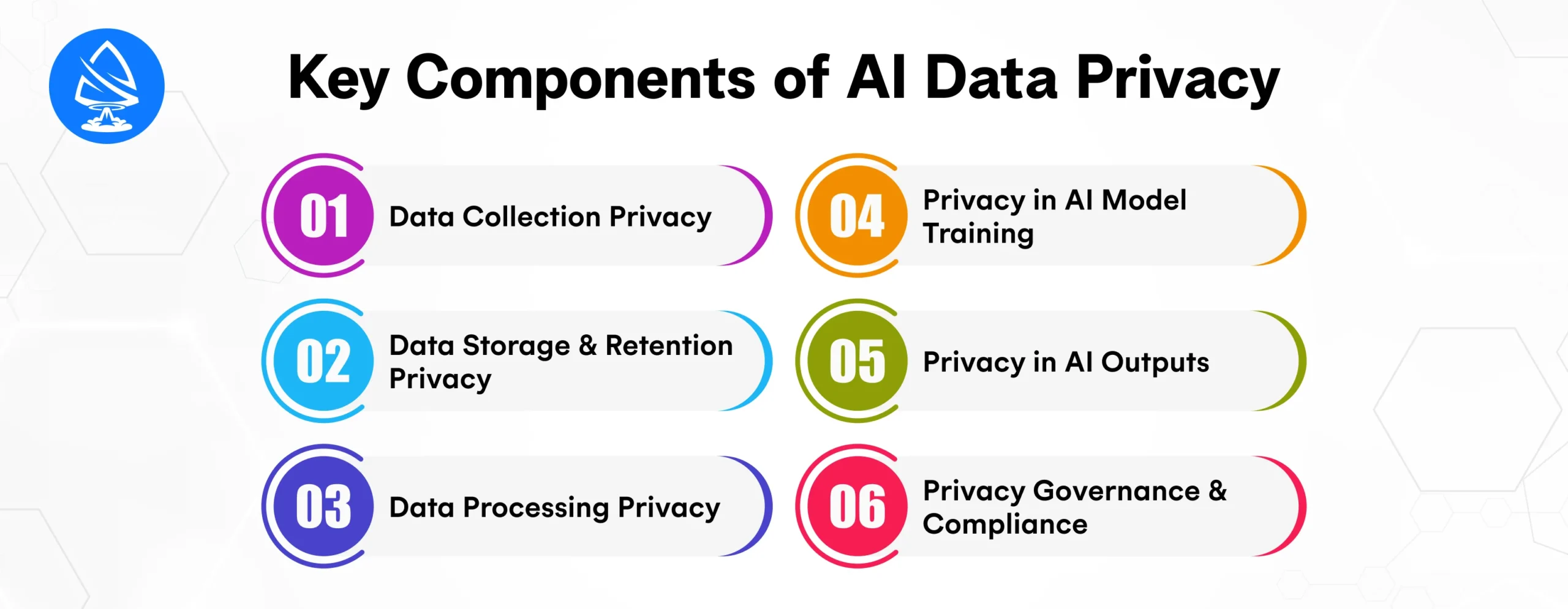
Protecting users during the stage where AI systems gather data.
AI should not collect more than it needs. This is known as data minimization.
Once data is collected, organizations must ensure it is stored securely.
AI should not store data indefinitely unless justified.
AI systems must process data in a secure and compliant manner.
AI training data often contains sensitive personal or corporate information.
AI systems sometimes reveal private data through their responses.
AI Data Privacy focuses on preventing such leaks.
This includes policies, audits, documentation, and meeting legal requirements.
Organizations must align their AI data practices with global privacy laws.
AI adoption is now mainstream across industries, including healthcare, finance, education, logistics, retail, and government. As AI becomes deeply integrated into daily operations, data flows grow exponentially.
AI without privacy controls is a liability that can destroy trust and expose businesses to risks.
As businesses across the USA adopt AI in customer service, marketing, HR, finance, healthcare, and product development, one issue has become unavoidable: AI introduces entirely new data privacy risks that traditional security strategies were never designed to handle. AI systems collect massive volumes of sensitive information, make autonomous decisions, and learn from user behavior, creating blind spots that can easily lead to privacy violations if not managed properly.
Below are the major AI Data Privacy challenges every organization must understand in 2026.
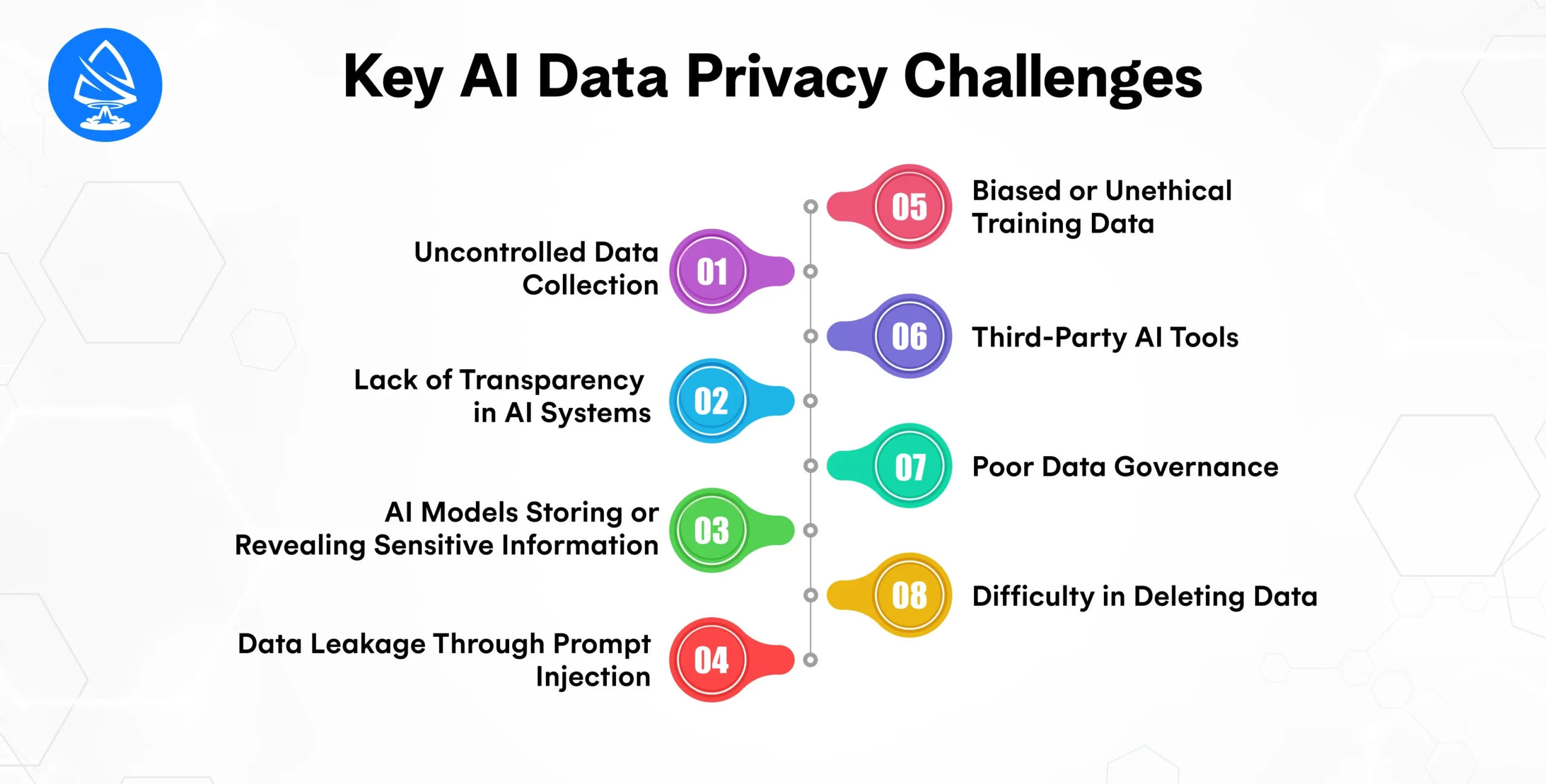
AI models perform better with more data, which encourages companies to collect huge datasets, often far beyond what is necessary.
An AI chatbot collects chat logs, metadata, customer identifiers, and behavioral patterns, even when only a small part of that is needed.
Most AI models operate as “black boxes.” Users don’t understand what data is being collected, how it’s used, or how decisions are made.
Lack of transparency weakens trust and violates privacy regulations.
LLMs and other AI models sometimes memorize parts of training data. This can lead to accidental disclosure during inference.
This challenge is one of the most dangerous AI privacy risks today.
AI can be tricked into exposing private training data or system instructions using crafted prompts.
Attackers exploit vulnerabilities in natural language instructions to force the model to leak sensitive data.
AI systems trained on unfiltered or poor-quality data absorb harmful patterns.
Biased AI exposes sensitive personal traits and creates discriminatory profiling.
Companies increasingly use external AI APIs, SaaS tools, and cloud platforms.
This creates shadow AI systems outside the company’s governance.
Most businesses do not have dedicated AI governance frameworks.
Weak governance leads to unintentional privacy breaches.
AI models trained on personal data may retain patterns or features that cannot simply be “deleted,” even if the user requests it.
This makes regulatory compliance difficult.
May you also want to know Hire Developers
Poor AI Data Privacy exposes businesses to severe legal, financial, ethical, and operational threats. Because AI systems collect massive volumes of sensitive information, customer data, behavioral patterns, employee records, health details, and financial transactions, any mismanagement can cause long-lasting damage. In 2026, privacy failures are more dangerous than traditional cybersecurity issues because AI models can unintentionally expose, infer, or misuse sensitive data in ways organizations may not fully understand.
Below are the most critical risks businesses face when AI privacy is poorly implemented.
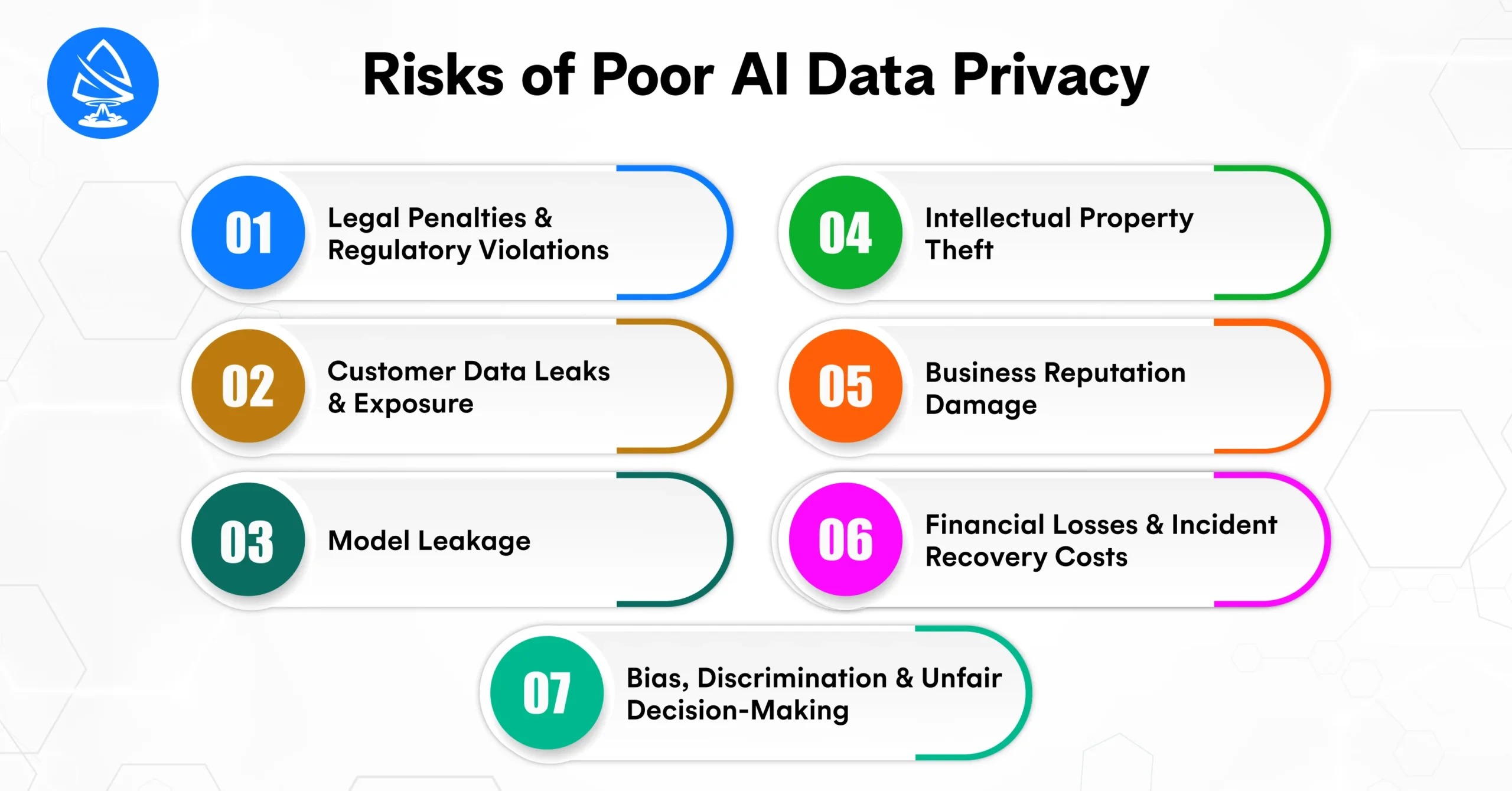
Global privacy laws are strict, and AI introduces new complexities that many companies overlook.
Businesses that mishandle data, even unintentionally, face serious consequences.
AI systems store or process:
A leak involving any of this information destroys trust instantly.
One of the most dangerous AI risks today: AI models can memorize parts of the training data and accidentally repeat them.
This type of leak is difficult to detect and almost impossible to reverse.
AI models may leak:
Losing IP can destroy competitive advantage.
A privacy failure becomes public news fast, especially when AI is involved.
Many small businesses never recover from a major data breach.
A breach caused by poor AI privacy can lead to massive expenses.
For some organizations, the financial impact can be fatal.
Poorly protected data often means poorly curated or biased data. AI systems may reveal personal information or make harmful assumptions.
Bias happens because training data may contain sensitive correlations. This violates both ethical and legal privacy requirements.
Artificial Intelligence systems are only as powerful as the data they are trained on. To understand user behavior, generate predictions, improve accuracy, and automate tasks, AI models rely on collecting, processing, analyzing, and learning from massive datasets. But this data collection isn’t always obvious to users, which is why understanding how AI gathers and uses your data is essential for protecting privacy.
Below is a complete breakdown of every stage where AI interacts with data and how that information is used.
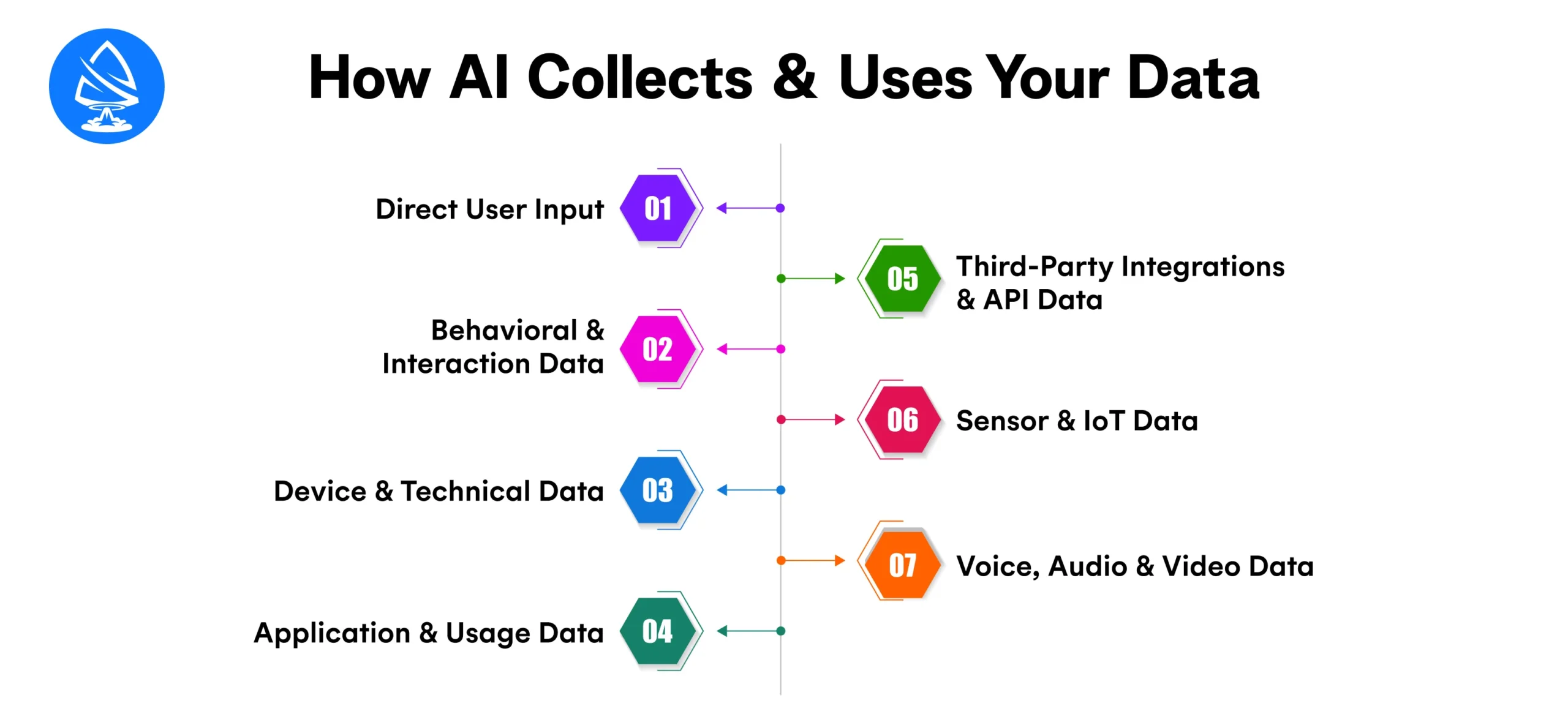
This is the data users intentionally provide when interacting with AI systems.
This is the core data that fuels most AI applications.
AI systems track how users behave within apps, websites, and digital tools.
This type of data powers recommendation systems like Netflix, Amazon, Spotify, and more.
AI systems automatically collect metadata from devices.
This data helps AI systems understand the user’s environment.
AI tools embedded in software systems collect ongoing usage metrics.
This data helps AI tools become smarter with time.
Many AI systems rely on third-party tools, plugins, and API connections.
Risk: Third-party AI tools may store or share your data without clear transparency.
Smart devices generate continuous streams of data used by AI.
This data is extremely sensitive and must be protected carefully.
AI-driven systems like voice assistants, CCTV analytics, and video editors process multimedia content.
This type of data is among the most sensitive and heavily regulated.
As AI becomes deeply integrated into business operations, the need for robust data protection increases exponentially. AI systems process huge volumes of sensitive information, including personal details, behavioral patterns, financial data, and internal business records. Without proper safeguards, this data becomes vulnerable to misuse, leakage, hacking, and regulatory violations.
Adopting AI-specific data protection best practices ensures your AI systems remain secure, ethical, compliant, and trustworthy. Below are the essential methods every organization should implement in 2026.
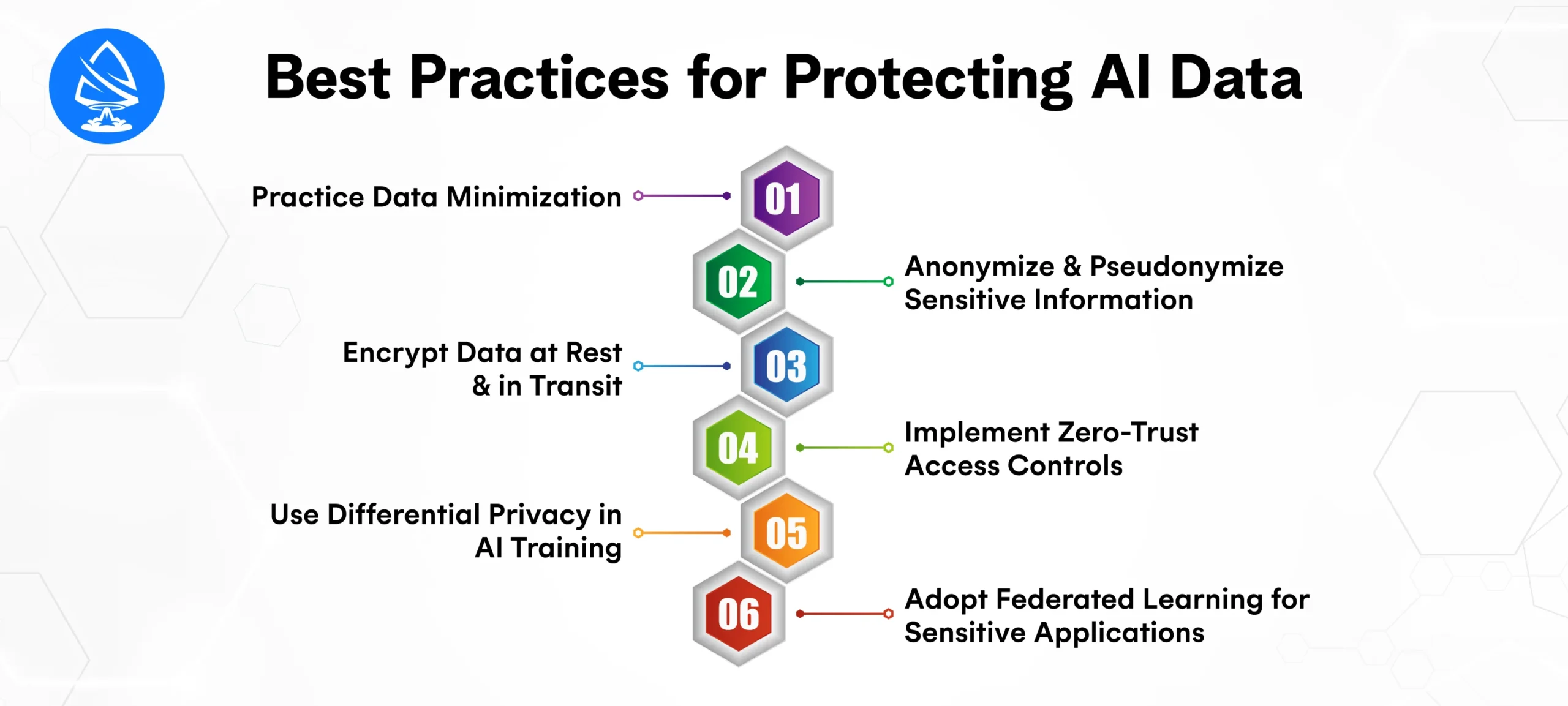
One of the most effective privacy measures is reducing the amount of data collected.
Less data = less risk.
Before using data to train or run AI systems, personal identifiers should be removed or masked.
Anonymized data is far less risky and often exempt from strict regulations.
Encryption is non-negotiable for modern AI systems.
Protects data stored in:
Secures data moving through:
Using standards like TLS 1.3, AES-256, and encrypted APIs ensures that attackers cannot intercept or decode sensitive information.
AI systems often expose multiple endpoints and integration layers. Zero-trust means never trust, always verify.
Only authorized users and services should interact with AI systems.
Differential privacy adds carefully calculated noise to training data so the AI model cannot reveal individual user information.
Differential privacy is one of the strongest defenses against inference attacks.
Federated learning allows AI models to train without centralizing raw data.
This approach drastically reduces the risk of central data breaches.
Use these pillars to architect privacy-focused AI systems.
Embed privacy from the first stage, not as an afterthought.
Keep personal data separated from training data pipelines.
Train models on-device or in distributed systems without sending raw data to servers.
Add mathematical noise so the model can’t reveal personal information.
Reduce cloud data transfers by processing data locally.
AI operates on encrypted data without ever seeing the original content.
These methods create a privacy-strong AI system that protects users at every stage.
In 2026, governments worldwide have introduced strict measures around AI.
Businesses must treat compliance as a priority, not an obstacle.
Here are the cutting-edge techniques helping businesses protect AI data:
Prevents models from revealing individual data.
Keeps data decentralized and secure.
Encrypts data even during processing.
AI creates safe, artificial data for training models.
Allows multiple parties to work on shared data without exposing it.
Replaces sensitive elements with random identifiers.
These methods form the foundation of ethical and compliant AI systems.
Building a strong AI privacy strategy is no longer optional; it’s a necessity for every business using AI tools, machine learning models, or large datasets. With strict regulations, rising consumer expectations, and increasing risks of data leaks, companies must adopt a structured, organization-wide approach to privacy. A privacy strategy ensures AI systems stay compliant, secure, and trustworthy while minimizing legal and operational risks.
Below is a step-by-step framework that any small business, enterprise, or startup can use to build a practical, scalable, and future-ready AI privacy strategy.
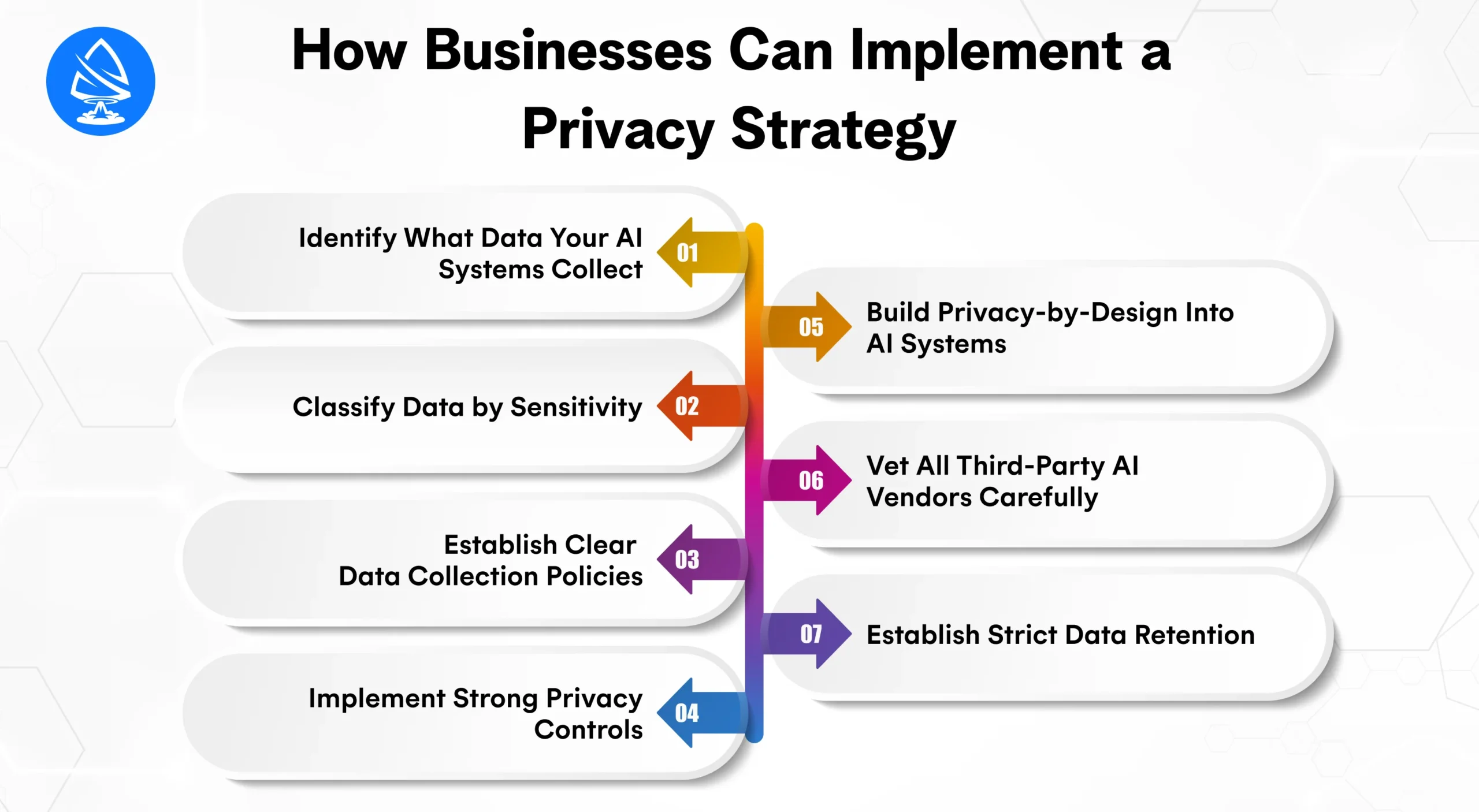
The first step is understanding what data enters your AI ecosystem.
You cannot protect what you do not know you have. Accurate mapping helps eliminate unnecessary collection and avoid shadow data.
Not all data carries the same privacy risk. Classifying data helps determine how strict your protection policies should be.
Each category gets its own handling rules, retention period, and security requirements.
A privacy strategy must explicitly state:
This eliminates ambiguity and prevents over-collection.
Privacy must be embedded across every stage of the AI lifecycle.
These controls protect your AI system from internal and external threats.
This means integrating strong privacy protections from day one, not as an afterthought.
If AI is built with privacy in mind, future risks and compliance issues are drastically reduced.
Most businesses use AI tools from external providers. These tools may collect or store your data.
Any vendor with weak privacy practices becomes a direct risk to your business.
AI systems often store logs, prompts, datasets, and feedback longer than necessary.
Shorter retention = smaller attack surface.
Working with a trusted artificial intelligence development company in USA provides major advantages.
A skilled Artificial Intelligence Developer ensures your AI systems remain secure, ethical, scalable, and compliant.
As businesses integrate AI into their operations, the importance of AI Data Privacy becomes impossible to ignore. Every piece of data flowing through an AI model must be handled with responsibility, transparency, and precision. Whether you’re a small business owner adopting AI tools or a large enterprise building AI-powered applications, data protection must become a strategic priority, not just a technical one.
Protecting customer information builds trust. Ensuring privacy compliance reduces legal risk. Eliminating data leaks safeguards your brand’s reputation. And adopting privacy-preserving technologies prepares your business for the future of AI.
Working with an experienced artificial intelligence development company in USA can help you navigate these complexities with confidence. From designing secure AI systems to implementing encrypted pipelines and ensuring regulatory compliance, the right partner ensures your AI systems are ethical, safe, and future-ready.
Want to understand the cost of building secure, privacy-focused AI solutions? Use our AI Project Cost Calculator to get instant and accurate pricing estimates.
1. What is AI Data Privacy?
AI Data Privacy protects personal and sensitive data used in AI systems through policies, encryption, and responsible practices.
2. Why is AI data collection risky?
AI often collects large volumes of data, increasing the chance of leaks, misuse, or unauthorized access.
3. What are common AI privacy issues?
Data leakage, model inversion, bias, excessive data collection, and weak access controls.
4. How can businesses protect AI data?
Use encryption, anonymization, access control, audits, and privacy-first AI architecture.
5. What is differential privacy?
A technique that adds noise to data, preventing models from revealing personal information.
6. Are third-party AI tools safe?
Only if vetted for compliance; many tools create shadow data risks.
7. Why is transparency important in AI?
Users must know how their data is used to maintain trust and meet regulatory requirements.
8. Can small businesses afford AI security?
Yes, AI security tools are becoming more accessible, and partnering with experts reduces cost and risk.

Artoon Solutions
Artoon Solutions is a technology company that specializes in providing a wide range of IT services, including web and mobile app development, game development, and web application development. They offer custom software solutions to clients across various industries and are known for their expertise in technologies such as React.js, Angular, Node.js, and others. The company focuses on delivering high-quality, innovative solutions tailored to meet the specific needs of their clients.
 For business inquiries only