- HR:+91-879-9184-787
- Sales:+91-908-163-7774


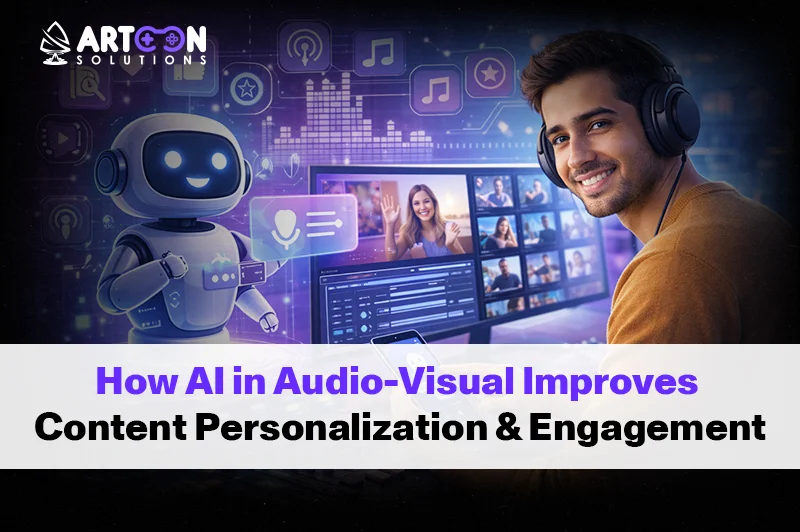
Digital content consumption has entered a new era. Audiences no longer want generic videos, static audio, or one-size-fits-all experiences. They expect content that adapts to their preferences, language, behavior, and context instantly and seamlessly. From streaming platforms and e-learning apps to marketing campaigns and enterprise communication tools, personalization has become the deciding factor between engagement and abandonment.
This is where AI in Audio-Visual technology is creating a fundamental shift. By combining artificial intelligence with audio and video processing, businesses can now understand, generate, adapt, and personalize content at scale. AI can analyze speech, facial expressions, viewing behavior, and engagement signals in real time, then use that intelligence to deliver hyper-personalized audio-visual experiences.
For founders, CTOs, product managers, and enterprise decision-makers, AI-driven audio-visual systems are no longer experimental innovations. They are strategic assets that directly impact user engagement, retention, accessibility, and monetization. Backed by advanced AI development services, these systems enable businesses to move faster from concept to scalable deployment. In this in-depth guide, we’ll explore how AI in audio-visual works, the technologies behind it, real-world use cases, benefits, challenges, and how organizations can implement it successfully to create meaningful, personalized content experiences.
Audio-visual content refers to any form of media that combines sound (audio) and visual elements (video or imagery) to communicate information, tell stories, educate audiences, or entertain users. By engaging both hearing and sight simultaneously, audio-visual content creates richer, more immersive experiences compared to text-only formats.
Below are the key sub-points that explain audio-visual content in detail.
Audio-visual content integrates sound and visuals into a single experience.
Core components include:
This combination enhances comprehension and emotional impact.
Audio-visual content appears across multiple digital and physical formats.
Examples include:
These formats dominate modern content consumption.
Audio-visual content is used to achieve specific goals.
Common purposes:
Its versatility makes it valuable across industries.
Audio-visual formats naturally attract attention.
Why it works:
This explains the growing reliance on audio-visual media.
Audio-visual content is central to digital platforms.
Where it is used:
Its importance increases when enhanced by AI in Audio-Visual systems.
Audio-visual content has evolved.
How it has changed:
Modern audio-visual content is increasingly powered by intelligent systems.
You may also want to know AI in Market Research
AI in Audio-Visual refers to the application of artificial intelligence technologies such as machine learning, natural language processing, speech recognition, computer vision, and generative AI to analyze, enhance, generate, and personalize audio and video content. Instead of static media experiences, AI enables audio-visual systems to understand context, user behavior, and content meaning, then adapt dynamically in real time.
Below are the key sub-points that explain AI in Audio-Visual in detail.
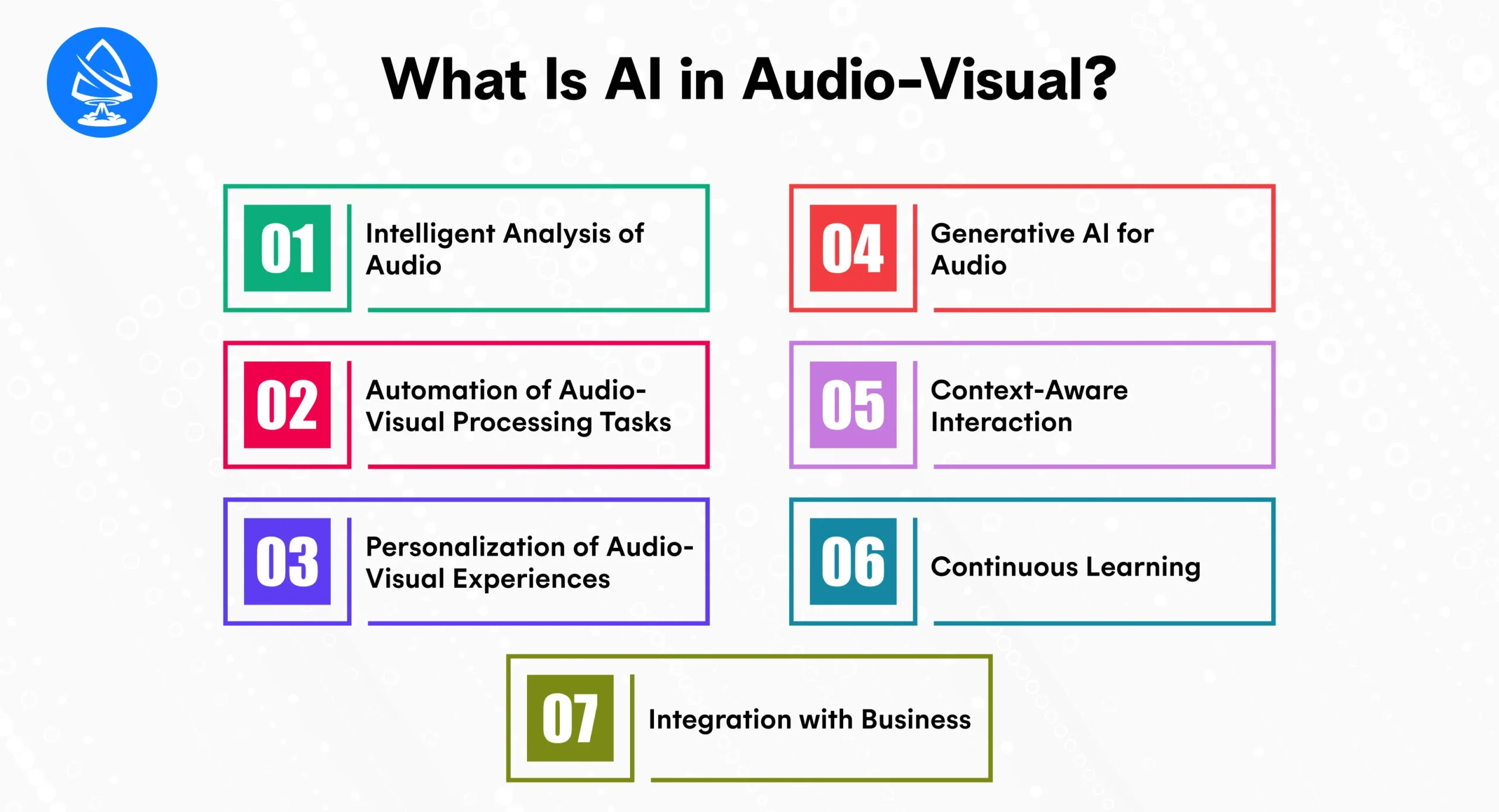
AI gives audio-visual systems the ability to “understand” media.
What AI analyzes:
This intelligence forms the foundation of modern audiovisual intelligence.
AI automates time-consuming AV workflows.
What AI automates:
Automation improves speed, accuracy, and scalability.
AI adapts content to individual users.
How personalization works:
Personalization is a core benefit of AI in Audio-Visual.
AI can create new audio-visual content dynamically.
Key capabilities include:
This reduces production costs and accelerates content creation.
AI enables responsive, interactive media.
Examples include:
Real-time intelligence enhances engagement and usability.
AI audio-visual systems improve over time.
How learning happens:
This self-improving nature differentiates AI in Audio-Visual from traditional AV systems.
AI-driven AV systems are embedded across industries.
Where they are used:
Integration turns AI audio-visual capabilities into business value.
Why AI Is Transforming Audio-Visual Content comes down to its ability to make media intelligent, adaptive, and deeply personalized at scale. Traditional audio-visual systems deliver the same content to every user, while AI in Audio-Visual enables real-time understanding, customization, and optimization of audio and video experiences. Below are the key reasons driving this transformation.
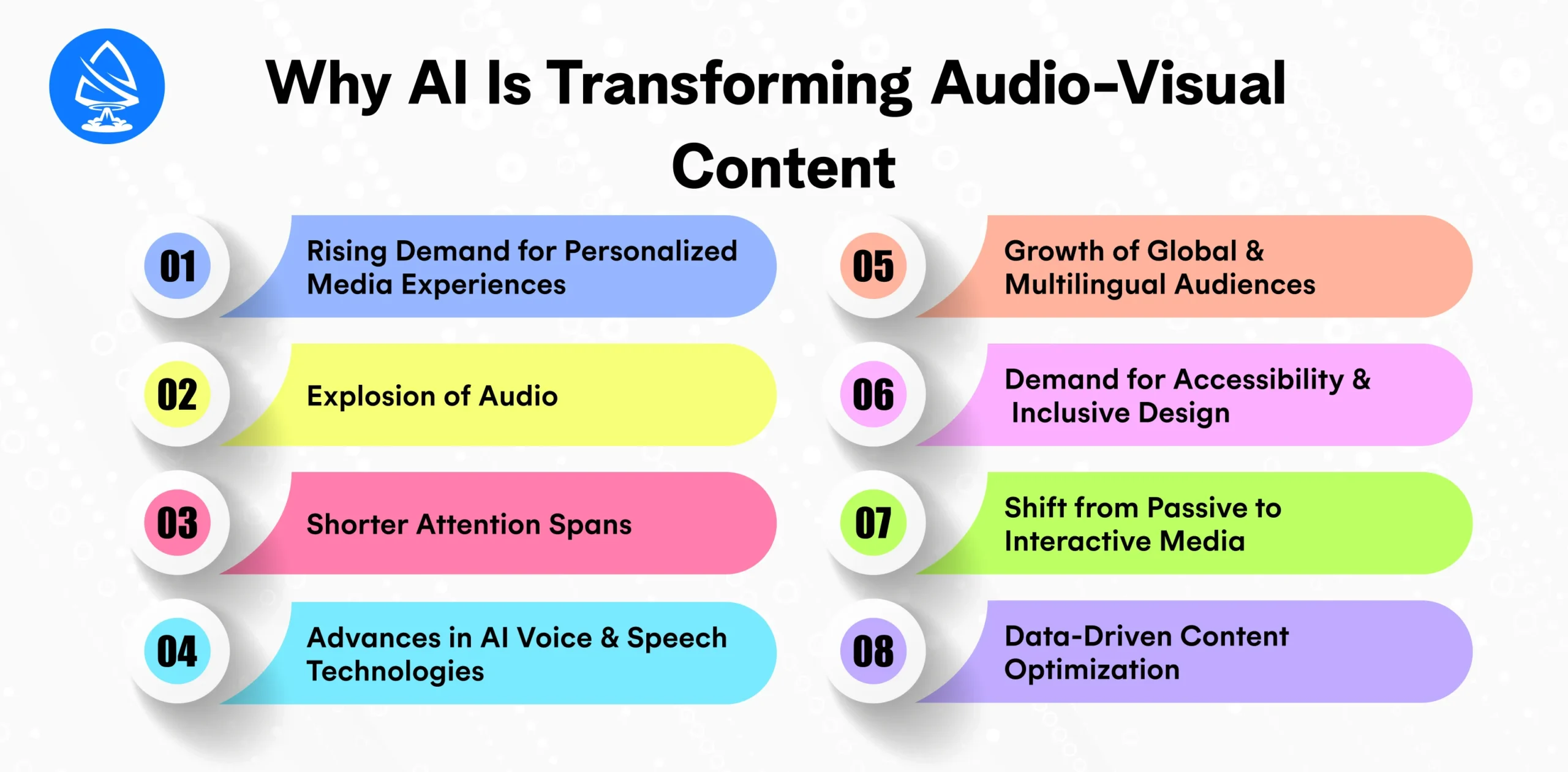
Audiences expect content tailored to their preferences.
Why this matters:
AI enables individualized audio-visual delivery at scale.
Digital platforms generate massive volumes of AV content.
Why this matters:
AI automates analysis, tagging, and recommendation of audio-visual content.
Capturing attention has become harder than ever.
Why this matters:
AI optimizes content flow and presentation to maintain attention.
Speech AI has reached human-like quality.
Why this matters:
These advances power scalable audio personalization.
Content now reaches worldwide audiences.
Why this matters:
AI enables instant translation, dubbing, and captioning.
Accessibility is no longer optional.
Why this matters:
AI makes audio-visual content accessible by default.
Users want interactive and responsive experiences.
Why this matters:
AI in Audio-Visual enables intelligent, interactive media.
Content performance must be measurable and improvable.
Why this matters:
This creates a feedback loop for smarter content strategies.
How AI in Audio-Visual works can be understood as a multi-stage pipeline that captures audio and video data, interprets it using intelligent models, personalizes outputs in real time, and continuously improves through feedback. Instead of static playback, AI in Audio-Visual systems analyzes context, behavior, and content meaning to deliver adaptive, engaging experiences. Below are the key sub-points.
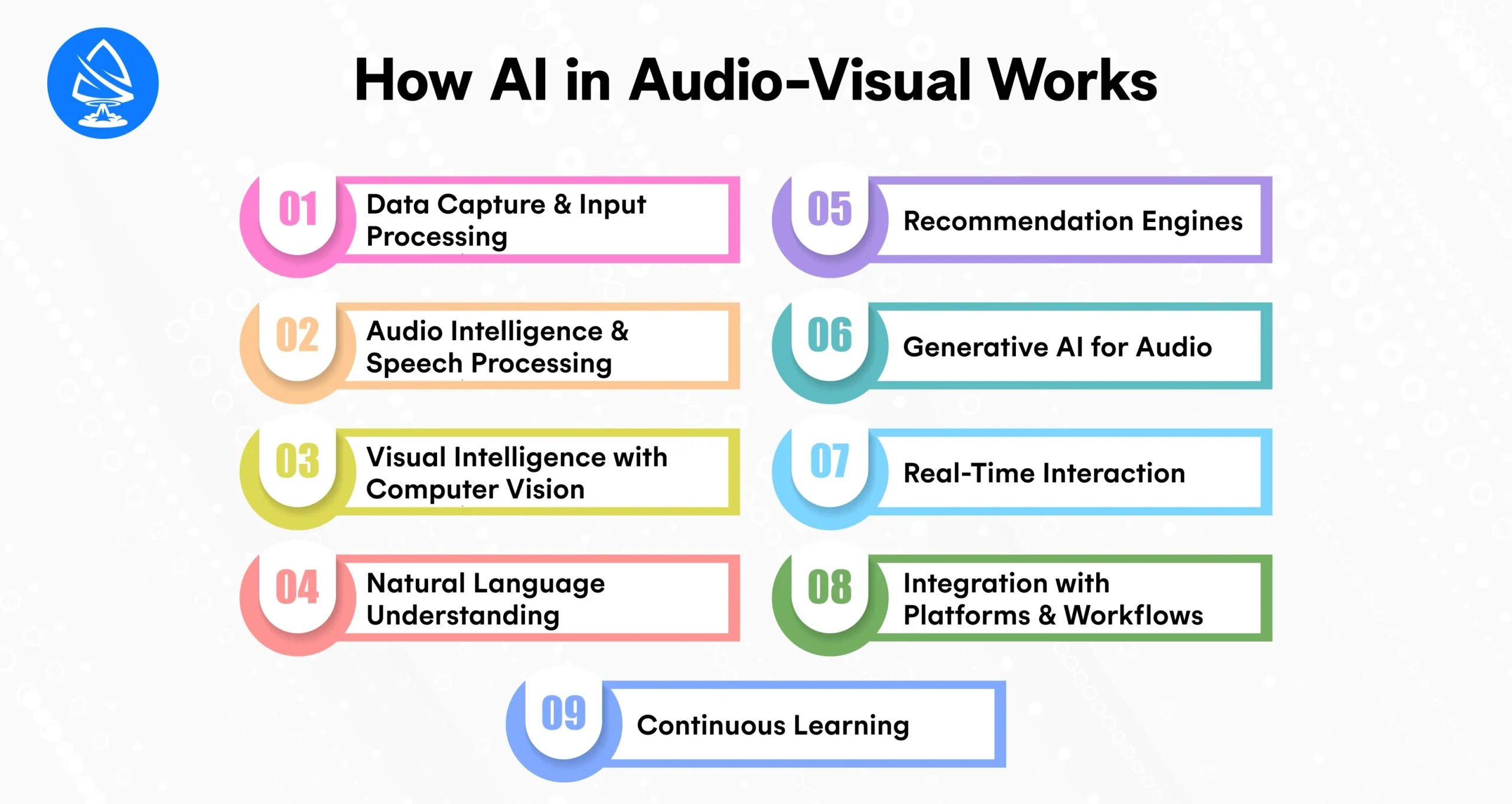
AI systems begin by ingesting raw audio-visual inputs.
Inputs include:
This comprehensive intake enables contextual understanding.
AI interprets and enhances audio signals.
Core capabilities:
These functions support use cases like AI note-taking and voice analytics.
Computer vision enables machines to “see” and interpret visuals.
What AI analyzes:
Visual intelligence powers engagement tracking and content tagging.
NLU helps AI understand meaning and intent.
How it’s used:
This connects audio and visuals to semantic understanding.
AI adapts content for each user.
Personalization actions include:
Personalization is central to AI in Audio-Visual engagement gains.
AI can generate new media dynamically.
Key capabilities:
Generative AI accelerates production and localization at scale.
AI systems respond instantly to context and behavior.
Examples:
Real-time intelligence enhances usability and immersion.
AI outputs must drive action.
Where integration happens:
Integration ensures insights and personalization are applied operationally.
AI improves with ongoing feedback.
How learning happens:
This feedback loop keeps AI in Audio-Visual accurate and relevant.
Convert speech to text and back naturally.
Understand visual elements and human behavior.
Detect patterns and predict preferences.
Create realistic voices, audio, and video.
Combine multiple AI capabilities into unified platforms.
Platforms recommend and adapt content dynamically.
Brands generate localized voiceovers at scale using AI voice generator free tools or enterprise solutions.
AI adapts lessons based on learner pace and comprehension.
AI transcribes, summarizes, and highlights key moments.
AI adjusts visuals and messaging in real time.
AI enables captions, translations, and voice assistance.
Personalized audio and visuals resonate emotionally.
Users consume information more easily.
AI-driven recommendations keep users engaged.
Voice tone and visual cues enhance storytelling.
The benefits of AI in Audio-Visual are transforming how organizations create, deliver, and optimize media experiences. By combining audio and video intelligence with personalization and automation, AI in Audio-Visual enables deeper engagement, greater efficiency, and scalable innovation. Below are the key benefits explained with clear sub-points.
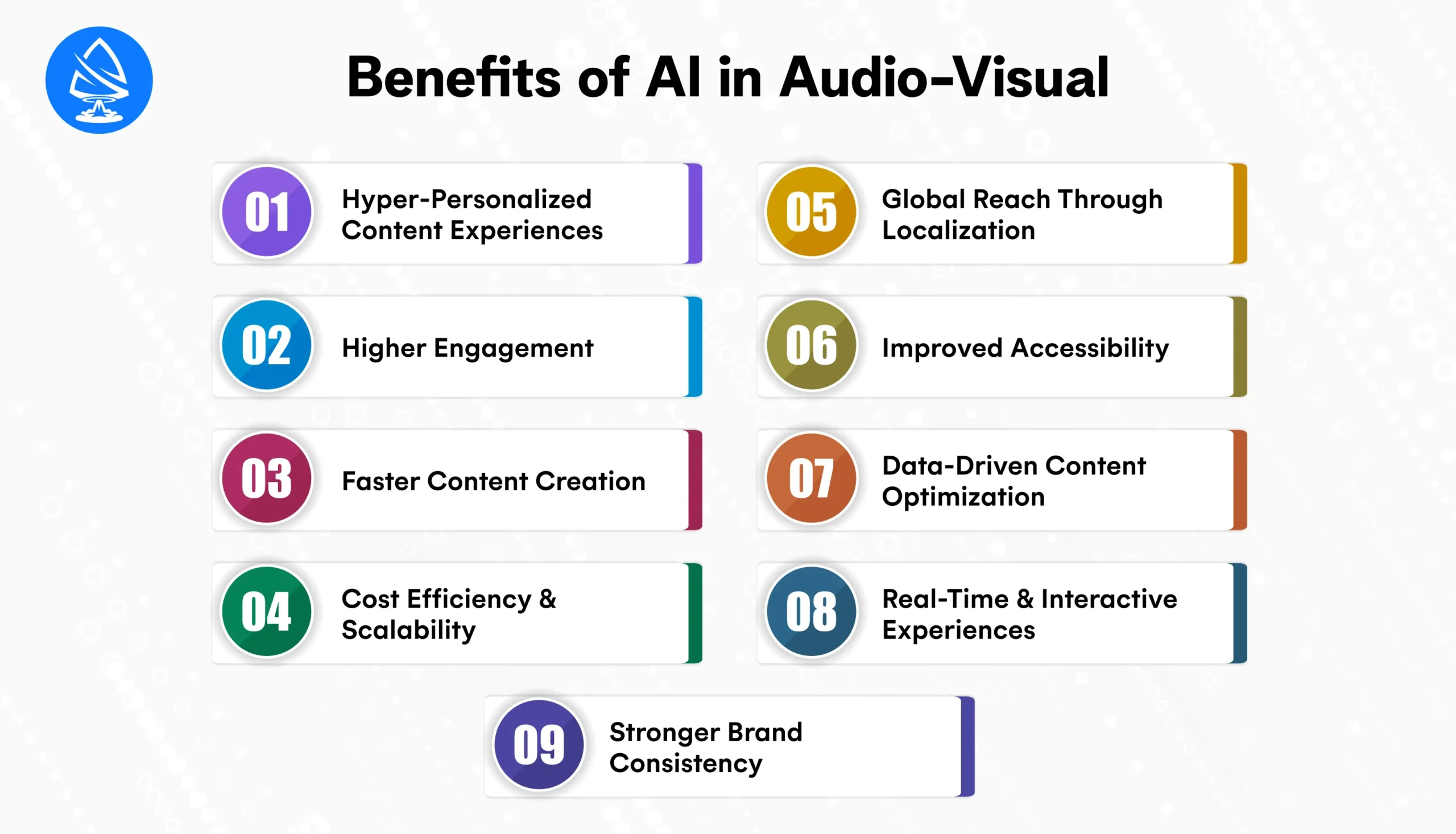
AI adapts audio-visual content to individual users.
How this helps:
Personalization drives a stronger emotional connection and engagement.
AI delivers content that feels more relevant and timely.
How this helps:
Engagement improvement is a core benefit of AI in Audio-Visual.
AI automates time-intensive AV tasks.
How this helps:
Speed and efficiency improve time-to-market.
AI reduces production and localization costs.
How this helps:
Cost savings make advanced AV experiences accessible.
AI removes language barriers.
How this helps:
Localization expands audience reach and inclusivity.
AI enhances accessibility by default.
How this helps:
Accessibility improves usability for all users.
AI learns what works and improves content continuously.
How this helps:
Data-driven optimization increases long-term performance.
AI enables responsive media.
How this helps:
Real-time intelligence boosts immersion.
AI standardizes audio-visual output.
How this helps:
Consistency strengthens brand identity at scale.
| Aspect | Traditional AV | AI in Audio-Visual |
| Personalization | Static | Dynamic |
| Scalability | Limited | Massive |
| Engagement | Passive | Interactive |
| Adaptability | Manual | Automated |
| Intelligence | None | Context-aware |
While the advantages are significant, the challenges of AI in Audio-Visual must be addressed carefully to ensure ethical, reliable, and scalable implementation. These challenges span technology, data, governance, and user trust. Below are the key challenges explained with clear sub-points.
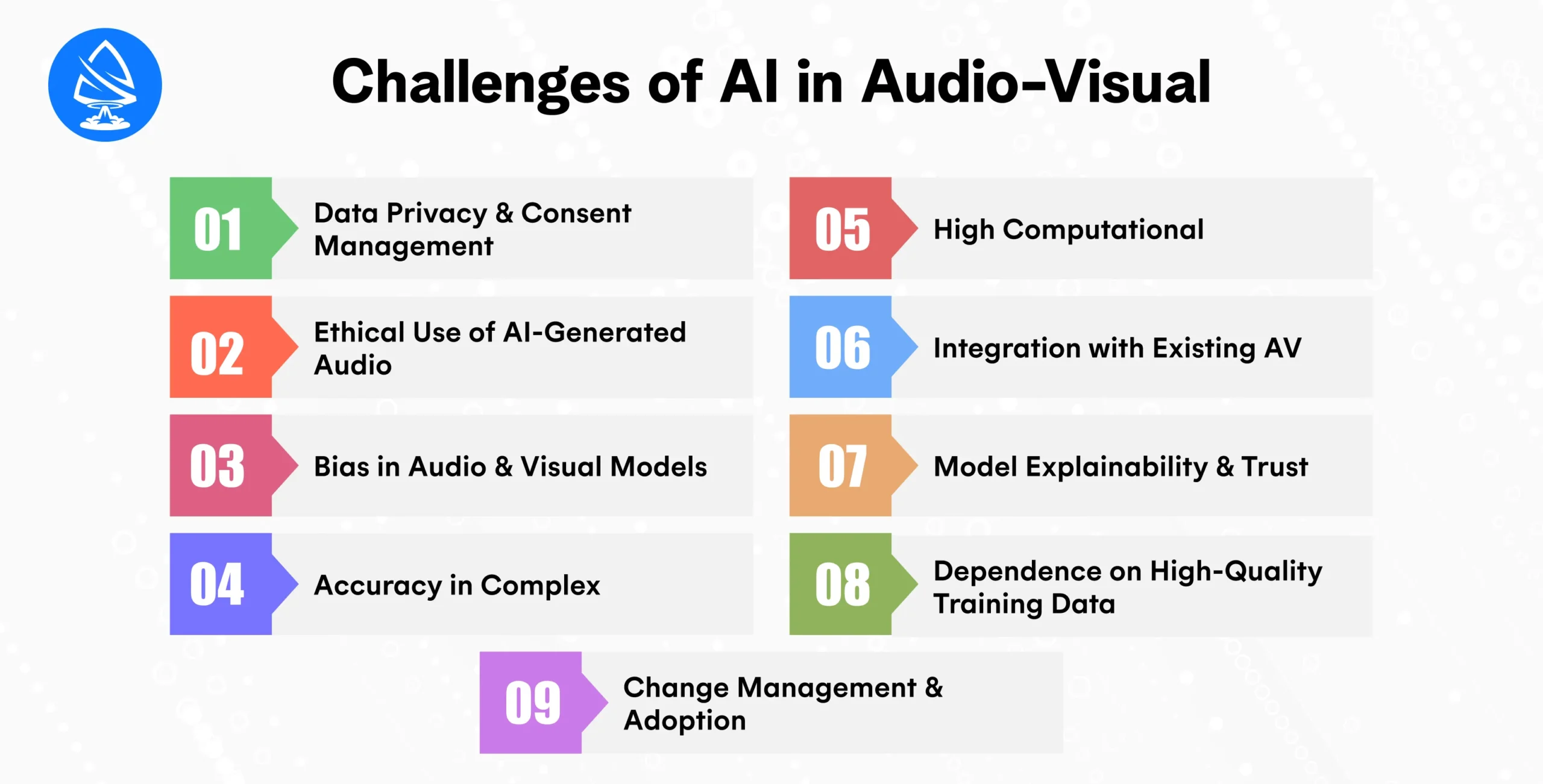
Audio and video data often contain sensitive personal information.
Why this is a challenge:
Strong data governance is critical for AI in Audio-Visual systems.
Generative AI raises authenticity concerns.
Why this is a challenge:
Ethical safeguards and transparency are essential.
AI models can inherit bias from training data.
Why this is a challenge:
Bias monitoring is a key requirement for responsible AI in Audio-Visual.
Real-world audio-visual data is unpredictable.
Why this is a challenge:
Robust model training and preprocessing are needed.
AI audio-visual processing is resource-intensive.
Why this is a challenge:
Cost optimization and efficient architecture are critical.
AI must fit into current workflows.
Why this is a challenge:
Seamless integration determines real-world success.
AI decisions can be difficult to interpret.
Why this is a challenge:
Transparent design builds trust in AI in Audio-Visual outputs.
Model performance relies on data diversity and quality.
Why this is a challenge:
An ongoing data strategy is essential.
Technology alone does not guarantee success.
Why this is a challenge:
Training and stakeholder alignment are critical.
You may also want to know Web App vs Cloud App
Implementing AI in Audio-Visual successfully requires a strategic blend of business clarity, the right technology choices, strong data practices, and organizational alignment. Companies that treat AI-powered audio-visual capabilities as a long-term platform rather than a one-off tool can deliver scalable personalization and sustained engagement. Below are the key sub-points that define successful implementation.
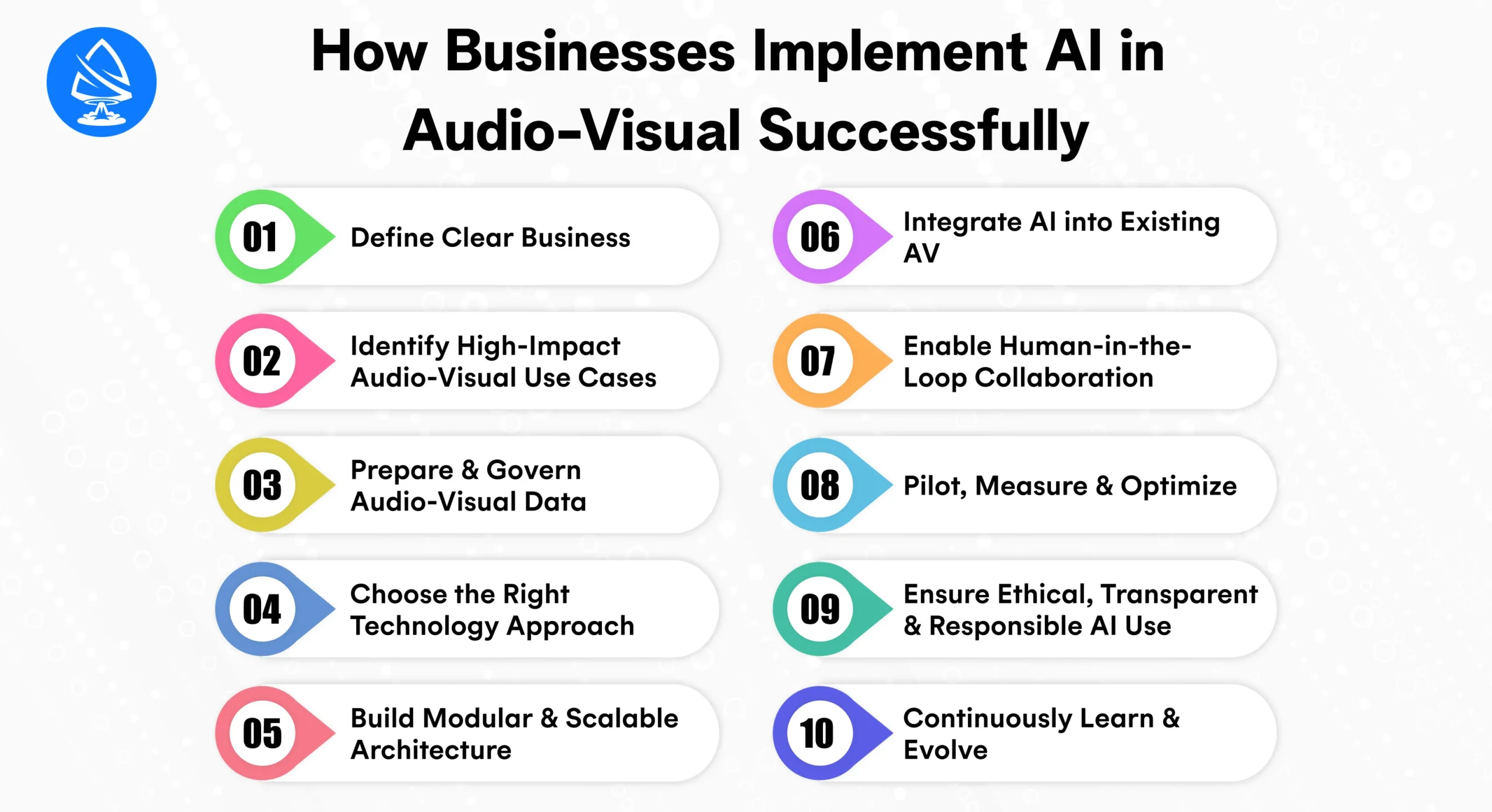
Successful implementations start with purpose.
What businesses do:
Clear objectives guide every decision in AI in Audio-Visual adoption.
Not all AV processes need AI at once.
What businesses do:
Targeted use cases accelerate early success.
Data quality determines AI performance.
What businesses do:
Strong data governance is essential for AI in Audio-Visual systems.
Technology strategy shapes scalability.
What businesses do:
The right approach balances speed, control, and cost.
AI AV systems must scale smoothly.
What businesses do:
Scalability supports growth and experimentation.
AI insights must drive action.
What businesses do:
Integration ensures AI in Audio-Visual delivers real value.
Human expertise enhances AI outcomes.
What businesses do:
This balance builds trust and quality.
Start small, then scale.
What businesses do:
Measured success justifies broader rollout.
Trust underpins adoption.
What businesses do:
Ethical practices protect brand reputation.
AI AV systems must adapt over time.
What businesses do:
Continuous improvement keeps AI in Audio-Visual effective and competitive.
Key metrics include:
AI in Audio-Visual is redefining how content is created, delivered, and experienced. By combining audiovisual intelligence with personalization engines and generative technologies, businesses can engage users more deeply, communicate more effectively, and scale content strategies globally. What was once static media is now adaptive, interactive, and emotionally intelligent.
Organizations that embrace AI-driven audio-visual systems gain a powerful advantage: higher engagement, stronger retention, and more inclusive experiences. The key lies in thoughtful implementation, ethical governance, and continuous optimization.
If you’re planning to adopt AI in audio-visual content and want clarity on investment, scope, and expected ROI, use our AI App Cost Calculator to evaluate your next step toward smarter, more engaging content experiences.
1. What is AI in audio-visual?
It applies AI to analyze, generate, and personalize audio and video content.
2. How does AI improve engagement?
By delivering content tailored to individual preferences and context.
3. Are AI voice generators realistic?
Yes, modern AI voice generator tools sound highly natural.
4. Is AI audio-visual expensive?
Costs vary, but ROI is often strong.
5. Can AI improve accessibility?
Yes, through captions, translations, and voice assistance.
6. Does AI replace human creators?
No, it augments creativity and efficiency.
7. Is AI AV secure?
With proper governance and compliance, yes.
8. Who should adopt AI in audio-visual?
Media companies, educators, marketers, and enterprises.

Artoon Solutions
Artoon Solutions is a technology company that specializes in providing a wide range of IT services, including web and mobile app development, game development, and web application development. They offer custom software solutions to clients across various industries and are known for their expertise in technologies such as React.js, Angular, Node.js, and others. The company focuses on delivering high-quality, innovative solutions tailored to meet the specific needs of their clients.
 For business inquiries only