- HR:+91-879-9184-787
- Sales:+91-908-163-7774


Augmented Reality has moved far beyond novelty filters and experimental demos. In 2026, AR is becoming a core interface for how people learn, shop, work, and interact with digital systems. What’s accelerating this shift is the deep integration of artificial intelligence. AI in Augmented Reality is transforming static overlays into intelligent, context-aware, and adaptive experiences that understand users, environments, and intent in real time.
For businesses, this convergence unlocks entirely new product categories and revenue streams. AI-powered AR applications can recognize objects, understand spatial environments, personalize experiences, predict user behavior, and automate decision-making inside immersive interfaces. From enterprise training and remote assistance to retail, healthcare, and industrial operations, AI-driven AR is moving into production at scale.
For founders, CTOs, and product leaders, 2026 is a defining year. Hardware maturity, edge computing, computer vision breakthroughs, and generative AI are aligning to make AI-powered AR commercially viable. This roadmap breaks down where the market is heading, what technologies matter most, and how organizations can build future-ready augmented reality AI applications that deliver real business value.
AI in Augmented Reality refers to the integration of artificial intelligence technologies into AR systems to create intelligent, context-aware, and adaptive experiences that interact seamlessly with the real world. Traditional AR overlays static digital elements onto physical environments, while AI-powered AR understands surroundings, recognizes objects, interprets user intent, and dynamically adjusts content in real time.
By combining computer vision, machine learning, spatial intelligence, and generative AI, AI-driven AR applications move beyond visuals to deliver decision-making, personalization, and automation directly within immersive environments. Many organizations work with an AI app development company to design AR solutions that are not only visually engaging but also operationally intelligent and scalable.
AI enables AR systems to identify objects, surfaces, faces, gestures, and environments in real time. This allows digital content to be accurately placed and to interact naturally with physical surroundings, forming the foundation of intelligent AR experiences.
AI-powered spatial mapping helps AR applications understand depth, scale, and spatial relationships. This ensures virtual objects behave realistically within physical spaces, supporting use cases like navigation, training, and industrial guidance.
AI analyzes user behavior, location, and environmental context to deliver personalized AR content. This makes interactions more relevant and adaptive, improving engagement and usability. Many businesses rely on artificial intelligence development services to implement personalization at scale.
AI in AR can provide real-time instructions, alerts, and recommendations based on what the system sees and understands. This is especially valuable in enterprise scenarios such as maintenance, healthcare, and field service operations.
Generative AI enables AR systems to create content on demand, such as instructions, simulations, or visual explanations. This reduces development time and allows AR applications to adapt instantly to new scenarios.
AI enhances AR interfaces with voice recognition and gesture control, allowing users to interact naturally without traditional input devices. This hands-free interaction is critical for productivity-focused AR applications.
AI-powered AR is designed to augment human capabilities rather than replace them. It supports users with intelligence and insights while humans retain control over decisions. To build such advanced systems, many organizations hire AI developers with expertise in computer vision, spatial computing, and AR frameworks.
You may also want to know AI in Inventory Management
The year 2026 marks a turning point for AI in Augmented Reality as multiple technological, commercial, and enterprise trends converge at scale. What was experimental just a few years ago is now production-ready, cost-effective, and strategically important for businesses. Below are the key reasons why 2026 stands out as a breakthrough year for AI-powered AR.
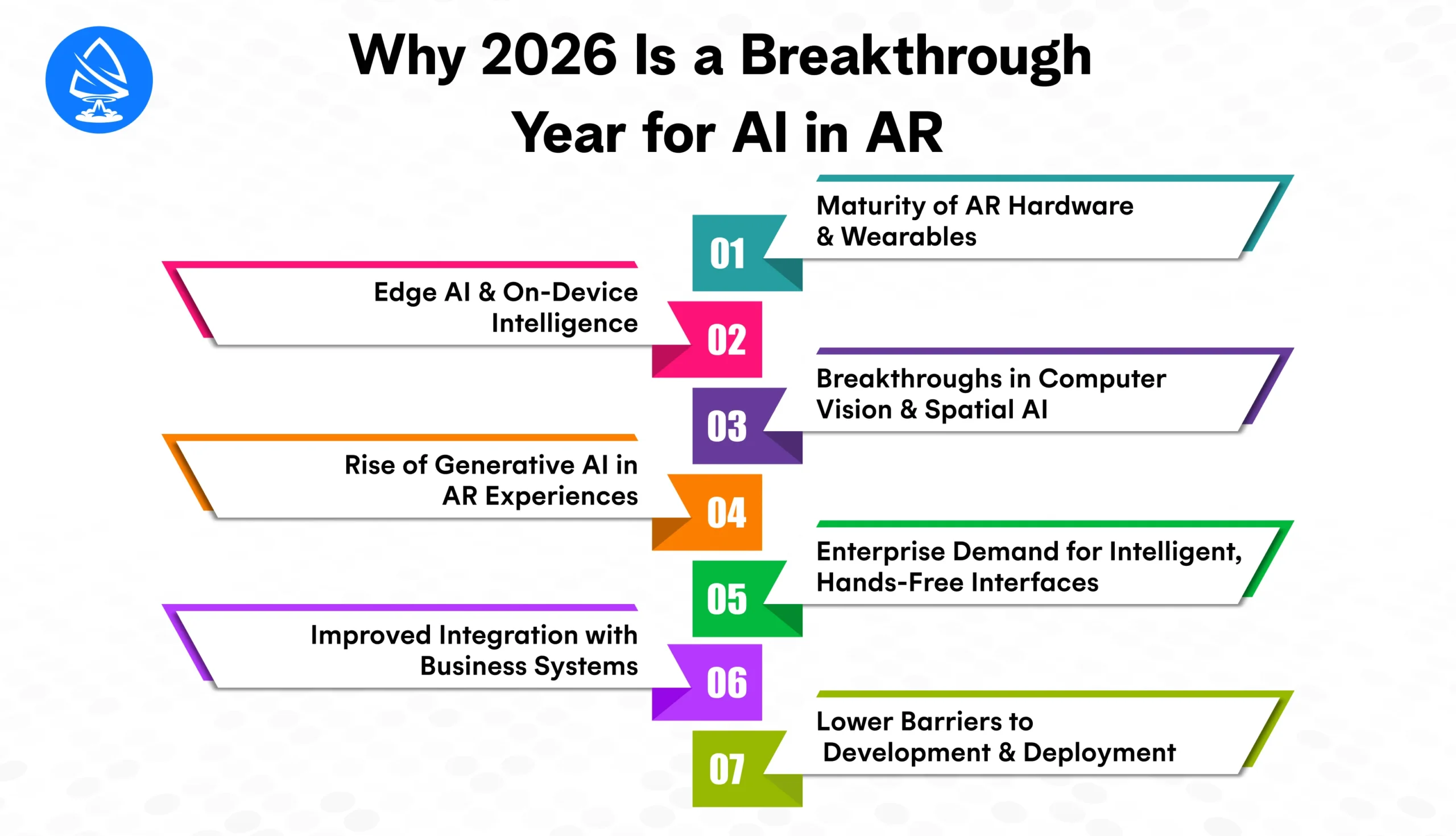
By 2026, AR headsets, smart glasses, and mobile AR hardware have reached enterprise-grade maturity. Improved field of view, better battery life, lighter form factors, and lower costs make AR viable for daily business use. This hardware readiness allows AI-driven AR applications to run reliably in real-world environments. Many companies collaborate with an AI app development company to align hardware capabilities with intelligent software experiences.
Advancements in edge computing allow AI models to run directly on AR devices instead of relying entirely on the cloud. This reduces latency, improves privacy, and enables real-time object recognition, spatial understanding, and decision support critical for AR use cases like manufacturing, healthcare, and field service.
AI models for vision, depth sensing, and spatial mapping have improved dramatically. In 2026, AR systems can understand complex environments, track objects accurately, and maintain stable overlays even in dynamic conditions. These advancements are accelerating adoption across industries, supported by specialized artificial intelligence development services focused on computer vision and spatial intelligence.
Generative AI is redefining how AR content is created and consumed. In 2026, AR applications can generate instructions, simulations, explanations, and visual elements on demand. This drastically reduces development cycles and enables highly adaptive, personalized AR experiences without manual content creation.
Businesses are actively seeking ways to improve productivity, reduce errors, and upskill workers. AI-powered AR delivers real-time guidance, contextual intelligence, and hands-free interaction, making it ideal for training, maintenance, remote assistance, and complex workflows. To meet this demand, organizations increasingly hire AI app developers with combined expertise in AR platforms and machine learning.
In 2026, AI AR applications integrate seamlessly with ERP, IoT, digital twins, and analytics platforms. This integration allows AR experiences to reflect live business data, enabling real-time insights and actionable intelligence directly within the user’s field of view.
Frameworks, SDKs, and cloud-edge toolchains have matured, making AI-powered AR more accessible. Businesses no longer need massive R&D budgets to experiment with accelerating innovation across startups, SMEs, and enterprises alike.
AI-powered augmented reality is made possible by a stack of advanced technologies working together to deliver real-time intelligence, spatial understanding, and adaptive user experiences. These core technologies transform AR from simple visual overlays into intelligent, interactive systems that understand context and act accordingly. Below are the key technologies powering AI in Augmented Reality.
Computer vision is the backbone of AI-driven AR. It enables systems to recognize objects, faces, gestures, text, and surfaces in real time. This allows AR applications to anchor digital content accurately in the physical world and interact meaningfully with real objects. Many enterprises partner with an AI app development company to build high-accuracy vision models tailored to their industry use cases.
Spatial AI allows AR systems to understand depth, distance, scale, and spatial relationships within an environment. Using SLAM, AI builds real-time 3D maps that let virtual objects behave realistically, occluding, persisting, and interacting with the physical space.
Machine learning models analyze user behavior, interaction patterns, and contextual data to continuously improve AR experiences. These models personalize content, optimize UI placement, and adapt workflows based on how users engage with AR environments. Advanced implementations often rely on artificial intelligence development services to design and train these adaptive models.
Edge AI enables real-time processing directly on AR devices such as smart glasses or mobile phones. By running AI models locally, AR applications achieve low latency, improved reliability, and stronger privacy, critical for industrial, healthcare, and field-service use cases.
NLP allows users to interact with AR systems using voice commands and natural language queries. This hands-free interaction is essential in environments where manual input is impractical. Voice-enabled AI makes AR more accessible, intuitive, and productivity-focused.
Generative AI enables AR applications to create content on demand, such as instructions, visual explanations, simulations, or guided workflows. Instead of prebuilding every scenario, AR systems can dynamically generate relevant content in real time, dramatically reducing development effort.
AI combines data from cameras, depth sensors, GPS, IMUs, and IoT devices to build a unified understanding of the environment. This sensor fusion improves accuracy, stability, and responsiveness in AR experiences.
While related, AI in AR and AI in VR serve different purposes.
The future lies in blended AR, VR, and AI experiences across devices.
By 2026, AI in augmented reality will move decisively from experimental pilots to mission-critical business applications. The convergence of mature AR hardware, edge AI, and generative intelligence enables real-world deployment across industries. Below are the most impactful use cases shaping the 2026 roadmap, explained with clear business relevance.
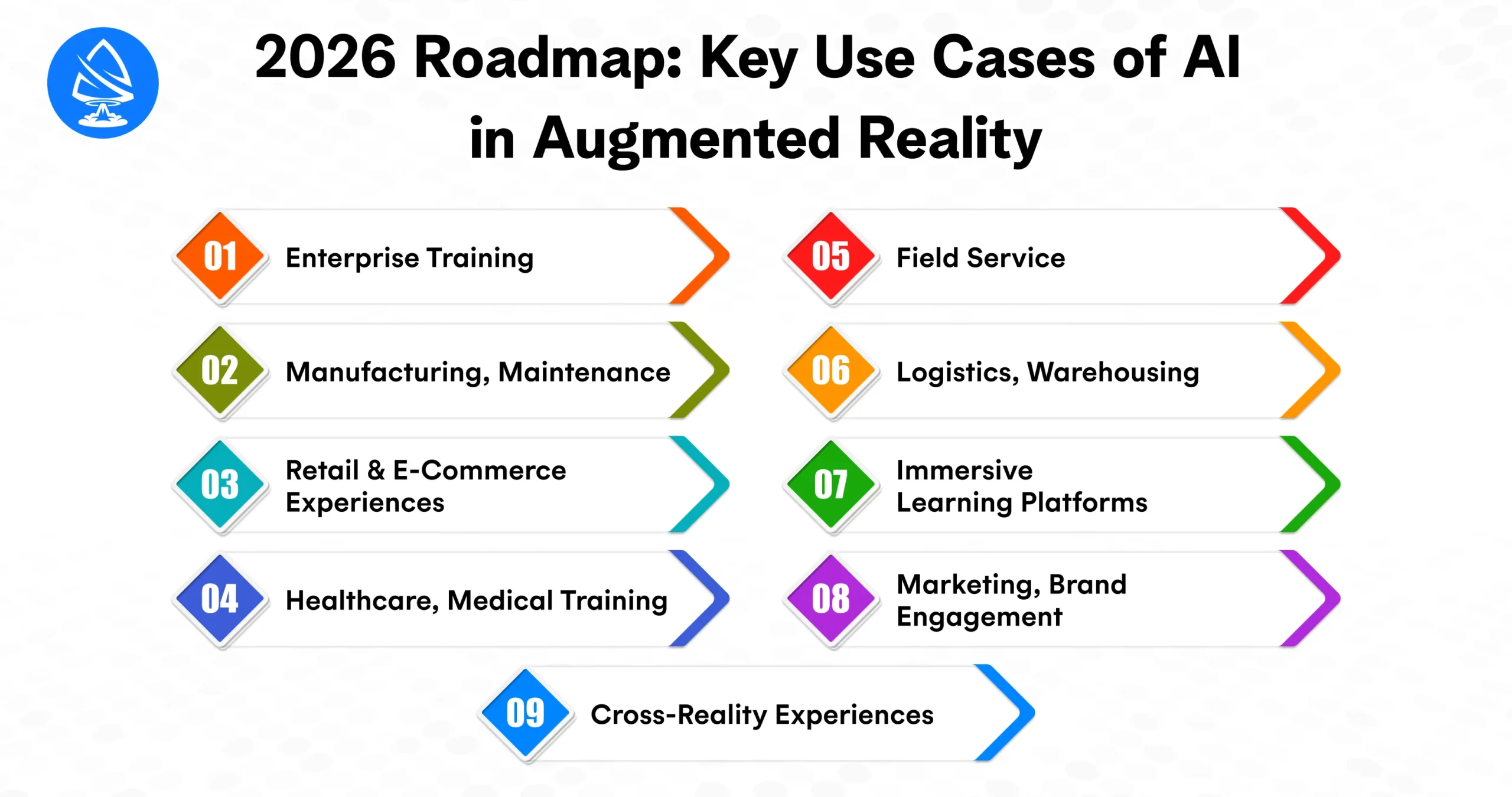
AI-powered AR delivers contextual, hands-free training directly in the employee’s field of view. Instead of static manuals or videos, AI analyzes tasks, environment, and user skill level to provide adaptive guidance in real time.
Key capabilities:
Many organizations partner with an AI app development company to build scalable AR training platforms that reduce onboarding time and human error.
In 2026, AI-driven AR becomes a core tool on factory floors. AI recognizes machinery, detects anomalies, and overlays actionable insights for technicians in real time.
Key capabilities:
These systems are often built using advanced artificial intelligence development services to ensure real-time accuracy and integration with industrial IoT systems.
AI-enhanced AR transforms shopping into an interactive, personalized experience. Customers can visualize products in real environments while AI adapts recommendations based on preferences and behavior.
Key capabilities:
Retailers increasingly use AI augmented reality to increase conversion rates and reduce returns.
AI in AR supports clinicians with real-time intelligence layered over physical patients or medical equipment. Accuracy, speed, and context awareness are critical in this domain.
Key capabilities:
To meet regulatory and accuracy requirements, healthcare providers often hire AI developers with experience in medical imaging and spatial computing.
AI-powered AR enables experts to assist on-site workers remotely while AI identifies components, suggests fixes, and validates steps automatically.
Key capabilities:
This use case is a major driver of AR and AI adoption in utilities, telecom, and energy sectors.
AI-driven AR improves speed and accuracy in logistics environments by guiding workers visually and adapting routes dynamically.
Key capabilities:
This is closely aligned with broader ai ar and operational intelligence initiatives.
AI-powered AR creates adaptive learning environments that respond to learner behavior and understanding levels.
Key capabilities:
Educational platforms increasingly blend AI and augmented reality to improve engagement and retention.
Brands use AI-driven AR to create immersive, data-driven customer experiences that adapt in real time.
Key capabilities:
This area benefits strongly from generative AI integrated into AR pipelines.
By 2026, boundaries blur between AR and VR. AI enables seamless transitions between physical and virtual spaces, supporting hybrid workflows.
Key capabilities:
Generative AI is becoming a defining force in the evolution of AI in Augmented Reality, fundamentally changing how AR experiences are created, personalized, and scaled. Instead of relying only on pre-built assets and static logic, generative AI enables AR systems to create content, guidance, and interactions dynamically based on real-time context, user intent, and environmental data. Below are the key ways generative AI is shaping AR applications in 2026 and beyond.
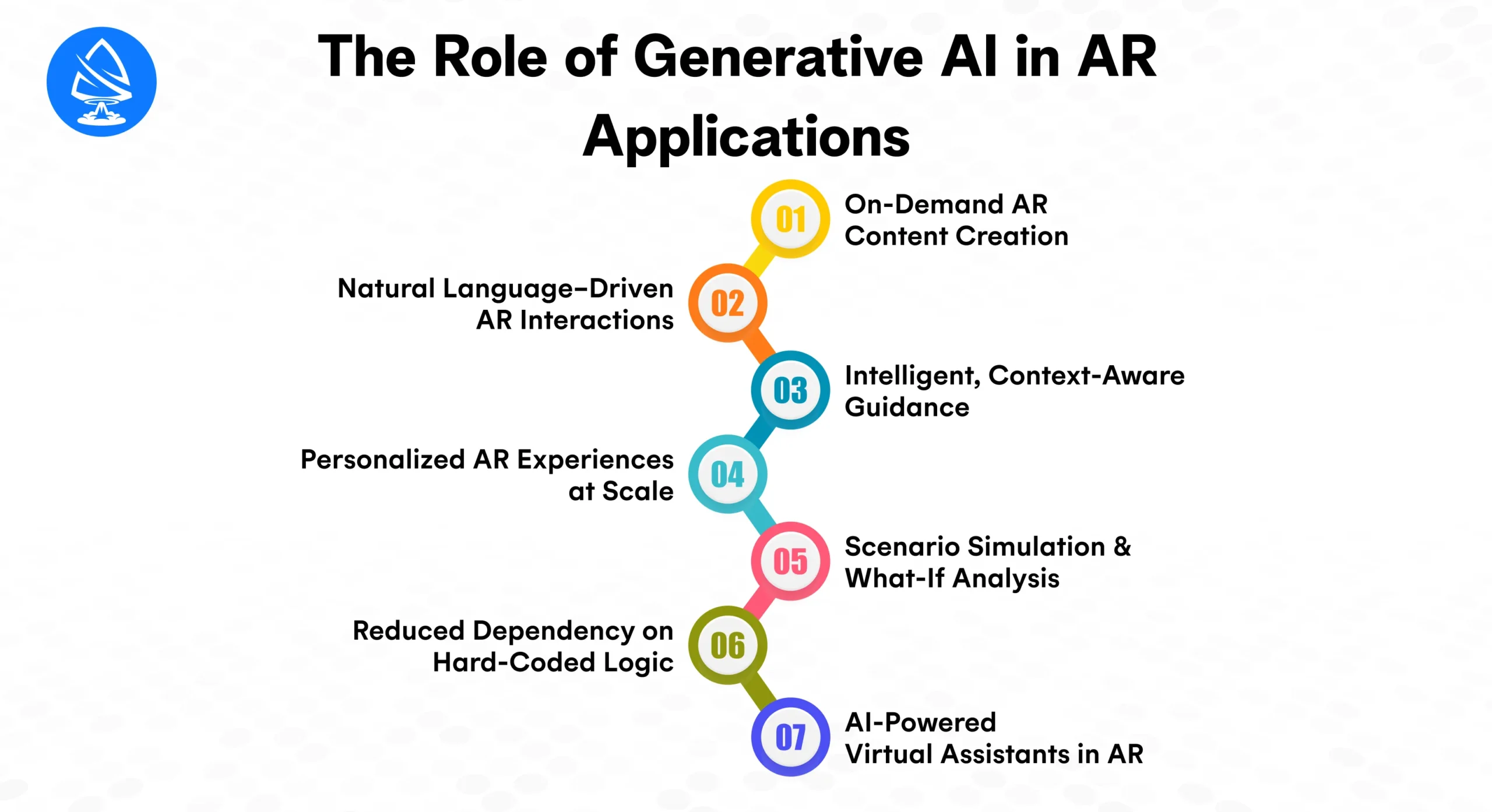
Generative AI allows AR applications to create visual elements, instructions, annotations, and simulations in real time. This eliminates the need to pre-design every scenario, significantly reducing development time and cost. Many businesses partner with an AI app development company to integrate generative models that can dynamically generate AR content at scale.
With generative AI, users can interact with AR systems using natural language. Instead of navigating menus, users can ask questions or request guidance, and the AR system generates contextual responses and visual overlays instantly. This makes AR interfaces more intuitive and accessible.
Generative AI analyzes what the AR system sees, objects, environments, and user actions, and generates step-by-step guidance tailored to the situation. This is especially valuable in training, maintenance, healthcare, and field service scenarios where real-time accuracy matters. Such capabilities are often implemented using specialized artificial intelligence development services.
Generative AI adapts AR content based on user behavior, skill level, preferences, and history. Two users looking at the same environment can receive completely different AR instructions or recommendations, making experiences highly personalized without manual configuration.
In enterprise AR applications, generative AI can simulate scenarios such as equipment failures, safety risks, or process changes directly within the AR environment. This enables immersive planning, training, and decision-making without real-world disruption.
Traditional AR systems rely heavily on rigid workflows. Generative AI introduces flexibility by generating responses and actions dynamically, allowing AR applications to handle edge cases and unexpected situations more effectively.
Generative AI enables intelligent virtual assistants that exist directly within AR environments. These assistants can explain objects, answer questions, summarize data, and guide users visually, acting as real-time co-pilots. To build such assistants, organizations often hire AI developers with expertise in generative models, computer vision, and AR frameworks.
Many organizations partner with an AI app development company to design scalable AR architectures.
These benefits are driving enterprise investment in AI and augmented reality platforms.
To overcome these, businesses rely on artificial intelligence development services and specialized AR teams.
You may also want to know AI in Change Management
Building AI-driven AR applications in 2026 requires a structured approach that combines spatial computing, artificial intelligence, and scalable system design. Successful teams focus on real business problems, edge-ready architectures, and continuous learning loops rather than experimental features. Below is a practical, future-ready framework to build production-grade AI in Augmented Reality applications.
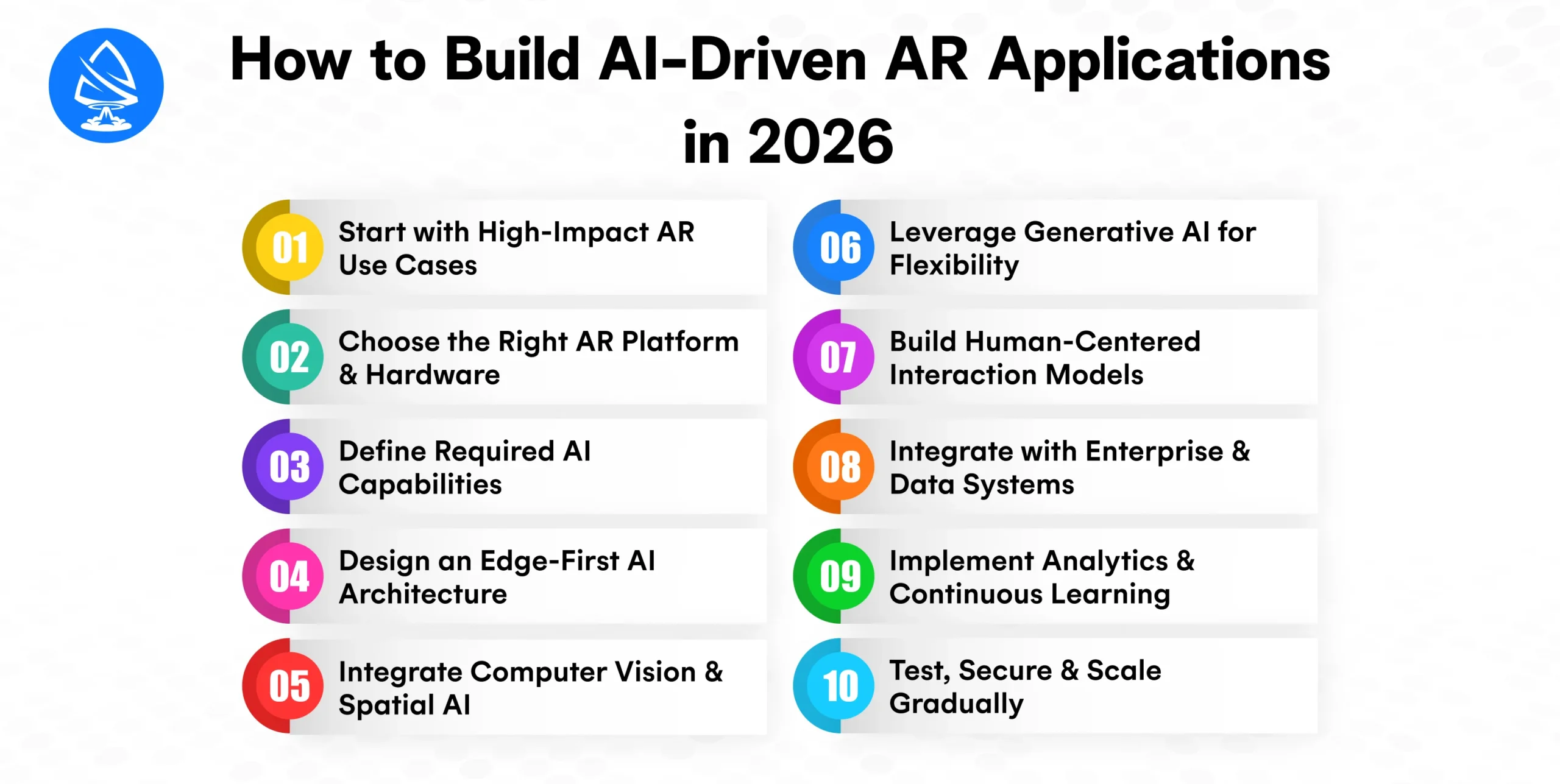
Begin by identifying problems where AI-powered AR delivers measurable value, such as training, maintenance, remote assistance, retail visualization, or healthcare support. Clear use cases help avoid overengineering and guide technology choices. Many organizations work with an AI app development company at this stage to validate feasibility and ROI.
Select AR platforms based on your target users and environment: mobile AR, smart glasses, or enterprise headsets. Hardware capabilities directly influence AI model size, latency, and interaction design, especially for real-time computer vision and spatial mapping.
Clearly map which AI functions your AR app needs, such as object recognition, gesture detection, voice interaction, personalization, or generative guidance. Avoid adding AI features that don’t support the core user workflow.
In 2026, most AI AR applications rely on edge AI for low latency and privacy. Run critical AI models on-device while offloading heavy training and analytics to the cloud. This hybrid approach is often designed using AI App development services with experience in edge computing and real-time systems.
Implement robust computer vision models for object detection, tracking, and scene understanding. Combine this with spatial AI to ensure digital content anchors correctly and behaves naturally within physical environments.
Use generative AI to create dynamic instructions, explanations, simulations, and virtual assistants inside AR. This reduces hard-coded logic and allows AR experiences to adapt to new scenarios without redevelopment.
Design AR interactions around natural inputs such as voice, gesture, and gaze. AI should reduce cognitive load, not increase it. Context-aware prompts and minimal UI overlays improve usability and safety.
Connect AR applications with ERP, IoT, digital twins, CRM, or analytics platforms to deliver real-time, data-driven AR experiences. Integration ensures AR insights are actionable, not isolated.
Track user interactions, task success rates, latency, and AI accuracy. Feed this data back into model retraining pipelines so the AR system improves over time. Long-term optimization often requires teams to hire AI developers skilled in MLOps, data engineering, and spatial analytics.
Pilot AI-driven AR applications in controlled environments before scaling. Focus on performance, privacy, explainability, and security, especially when visual or biometric data is involved. Gradual rollout reduces risk and builds internal confidence.
AI-powered AR systems collect sensitive visual and contextual data.
Trust will be a key differentiator in 2026.
The convergence of AI in Augmented Reality is reshaping how digital experiences are built and consumed. In 2026, AR is no longer about visual novelty; it’s about intelligence, context, and action. Businesses that embrace AI-powered AR now will lead in productivity, engagement, and innovation over the next decade.
For decision-makers, the opportunity is clear: invest in scalable architectures, focus on high-impact use cases, and build with intelligence at the core. Whether you’re creating enterprise training tools, immersive retail experiences, or industrial AR platforms, AI is the differentiator that turns AR into a business engine.
If you’re planning to build or scale AI-powered AR applications, start with a clear roadmap and the right technical partners. Use our AI App Development Cost Calculator to estimate your AI AR investment and take the next step toward building future-ready augmented reality solutions.
1. What is AI in Augmented Reality?
It combines AI with AR to create intelligent, context-aware experiences.
2. How is AI used in AR applications?
Through computer vision, spatial mapping, personalization, and automation.
3. Is AI in AR expensive to build?
Costs vary, but edge AI and tools are reducing barriers.
4. What industries benefit most from AI AR?
Manufacturing, healthcare, retail, training, and field services.
5. How does generative AI enhance AR?
It enables dynamic content creation and natural interactions.
6. Is AI AR suitable for small businesses?
Yes, scalable platforms make adoption easier than before.
7. What skills are needed to build AI AR apps?
AR development, computer vision, ML, and UX design.
8. Will AI replace humans in AR workflows?
No, it augments human capabilities with intelligence.

Artoon Solutions
Artoon Solutions is a technology company that specializes in providing a wide range of IT services, including web and mobile app development, game development, and web application development. They offer custom software solutions to clients across various industries and are known for their expertise in technologies such as React.js, Angular, Node.js, and others. The company focuses on delivering high-quality, innovative solutions tailored to meet the specific needs of their clients.
 For business inquiries only




