- HR:+91-879-9184-787
- Sales:+91-908-163-7774


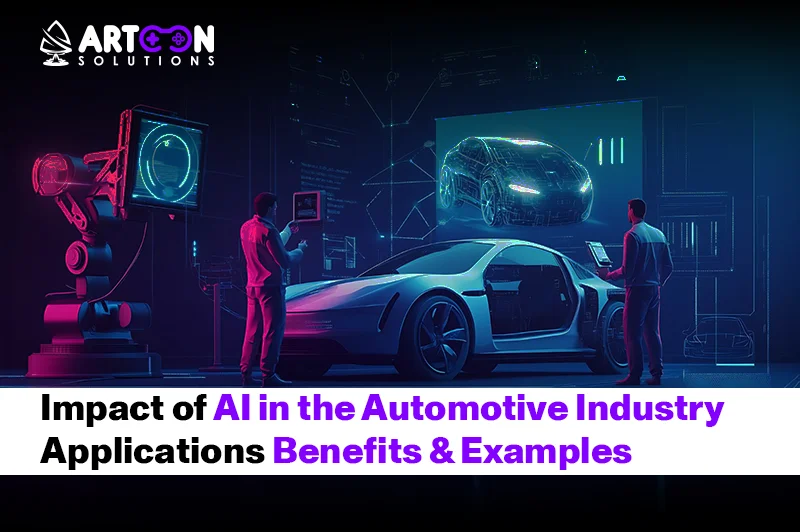
The automotive industry is undergoing a profound transformation due to the rapid advancement of artificial intelligence (AI) technologies. From autonomous vehicles to smart manufacturing, AI is reshaping how cars are designed, built, and operated. The integration of AI in the automotive industry is not just a trend; it’s a revolutionary change that promises to enhance safety, efficiency, and user experience.
In this article, we will explore the impact of AI on the automotive industry, its applications, the benefits it brings, and real-world examples of AI-powered vehicles. Whether you’re a business leader in the automotive sector or simply curious about how AI is transforming the industry, this comprehensive guide will cover everything you need to know. Working with a custom AI development company can help you leverage AI technologies to stay ahead in the automotive market.
AI in the automotive industry refers to the application of artificial intelligence techniques to improve various processes, enhance vehicle performance, and enable automation. AI technologies, including machine learning, deep learning, computer vision, and natural language processing (NLP), are used to enable vehicles to perform complex tasks traditionally done by humans.
The AI in the automotive industry is transforming multiple aspects of vehicle development, design, and operation. AI technologies are being applied in various areas to enhance safety, efficiency, user experience, and sustainability. Below are the key areas where AI is making a significant impact in the automotive industry:
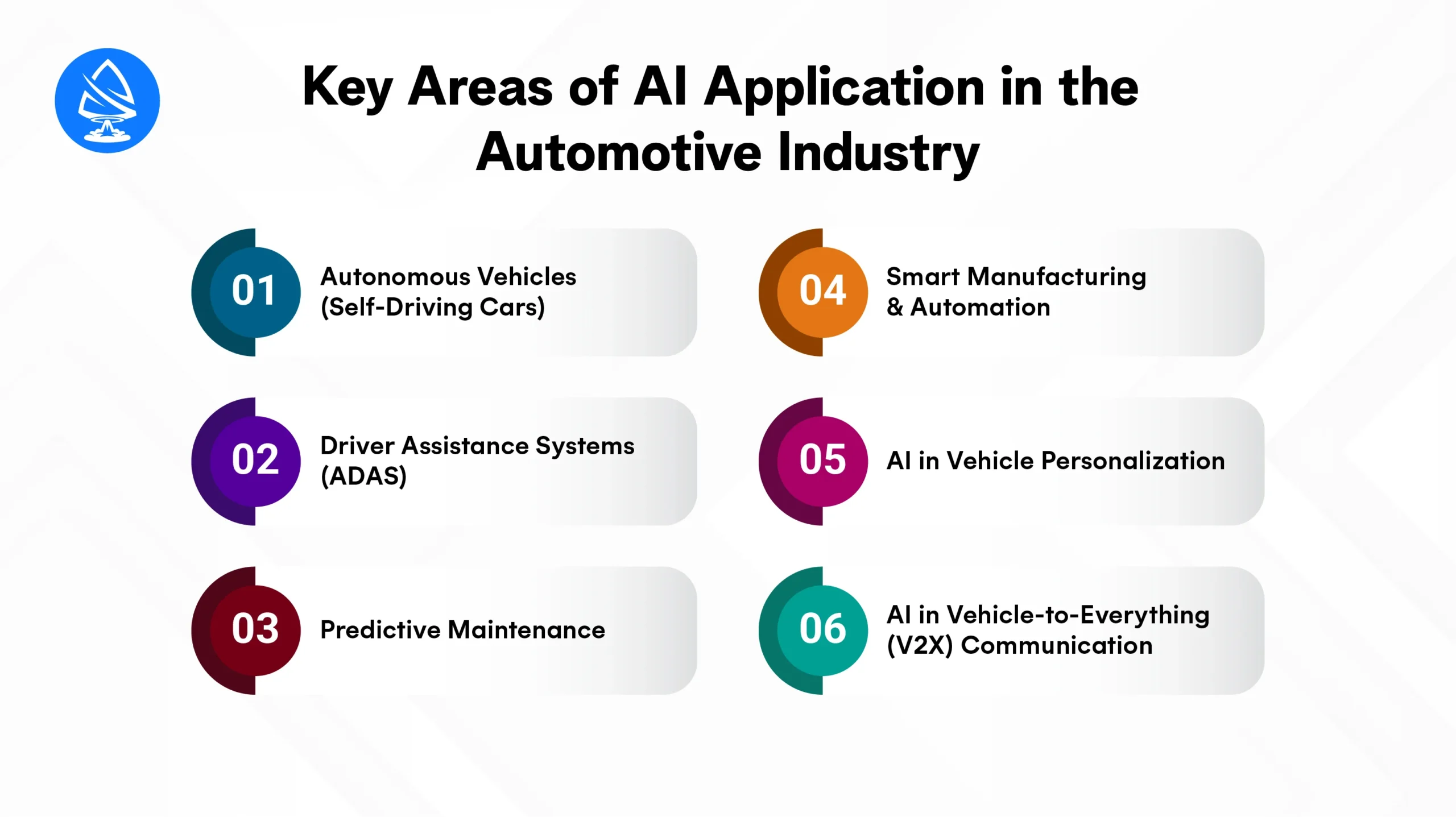
One of the most revolutionary applications of AI in the automotive industry is the development of autonomous vehicles. These vehicles rely on advanced AI algorithms to interpret data from sensors, cameras, and radar systems to make real-time decisions for navigation, path planning, and obstacle detection, all without human intervention.
AI enables cars to “see” the world around them through cameras and sensors. These systems recognize traffic signals, pedestrians, other vehicles, and road signs, making real-time decisions based on the environment.
AI-powered vehicles use LIDAR (Light Detection and Ranging) and radar sensors to map out 3D environments, detecting obstacles and identifying free spaces.
These technologies allow the car’s AI to learn from its experiences and improve decision-making over time, leading to safer and more efficient self-driving operations.
For instance, companies like Waymo, Tesla, and Cruise are developing self-driving cars that leverage these AI technologies to enable fully autonomous driving, offering a glimpse of the future of transportation.
Another significant area where AI is applied is in Advanced Driver Assistance Systems (ADAS), which assist drivers in controlling the vehicle and improving safety. AI-powered ADAS technologies help reduce human error, prevent accidents, and make driving more comfortable.
You may also want to know about NLP in Healthcare
AI adjusts the car’s speed to maintain a safe distance from the vehicle ahead, ensuring smoother traffic flow.
AI detects when a vehicle drifts out of its lane without signaling and can provide steering assistance to bring the car back into the lane.
AI detects potential collisions with pedestrians or other vehicles and activates automatic braking to prevent or reduce the impact of an accident.
AI algorithms can identify and interpret road signs, helping drivers adhere to speed limits and other traffic rules.
Companies such as BMW, Mercedes-Benz, and Audi have incorporated AI-driven ADAS systems in their vehicles to enhance driver safety and convenience.
AI is playing a crucial role in predictive maintenance in the automotive industry. Predictive maintenance uses AI algorithms to monitor the health of various vehicle components and predict when they may fail or require maintenance.
AI systems collect data from various sensors within the vehicle, such as the engine, battery, and brakes. These systems continuously analyze the data to detect any signs of malfunction or wear and tear.
AI algorithms can monitor factors such as temperature, vibrations, and pressure to determine if components are operating within the normal range or if they need repair or replacement.
Based on the data and predictions, AI can help fleet operators or vehicle owners schedule maintenance before an issue causes a breakdown, reducing unplanned downtime and improving the overall efficiency of vehicle operations.
This application is increasingly being adopted by fleet management systems and automakers like General Motors and Ford, reducing operational costs and enhancing vehicle longevity.
AI has significantly impacted the manufacturing process in the automotive industry. Automation in car manufacturing has been enhanced through AI, making production lines faster, more efficient, and highly adaptable.
AI-powered robots are used in various stages of car manufacturing, including assembly, painting, welding, and testing. These robots can perform tasks with high precision and speed, improving production quality and reducing human error.
AI-powered computer vision systems inspect parts and components for defects during manufacturing. This ensures that only high-quality parts reach the assembly line, minimizing the chance of defects or recalls.
AI is also used to optimize the automobile supply chain, forecasting demand, improving inventory management, and reducing the lead time from raw materials to finished products.
For example, Toyota, Volkswagen, and Ford are leveraging AI technologies to streamline their manufacturing processes and create vehicles with higher precision.
AI is enhancing the personalization of the in-car experience by learning user preferences and adapting the vehicle’s settings to suit individual drivers.
Key features powered by AI include:
AI can store driver preferences, such as seat positions, music playlists, climate control settings, and route preferences. This ensures that each time the driver enters the vehicle, the car automatically adjusts to their liking.
AI-powered voice recognition systems allow drivers to interact with their vehicles hands-free, controlling navigation, entertainment, and communication systems with natural language commands. This improves the convenience and safety of driving.
AI-based navigation systems use real-time traffic data, road conditions, and user preferences to suggest the most optimal routes, saving time and fuel.
Mercedes-Benz and Audi are examples of automakers that have integrated AI to personalize driving experiences for individual users, enhancing comfort and convenience.
AI is being used to develop Vehicle-to-Everything (V2X) communication, which allows vehicles to communicate with each other and the surrounding infrastructure, such as traffic lights, road signs, and other vehicles. This communication helps improve traffic flow, reduce accidents, and enhance the overall safety of road systems.
Key aspects of V2X communication include:
AI helps vehicles communicate with one another to prevent collisions, such as when a vehicle brakes suddenly or swerves into another lane.
AI-powered systems can communicate with smart infrastructure, such as traffic signals, to optimize traffic flow and reduce congestion.
AI systems can help detect pedestrians crossing the road and alert the driver or vehicle to stop, ensuring pedestrian safety.
Audi and Toyota are leading the charge in implementing V2X systems in their vehicles, pushing the boundaries of what connected vehicles can achieve.
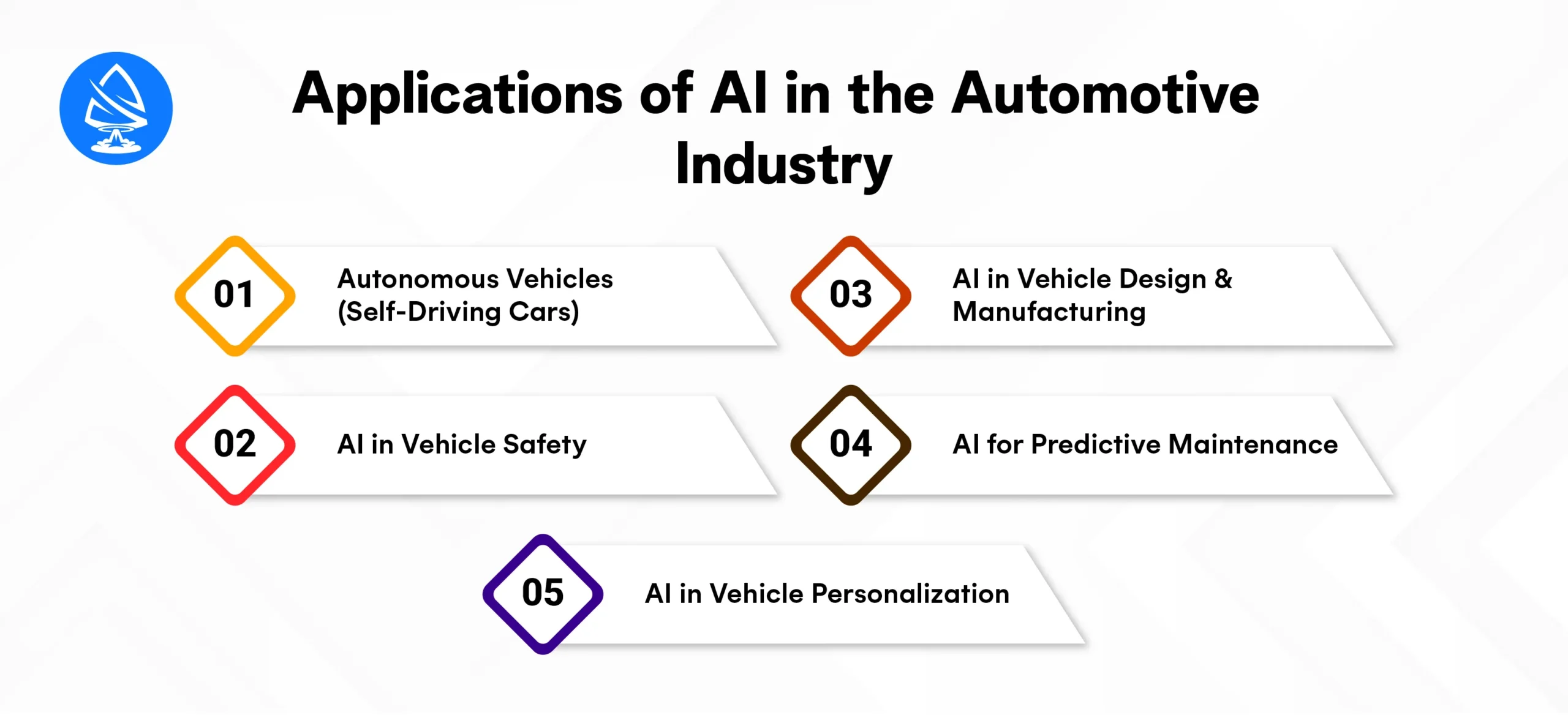
One of the most transformative applications of AI in the automotive industry is the development of autonomous vehicles. Self-driving cars use AI to interpret sensor data, make decisions, and navigate safely without human input. These vehicles rely on deep learning algorithms, computer vision, and radar to detect obstacles, recognize traffic signals, and understand their surroundings.
Example: Companies like Tesla and Waymo are at the forefront of self-driving technology, leveraging AI to improve autonomous driving systems and offer safer, more efficient driving experiences.
AI-powered systems in vehicles are enhancing safety features by enabling driver assistance systems (ADAS). These systems include automatic emergency braking, lane-keeping assist, and adaptive cruise control, all powered by AI to analyze real-time data from sensors and cameras.
Example: Audi and BMW have integrated AI-driven safety features into their vehicles to provide safer driving experiences, including emergency braking, lane-keeping, and pedestrian detection.
AI is transforming the design and manufacturing processes of automobiles by enabling faster, more efficient production lines.
Example: Ford uses AI to optimize its manufacturing process, using machine learning models to predict when factory robots need maintenance, ensuring smoother production.
One of the significant benefits of AI in the automobile industry is predictive maintenance. AI algorithms can analyze sensor data from vehicles to predict potential issues before they occur.
Example: General Motors uses AI to monitor vehicle health and predict maintenance needs in real-time, allowing for proactive maintenance and reducing vehicle downtime.
AI can personalize the in-car experience for drivers by learning preferences and adapting settings accordingly. AI-powered systems can adjust seat positions, mirror angles, cabin temperature, and even recommend music based on the driver’s habits and preferences.
Example: Mercedes-Benz has integrated AI in their vehicles to provide a highly personalized driving experience, including seat adjustments and entertainment preferences based on individual driver profiles.
You may also want to know AI is Transforming BFSI Sector
The integration of AI in the automotive industry has brought about numerous benefits that are transforming the way vehicles are designed, produced, and operated. From improving safety to enhancing efficiency, AI is playing a pivotal role in revolutionizing the automotive sector. Let’s explore the key benefits that AI offers in the automotive industry:
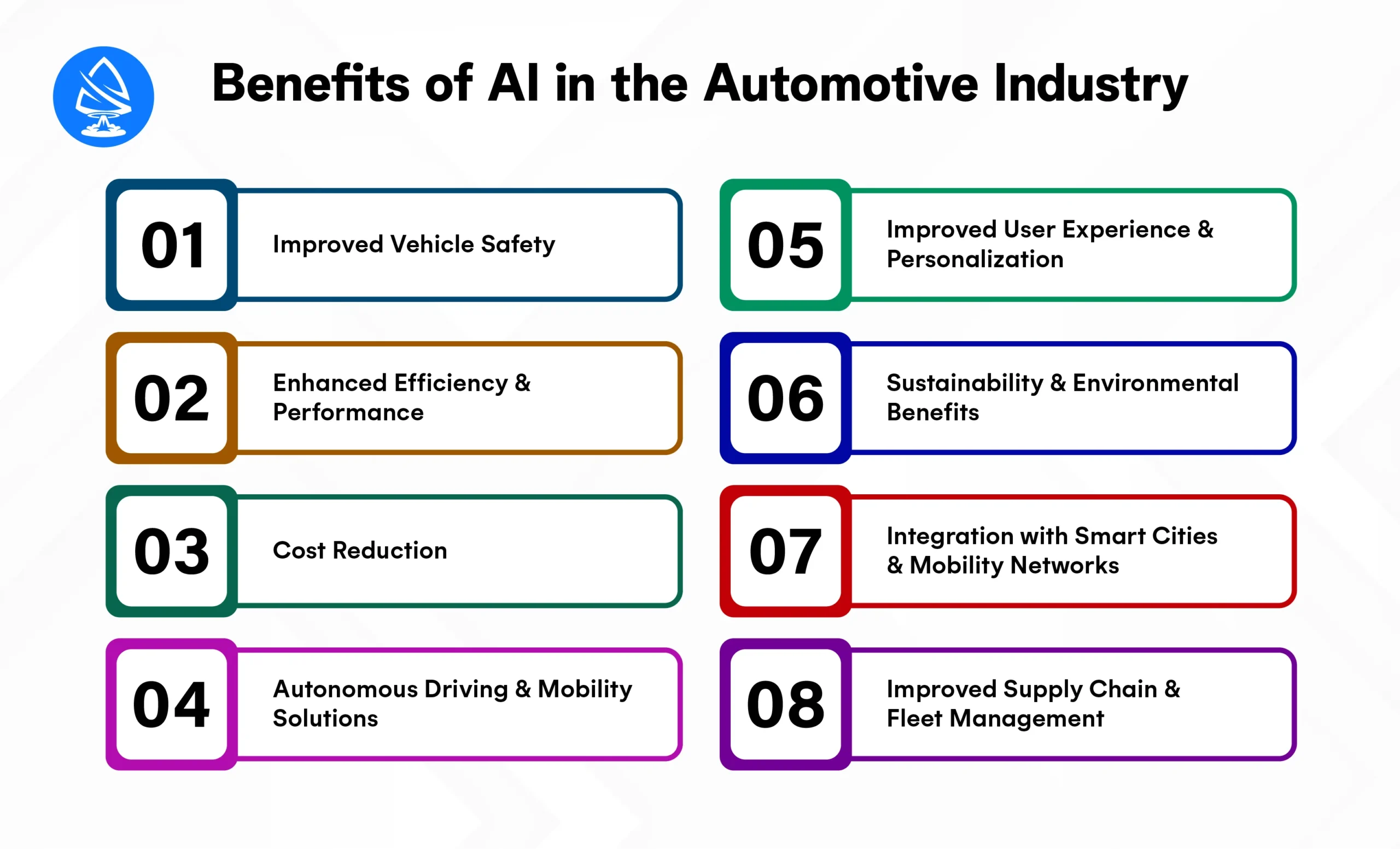
One of the most significant benefits of AI in the automotive industry is its ability to enhance vehicle safety.
These features, powered by AI, significantly reduce the risk of accidents and enhance overall driving safety.
It has dramatically improved the efficiency and performance of vehicles, from the manufacturing process to real-world driving.
AI has the potential to lower costs in various areas of the automotive industry, from production to maintenance. By automating manufacturing processes, improving supply chain management, and enabling predictive maintenance, AI helps reduce both operational and repair costs.
AI powers autonomous vehicles, transforming how people travel and transport goods. They use sensor and camera data to make driving decisions without human drivers.
AI is transforming the in-car experience by offering personalized features and intuitive controls that enhance the comfort and convenience of driving.
AI plays a significant role in helping the automotive industry reduce its environmental impact and contribute to sustainability goals.
AI is not only transforming individual vehicles but also contributing to the development of smart cities and mobility networks.
AI can optimize the automotive supply chain by predicting demand, managing inventory, and optimizing manufacturing schedules. Additionally, AI-powered fleet management systems help monitor vehicle health, optimize routes, and improve efficiency in transportation logistics.
The automotive industry is experiencing a massive shift thanks to the integration of AI technologies. From self-driving cars to smarter manufacturing processes, AI is driving innovation across the sector.
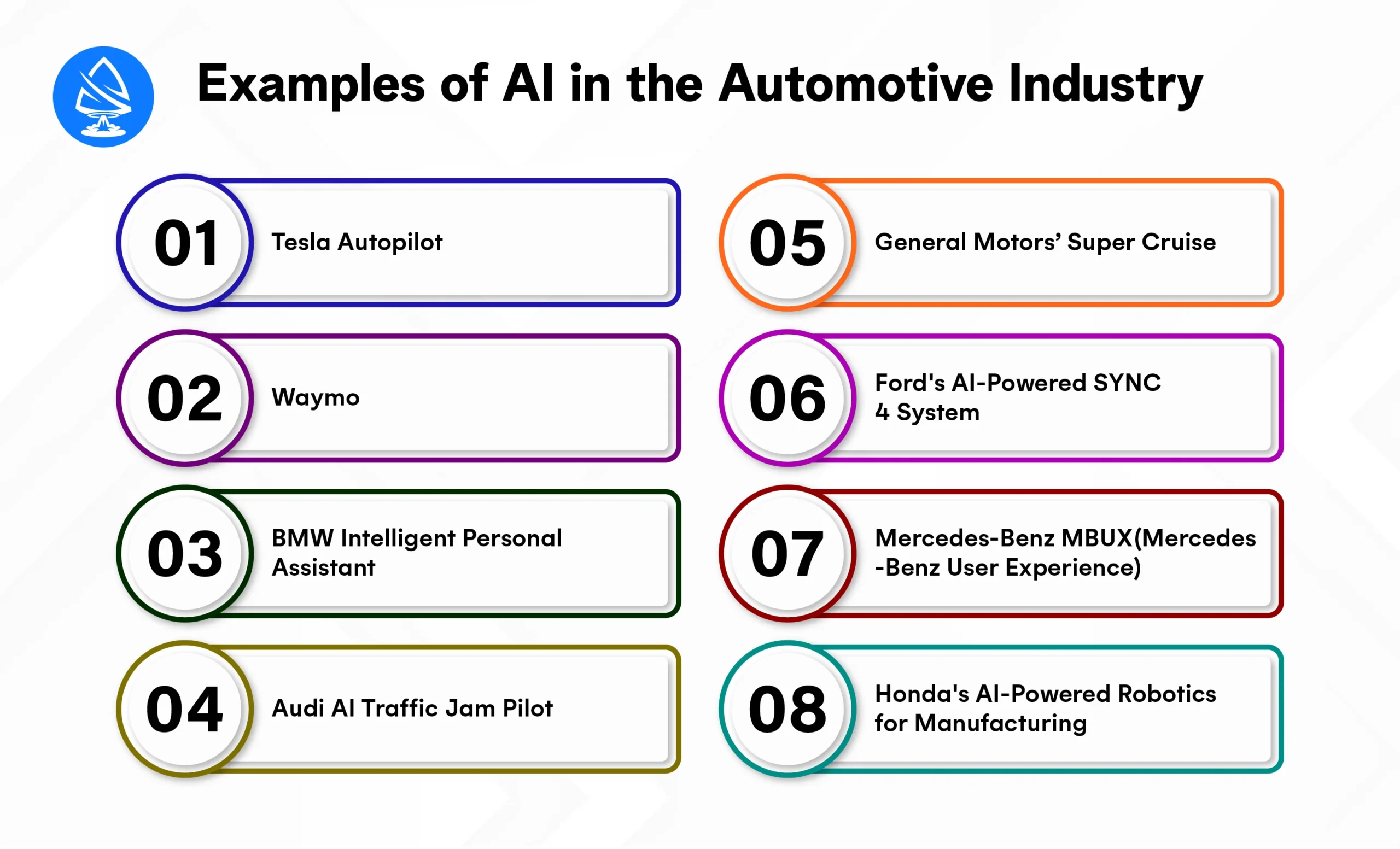
One of the most well-known and widely discussed examples of AI in automotive is Tesla’s Autopilot system. Tesla’s self-driving technology uses a combination of AI, deep learning, and sensor data to enable autonomous driving capabilities.
Waymo, a subsidiary of Alphabet, is another prime example of AI-powered autonomous vehicles. Waymo’s self-driving cars are among the most advanced in the world, relying on AI to navigate complex urban environments.
BMW’s Intelligent Personal Assistant is an AI-powered system that enhances the in-car experience by offering personalized features. It allows drivers to interact with their vehicles using voice commands, making the driving experience more seamless and intuitive.
Audi’s AI Traffic Jam Pilot is an example of AI being applied to driver assistance systems.
General Motors’ Super Cruise is an AI-powered hands-free highway driving system assisting steering, braking, and acceleration.
Ford’s SYNC 4 is an AI-powered infotainment system that allows drivers to interact with their vehicle through natural language commands and touch gestures. It integrates with a variety of vehicle functions to enhance the driving experience.
Mercedes-Benz has incorporated AI into its MBUX infotainment system, allowing for a seamless and personalized in-car experience. MBUX uses machine learning to understand the driver’s preferences and adjust the system accordingly.
In addition to using AI in vehicles, Honda is also utilizing AI in automotive manufacturing to improve efficiency and quality control. The company has implemented AI-powered robots that help in the assembly of parts and the testing of vehicles.
The impact of AI in the automotive industry is profound, with AI technologies revolutionizing vehicle manufacturing, design, safety, and personalization. From self-driving cars to predictive maintenance, AI is enabling the automotive industry to become smarter, safer, and more efficient.
Businesses in the automotive sector must embrace these changes and invest in AI in automobile industry technologies to stay competitive. Partnering with an AI application developer can help you build and integrate these advanced AI technologies into your automotive solutions.
1. What is AI in the automotive industry?
AI in the automotive industry uses machine learning, computer vision, and sensor data to improve vehicles, manufacturing, and safety.
2. How does AI help in vehicle safety?
AI improves vehicle safety through driver assistance systems like emergency braking, lane-keeping, and collision detection.
3. What are the benefits of AI in automotive manufacturing?
AI enhances automotive manufacturing through automation, defect detection, predictive maintenance, and optimized production schedules.
4. What is an example of AI in autonomous vehicles?
Tesla’s Autopilot uses AI-powered cameras, radar, and machine learning to enable autonomous driving.
5. How does AI improve vehicle maintenance?
AI enables predictive vehicle maintenance by analyzing sensor data to prevent failures and reduce downtime.
6. What role does AI play in the development of electric vehicles (EVs)?
AI optimizes EV battery management by improving efficiency, extending battery life, and enhancing vehicle performance.
7. Can AI personalize the in-car experience?
Yes, AI personalizes in-car experiences by adjusting seats, temperature, and music based on driver preferences.

Artoon Solutions
Artoon Solutions is a technology company that specializes in providing a wide range of IT services, including web and mobile app development, game development, and web application development. They offer custom software solutions to clients across various industries and are known for their expertise in technologies such as React.js, Angular, Node.js, and others. The company focuses on delivering high-quality, innovative solutions tailored to meet the specific needs of their clients.
 For business inquiries only