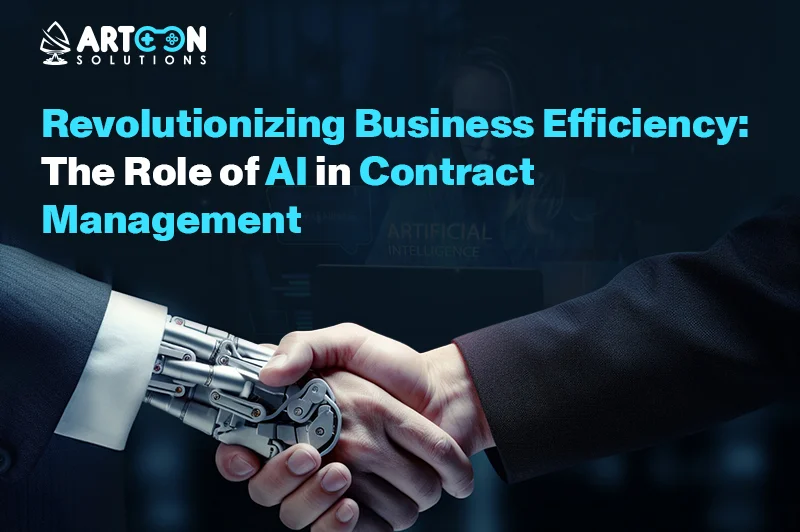
In today’s fast-paced business environment, efficiency and accuracy are essential for staying ahead of the competition. One area where AI in contract management is proving to be a game-changer is in the legal and contractual workflows. Traditionally, managing contracts has been a complex, manual, and time-consuming process, often prone to errors and delays.
This article explores how AI contract management improves efficiency, benefits businesses, and drives innovation. It explains key technologies and ways to gain a competitive edge. Hiring AI developers helps customize and integrate the right contract management solutions.
What is AI in Contract Management?
AI in contract management refers to the application of artificial intelligence (AI) technologies such as machine learning (ML), natural language processing (NLP), and data analytics to enhance and streamline the entire process of managing contracts. Traditional contract management processes, which are typically manual, time-consuming, and error-prone, are significantly improved with the integration of AI. By automating and optimizing tasks, AI helps businesses save time, reduce risks, and enhance overall contract efficiency.
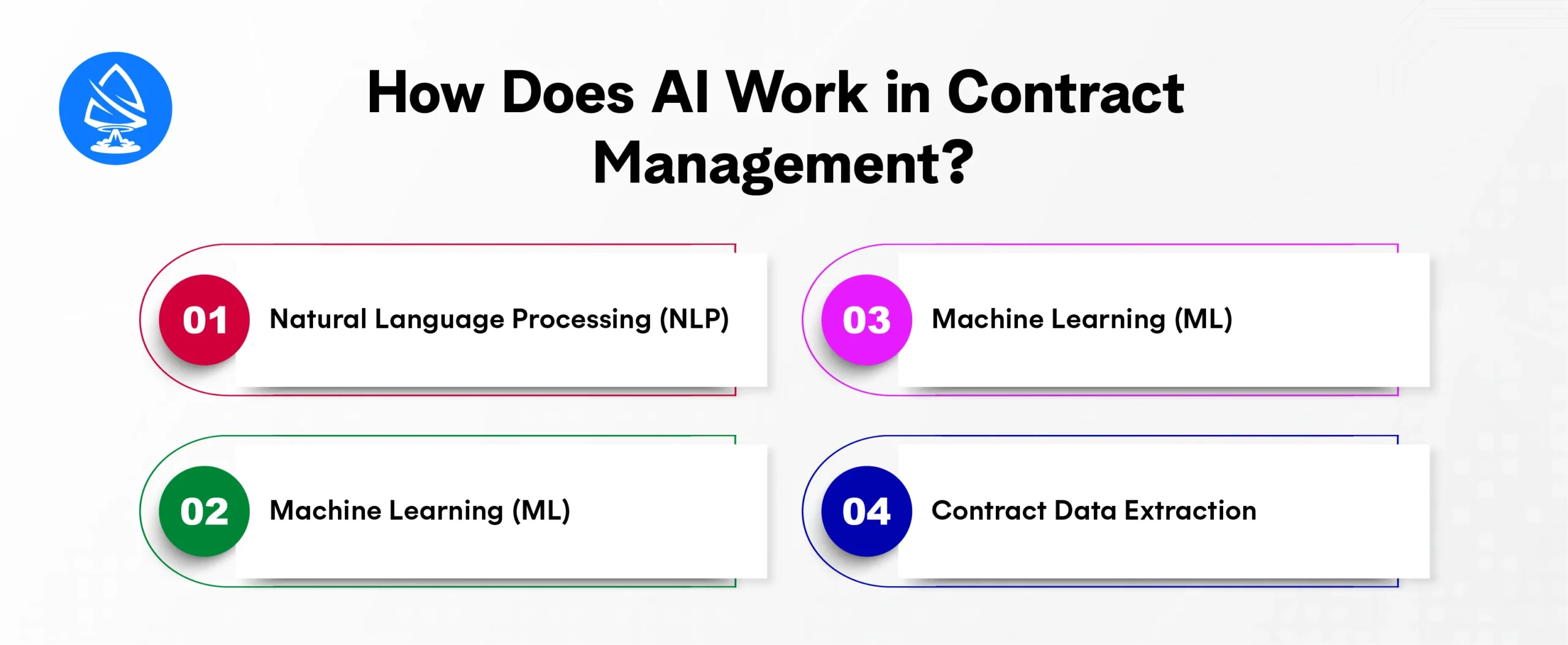
How Does AI Work in Contract Management?
AI in contract management works by analyzing, interpreting, and processing contract data in ways that would be impractical or inefficient for humans. It utilizes sophisticated AI techniques to automate repetitive tasks and provide actionable insights throughout the contract lifecycle.
1. Natural Language Processing (NLP)
One of the key components of AI in contract management is Natural Language Processing (NLP). NLP allows AI to read, understand, and interact with human language. In the context of contract management, NLP algorithms can analyze legal text, recognize clauses, and understand their meaning within the contract.
Clause Identification: AI tools powered by NLP can automatically identify key clauses, such as termination clauses, payment terms, and renewal dates, in a contract. This reduces the manual effort of extracting and reviewing important terms.
Contract Summarization: NLP helps in summarizing lengthy contracts by highlighting critical information, allowing businesses to quickly understand the essence of a contract without having to read every detail.
2. Machine Learning (ML)
Machine learning allows AI systems to improve over time by learning from data. In contract management, ML algorithms can analyze past contracts to identify patterns and trends that can help automate decision-making processes.
Predictive Analysis: By analyzing historical contract data, AI can predict future contract behaviors, such as when a contract is likely to be renegotiated or renewed, helping businesses to plan ahead.
Risk Identification: Machine learning can identify potential risks in contracts by learning from previous instances where issues arose. For example, the system can flag ambiguous clauses or terms that could lead to legal disputes.
3. Automation
AI-driven automation in contract management includes the ability to handle repetitive tasks that usually require human intervention. These include tasks such as contract creation, review, approval workflows, and renewal tracking.
Contract Creation: AI can automate the generation of contracts by populating predefined templates with necessary terms and conditions based on specific requirements or data inputs.
Review and Approval Workflows: AI tools streamline the review process by automatically checking for standard compliance and legal accuracy, routing the document for approval without human input until necessary.
Monitoring Deadlines and Renewals: AI can track key contract dates, such as expiration or renewal dates, and send automated reminders or alerts to relevant stakeholders.
4. Contract Data Extraction
AI tools can extract data from contracts with speed and accuracy, transforming unstructured contract data into structured, actionable insights. This is crucial for large-scale contract management, where contracts may contain thousands of pages of text.
Contract Data Extraction Software: AI uses optical character recognition (OCR) and NLP to extract specific data points (e.g., contract value, key deadlines, terms, parties involved) and populate them into centralized contract management systems, making the data easier to access and manage.
AI’s role in contract management is more than just automating repetitive tasks. Here are the key reasons why AI is becoming indispensable in this field:
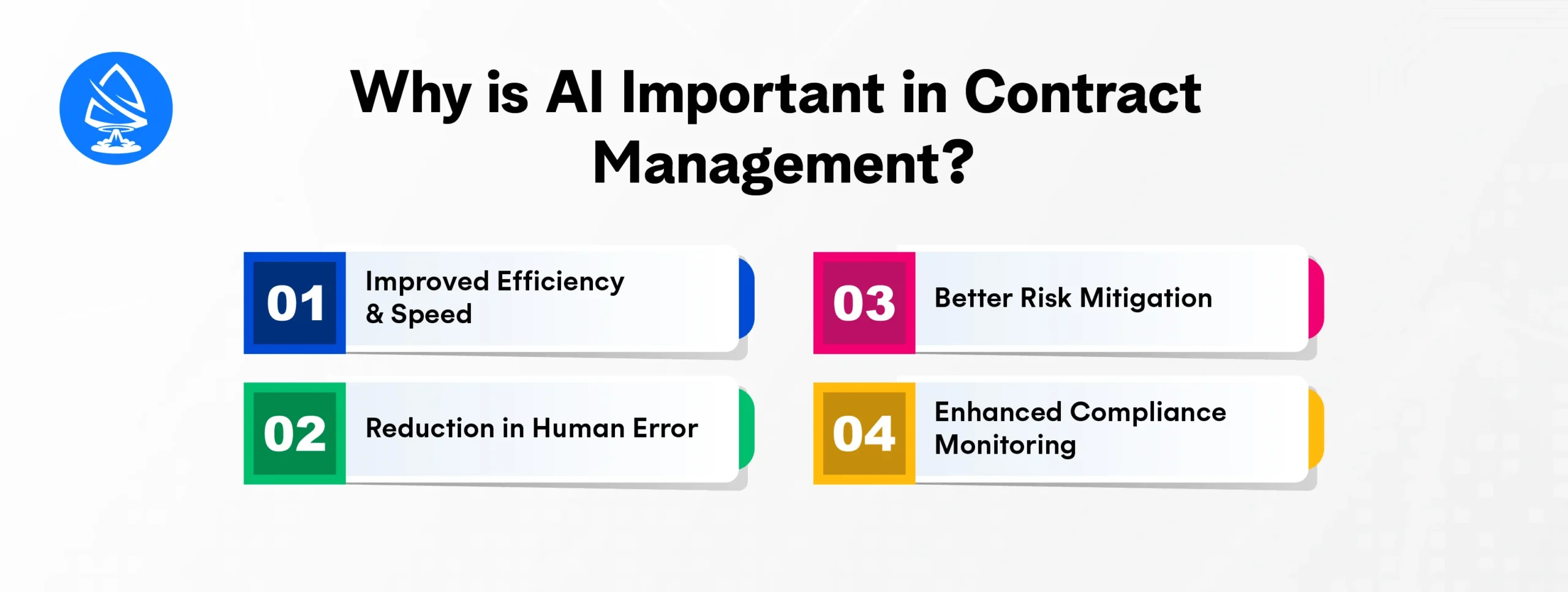
A. Improved Efficiency and Speed
By automating routine tasks such as contract creation, review, and data extraction, AI dramatically speeds up the contract lifecycle.
Time Savings: AI can process and analyze contracts in a fraction of the time it would take a human to do so, increasing productivity and reducing bottlenecks in contract workflows.
Quick Access to Information: AI-powered contract management systems enable fast searches through large volumes of contracts, providing stakeholders with the information they need when they need it.
B. Reduction in Human Error
One of the key advantages of AI in contract management is its ability to reduce the risk of human error.
Accuracy: AI eliminates the chances of overlooking critical contract clauses or data discrepancies that can lead to legal disputes or financial penalties.
Consistency: AI ensures that every contract is reviewed and processed consistently, eliminating inconsistencies that often arise when multiple human reviewers are involved.
C. Better Risk Mitigation
This allows businesses to address these risks proactively rather than reactively.
Risk Detection: AI contract management systems can flag clauses that might lead to disputes, such as vague terms, inconsistent language, or clauses that do not align with business interests.
Predictive Insights: Machine learning models can predict potential risks based on historical data, such as the likelihood of contract disputes, contract non-renewal, or delays in execution.
D. Enhanced Compliance Monitoring
In today’s complex legal landscape, compliance with regulatory and contractual obligations is more critical than ever. AI helps ensure that companies remain compliant with the terms outlined in their contracts and the relevant laws.
Continuous Monitoring: AI systems monitor contracts for compliance with terms like deadlines, payment schedules, and regulatory requirements, alerting stakeholders when actions are needed to remain compliant.
Audit Trail: AI systems maintain an audit trail of all contract changes, approvals, and activities, helping organizations demonstrate compliance during audits or disputes.
Real-World Applications of AI in Contract Management
AI is transforming contract management across industries by improving contract lifecycle management, reducing errors, and enhancing decision-making. Here are some real-world applications:
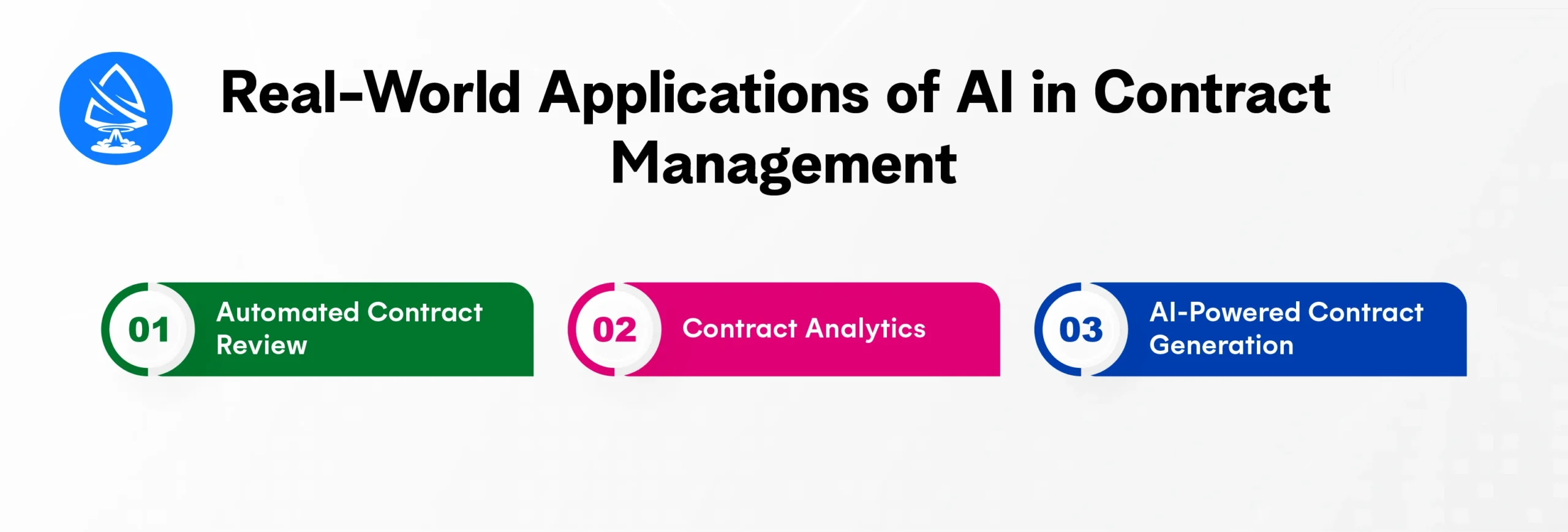
1. Automated Contract Review
AI contract review software can analyze contracts and flag problematic clauses, such as ambiguous terms or clauses that are not in line with company policy. It speeds up the review process and ensures that contracts are consistent with organizational standards.
Example: Kira Systems uses machine learning to extract critical clauses from contracts, allowing legal teams to review contracts faster and with higher accuracy.
2. Contract Analytics
AI tools analyze historical contract data to provide insights into trends and behaviors. These insights help businesses optimize future contracts, improve negotiation strategies, and ensure better compliance with terms.
Example: Luminance uses AI to help businesses analyze risk contracts, uncover patterns, and optimize contract terms based on past data.
3. AI-Powered Contract Generation
AI can automate the creation of contracts by pulling data from other systems or documents to fill out templates. This ensures consistency and accuracy while speeding up contract creation.
Example: ContractPodAI automates contract creation, offering tools to generate, negotiate, and track contracts from start to finish.
Key Technologies in AI for Contract Management
Several AI technologies are crucial for enhancing contract management, including:
1. Natural Language Processing (NLP)
NLP is essential for understanding the textual content of contracts. It enables AI to read, interpret, and generate human-like responses based on contract data.
2. Machine Learning (ML)
Machine learning helps AI systems learn from historical contract data to predict outcomes, identify risks, and improve decision-making.
3. Robotic Process Automation (RPA)
RPA automates repetitive tasks, such as contract data entry, approval workflows, and compliance checks, allowing legal teams to focus on more strategic activities.
Key Benefits of AI in Contract Management
Artificial Intelligence (AI) has become a transformative force in various business domains, and contract management is no exception. Traditionally, managing contracts involved complex, manual processes that were time-consuming, error-prone, and inefficient. However, with the advent of AI in contract management, businesses can now streamline these processes, reduce costs, and improve overall efficiency.
Here, we’ll explore the key benefits that AI brings to the table when it comes to managing contracts and how businesses can leverage these technologies to improve their operations.
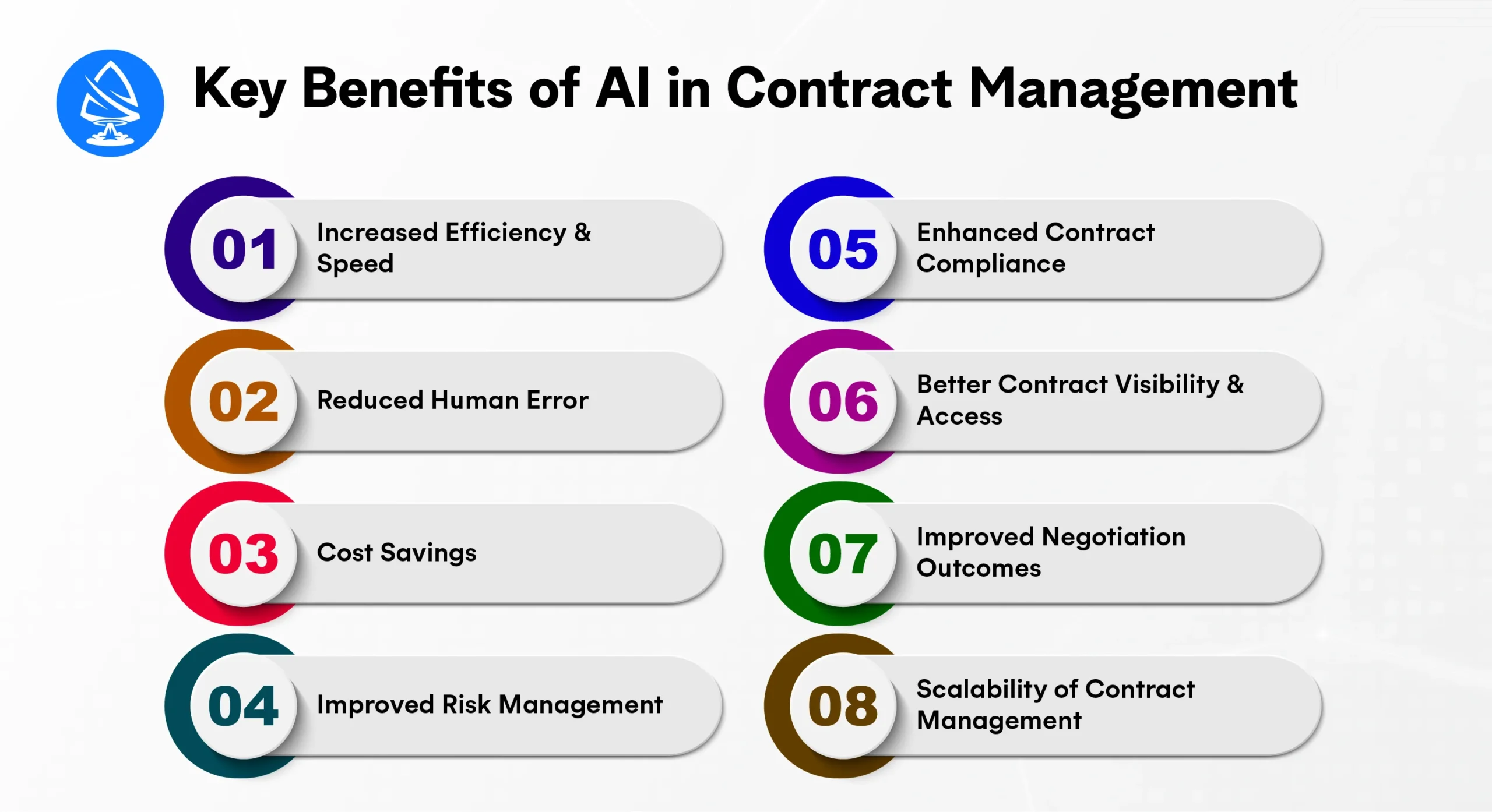
1. Increased Efficiency and Speed
One of the primary benefits of using AI in contract management is the significant improvement in efficiency and speed. Traditionally, legal teams spend a significant amount of time reviewing and drafting contracts manually. With AI, much of this work can be automated, saving businesses valuable time and allowing legal teams to focus on more strategic tasks.
Automated Contract Review: AI tools can automatically scan, analyze, and review contracts in a fraction of the time it would take a human. AI algorithms can identify key clauses, flag risky terms, and ensure that contracts comply with legal standards.
Faster Contract Creation: AI can help generate contracts based on predefined templates, speeding up the creation process. AI-driven systems can autofill information like dates, parties involved, and other contract terms, reducing the time spent on drafting documents.
2. Reduced Human Error
Manual contract management processes are highly susceptible to human error. Legal teams can miss important clauses, overlook deadlines, or misinterpret contract terms, leading to costly mistakes. AI can mitigate this risk by automating the review process and ensuring consistency.
Accurate Data Extraction: AI can extract key data from contracts with a high degree of accuracy, ensuring that important information such as payment terms, renewal dates, and parties involved is correctly captured.
Consistency in Reviewing Terms: AI ensures that contracts are reviewed consistently across all agreements. For example, if a certain clause is important for compliance, AI will automatically check for it in every contract.
3. Cost Savings
AI in contract management significantly reduces the costs associated with contract drafting, review, and administration. By automating routine tasks, AI can lower the need for extensive manual labor, enabling businesses to reallocate resources to more strategic activities.
Labor Savings: By automating repetitive tasks, businesses can reduce the number of hours legal teams spend on contract review, saving costs related to manpower.
Error Reduction: Fewer errors mean fewer costly disputes or issues arising from contract mismanagement, helping businesses avoid legal expenses and penalties.
4. Improved Risk Management
AI in contract management helps businesses identify potential risks and mitigate them before they become costly problems. By analyzing contract terms, AI can flag unfavorable clauses, non-compliance issues, and other risks that may not be immediately obvious.
Risk Identification: AI tools can highlight risky or unfavorable contract terms, such as excessive penalties, vague language, or obligations that might lead to disputes.
Predictive Analytics: AI systems can analyze historical contract data to predict potential risks, such as the likelihood of non-renewal or missed deadlines. This proactive approach helps businesses address potential issues before they escalate.
5. Enhanced Contract Compliance
Compliance is a critical factor in contract management, especially as businesses face increasingly complex regulations and legal requirements. AI helps ensure that contracts meet all legal standards and compliance requirements.
Automated Compliance Monitoring: AI systems continuously monitor contracts to ensure compliance with regulatory standards, company policies, and specific industry requirements.
Real-Time Alerts: AI can provide real-time alerts for contract deadlines, renewal dates, or compliance checks, helping businesses avoid missing important obligations or failing to comply with changing laws.
6. Better Contract Visibility and Access
AI tools improve contract visibility by organizing and storing contracts in a centralized, easily searchable database. This makes it easier for businesses to find, review, and manage contracts, improving overall contract administration.
Centralized Data Storage: AI enables the creation of a single, searchable repository of all contracts, making it easy to access and manage documents when needed.
Smart Search: AI can help businesses quickly locate specific terms, clauses, or obligations within contracts, reducing the time spent searching for information manually.
7. Improved Negotiation Outcomes
AI can support contract negotiations by analyzing historical contract data and offering recommendations based on past outcomes.
AI-Assisted Negotiations: By analyzing past contracts, AI can recommend favorable clauses, payment terms, or risk mitigation strategies that have led to successful agreements in the past.
Real-Time Insights: AI provides real-time data during negotiations, enabling legal teams to make informed decisions and react quickly to changing conditions.
8. Scalability of Contract Management
As businesses grow, the volume of contracts they need to manage also increases. AI-powered systems are highly scalable, meaning businesses can easily manage large volumes of contracts without compromising efficiency or accuracy.
Handling High Volumes: AI can automatically process and review thousands of contracts, making it easy for businesses to handle a growing portfolio of agreements.
Flexible Solutions: AI contract management systems can be customized to handle different contract types, industries, and regulatory environments, allowing businesses to scale their contract operations with ease.
The integration of AI in contract management has transformed how businesses create, manage, and optimize contracts. These technologies have significantly streamlined traditional contract management processes, providing businesses with faster, more efficient, and cost-effective solutions.
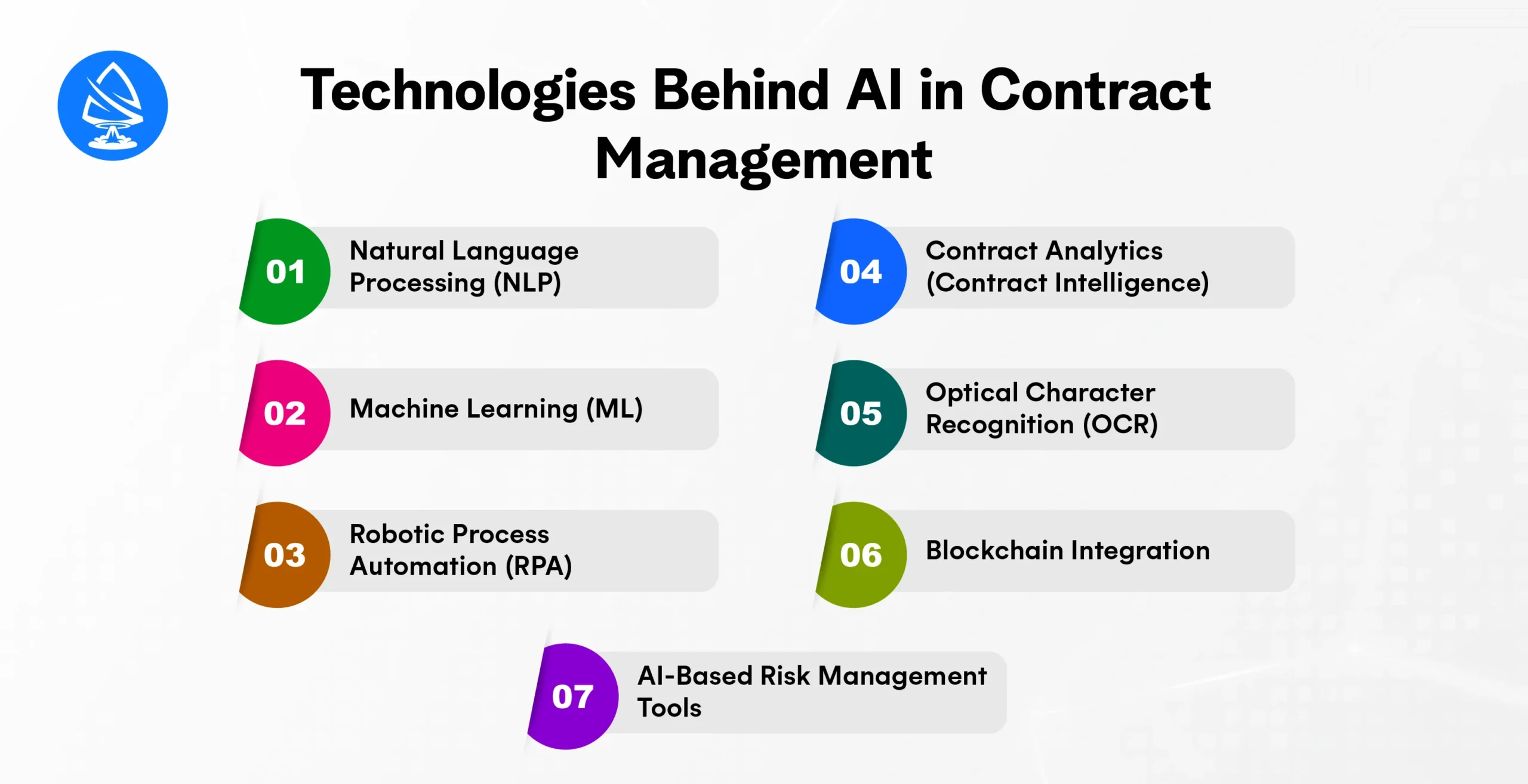
1. Natural Language Processing (NLP)
One of the most essential AI technologies used in contract management is Natural Language Processing (NLP). NLP enables machines to understand, interpret, and generate human language.
How NLP Works in Contract Management:
Clause Identification: NLP algorithms can automatically identify and extract key clauses in contracts, such as payment terms, termination clauses, and confidentiality agreements.
Text Summarization: NLP can summarize lengthy legal documents, making it easier for legal teams to understand key contract details without reading the entire document.
Data Extraction: AI systems powered by NLP can extract critical data from contracts, such as dates, parties involved, amounts, and other essential terms. This data is then stored in a structured format for easy retrieval and analysis.
2. Machine Learning (ML)
Machine learning enables systems to learn from data and improve without explicit programming. In contract management, ML analyzes contract data to identify patterns and predict outcomes.
How ML Works in Contract Management:
Contract Review and Analysis: ML models can analyze past contract data to identify trends, discrepancies, and high-risk clauses that need attention. Over time, the system learns from new data and becomes better at identifying risks and opportunities in contracts.
Predictive Analytics: ML can predict outcomes based on historical data, such as the likelihood of a contract being renewed or breached, helping businesses proactively manage risks and opportunities.
Contract Optimization: ML can analyze various contract terms to suggest optimizations, such as better clauses or terms that align with previous successful agreements.
3. Robotic Process Automation (RPA)
Robotic Process Automation (RPA) is a technology used to automate repetitive, rule-based tasks.
How RPA Works in Contract Management:
Document Generation: RPA can automatically create contracts based on predefined templates, pulling relevant data from other sources to populate fields such as contract dates, parties involved, and terms.
Contract Approval Workflow: RPA automates the workflow by routing contracts to the appropriate stakeholders for approval and notifying them of required actions, reducing delays and errors in the approval process.
Data Entry and Updates: RPA bots can update contract details in systems, ensuring that contract data is always accurate and up to date across all platforms.
4. Contract Analytics
This technology uses AI to evaluate contracts at a deeper level, providing more advanced insights that traditional methods can’t offer.
How Contract Analytics Works:
Risk Detection: AI-powered contract analytics tools can identify high-risk clauses or obligations in contracts that may result in legal disputes, compliance issues, or financial loss.
Clause and Term Analysis: Contract analytics tools evaluate the effectiveness of specific clauses, ensuring that they are aligned with business goals and compliant with regulations.
Compliance Monitoring: These tools can continuously monitor contract terms for compliance with internal policies and legal regulations, alerting stakeholders when action is needed.
5. Optical Character Recognition (OCR)
Optical Character Recognition converts scanned documents, PDFs, and images into searchable, editable data. OCR helps AI extract information from physical and non-editable contract documents.
How OCR Works in Contract Management:
Data Extraction from Scanned Contracts: OCR enables AI systems to scan contracts and extract information such as dates, parties involved, contract amounts, and clauses, which can then be analyzed and processed.
Integration with AI Systems: Once OCR has converted the document to digital text, AI tools can analyze it using NLP and ML to extract and understand relevant contract terms.
Searchability: After OCR processes the document, contracts become searchable in digital form, making it easier to find specific clauses or terms.
6. Blockchain Integration
Blockchain is increasingly integrated with AI to enhance contract security and transparency. Its decentralized ledger securely records contracts and prevents tampering or fraud.
How Blockchain Works in Contract Management:
Smart Contracts: Blockchain enables the use of smart contracts, which are self-executing contracts with the terms of the agreement directly written into code. These contracts automatically execute when predefined conditions are met, reducing the need for intermediaries.
Security and Transparency: Blockchain records every action taken on a contract, providing a transparent, auditable trail of events that is immutable, ensuring that all contract-related actions are securely recorded and traceable.
7. AI-Based Risk Management Tools
AI-powered risk management tools are essential for identifying and mitigating potential risks in contracts. These tools leverage AI to continuously monitor contract clauses, flagging any potential issues before they become critical.
How AI-Based Risk Management Works:
Continuous Monitoring: AI can monitor ongoing contracts for any clauses that could expose the business to potential risks, such as financial penalties or compliance violations.
Predictive Risk Analysis: AI tools analyze historical contract data to predict potential risks in future contracts, enabling proactive management and mitigation.
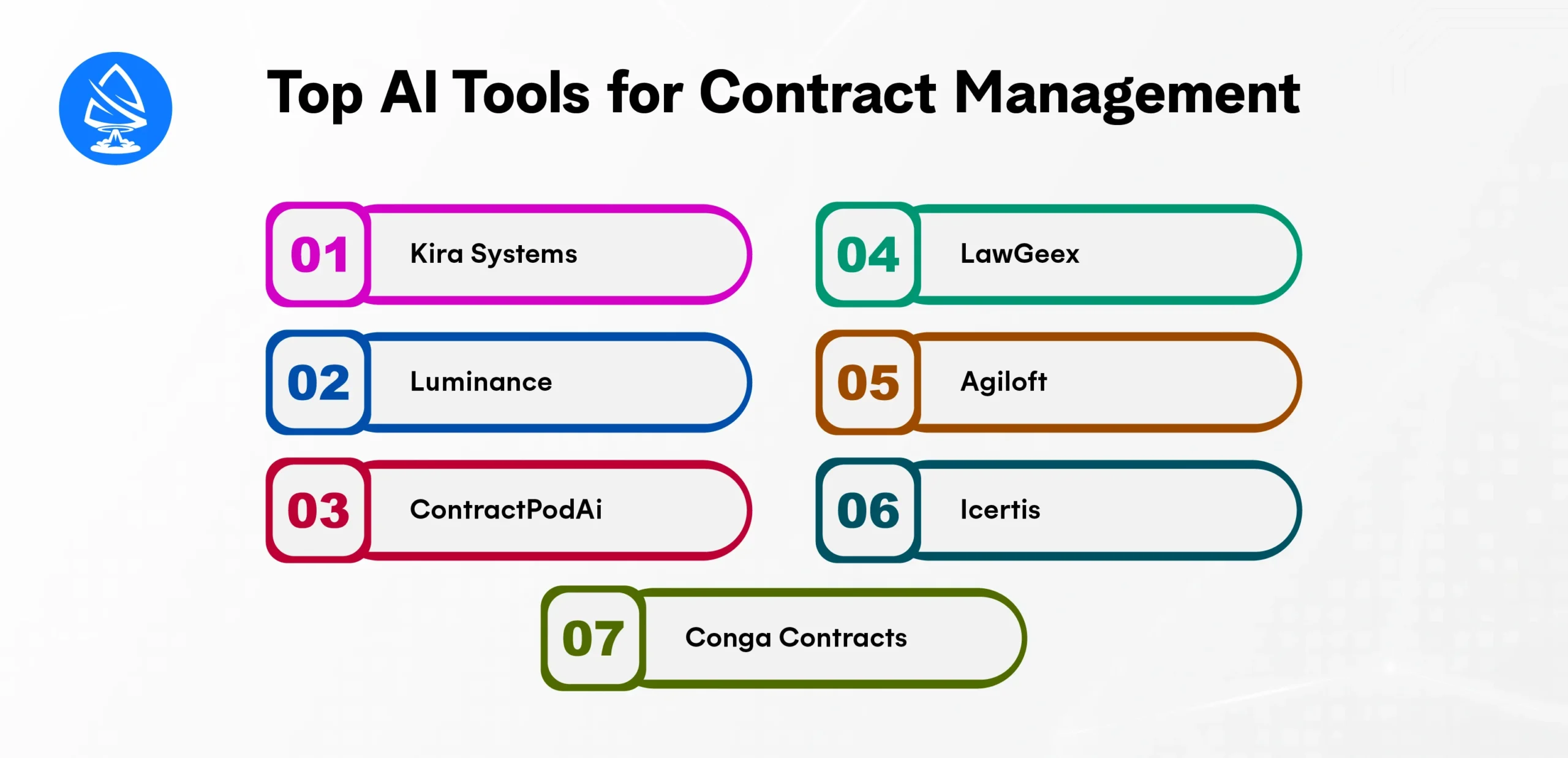
Top AI Tools for Contract Management
Contract management is a critical process for businesses, particularly in industries where legal agreements play a central role in operations. AI provides powerful tools to streamline the entire contract lifecycle, from creation to compliance and analysis. These tools automate tasks, reduce errors, improve compliance, and deliver valuable contract insights.
Below are some of the top AI tools for contract management, designed to enhance productivity, improve accuracy, and reduce risks.
1. Kira Systems
Kira Systems uses machine learning and NLP to automate contract review and analysis. It helps legal and financial teams process large contract volumes quickly and accurately.
Key Features:
Contract Review and Data Extraction: Kira can automatically extract important contract clauses, terms, and conditions, making it easier for legal teams to review complex documents.
Customizable Models: It uses customizable machine learning models that can be tailored to specific needs, allowing users to focus on the most relevant data points for their organization.
Search and Analytics: Kira allows users to search for specific clauses across large datasets of contracts, enabling them to identify trends, risks, and opportunities in their agreements.
2. Luminance
Luminance is an AI-powered contract review software using machine learning for real-time analysis. It helps legal teams identify risks, spot trends, and automate contract reviews effectively.
Key Features:
Automated Document Analysis: Luminance automates the process of reading and understanding contracts, using AI to identify key terms and clauses that require attention.
AI-Powered Risk Detection: The system detects potential risks in contract terms and provides users with a summary of key risks or deviations from company standards.
Advanced Search: Luminance allows users to search across multiple contracts for specific terms, clauses, or conditions, making it easy to locate specific information.
3. ContractPodAi
ContractPodAi is a comprehensive contract management solution that uses AI to automate the creation, management, and review of contracts. It integrates NLP and machine learning technologies to simplify the contract lifecycle and increase efficiency across the organization.
Key Features:
Automated Contract Creation: The platform allows businesses to automatically generate contracts from pre-approved templates, ensuring consistency and reducing errors.
AI Contract Review: ContractPodAi reviews contracts in real-time, highlighting important clauses and flagging risks.
Contract Analytics: The platform provides detailed analytics on contract performance, helping businesses identify key performance metrics and areas for improvement.
Collaboration Features: ContractPodAi offers tools for collaboration and workflow management, making it easier for teams to work together on contract creation and negotiation.
4. LawGeex
LawGeex is an AI-powered contract review software that specializes in automating the process of reviewing legal documents.
Key Features:
Automated Legal Review: LawGeex compares contract clauses with established legal standards, ensuring that agreements comply with internal and regulatory requirements.
Risk and Compliance Identification: The AI system automatically identifies risky clauses or non-compliant terms, allowing businesses to address issues before they become problematic.
High Accuracy: LawGeex boasts high accuracy in contract review, often performing at a level comparable to human lawyers, but much faster.
5. Agiloft
Agiloft offers a robust AI contract management solution designed to help businesses automate contract workflows and improve contract compliance. With its customizable templates and AI-powered tools, Agiloft is widely used across industries such as manufacturing, healthcare, and government.
Key Features:
Contract Lifecycle Management: Agiloft provides end-to-end contract lifecycle management, automating the entire process from creation and review to approval and renewal.
AI-Powered Workflow Automation: The platform offers workflow automation tools that streamline approval, negotiation, and execution processes.
Advanced Search and Reporting: Agiloft’s search functionality allows businesses to quickly locate contract terms, clauses, or obligations across multiple contracts.
Compliance Tracking: The system tracks key compliance milestones and sends automatic alerts when action is needed, such as for renewals or compliance checks.
6. Icertis
Icertis is a leader in contract lifecycle management (CLM) that leverages AI to streamline contract management processes and improve contract visibility. It uses advanced AI technologies to analyze contract terms, track key obligations, and mitigate risks.
Key Features:
Contract Repository: Icertis creates a centralized repository for all contracts, making it easy for businesses to store, access, and manage contracts from various departments.
AI-Driven Risk Management: The platform uses AI-powered analytics to identify risks, track compliance, and ensure that contractual obligations are met.
Smart Contracting: Icertis supports smart contracts, which automatically execute predefined actions when certain conditions are met, ensuring faster and more secure contract execution.
End-to-End Automation: From contract creation to approval, negotiation, and renewal, Icertis automates the entire contract lifecycle, improving efficiency and reducing errors.
7. Conga Contracts
Conga Contracts offers a suite of AI-powered tools to help businesses manage contracts from initiation to execution.
Key Features:
Contract Creation and Automation: Conga Contracts helps users automate contract creation by using AI to fill in contract templates with the relevant data and clauses.
Collaboration Tools: The platform offers tools that allow legal and business teams to collaborate more effectively during the contract creation and negotiation process.
Contract Analysis and Optimization: Conga uses AI to analyze contract data, providing insights and suggestions for improving contract terms or identifying opportunities for negotiation.
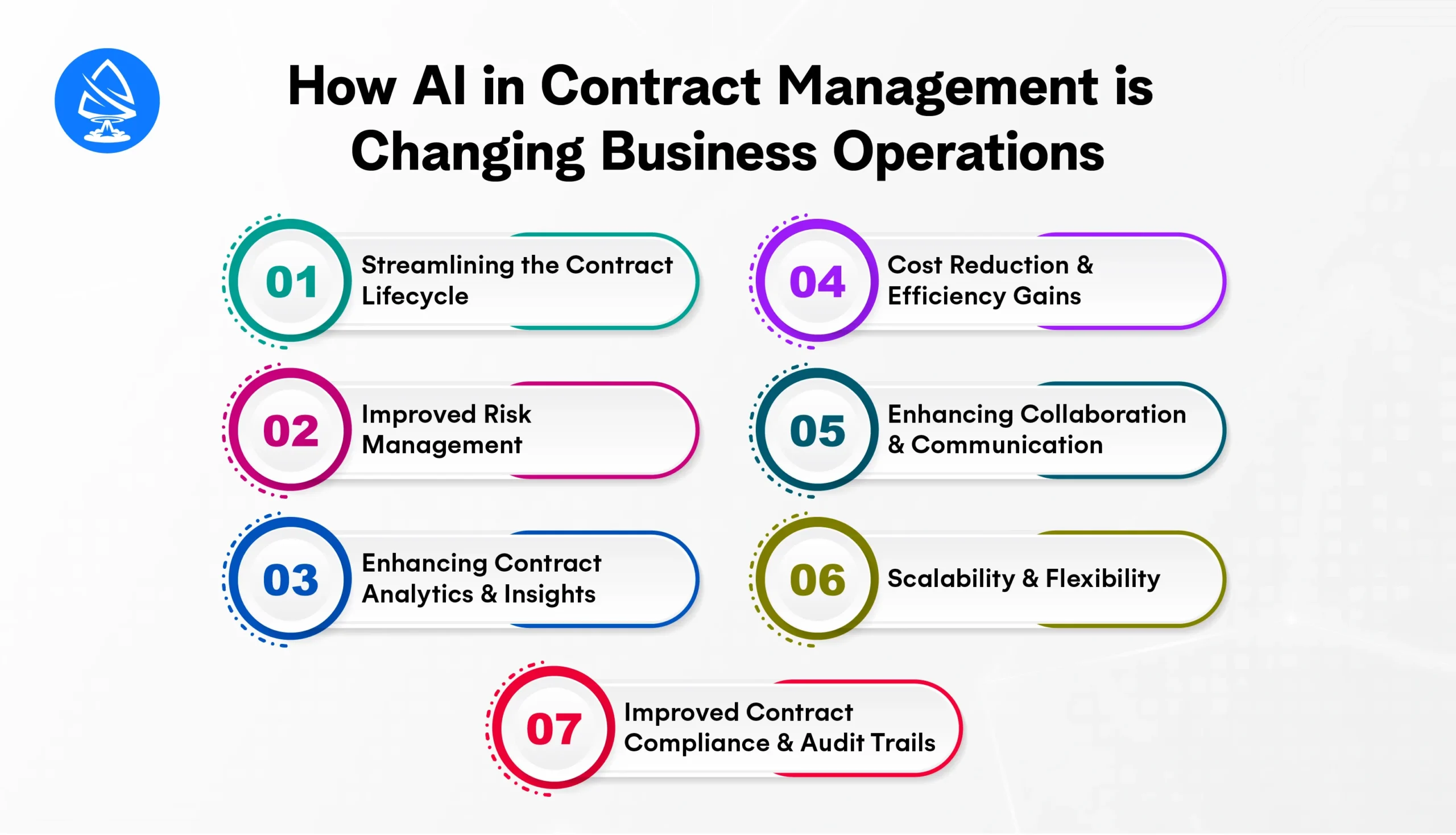
How AI in Contract Management is Changing Business Operations
The advent of artificial intelligence (AI) has drastically altered many aspects of business operations, and one area where its impact is particularly profound is contract management. Traditional contract management processes are often complex, time-consuming, and prone to human error.
1. Streamlining the Contract Lifecycle
Traditionally, contract management has involved various manual steps, including drafting, reviewing, negotiating, approving, and monitoring contracts. These steps are time-consuming and prone to delays due to human error, communication gaps, and document mismanagement.
How AI is Transforming the Contract Lifecycle:
Automated Drafting: AI tools can automatically generate contract drafts based on pre-established templates. These templates can be customized based on business-specific requirements, drastically reducing the time it takes to create a contract.
Contract Review and Approval: AI-powered systems use natural language processing (NLP) to analyze contract text, flagging key clauses and terms, and even suggesting edits to ensure compliance with company policies and regulations. This speeds up the approval process and reduces the risk of missing critical terms.
Approval Workflows: With AI-driven automation, contracts can be routed automatically to the appropriate stakeholders for approval, reducing the bottleneck created by manual processes and increasing speed.
2. Improved Risk Management
AI enhances risk management in contract management by analyzing contract data and identifying potential risks before they become serious issues. In traditional contract management, identifying risks often required manually reviewing each clause, which could be time-consuming and incomplete.
How AI is Improving Risk Management:
Contract Risk Analysis: AI tools use machine learning to identify patterns and inconsistencies across contracts that could signal potential risks, such as ambiguous terms, non-compliance with regulations, or financially unfavorable clauses.
Predictive Analytics: AI models can predict future risks based on historical data, such as identifying contracts that are likely to lead to disputes, late payments, or contract breaches. This allows businesses to take proactive measures to address risks.
Compliance Monitoring: AI constantly monitors contracts for compliance, ensuring that each agreement adheres to both internal policies and external regulatory requirements. Automated compliance checks also reduce the risk of human error or missed deadlines.
3. Enhancing Contract Analytics and Insights
AI is bringing an unprecedented level of contract analytics to businesses. Traditional contract management systems stored contracts in repositories but lacked the tools to analyze and extract meaningful insights from them. AI, however, can analyze contracts at scale, extracting key data and generating insights that inform better business decisions.
How AI is Revolutionizing Contract Analytics:
Clause and Term Analysis: AI tools can quickly identify specific clauses, terms, or obligations across a range of contracts. For example, businesses can easily identify contracts that contain similar payment terms, expiration dates, or indemnification clauses.
Data Extraction: AI can extract essential contract data, such as financial terms, renewal dates, and obligations, and populate it into structured databases, making it easier for legal and operational teams to track key information.
Advanced Reporting: AI-powered contract management tools can create reports based on contract data, such as contract renewal rates, missed deadlines, or performance indicators, providing actionable insights for decision-making.
4. Cost Reduction and Efficiency Gains
AI reduces costs and improves operational efficiency in contract management. By automating routine tasks, businesses reduce overhead and improve contract process speed and quality.
How AI Drives Cost Savings:
Labor Efficiency: AI automation reduces the need for large legal teams to manually draft, review, and approve contracts, freeing up resources to focus on more strategic and higher-value tasks.
Fewer Errors and Disputes: AI helps reduce human errors in contract management, which could otherwise lead to costly legal disputes or missed deadlines. The accuracy and consistency AI offers help businesses avoid fines, penalties, and disputes related to contract non-compliance.
Faster Processing: AI tools dramatically speed up the contract lifecycle, reducing delays and enabling quicker responses to contract creation and renewal, ensuring faster deal closures.
5. Enhancing Collaboration and Communication
AI in contract management not only automates processes but also enhances collaboration and communication across teams. Contracts typically require input from multiple stakeholders, including legal, procurement, finance, and executive teams. AI can streamline this collaborative process, making it more transparent and efficient.
How AI Facilitates Collaboration:
Centralized Contract Repository: AI tools provide a single, secure, and searchable repository for all contracts, enabling stakeholders across departments to access and collaborate on contract-related documents with ease.
Real-Time Updates: AI contract management systems provide real-time updates on contract status, allowing stakeholders to track progress and take action as needed, without delays.
Improved Communication: AI systems can automatically route contracts to the appropriate people, ensuring timely approvals and that all teams are aligned throughout the contract process.
6. Scalability and Flexibility
As businesses grow, so does the volume of contracts they manage. Traditional contract management processes often struggle to keep up with increasing volumes, leading to inefficiencies.
How AI Supports Scalability:
Handling Large Volumes of Contracts: AI can process, analyze, and review large volumes of contracts at scale, making it easier for businesses to manage hundreds or even thousands of contracts simultaneously.
Flexible Solutions: AI contract management tools can be customized to meet the specific needs of different industries, making them adaptable to various types of contracts and workflows.
Integration with Other Systems: Many AI-powered contract management tools can integrate with existing enterprise systems (e.g., ERP or CRM systems), allowing businesses to manage contracts across departments seamlessly.
7. Improved Contract Compliance and Audit Trails
Maintaining compliance with contracts is a crucial part of managing legal agreements. Non-compliance can lead to legal disputes, penalties, or business risks. AI tools help businesses monitor and ensure compliance with contract terms and obligations, reducing the likelihood of breaches.
How AI Improves Compliance:
Continuous Monitoring: AI systems can continuously monitor contracts for compliance with company policies, regulations, and legal standards, alerting businesses when action is required.
Audit Trails: AI provides a transparent, digital audit trail for all contract-related actions, from creation to approval and execution. This ensures accountability and traceability, especially in highly regulated industries.
Automated Compliance Checks: AI systems can automatically check contracts for compliance with industry-specific regulations, legal frameworks, and organizational policies.
Conclusion
The integration of AI in contract management is revolutionizing how businesses handle contracts. AI-powered tools automate tasks, reduce errors, mitigate risks, and improve contract compliance. AI contract analysis improves efficiency, lowers costs, and delivers valuable insights. Partnering with a US-based AI development company enables customized contract management solutions.
By adopting AI contract management software, businesses can streamline their operations, enhance productivity, and ensure better compliance with evolving regulations. As AI continues to evolve, the future of contract management is increasingly being defined by smart, automated, and data-driven technologies.
Frequently Asked Questions
1. What is AI in contract management?
AI in contract management uses machine learning and NLP to automate contract review, creation, and compliance tracking.
2. How does AI improve contract review?
AI speeds contract review by extracting key clauses, flagging risks, and ensuring compliance.
3. What are the benefits of AI in contract management?
The main benefits include improved efficiency, cost reduction, enhanced accuracy, risk mitigation, and better compliance tracking.
4. Can AI be used to automate contract drafting?
Yes, AI contract tools automate draft creation using templates and historical data for accuracy.
5. What is contract intelligence?
Contract intelligence uses AI to analyze contract data, improve terms, detect risks, and generate insights.
6. How does AI detect contract risks?
AI uses machine learning and NLP to identify risky clauses, ambiguities, and compliance issues in contracts.
7. What are AI-powered contract management systems?
AI-powered contract systems automate review, data extraction, compliance tracking, and risk analysis.
8. How can businesses implement AI in contract management?
Businesses can implement AI in contract management through partnerships, proper tools, and system integration.
Written By :
Artoon Solutions
Artoon Solutions is a technology company that specializes in providing a wide range of IT services, including web and mobile app development, game development, and web application development. They offer custom software solutions to clients across various industries and are known for their expertise in technologies such as React.js, Angular, Node.js, and others. The company focuses on delivering high-quality, innovative solutions tailored to meet the specific needs of their clients.



 For business inquiries only