- HR:+91-879-9184-787
- Sales:+91-908-163-7774


The legal industry is no stranger to innovation, but in recent years, the integration of artificial intelligence (AI) into legal practices has ushered in a new era of automation, efficiency, and precision. AI in law is transforming various aspects of legal work, including legal research and document review, as well as providing automated legal advice and enhancing client interactions. As the AI legal software landscape continues to evolve, the impact on the legal field is profound and far-reaching.
This article explores AI applications in law, including chatbots, research assistants, and automated legal advice. Additionally, we will examine the AI regulations and ethical considerations shaping this rapidly growing field. This guide offers insights into AI’s current and future role in the legal industry. To fully harness the potential of AI in your legal practice, you can hire AI developers to build customized solutions tailored to your needs.
AI adoption in law is growing as firms automate tasks and reduce costs. Lawyers can focus more on strategic and client-facing work.
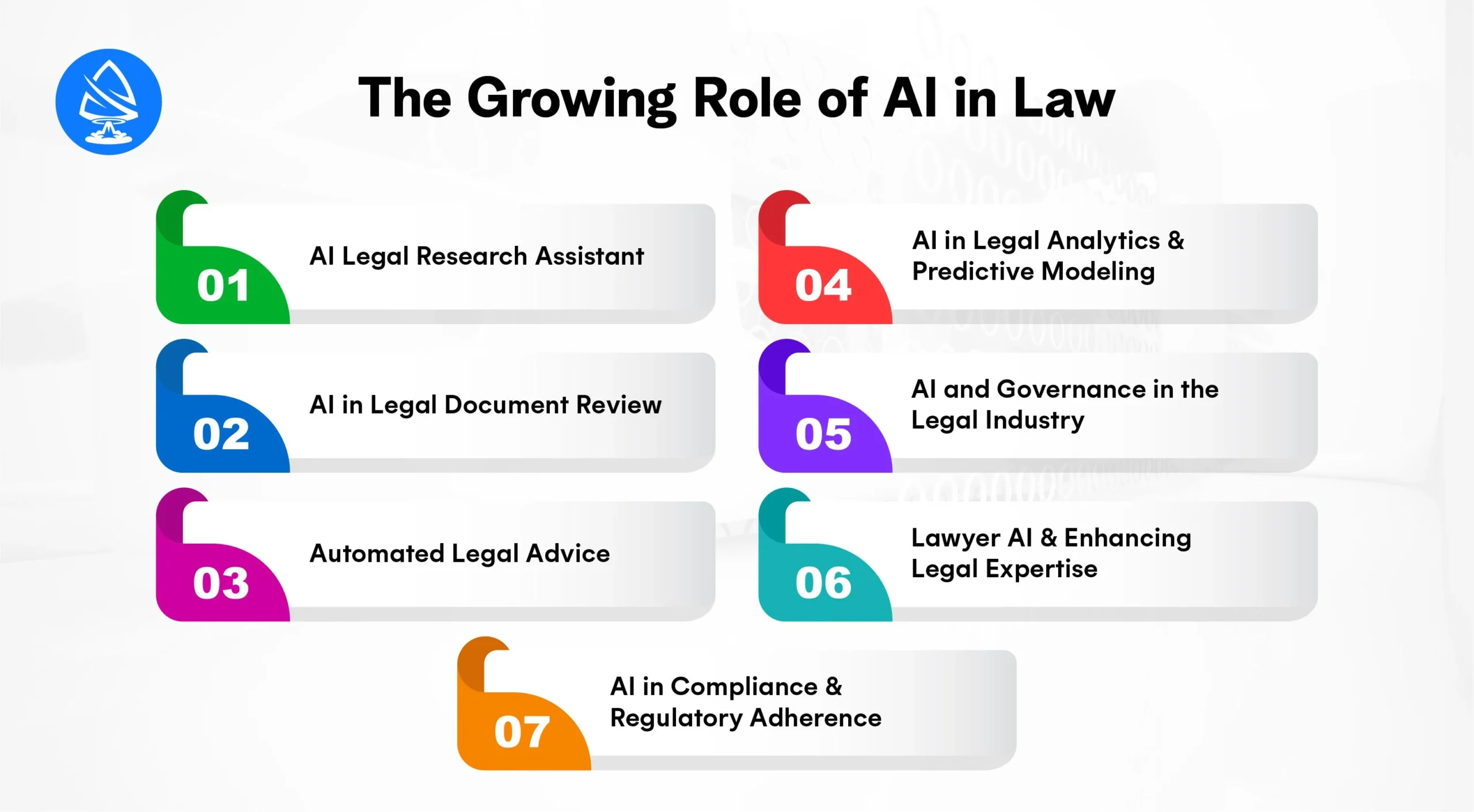
Legal research is time-consuming and labor-intensive for lawyers. AI tools speed up research by quickly analyzing large legal datasets.
You may also want to know about Artificial Superintelligence
Reviewing contracts and legal documents is time-consuming and error-prone. AI tools speed up document review and improve accuracy.
One of the most exciting developments in AI in law is the advent of automated legal advice. AI legal chatbots provide basic advice, reduce workload, and deliver faster client responses.
AI-driven analytics provide predictive insights for legal strategy and litigation planning. Machine learning models deliver data-driven insights for legal practitioners.
As the use of AI in law continues to grow, there is a critical need for AI governance and regulation to ensure that AI systems are being used ethically and responsibly. Governments and regulatory bodies are working to establish guidelines for the ethical use of AI in the legal field.
AI for law is not about replacing lawyers; rather, it is about enhancing their abilities and making their work more efficient. AI tools are designed to assist lawyers in their tasks, allowing them to deliver better outcomes and improve their expertise.
You may also want to know AI in Supply Chain Management
AI is transforming the legal industry through research automation, document review, and client engagement. Law firms use AI to improve efficiency, reduce costs, and enhance service quality.
AI tools like research assistants, contract review, and legal chatbots are reshaping legal work. However, the integration of AI in law also raises important questions around AI governance, data privacy, and ethics. As AI regulations evolve, legal professionals must stay informed and ensure compliance.
For law firms looking to embrace AI technologies, partnering with an artificial intelligence development company or hiring AI developers can help build customized solutions tailored to their specific needs. AI will play an essential role in shaping the future of legal practice.
1. How is AI used in law?
AI in law is used for automated legal advice, legal research, document review, and case prediction. It helps streamline legal processes and enhance efficiency in law firms.
2. What are AI legal chatbots?
AI legal chatbots are automated tools that provide clients with basic legal advice and assist in legal processes, such as answering frequently asked questions or processing simple legal queries.
3. Can AI replace lawyers?
AI is designed to assist lawyers, not replace them. While it automates repetitive tasks like research and document review, human expertise and judgment remain essential for complex legal issues.
4. What is an AI legal research assistant?
An AI legal research assistant is a tool that uses natural language processing and machine learning to analyze large datasets of legal documents and provide relevant case law and insights for lawyers.
5. How does AI improve legal document review?
AI improves legal document review by automating the analysis of contracts and other legal texts, identifying key clauses, potential risks, and inconsistencies more efficiently than manual methods.
6. What is the role of AI in compliance and regulations?
AI helps with compliance by automating the monitoring of regulatory changes, managing risk, and generating reports, ensuring businesses adhere to legal standards and regulations.
7. How does AI assist with client interactions in law firms?
AI tools like chatbots and virtual assistants help law firms engage with clients by providing instant responses to inquiries, scheduling appointments, and assisting in document processing.
8. What are the ethical concerns surrounding AI in law?
Ethical concerns include data privacy, bias in AI algorithms, and accountability for AI-driven legal decisions. It’s essential to establish ethical guidelines for AI use in the legal field to ensure fairness and transparency.

Artoon Solutions
Artoon Solutions is a technology company that specializes in providing a wide range of IT services, including web and mobile app development, game development, and web application development. They offer custom software solutions to clients across various industries and are known for their expertise in technologies such as React.js, Angular, Node.js, and others. The company focuses on delivering high-quality, innovative solutions tailored to meet the specific needs of their clients.
 For business inquiries only