- HR:+91-879-9184-787
- Sales:+91-908-163-7774


Data is the backbone of every modern enterprise, but inconsistent, duplicate, and poorly governed data can quickly turn that backbone into a bottleneck. As organizations scale across products, regions, and systems, managing core business entities like customers, products, suppliers, and locations becomes increasingly complex. Traditional AI in Master Data Management (MDM) systems helped centralize and standardize data, but they often struggle with volume, velocity, and variety in today’s digital landscape.
This is where AI in Master Data Management is changing the game. By embedding artificial intelligence and machine learning into MDM, organizations can automatically cleanse, match, enrich, and govern master data at scale. AI-driven MDM reduces manual effort, improves accuracy, accelerates ERP initiatives, and enables trusted analytics across the enterprise.
For founders, CTOs, product managers, and enterprise decision-makers, AI-powered MDM is no longer a back-office upgrade; it’s a strategic enabler for digital transformation. This guide explains what AI in MDM is, how it works, real-world use cases, benefits, challenges, and best practices to implement it successfully.
What Is Master Data Management? Master Data Management (MDM) is a disciplined approach to creating, maintaining, and governing a single, trusted source of truth for an organization’s most critical business data. Master data represents the core entities that remain relatively stable across systems and processes, such as customers, products, suppliers, locations, and employees. MDM ensures this data is accurate, consistent, and shared uniformly across the enterprise.
Below are the key sub-points that explain Master Data Management in detail.
Master data is the foundational data used by multiple departments and systems across an organization.
Common master data domains:
MDM focuses on managing these entities centrally to avoid duplication and inconsistency.
One of the primary goals of Master Data Management is to establish a single, authoritative version of each master data record.
Why this matters:
Without MDM, different systems often maintain different versions of the same data.
MDM synchronizes master data across ERP, CRM, billing, supply chain, and analytics platforms.
Why this matters:
This is especially critical for master data in ERP environments.
MDM enforces data quality standards such as accuracy, completeness, uniqueness, and validity.
Key activities include:
High-quality master data directly impacts operational efficiency.
Master Data Management defines clear ownership, approval workflows, and policies for data changes.
Why this matters:
Governance is a core pillar of any enterprise-grade master data solution.
MDM creates standardized data models that define how master data entities are structured.
Why this matters:
This standardization supports long-term growth and digital transformation.
MDM supports both operational processes and analytics by providing reliable, reusable data.
Business impact:
These outcomes drive many real-world master data management use cases.
Modern MDM is the foundation for AI, analytics, and automation initiatives.
Why this matters:
This is why MDM is often described as the backbone of enterprise data strategy.
You may also want to know about AI in Self-Driving Cars
What Is AI in Master Data Management? AI in Master Data Management refers to the application of artificial intelligence technologies such as machine learning, natural language processing, and pattern recognition to automate, enhance, and scale traditional Master Data Management (MDM) processes. Instead of relying solely on static rules and heavy manual intervention, AI-driven MDM systems learn from data patterns to continuously improve data quality, matching accuracy, and governance.
Below are the key sub-points that explain AI in Master Data Management in detail.
AI automates repetitive and time-consuming MDM tasks that were traditionally handled by data stewards.
Key capabilities:
This makes AI in Master Data Management faster and more scalable than rule-based MDM.
AI uses machine learning models to identify duplicate or related records even when data values do not exactly match.
Key capabilities:
This approach is commonly referred to as MDM AI or master data management machine learning.
AI automatically classifies master data and enriches it using internal and external sources.
Key capabilities:
This significantly improves the usability of master data across systems.
AI models continuously assess data quality and predict potential issues before they impact downstream systems.
Key capabilities:
This is a major upgrade over traditional reactive data quality checks.
AI uses NLP to understand and process unstructured or semi-structured master data attributes.
Key capabilities:
This expands MDM beyond rigid, structured datasets.
AI supports data governance by recommending actions and prioritizing records that need human attention.
Key capabilities:
Human experts remain in control, but AI optimizes their workload.
Unlike traditional MDM systems, AI-driven MDM improves as more data and decisions are processed.
Key capabilities:
This adaptability is central to the long-term value of AI in Master Data Management.
AI-powered MDM provides clean, consistent master data that fuels analytics, ERP, CRM, and AI initiatives.
Business impact:
This is why AI-driven MDM is critical for data management for AI and data management artificial intelligence strategies.
Traditional MDM solutions face several limitations:
As organizations adopt cloud, SaaS, and data-driven products, these limitations become blockers for master data in ERP and analytics initiatives.
How AI in Master Data Management works can be understood as an intelligent, end-to-end process that continuously ingests, analyzes, cleanses, matches, and governs master data using learning-based automation. Unlike traditional MDM, which depends on static rules and manual intervention, AI-driven MDM adapts dynamically as data, sources, and business needs evolve.
Below is a detailed breakdown with clear sub-points.
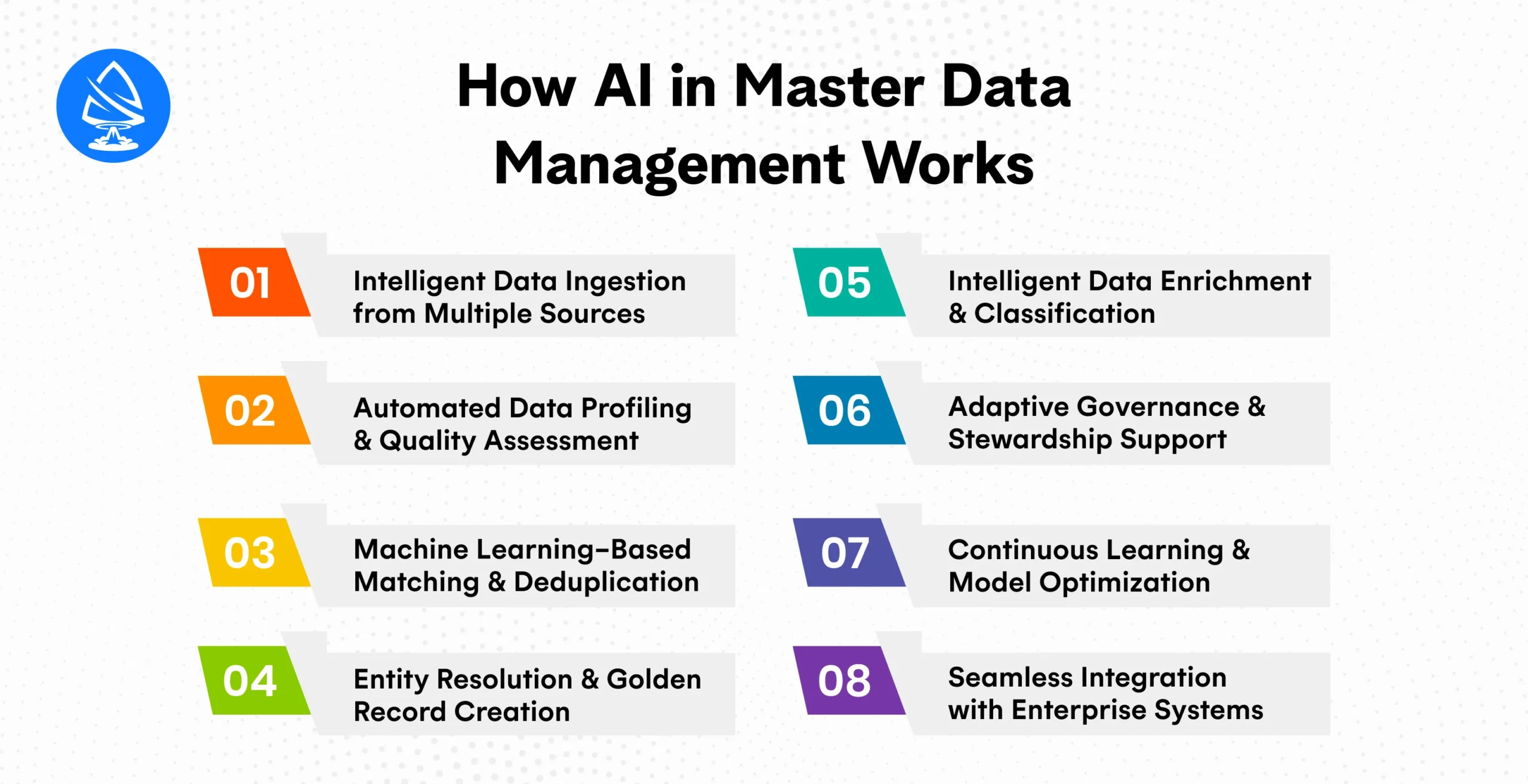
AI-powered MDM systems ingest master data from diverse internal and external sources such as ERP, CRM, eCommerce platforms, data lakes, and third-party feeds.
How AI helps:
This step is foundational for scalable AI in Master Data Management implementations.
Once ingested, AI analyzes the data to understand patterns, completeness, accuracy, and anomalies.
How AI helps:
This replaces slow, manual data audits with continuous intelligence.
AI uses machine learning models to identify duplicate or related records even when values don’t exactly match.
How AI helps:
This is a core capability of master data management, machine learning, and MDM AI.
AI determines which data attributes are most trustworthy and combines them into a single, authoritative “golden record.”
How AI helps:
This step is critical for reliable master data in ERP and analytics systems.
AI enriches master data using internal references and external data sources.
How AI helps:
This dramatically increases the usability of master data across business functions.
AI assists data stewards by recommending actions rather than enforcing rigid workflows.
How AI helps:
This balances automation with control in AI in Master Data Management.
AI models continuously learn from new data, feedback, and stewardship decisions.
How AI helps:
This adaptability supports long-term scalability and reduces maintenance effort.
AI-driven MDM synchronizes clean master data back to operational and analytical systems.
How AI helps:
This integration is essential for data management for AI and enterprise analytics.
Learns matching rules and data relationships dynamically.
Understands names, addresses, descriptions, and unstructured attributes.
Models relationships between entities across domains.
Reduces human intervention in stewardship workflows.
Many enterprises build these capabilities with an AI app development company specializing in enterprise data platforms.
These are common customer MDM use cases.
These examples highlight practical master data management use cases.
The benefits of AI in Master Data Management go far beyond automation. By embedding intelligence into core data processes, organizations gain higher data quality, faster insights, and scalable governance, turning master data into a strategic asset. Below are the key benefits explained in detail with clear sub-points.
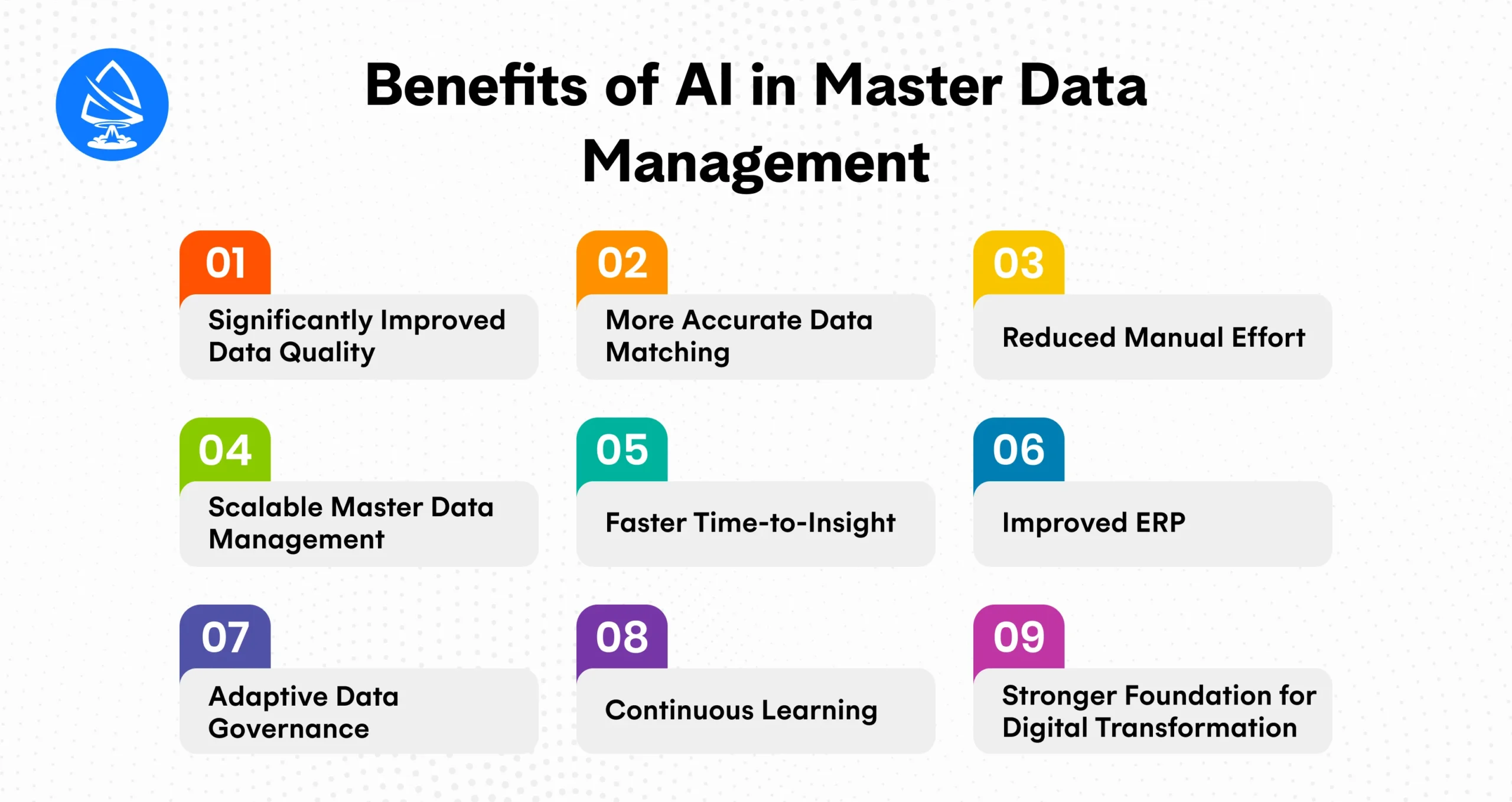
AI continuously cleanses, standardizes, and validates master data across sources.
How this helps:
High-quality data is the foundation of successful AI in Master Data Management initiatives.
Machine learning identifies relationships and duplicates even when records don’t exactly match.
How this helps:
This is a major advantage of master data management and machine learning.
AI automates tasks that traditionally required extensive data steward involvement.
How this helps:
This efficiency is often described as MDM AI in action.
AI handles growing data volumes, sources, and domains without linear increases in effort.
How this helps:
Scalability is essential for modern master data solution strategies.
Clean, trusted master data improves downstream reporting and analytics accuracy.
How this helps:
This directly supports data management for AI and analytics initiatives.
AI-driven MDM provides consistent master data across transactional systems.
How this helps:
This is especially valuable for master data in ERP modernization projects.
AI enforces governance rules intelligently and flags exceptions for review.
How this helps:
This strengthens enterprise data governance without adding friction.
AI models improve as more data and feedback are processed.
How this helps:
This adaptability defines the future of MDM.
AI-powered MDM supports cloud migration, AI initiatives, and omnichannel experiences.
How this helps:
| Aspect | Traditional MDM | AI-Driven MDM |
| Matching | Rule-based | Learning-based |
| Scalability | Limited | High |
| Manual Effort | High | Low |
| Adaptability | Low | Continuous |
| Time-to-Value | Slow | Fast |
While AI in Master Data Management delivers powerful benefits, implementing it successfully comes with real-world challenges. These challenges span data readiness, technology, governance, and organizational change. Understanding them early helps organizations plan effectively and reduce risk. Below are the key challenges of implementing AI in MDM, explained with clear sub-points.
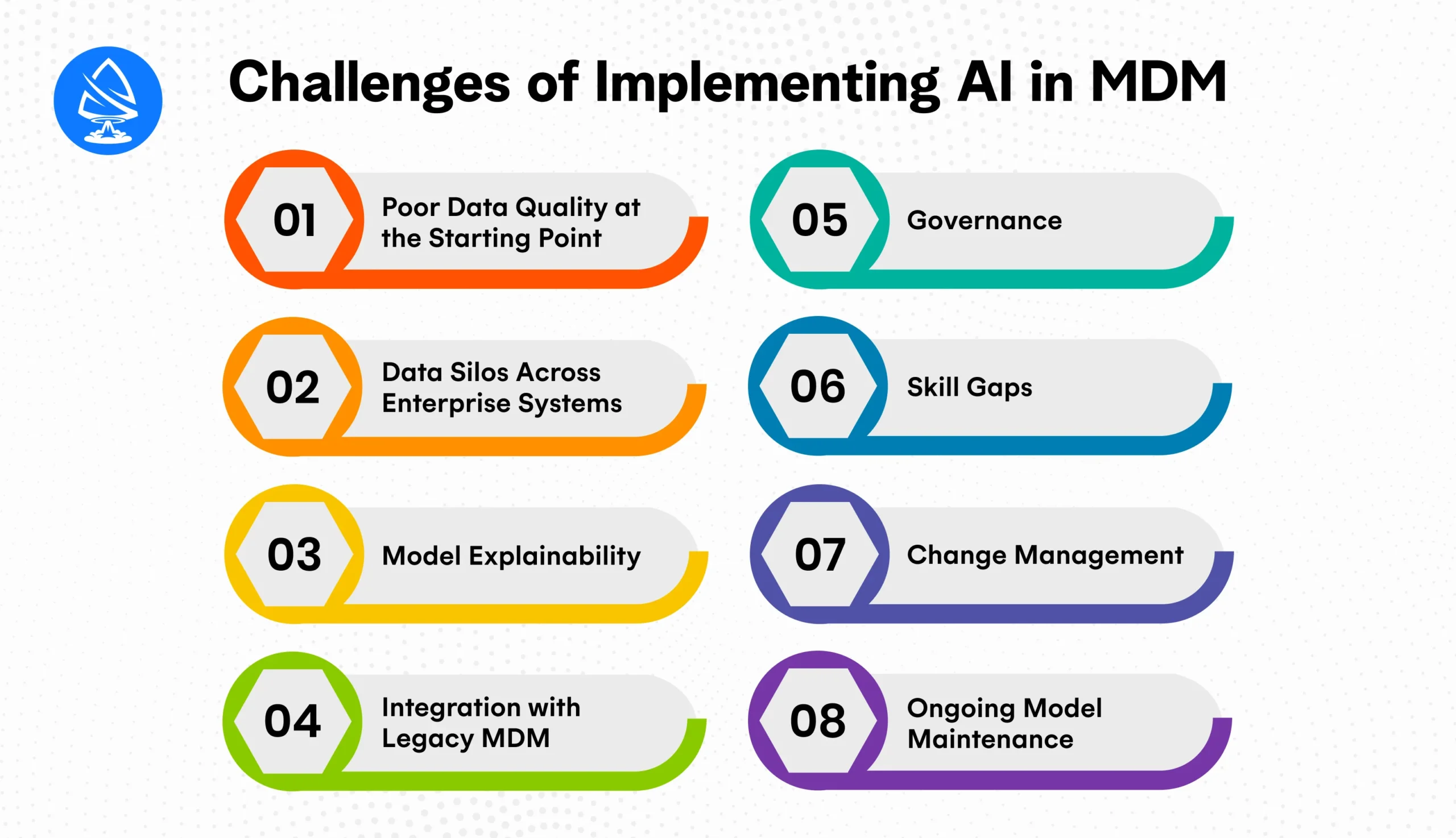
AI models are only as good as the data they learn from. Many organizations begin MDM initiatives with fragmented, inconsistent, or incomplete master data.
Why this is a challenge:
Addressing foundational data quality is essential before scaling AI in Master Data Management.
Master data often resides in multiple disconnected systems, such as ERP, CRM, and legacy databases.
Why this is a challenge:
Breaking down silos is critical for effective master data management and machine learning.
AI-driven matching and decision-making can appear as a “black box” to business users and regulators.
Why this is a challenge:
Explainable AI is increasingly important for enterprise MDM AI adoption.
Many organizations already use traditional MDM platforms or tightly coupled ERP systems.
Why this is a challenge:
This is particularly relevant for master data in ERP environments.
AI introduces automation into data decisions that were previously manual, raising governance questions.
Why this is a challenge:
Strong governance models are required to guide AI in Master Data Management.
Implementing AI-driven MDM requires a mix of data engineering, machine learning, and governance expertise.
Why this is a challenge:
Many organizations address this by partnering with experienced teams or upskilling internally.
Shifting from rule-based MDM to AI-driven processes can face resistance from data teams.
Why this is a challenge:
Successful AI MDM initiatives include strong change management strategies.
AI models must be monitored and retrained as data, business rules, and sources evolve.
Why this is a challenge:
Sustainable AI MDM requires lifecycle management, not one-time deployment.
You may also want to know the Best Web Application Builders
Successfully adopting AI in Master Data Management requires a structured, business-driven approach that balances automation with governance. Organizations that see real value focus on phased execution, strong data foundations, and continuous improvement rather than a one-time technology rollout. Below are the key sub-points that define a successful implementation strategy.
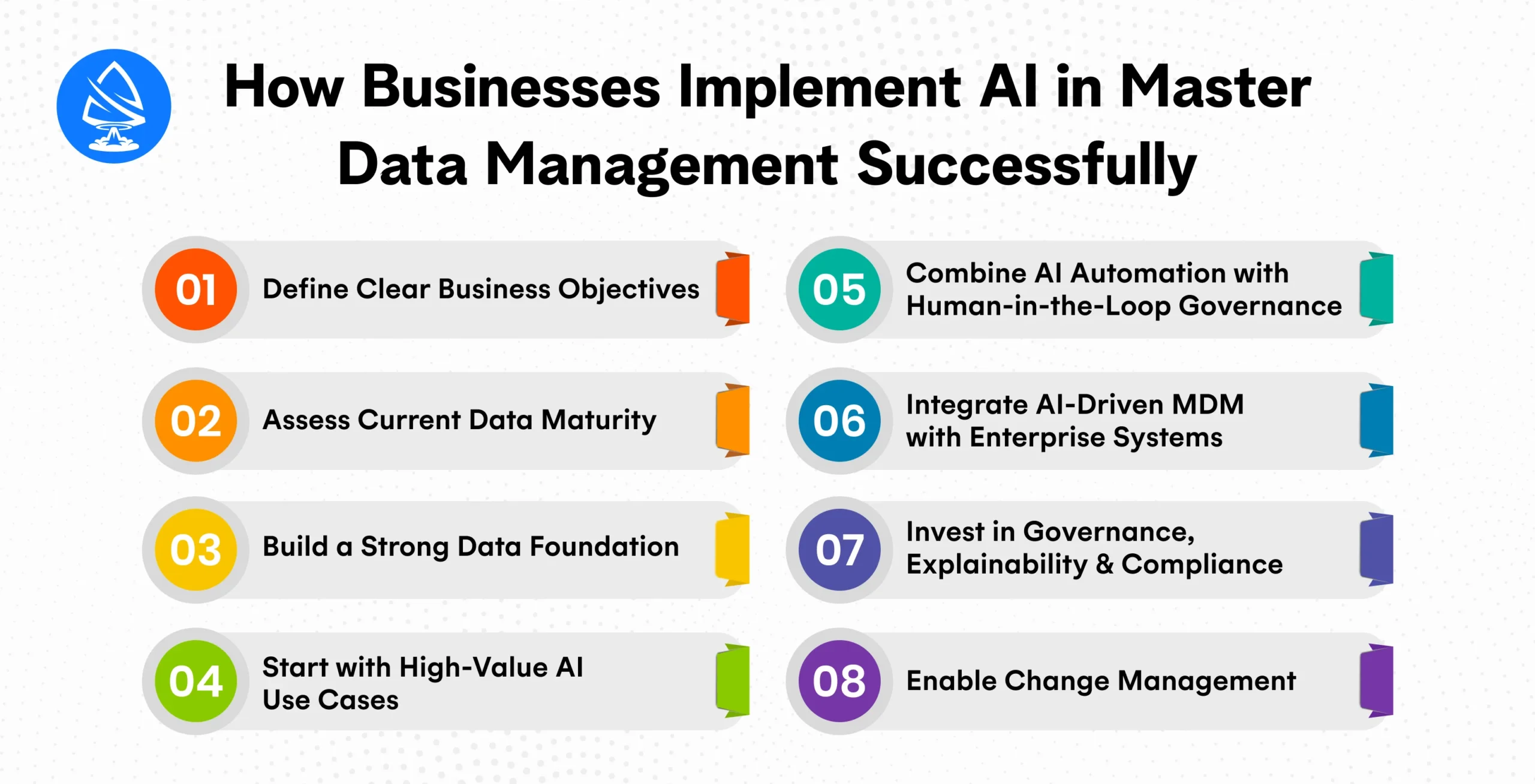
Successful initiatives start by aligning AI-driven MDM with concrete business goals.
What businesses do:
A clear scope ensures AI in Master Data Management delivers measurable ROI.
Before introducing AI, organizations evaluate the state of existing master data and processes.
What businesses do:
This assessment sets realistic expectations for MDM AI adoption.
AI-powered MDM depends on accessible, well-governed data pipelines.
What businesses do:
This foundation is critical for scalable master data management and machine learning.
Rather than automating everything, organizations prioritize use cases with immediate business impact.
Common starting points:
These targeted wins build confidence in AI in Master Data Management.
Successful implementations balance AI-driven recommendations with human oversight.
What businesses do:
This hybrid model increases trust and adoption of MDM AI.
AI-powered master data must flow seamlessly into operational and analytical platforms.
What businesses do:
This integration is especially important for master data in ERP environments.
AI decisions in MDM must be transparent and auditable.
What businesses do:
This step is critical for regulated industries and enterprise trust.
Technology alone does not guarantee success; people do.
What businesses do:
Strong adoption accelerates the value of AI in Master Data Management.
AI-driven MDM is an ongoing capability, not a one-time project.
What businesses do:
Continuous optimization supports the long-term future of MDM.
Many organizations rely on AI app development services to design, implement, and scale these platforms. For custom needs, enterprises often hire AI developers with MDM and data engineering expertise.
The future of MDM is autonomous, adaptive, and embedded into every business process. AI-driven MDM will:
Organizations that invest early gain a significant competitive advantage.
AI in Master Data Management is redefining how enterprises manage their most critical data assets. By automating data quality, matching, and governance, AI-driven MDM delivers faster insights, lower costs, and more reliable decision-making across the organization. In a world where analytics, ERP, and AI initiatives depend on trusted data, modern MDM is no longer an option; it’s foundational.
For business leaders, the path forward is clear: adopt AI-powered MDM as a strategic capability, not just a data project. Whether you’re modernizing ERP, improving customer experience, or preparing for advanced analytics, AI in MDM sets the stage for success.
If you’re planning an AI-driven MDM initiative and want clarity on scope, cost, and timeline, use our AI App Cost Calculator to estimate your investment and take the next step toward a smarter data foundation.
1. What is AI in Master Data Management?
It uses AI to automate and improve master data quality, matching, and governance.
2. How does AI improve MDM accuracy?
By learning patterns and reducing reliance on static rules.
3. Is AI MDM suitable for small businesses?
Yes, scalable solutions exist for SMEs.
4. Can AI MDM integrate with ERP systems?
Yes, it significantly improves ERP data reliability.
5. Does AI replace data stewards?
No, it augments them by automating routine tasks.
6. Is AI-driven MDM secure?
With proper governance, it meets enterprise security standards.
7. How long does implementation take?
Typically faster than traditional MDM due to automation.
8. What skills are needed to run AI MDM?
Data engineering, ML, and governance expertise.

Artoon Solutions
Artoon Solutions is a technology company that specializes in providing a wide range of IT services, including web and mobile app development, game development, and web application development. They offer custom software solutions to clients across various industries and are known for their expertise in technologies such as React.js, Angular, Node.js, and others. The company focuses on delivering high-quality, innovative solutions tailored to meet the specific needs of their clients.
 For business inquiries only