In today’s hyper-connected world, mobile phones are more than just communication tools; they’ve become smart assistants, entertainment hubs, and productivity partners. A major force behind this transformation is Artificial Intelligence (AI) in Mobile Phones. From AI cameras that capture studio-like photos to voice assistants that simplify daily tasks, AI has deeply embedded itself into the smartphone ecosystem.
But this innovation also raises questions: Is AI on phones truly beneficial? Does it improve user experience, or does it introduce risks like privacy concerns? This blog explores the role of AI in mobile devices, its benefits, limitations, and what the future holds. To harness AI’s potential effectively, partnering with an AI App Development company can help you develop mobile solutions that prioritize both innovation and privacy.
What is AI in Mobile Phones?
AI in mobile phones refers to the integration of artificial intelligence technologies such as machine learning (ML), natural language processing (NLP), deep learning, and computer vision into smartphone hardware and software. Unlike traditional phones that follow fixed commands, AI smartphones can learn from user behavior, adapt over time, and make intelligent decisions without explicit instructions.
In simple terms, AI in phones makes your device “smarter” by analyzing data from your daily activities, calls, texts, app usage, photos, voice input, and even your movements. It then uses this information to personalize your experience, optimize performance, and enhance features like cameras, security, and battery life.
Key Capabilities of AI in Phones
AI Camera Features
AI camera phones automatically detect scenes (food, pets, landscapes) and adjust exposure, focus, and color balance.
Computational photography uses AI to improve low-light shots, add depth-of-field effects, and stabilize videos.
Voice Recognition and Assistants
Siri, Google Assistant, and Bixby rely on AI to understand natural language.
These assistants can answer questions, send messages, or control smart home devices.
Performance Optimization
AI algorithms analyze how you use your phone and allocate resources accordingly.
They manage RAM, boost gaming performance, and extend battery life.
Security Enhancements
AI face recognition uses 3D mapping and machine learning to prevent spoofing.
Fingerprint scanning becomes more accurate as AI learns over time.
Predictive and Personalized Experiences
AI predicts which app you’re likely to open next.
Suggests smart replies in messaging apps.
Recommends content, music, or shopping deals tailored to your interests.
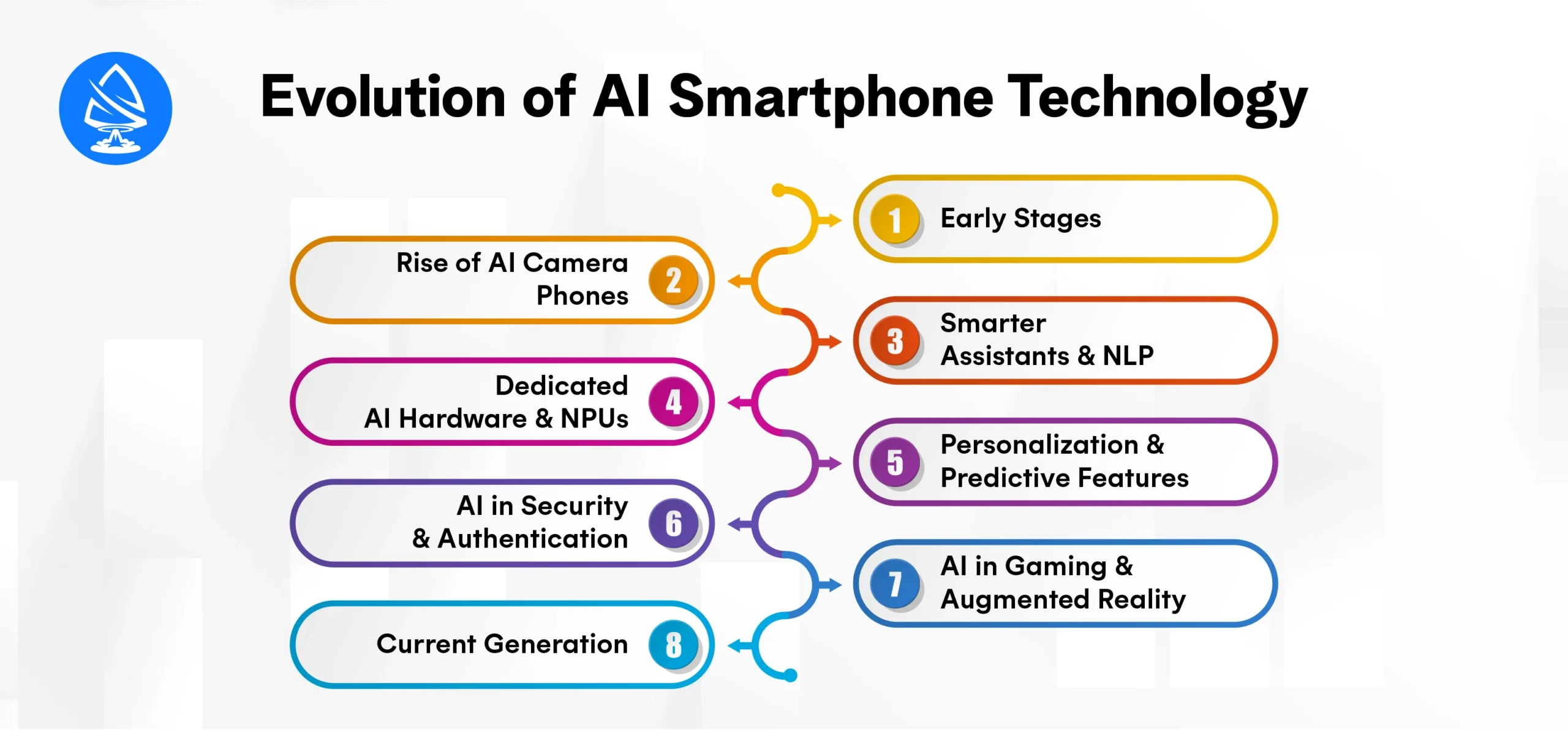
The journey of AI in mobile phones has been nothing short of revolutionary. From simple voice commands to advanced AI-powered ecosystems, smartphones have evolved into intelligent companions that learn, adapt, and enhance user experiences. Let’s walk through the key stages of this evolution:
1. Early Stages – Voice Commands and Basic Automation
The first step toward AI in phones came with voice recognition features like Apple’s Siri (2011) and Google Now (2012).
These assistants could set alarms, make calls, or answer simple queries.
Although limited, they showed the potential of integrating AI in mobile phones to make devices more interactive.
2. Rise of AI Camera Phones
Around 2016–2017, smartphone makers began focusing on AI camera phones.
Brands like Huawei introduced AI-powered scene recognition, automatically adjusting brightness, contrast, and color saturation.
Google Pixel took computational photography mainstream, allowing users to capture professional-quality photos in low-light conditions.
This was the first time consumers clearly experienced how AI smartphones could outperform human settings.
3. Smarter Assistants and NLP
Virtual assistants became more advanced, using natural language processing to understand context rather than just keywords.
Google Assistant and Amazon Alexa pushed boundaries by integrating with smart homes, apps, and services.
Instead of just executing tasks, assistants could now hold basic conversations and predict follow-up questions.
4. Dedicated AI Hardware and NPUs
The next milestone was the introduction of AI chips:
Apple Neural Engine in iPhones (2017).
Huawei Kirin 970 with a dedicated NPU.
Qualcomm Snapdragon AI Engine for Android phones.
These processors enabled on-device AI, reducing reliance on cloud servers.
Benefits included faster processing, better privacy, and energy efficiency.
5. Personalization and Predictive Features
AI smartphones began learning from user behavior:
Predicting the next app a user would open.
Suggesting smart replies in messaging apps.
Recommending music, videos, and shopping deals based on habits.
This shifted mobile phones from being reactive tools to proactive assistants.
6. AI in Security and Authentication
Biometric security became AI-driven.
Face unlock used 3D mapping and ML to detect depth and prevent spoofing.
Fingerprint sensors improved accuracy with continuous AI learning.
Behavioral AI authentication emerged by analyzing typing speed, walking patterns, and gestures for added security.
7. AI in Gaming and Augmented Reality (AR)
AI on phones enhanced gaming performance with optimized graphics rendering, reduced lag, and adaptive performance modes.
In AR, AI-enabled real-time translation of text, immersive AR filters, and interactive 3D object scanning.
8. Current Generation – The All-in-One AI Phone
Today’s AI mobile phones combine all these advancements into holistic experiences:
Smarter cameras with computational photography.
Virtual assistants with conversational AI.
AI chips are powering faster, energy-efficient performance.
Predictive AI is making phones intuitive and adaptive.
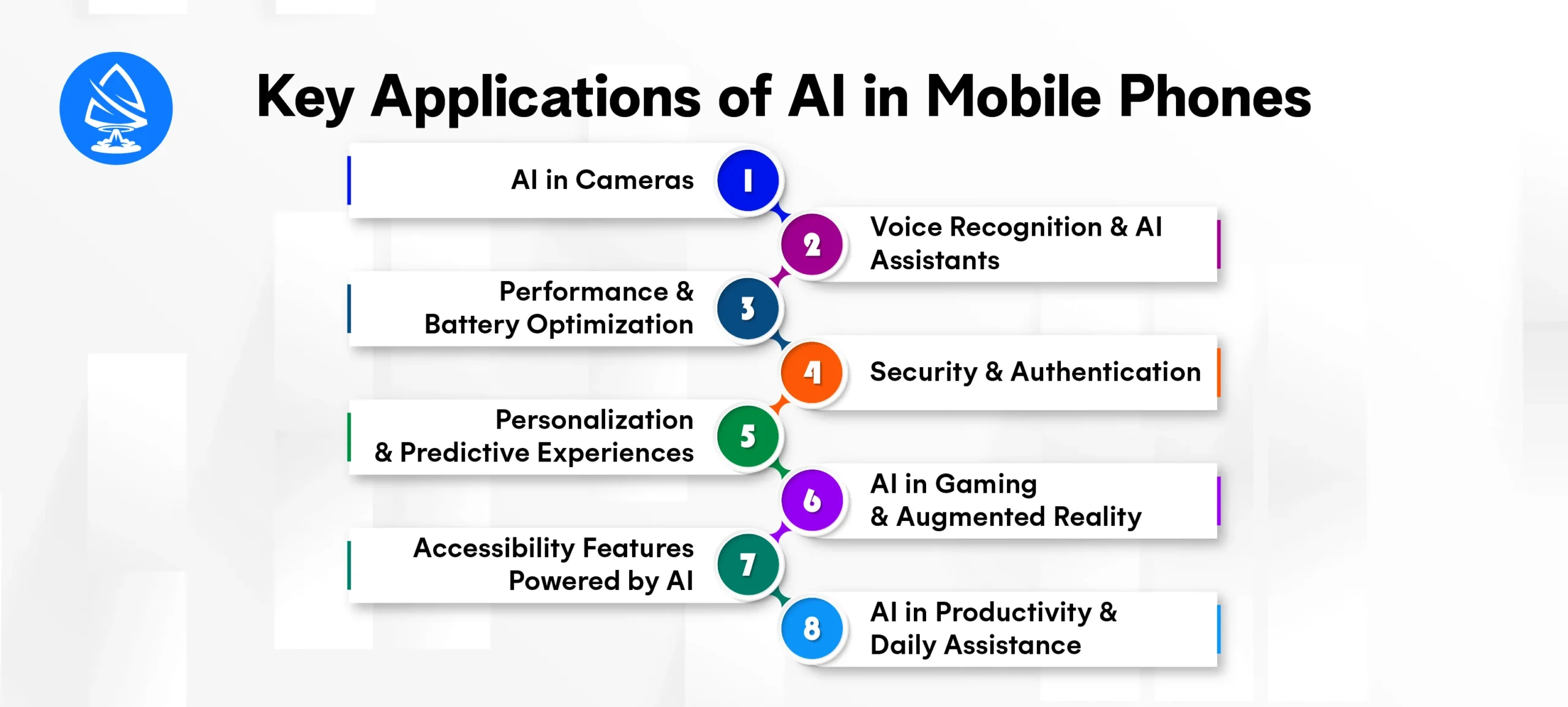
Key Applications of AI in Mobile Phones
Artificial Intelligence has moved from being a “cool add-on” to a core component of modern smartphones. Today’s AI mobile phones are not just communication devices; they are intelligent assistants that adapt to user behavior, optimize performance, and enhance experiences across multiple areas. Below are the most impactful applications of AI in phones:
1. AI in Cameras – Smarter Photography
The AI camera phone has redefined mobile photography.
Scene Detection: AI recognizes objects like food, pets, sunsets, or text and automatically adjusts exposure, contrast, and colors.
Portrait Mode & Bokeh Effects: AI separates background and subject for DSLR-like shots.
Low-Light Photography: AI algorithms enhance brightness and detail without overexposure.
Video Stabilization: AI corrects shaky footage in real time.
Example: Google Pixel’s Night Sight and Apple’s Deep Fusion use AI to deliver professional-grade photography on mobile devices.
2. Voice Recognition and AI Assistants
AI powers assistants like Siri, Google Assistant, and Bixby.
Understand natural language (not just commands).
Execute tasks like scheduling meetings, sending messages, or controlling smart home devices.
Learn user habits to provide contextual suggestions.
Example: Asking Google Assistant, “What’s my schedule tomorrow?” integrates calendar, travel times, and reminders for a personalized response.
3. Performance and Battery Optimization
AI ensures smartphones with AI run faster and last longer.
App Usage Prediction: Frequently used apps load quickly.
Resource Management: AI allocates CPU/GPU power where needed.
Battery Efficiency: AI learns charging patterns and optimizes battery usage to extend lifespan.
Example: Huawei’s AI-based power management adapts CPU/GPU usage for optimal efficiency.
4. Security and Authentication
Security has become a major AI-driven feature in AI cell phones.
Facial Recognition: AI-powered 3D mapping prevents spoofing by photos or videos.
Fingerprint Recognition: Becomes faster and more accurate as AI learns over time.
Behavioral Biometrics: AI can analyze typing speed, walking patterns, or gestures for added authentication layers.
Example: Apple’s Face ID uses AI neural networks for secure and accurate recognition.
5. Personalization and Predictive Experiences
AI smartphones adapt to user preferences:
Predict which app you’ll open at specific times.
Suggest quick replies in messaging apps.
Recommend music, videos, or shopping items tailored to your habits.
Example: Spotify and YouTube use AI to recommend content based on past behavior.
6. AI in Gaming and Augmented Reality (AR)
Gaming: AI reduces lag, optimizes frame rates, and enhances graphics rendering.
AR Applications: Real-time translation of signs, interactive filters in social media, and immersive AR gaming.
Example: Pokémon Go uses AI and AR to merge the virtual and real world.
7. Accessibility Features Powered by AI
AI makes AI mobile phones more inclusive for people with disabilities.
Real-time speech-to-text transcription.
Text-to-speech for visually impaired users.
Image recognition to describe surroundings.
AI-powered apps that translate sign language into text.
Example: Google’s Live Transcribe helps the hearing impaired by turning conversations into real-time captions.
8. AI in Productivity and Daily Assistance
AI goes beyond entertainment and security; it boosts productivity.
Smart email categorization and spam detection.
Calendar and meeting suggestions based on patterns.
AI-enhanced document scanning and OCR (optical character recognition).
Example: Microsoft Office Lens uses AI to scan and convert handwritten notes into digital documents.
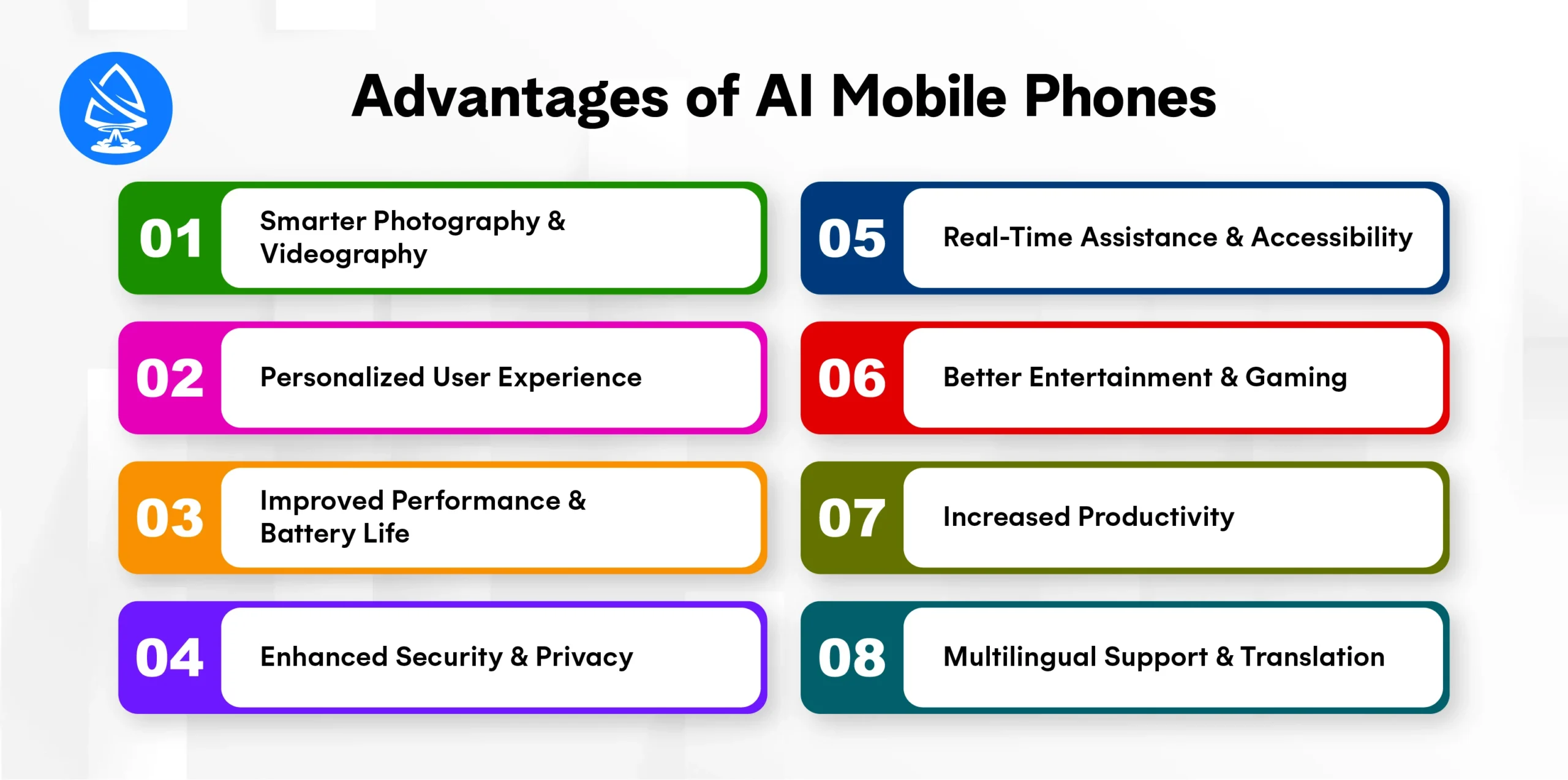
The rise of AI in mobile phones has transformed them from simple communication tools into intelligent, adaptive companions. By integrating artificial intelligence, AI smartphones can optimize performance, enhance usability, and personalize experiences like never before. Below are the key advantages of AI mobile phones explained in detail:
1. Smarter Photography and Videography
One of the most visible advantages is the AI camera phone revolution.
Automatic Scene Recognition: Detects whether you’re shooting food, landscapes, or portraits and adjusts settings accordingly.
Low-Light Photography: AI enhances brightness and reduces noise without using flash.
Video Enhancements: Real-time stabilization, slow-motion optimization, and background blurring.
Benefit: Users can capture professional-grade images without being photography experts.
2. Personalized User Experience
AI learns your daily habits and adapts accordingly.
Predicts which apps you’ll use at certain times.
Suggests smart replies in messaging apps.
Recommends songs, shows, and shopping items based on your behavior.
Benefit: A more intuitive and seamless experience that feels custom-made for each user.
3. Improved Performance and Battery Life
AI optimizes phone resources intelligently.
Performance Boost: Allocates CPU and GPU power based on tasks (e.g., high power for gaming, low for browsing).
Battery Optimization: Monitors usage patterns to extend battery life.
Adaptive Charging: Prevents overcharging to increase battery lifespan.
Benefit: Phones run smoothly and last longer, even with heavy usage.
4. Enhanced Security and Privacy
AI in phones adds advanced layers of protection.
Face Unlock: AI maps facial details in 3D for secure authentication.
Fingerprint Scanning: Improves accuracy with continuous learning.
Behavioral Security: AI monitors typing, voice, or walking patterns for additional verification.
Benefit: Users enjoy safer, faster, and more reliable authentication methods.
5. Real-Time Assistance and Accessibility
AI-powered assistants (Siri, Google Assistant, Alexa) make tasks effortless.
Hands-free calling, texting, and reminders.
Real-time translations for travelers.
Accessibility features like speech-to-text and text-to-speech.
Benefit: Makes smartphones more inclusive and useful for people with disabilities.
6. Better Entertainment and Gaming
AI enhances entertainment by improving quality and responsiveness.
Gaming: Reduces lag, optimizes graphics, and personalizes gameplay.
Streaming: AI adjusts video quality based on internet speed.
Music and Content Suggestions: Personalized playlists and movie recommendations.
Benefit: A smoother, richer entertainment experience.
7. Increased Productivity
AI mobile phones streamline daily tasks.
Email Management: Automatically sorts important emails and spam.
Smart Calendars: Suggests meeting times and reminders.
Document Scanning: AI converts images into editable text with OCR technology.
Benefit: Saves time and increases workplace or study efficiency.
8. Multilingual Support and Translation
AI enables real-time translation in text, audio, or even camera mode.
Translate menus, signs, or conversations instantly.
Break language barriers for global travelers.
Benefit: Makes international communication seamless.
Challenges and Concerns of AI in Phones
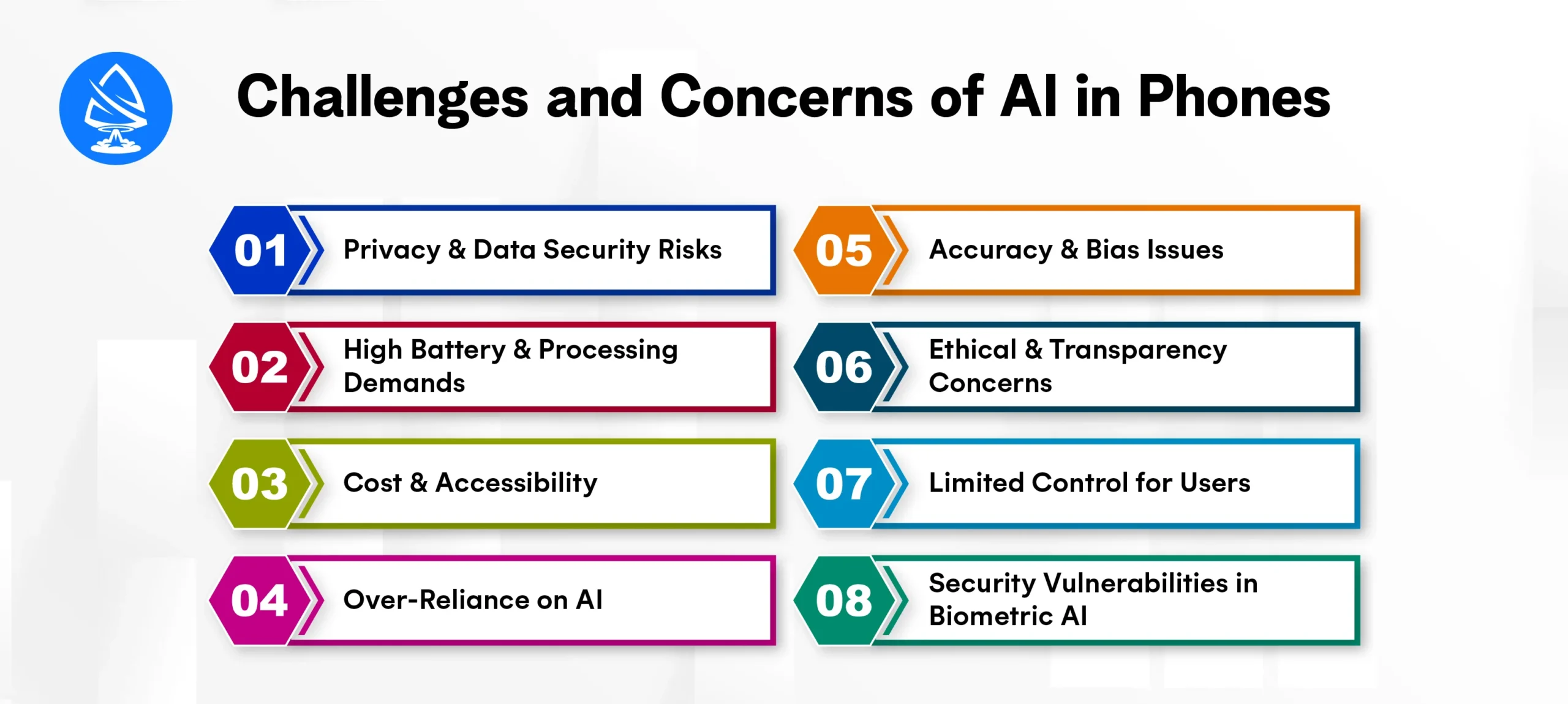
While AI in mobile phones brings incredible convenience, personalization, and smarter features, it also comes with a set of challenges and concerns that cannot be ignored. As AI smartphones become more integrated into our lives, questions about privacy, cost, reliability, and ethical use are rising.
Here are the major concerns associated with AI in phones:
1. Privacy and Data Security Risks
AI relies heavily on data collection photos, voice recordings, location history, browsing patterns, and even biometric details.
Personal data is stored and processed to improve AI features like predictive typing or AI camera enhancements.
Cloud-based AI functions may expose user data to cyberattacks or unauthorized use.
Concern: Users often have little control over how their personal data is stored, shared, or monetized by companies.
2. High Battery and Processing Demands
Although AI mobile phones optimize battery life in many cases, running constant AI processes can drain power.
Features like real-time AI translation, AR gaming, or live video processing consume significant energy.
Intensive AI algorithms require advanced processors, leading to overheating concerns.
Concern: Not all devices handle AI efficiently, which can frustrate users with shorter battery life.
3. Cost and Accessibility
AI-driven smartphones often come at a premium price due to advanced AI chips, cameras, and processors.
Brands like Apple, Samsung, and Huawei integrate costly AI hardware.
Mid-range and budget users may find it difficult to afford these devices.
Concern: Widening the digital divide between premium and budget smartphone users.
4. Over-Reliance on AI
With AI on phones predicting our actions and automating tasks, there’s a growing concern of over-dependence.
Users may lose problem-solving skills or become passive consumers.
AI suggestions can limit creativity and independent choices.
Concern: Reduces human agency by shaping user behavior subtly.
5. Accuracy and Bias Issues
AI is not always perfect; it learns from data, and if that data is biased, the results will be biased too.
AI face recognition has shown lower accuracy across different demographics, raising concerns about inclusivity.
Predictive text and voice assistants may misinterpret non-standard accents or dialects.
Concern: Errors or bias in AI smartphones can result in unfair or inaccurate outcomes.
6. Ethical and Transparency Concerns
AI algorithms on phones often work like a “black box.”
Users don’t know how decisions are made, for example, why certain ads, content, or suggestions appear.
Lack of transparency raises ethical questions about manipulation, targeted advertising, and user autonomy.
Concern: Without clear governance, AI risks being used for profit-driven manipulation rather than user benefit.
7. Limited Control for Users
Many AI mobile phones offer little flexibility to disable or adjust AI features.
Users may not want predictive suggestions or always-on AI assistants listening to their commands.
Disabling AI features can sometimes reduce the phone’s overall performance.
Concern: Users may feel forced to accept AI without meaningful opt-out options.
8. Security Vulnerabilities in Biometric AI
AI-powered biometrics like facial recognition and fingerprints improve convenience but can be compromised.
Hackers have bypassed some AI phone face recognition systems using 3D masks or high-quality photos.
Data breaches of biometric information are more dangerous than passwords (you can’t “reset” your face or fingerprint).
Concern: Misuse of biometric AI data can have long-term security implications.
AI Smartphones in Different Brands
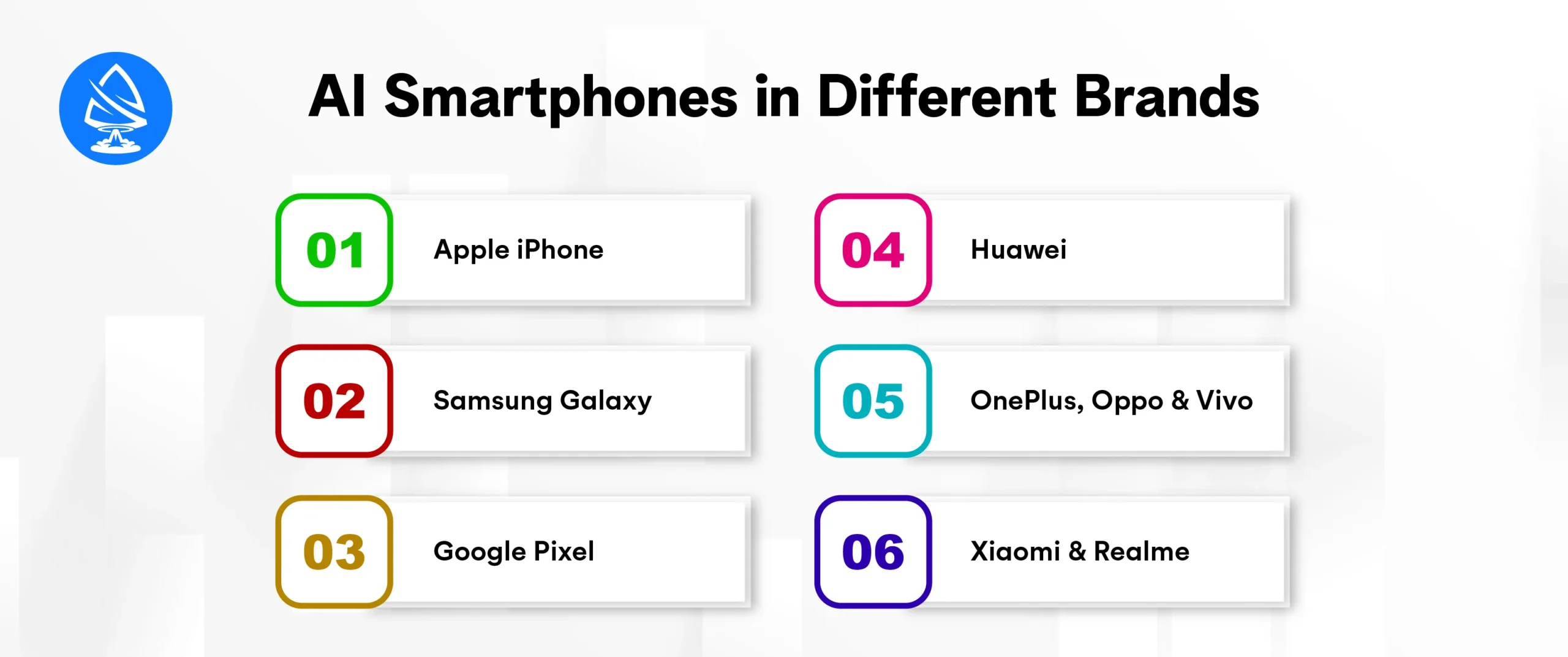
The global smartphone market has embraced AI in mobile phones as a core selling point. Leading brands compete by adding AI-powered features such as smarter cameras, faster processors, stronger security, and personalized experiences. Each brand uses AI differently to set itself apart.
Here’s how major players integrate AI smartphones into their product lines:
1. Apple iPhone
Apple has been at the forefront of bringing AI to phones with its dedicated Neural Engine, part of the A-series Bionic chips.
Face ID: AI-driven 3D facial recognition ensures secure authentication.
Siri: Apple’s AI voice assistant uses natural language processing to deliver contextual responses.
Photography: Features like Smart HDR and Deep Fusion use AI for sharper, more detailed images.
AR Capabilities: iPhones integrate AI with ARKit for gaming, shopping previews, and education.
Why it matters: Apple emphasizes privacy-first AI, keeping most processes on-device for better security.
2. Samsung Galaxy
Samsung has turned AI smartphones into lifestyle devices through its Galaxy series.
Bixby: Samsung’s AI assistant provides contextual recommendations and smart home integration.
AI Camera Phone Features: Scene optimizer detects up to 30 types of objects and adjusts settings automatically.
Battery and Performance Management: AI learns usage patterns to improve multitasking and power efficiency.
DeX Mode: AI enhances mobile-to-desktop productivity by adapting apps for larger screens.
Why it matters: Samsung focuses on versatile AI that adapts to productivity, entertainment, and personalization.
3. Google Pixel
Google’s Pixel line is best known for AI camera phone technology.
Night Sight: AI-powered low-light photography produces sharp, bright images.
Call Screening: Google Assistant screens calls and transcribes conversations.
Adaptive Battery & Adaptive Sound: AI adjusts performance and sound quality based on surroundings.
Real-Time Translation: AI-driven instant language translation directly on-device.
Why it matters: Pixel phones highlight how AI in phones can replace traditional hardware with computational AI.
4. Huawei
Huawei was among the first to launch AI smartphones with built-in NPUs (Neural Processing Units).
Kirin AI Processor: Specially designed for on-device AI tasks like face recognition and image processing.
AI Photography: Scene detection for over 1,500 scenarios across 25 categories.
Battery Optimization: AI balances performance and efficiency.
Security: Built-in AI boosts malware detection and system security.
Why it matters: Huawei positioned itself as a hardware AI leader, building custom AI chips for powerful processing.
5. OnePlus, Oppo, and Vivo
These brands make AI in phones accessible to broader markets.
AI Beautification Modes: Enhance selfies by adjusting skin tones and lighting.
AI Gaming Modes: Reduce lag and optimize system resources during gameplay.
Screen Optimization: AI adjusts brightness and refresh rate dynamically.
Voice Assistants & Translation: Integrated AI assistants for daily tasks.
Why it matters: These brands focus on AI for lifestyle and entertainment, making AI affordable and appealing to younger demographics.
6. Xiaomi and Realme
Xiaomi and Realme have democratized AI mobile phones, bringing smart features to mid-range devices.
AI Scene Recognition: Entry-level AI camera phones can identify scenes for better images.
Battery Optimization: AI-based adaptive charging extends phone life.
AI Voice Commands: Integrated assistants help with navigation and smart home control.
Why it matters: They make AI smartphones accessible to price-sensitive users worldwide.
Future of AI in Mobile Phones
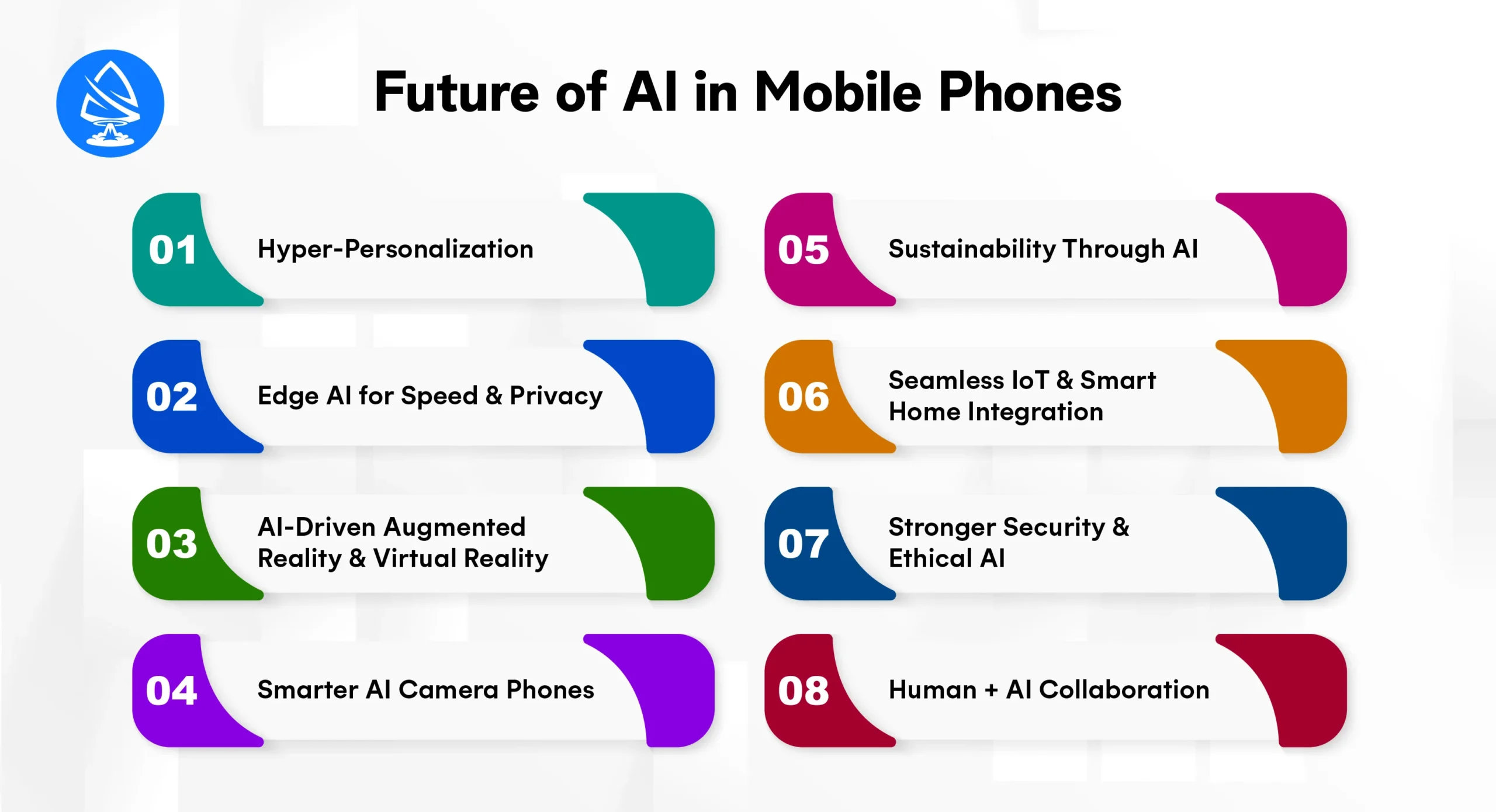
The role of AI in mobile phones is growing at an unprecedented pace. From AI camera phones that already outperform digital cameras to AI smartphones capable of real-time translations, the progress so far is just the beginning. As AI technologies evolve, mobile phones will shift from being “smart devices” to intelligent companions capable of anticipating needs, solving problems, and seamlessly integrating into every part of our lives.
Here are the key trends shaping the future of AI in phones:
1. Hyper-Personalization
Future AI smartphones will understand user preferences on a deeper level.
They’ll predict moods, habits, and needs before users even express them.
Music, shopping, fitness, and productivity apps will deliver tailored recommendations in real time.
Impact: Users will experience a truly personal smartphone, almost like a digital twin that evolves with them.
2. Edge AI for Speed and Privacy
Today, many AI tasks rely on cloud processing, but the future is moving toward on-device AI (Edge AI).
AI chips like Apple’s Neural Engine and Qualcomm’s AI processors will become more powerful.
More data will be processed locally, reducing latency and enhancing privacy.
Impact: Faster performance, better energy efficiency, and reduced dependency on internet connections.
3. AI-Driven Augmented Reality (AR) and Virtual Reality (VR)
AI mobile phones will merge with AR/VR experiences.
Features like real-time object recognition, immersive AR gaming, and AI-enhanced video calls will become standard.
Smartphones will evolve into AR-powered devices for shopping, education, and healthcare.
Impact: Everyday activities like online shopping or learning will become immersive and interactive.
4. Smarter AI Camera Phones
AI will move beyond scene detection to professional-level video editing, real-time background replacement, and 3D photography.
Phones may use AI to automatically generate highlight reels, correct angles, or even create virtual avatars.
Impact: Every user becomes a content creator with studio-grade tools in their pocket.
5. Sustainability Through AI
AI will optimize charging cycles, reducing battery wear and extending device lifespan.
Smarter recycling and refurbishment recommendations may be built into AI smartphones.
Energy consumption will be reduced with adaptive power usage.
Impact: Greener, more sustainable devices with a longer lifecycle.
6. Seamless IoT and Smart Home Integration
Future AI phones will act as the central hub of connected ecosystems (homes, cars, workplaces).
AI assistants will coordinate with IoT devices controlling lights, monitoring health wearables, managing cars, and more.
Impact: Phones evolve into control centers for daily life.
7. Stronger Security and Ethical AI
AI will strengthen biometric authentication with multi-layered security (face, fingerprint, voice, and behavioral patterns combined).
Explainable AI (XAI) will provide transparency, helping users understand how AI decisions are made.
Regulations will enforce responsible and ethical AI in mobile devices.
Impact: Higher user trust and wider acceptance of AI-powered phones.
8. Human + AI Collaboration
Instead of replacing humans, AI will augment human capabilities.
Phones will help users manage stress, monitor health, and even provide emotional support through AI companions.
Impact: Smartphones transform into life coaches and health advisors, not just communication devices.
How Businesses Benefit from AI in Phones
The rise of AI cell phones creates opportunities for companies:
App Developers can create AI-powered apps.
Marketers can target users with personalized campaigns.
Enterprises can use AI features for productivity and collaboration.
To succeed, companies often partner with an AI development company or an artificial intelligence app development company to build cutting-edge applications. Organizations looking to innovate in this space may hire AI developers or work directly with an expert Artificial Intelligence Developer to design solutions tailored to mobile platforms.
Conclusion
Artificial Intelligence in mobile phones has redefined what smartphones can do. From AI camera phones capturing stunning photos to AI smartphones predicting user needs, the technology offers undeniable advantages in convenience, personalization, and security. However, challenges like privacy concerns, high costs, and ethical implications cannot be ignored.
For consumers, the benefits often outweigh the risks. AI makes devices smarter, more efficient, and more accessible. For businesses, AI in phones opens up opportunities to create AI-powered apps, drive engagement, and enhance user experiences.
Ultimately, whether AI in mobile phones is a “good thing” depends on how responsibly it’s implemented. With proper governance, transparency, and user control, AI cell phones will continue to evolve into powerful companions that enhance daily life while respecting privacy and trust.
Frequently Asked Questions
1. What is AI in mobile phones?
AI in mobile phones refers to using artificial intelligence to enhance features like cameras, voice assistants, performance, and personalization.
2. What are AI camera phones?
AI camera phones use machine learning to adjust settings for better photos and videos automatically.
3. How does AI improve smartphone performance?
AI optimizes battery life, enhances security, and learns user behavior to predict and streamline tasks.
4. Is AI in phones safe?
Yes, but privacy risks exist. Responsible data handling and on-device AI reduce concerns.
5. Which smartphones with AI are most popular?
Apple iPhone, Google Pixel, Samsung Galaxy, and Huawei are leading AI smartphones.
6. Can AI be used offline on phones?
Yes, edge AI allows devices to process data locally without always relying on cloud servers.
7. How does AI benefit businesses through mobile phones?
AI enables personalized apps, smarter marketing, and better user engagement for businesses.
8. Should companies hire AI developers for mobile apps?
Yes, working with an Artificial Intelligence Developer or an AI development company ensures scalable, innovative mobile solutions.
Written By :
Artoon Solutions
Artoon Solutions is a technology company that specializes in providing a wide range of IT services, including web and mobile app development, game development, and web application development. They offer custom software solutions to clients across various industries and are known for their expertise in technologies such as React.js, Angular, Node.js, and others. The company focuses on delivering high-quality, innovative solutions tailored to meet the specific needs of their clients.



 For business inquiries only