- HR:+91-879-9184-787
- Sales:+91-908-163-7774


Procurement has evolved far beyond purchase orders and supplier negotiations. In today’s volatile global economy, procurement teams are under pressure to reduce costs, manage supplier risk, ensure compliance, and respond quickly to market disruptions. Manual processes, spreadsheets, and rule-based procurement systems are no longer sufficient to support these demands at scale.
This is where AI in procurement is becoming a game-changer.
Artificial intelligence enables procurement leaders to move from reactive sourcing to predictive, data-driven decision-making. By analyzing vast volumes of supplier data, market trends, contracts, and historical spending patterns, AI helps organizations identify cost-saving opportunities, mitigate risk, and build resilient supply chains.
In this comprehensive guide, we explore how AI in procurement is reshaping sourcing strategies, real-world use cases, benefits, implementation approaches, and why businesses are rapidly investing in AI-powered procurement solutions to gain a competitive edge.
AI in procurement refers to the use of artificial intelligence technologies such as machine learning, predictive analytics, natural language processing (NLP), and generative AI to automate, optimize, and enhance procurement and sourcing activities. Instead of relying on manual workflows, static rules, or historical averages, AI-powered procurement systems continuously learn from data to make smarter, faster, and more accurate decisions.
At its core, AI transforms procurement from a transactional, back-office function into a strategic, data-driven capability that actively contributes to cost savings, risk management, and business growth.
AI-driven procurement platforms analyze data from multiple sources, including:
By processing this information, AI systems identify patterns, predict outcomes, and recommend actions that would be difficult or impossible to uncover manually.
AI fundamentally changes procurement by enabling:
These capabilities allow procurement teams to act proactively rather than reactively.
You may also want to know about AI in ERP Systems
Procurement teams are under more pressure than ever before. Global supply chain disruptions, cost volatility, regulatory complexity, and rising expectations from leadership have exposed the limitations of traditional procurement processes. Manual sourcing, spreadsheet-based analysis, and rule-driven systems simply cannot keep up with today’s speed and scale. As a result, procurement teams are turning to AI now to gain control, intelligence, and agility.
Below are the key reasons driving rapid AI adoption in procurement.
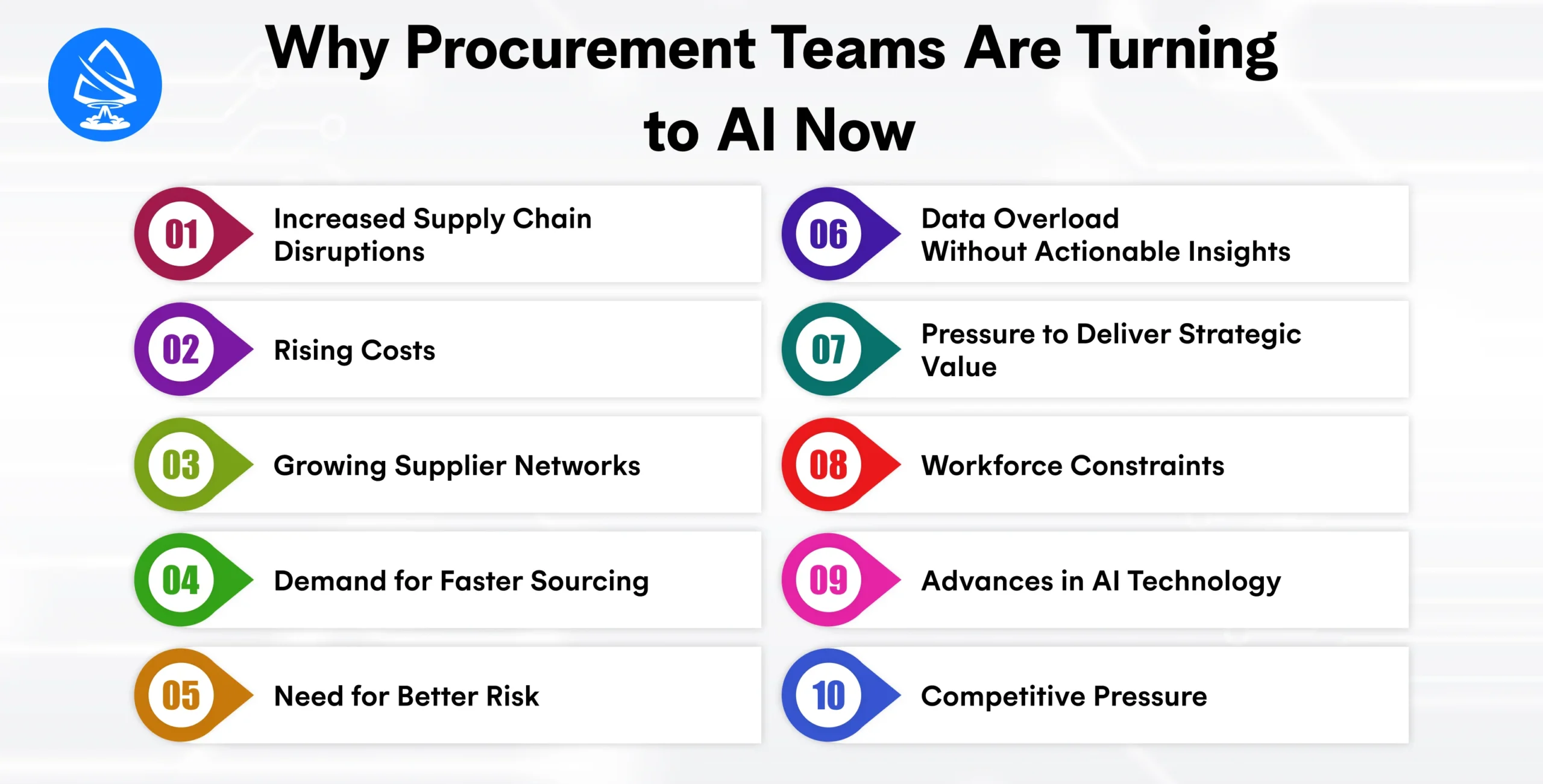
Recent years have shown how fragile global supply chains can be. Delays, shortages, geopolitical tensions, and supplier failures can halt operations overnight.
AI helps procurement teams:
This predictive capability is critical for building resilient procurement operations.
Raw material prices, transportation costs, and supplier pricing are increasingly volatile.
AI enables:
Procurement teams can actively manage costs instead of reacting after margins are impacted.
Organizations now manage hundreds or thousands of suppliers across regions and categories.
AI helps by:
This reduces complexity without sacrificing control.
Business units expect procurement to move faster and support rapid decision-making.
AI automates:
This dramatically shortens procurement cycle times.
Procurement teams must comply with regulatory, contractual, and internal policy requirements.
AI supports:
This reduces manual oversight and audit exposure.
Procurement systems generate vast amounts of data, but much of it remains unused.
AI converts data into:
This shifts procurement from reporting to decision-making.
Modern procurement is expected to contribute to business growth, not just cost control.
AI enables:
Procurement becomes a strategic business function.
Procurement teams face limited resources and increasing workloads.
AI augments teams by:
This increases productivity without increasing headcount.
AI tools are now more affordable, scalable, and easier to integrate with existing systems.
Lower barriers to adoption mean:
AI-driven procurement leaders are setting new standards for speed, cost efficiency, and resilience.
To remain competitive, organizations must:
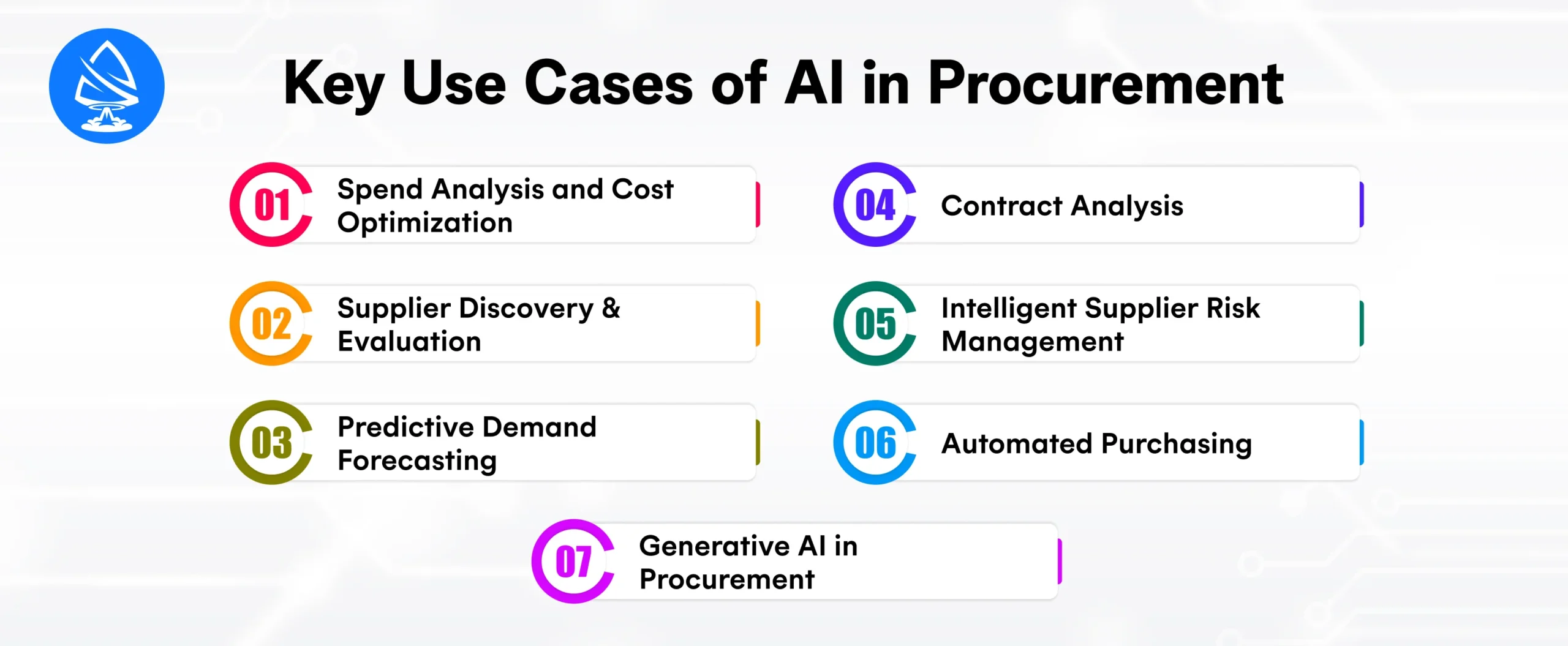
AI analyzes historical spend data across categories, vendors, and regions to uncover inefficiencies.
AI scans internal and external data sources to identify and rank potential suppliers.
AI forecasts procurement demand based on historical usage, seasonal trends, and external signals.
Natural language processing enables AI to analyze contracts for key clauses, risks, and compliance gaps.
AI monitors supplier data in real time to identify early risk signals.
This allows procurement teams to act before disruptions occur.
AI automates routine purchasing decisions based on predefined policies and predictive insights.
Generative AI supports procurement teams by:
This significantly improves productivity.
The adoption of AI in procurement delivers transformative value by making sourcing, purchasing, and supplier management more intelligent, predictive, and efficient. Instead of relying on manual analysis and static rules, AI-powered procurement systems continuously learn from data to improve decisions, reduce risk, and drive measurable business outcomes.
Below are the key benefits of AI in procurement, explained in detail.
AI analyzes historical and real-time spend data across categories, suppliers, and regions to uncover inefficiencies that manual reviews often miss.
This enables procurement teams to reduce overall spend without compromising quality or supply continuity.
Traditional sourcing cycles can take weeks due to manual supplier evaluation and data analysis.
AI accelerates sourcing by:
This shortens sourcing timelines and improves decision accuracy.
AI continuously monitors supplier data, financial health, and external risk signals.
Procurement teams can respond before issues impact operations.
AI predicts future procurement demand using historical consumption, seasonality, and external factors.
Accurate forecasting supports more stable operations.
AI automates repetitive tasks such as purchase order creation, approvals, and invoice matching.
This allows teams to focus on strategic initiatives instead of administrative tasks.
Natural language processing enables AI to analyze contracts for key clauses, risks, and obligations.
This strengthens governance across procurement operations.
AI converts large volumes of procurement data into actionable insights.
This supports confident, data-driven decision-making.
AI augments procurement teams by handling analysis and routine tasks.
Teams scale effectively without proportional cost increases.
Highly specialized components and long supplier lead times.
Business impact: Improved supply chain resilience and reduced production risk.
You may also want to know about AI in Security
AI in procurement is not a one-size-fits-all solution. Its real value emerges when applied to industry-specific procurement challenges, supplier ecosystems, and regulatory environments. Across sectors, organizations are using AI to reduce costs, improve sourcing speed, manage risk, and build resilient supply chains.
Below are practical examples of how AI in procurement is being used across major industries.
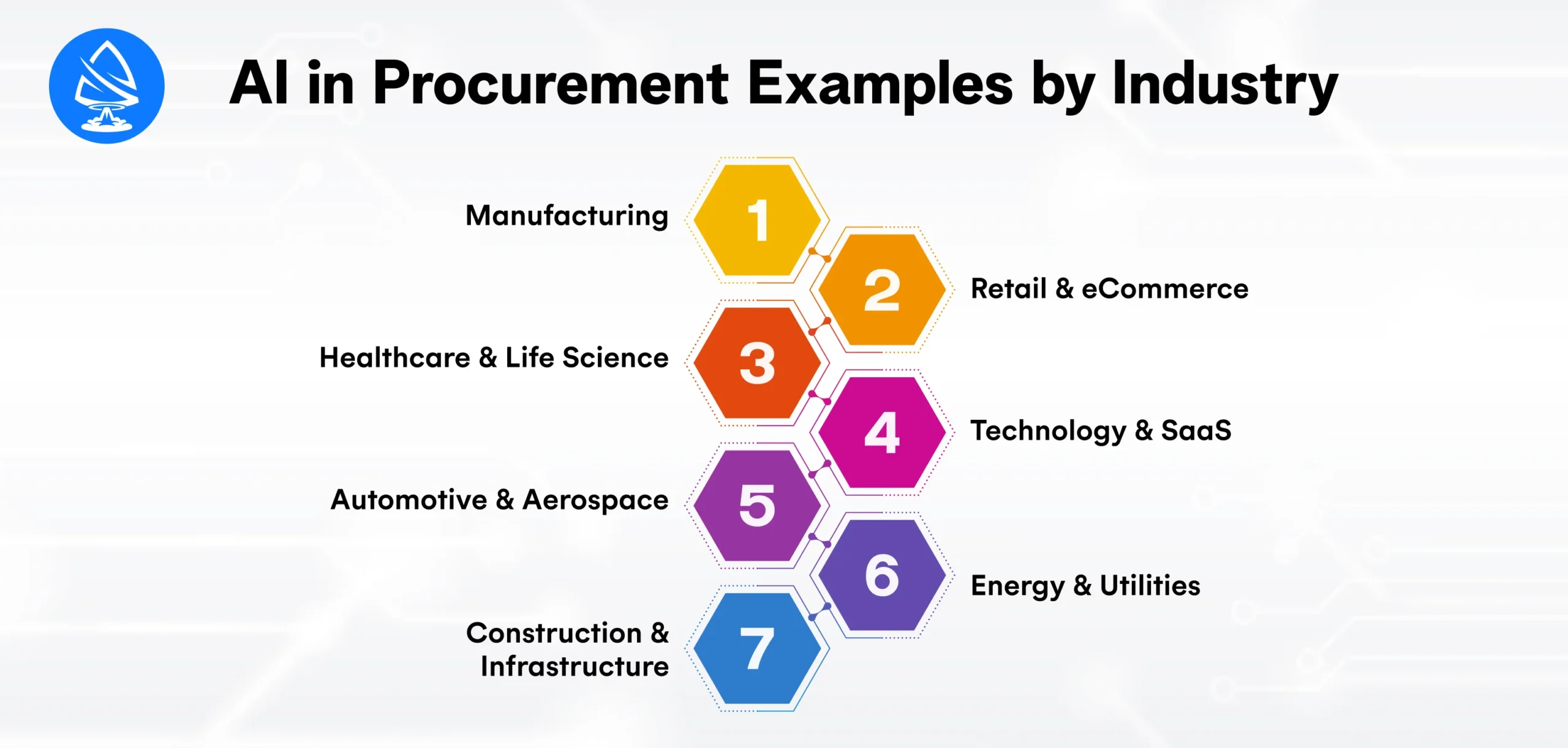
Manufacturers deal with complex supplier networks, volatile raw material prices, and tight production schedules.
Business impact: Reduced downtime, lower material costs, and improved production planning.
Retail procurement must respond quickly to changing consumer demand and seasonal trends.
Business impact: Lower inventory costs, fewer stockouts, and faster go-to-market execution.
Healthcare procurement operates under strict regulatory requirements and critical supply needs.
Business impact: Improved compliance, reduced shortages, and safer patient care.
Technology companies rely heavily on software, cloud services, and global vendors.
Business impact: Reduced software spend, better vendor negotiations, and stronger security posture.
These industries depend on highly specialized components and long supplier lead times.
Business impact: Improved supply chain resilience and reduced production risk.
Energy procurement involves long-term contracts, volatile pricing, and regulatory oversight.
Business impact: Lower procurement costs and improved contract governance.
Construction projects face fluctuating material costs and supplier delays.
Business impact: Improved project timelines and budget control.
Implementing AI in procurement is not a one-time technology deployment; it is a strategic transformation that requires clear objectives, strong data foundations, and cross-functional alignment. Organizations that approach AI adoption with a structured, phased strategy achieve faster ROI, higher adoption, and long-term scalability.
Below is a step-by-step implementation strategy for AI in procurement, designed to minimize risk and maximize value.
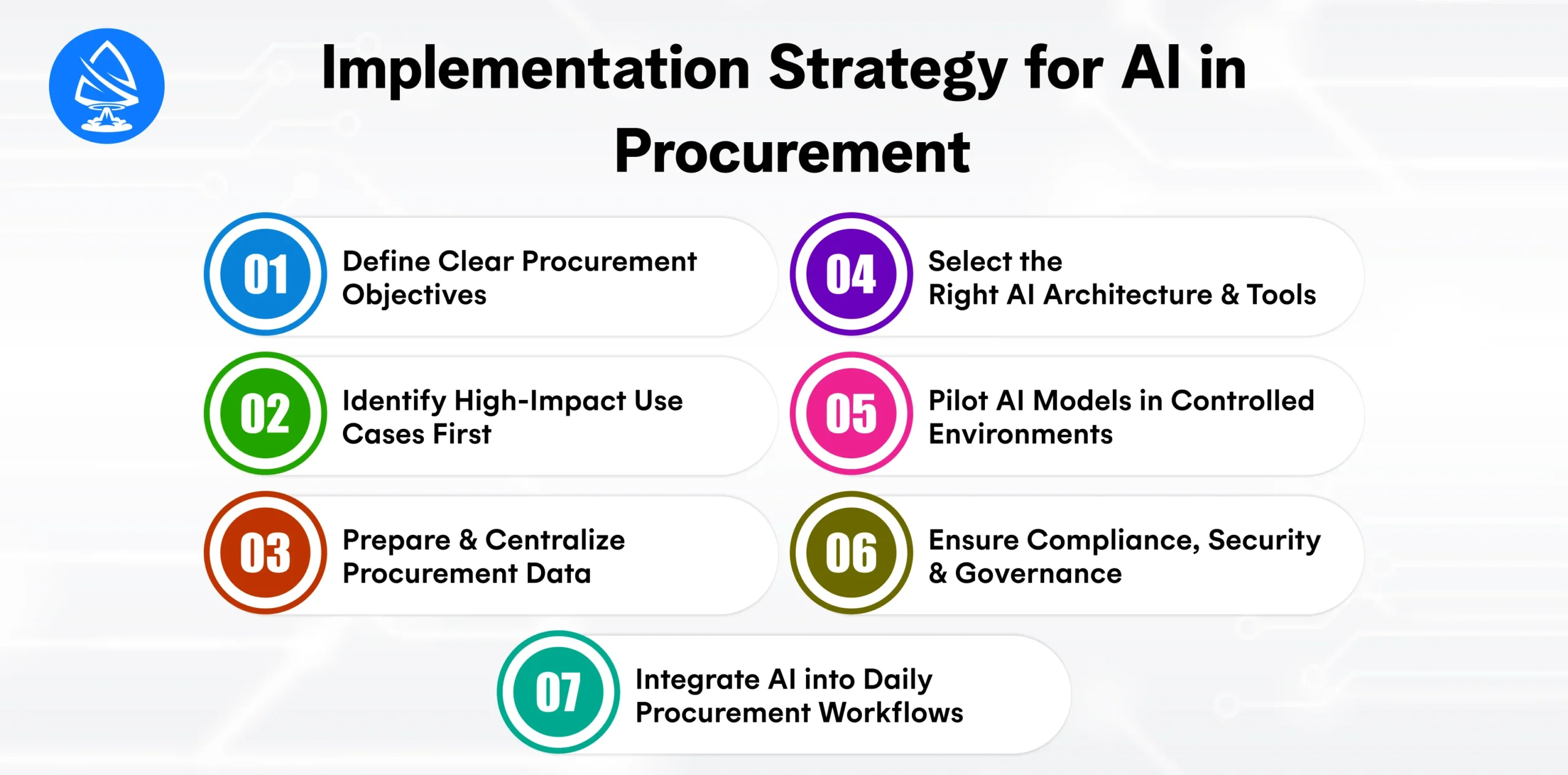
Start by identifying the specific business problems AI should solve. Common objectives include:
Clear goals ensure AI initiatives remain aligned with business outcomes rather than becoming experimental projects.
Not all procurement processes need AI at once. Prioritize areas where AI delivers immediate value, such as:
Focusing on high-impact use cases helps build confidence and internal buy-in.
AI is only as effective as the data it uses. Organizations must:
High-quality, centralized data is the foundation of successful AI procurement.
Choose AI solutions that:
Cloud-based, modular architectures often provide faster deployment and flexibility.
Before full rollout:
Pilots reduce risk and demonstrate tangible value early.
Procurement involves sensitive financial and supplier data. AI implementation must include:
Strong governance builds trust with legal, finance, and compliance teams.
AI should enhance, not disrupt existing workflows. This includes:
Seamless integration drives adoption.
Partnering with an experienced AI app development company helps ensure smooth implementation.
Most organizations see ROI within 6–12 months.
While AI in procurement offers significant benefits, many organizations face obstacles during adoption that can delay value realization or limit impact. These challenges are rarely about the technology alone; they often stem from data, processes, people, and governance. Understanding these issues early helps procurement leaders plan realistic, successful AI initiatives.
Below are the most common challenges in AI procurement adoption, explained in detail.
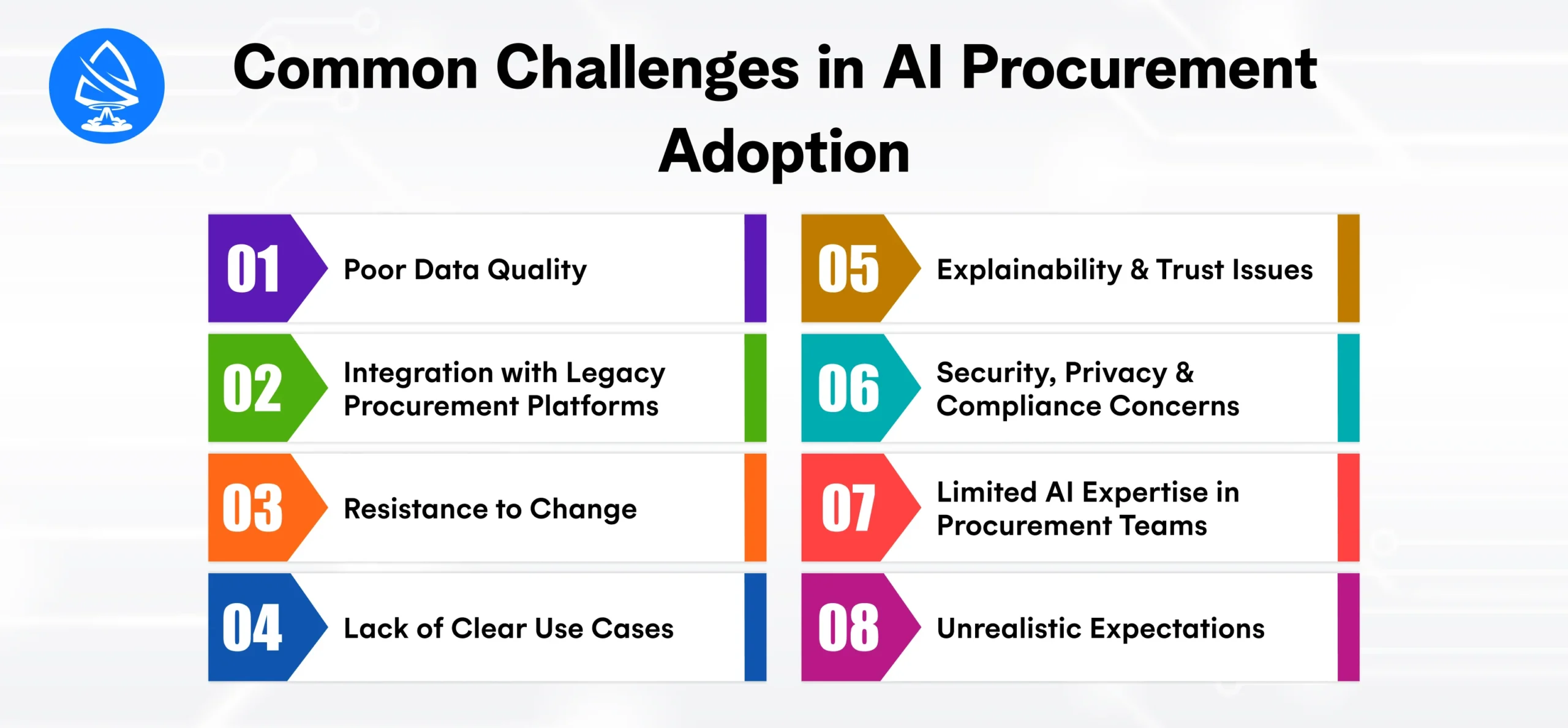
AI depends on clean, consistent, and well-structured data. Many procurement teams struggle with:
Without reliable data, AI models produce inaccurate or biased insights, limiting trust and usability.
Many organizations rely on outdated procurement and ERP systems that were not designed for AI integration.
These barriers slow down implementation and reduce AI’s effectiveness.
Procurement professionals may view AI as:
Without proper training and communication, teams may ignore AI recommendations, reducing ROI.
Some AI initiatives fail because they are driven by technology rather than business needs.
This leads to pilot projects that never scale.
Procurement decisions involve financial risk, compliance, and supplier relationships.
AI systems that cannot explain:
Often face pushback from legal, finance, and compliance teams.
Procurement data includes sensitive pricing, contracts, and supplier information.
Without robust security and governance, AI adoption becomes risky.
Most procurement teams lack in-house AI skills.
This creates challenges such as:
Organizations often need external expertise to bridge this gap.
AI is sometimes expected to deliver instant, dramatic results.
When results take time, confidence in AI initiatives can erode.
These challenges can be mitigated with the right strategy and artificial intelligence development services.
As AI adoption accelerates across functions like procurement, finance, logistics, and customer operations, many organizations realize that success depends on more than just buying software. Businesses partner with AI experts to reduce risk, accelerate time-to-value, and ensure AI delivers measurable outcomes aligned with business goals.
Here’s why partnering with AI specialists has become the preferred path.
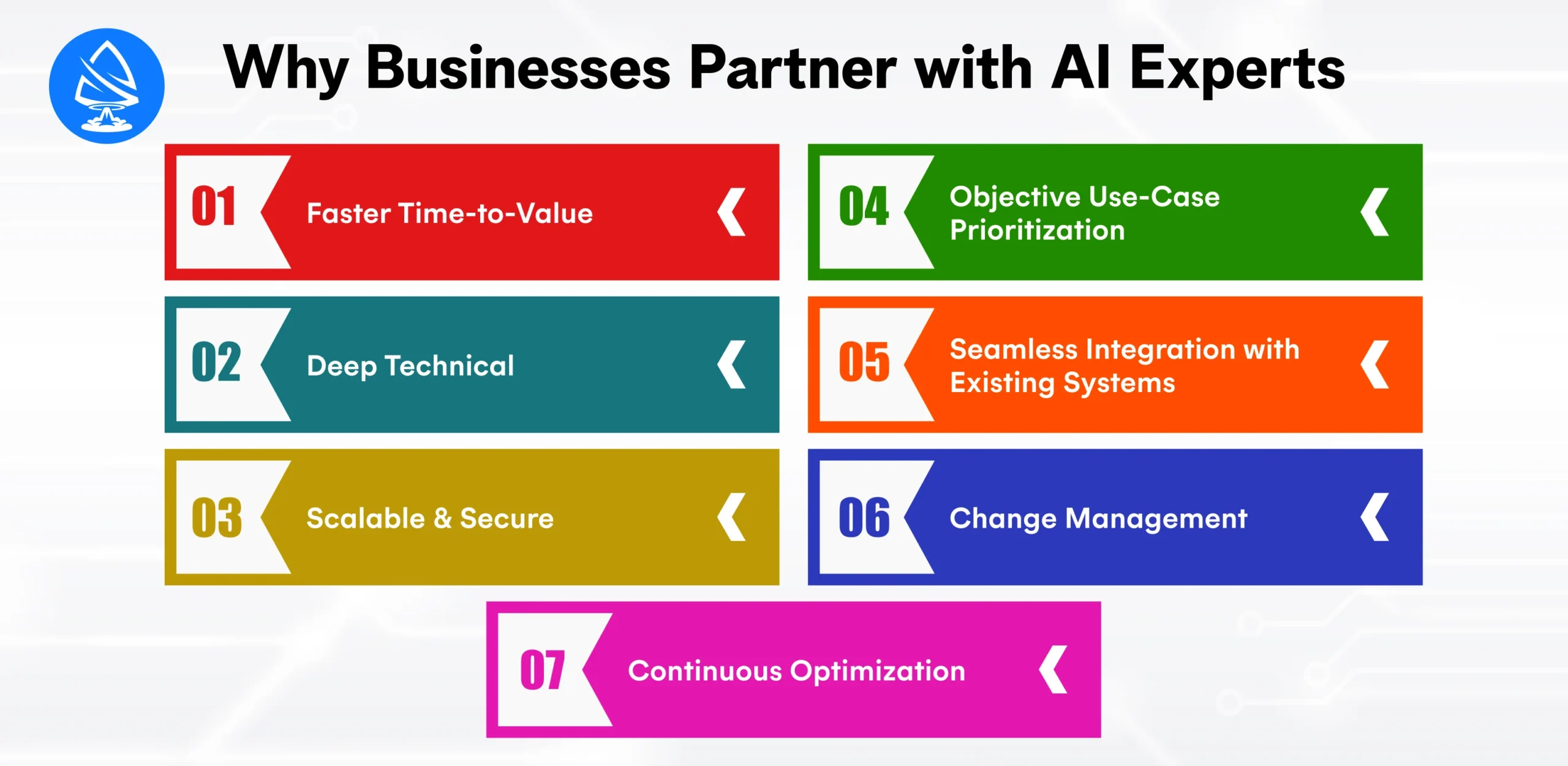
AI experts bring proven frameworks, reusable components, and real-world experience that shorten deployment timelines. They help avoid common pitfalls, such as poor data prep, misaligned use cases, and overengineering, so organizations see results faster with fewer setbacks.
Effective AI requires more than algorithms. Experts combine:
This blend ensures AI solutions are practical, accurate, and trusted by users.
AI experts design solutions that scale across regions and categories while meeting enterprise requirements for:
This is critical when AI influences financial decisions and supplier relationships.
Experienced partners help identify high-impact, quick-win use cases and define success metrics upfront. This prevents “AI for AI’s sake” and ensures investments are tied to cost savings, risk reduction, or productivity gains.
AI experts integrate solutions with ERPs, procurement platforms, CRMs, and data lakes, minimizing disruption and maximizing adoption. They ensure AI insights are embedded directly into daily workflows.
Adoption fails without people. AI partners support:
This drives sustained usage and long-term value.
AI is not a one-off project. Experts provide ongoing monitoring, retraining, and optimization as data and business needs evolve, protecting ROI over time.
AI in procurement is transforming sourcing from a manual, reactive function into a strategic, intelligent capability. By leveraging predictive insights, automation, and generative AI, procurement teams can reduce costs, manage supplier risk, and respond faster to market changes. As supply chains grow more complex, AI-driven procurement becomes essential for resilience and long-term competitiveness.
Organizations that invest in AI today position themselves for smarter sourcing, stronger supplier relationships, and sustainable growth.
Estimate Your AI Procurement Investment with Our AI App Cost Calculator
Talk to Experts About Building an AI-Powered Procurement System
1. Is AI in procurement suitable for small businesses?
Yes, AI solutions can scale to fit small and mid-sized procurement teams.
2. Can AI replace procurement professionals?
No, AI augments human expertise, not replaces it.
3. How secure is AI procurement software?
Security depends on architecture, encryption, and access controls.
4. What data is required for AI procurement?
Spend data, supplier data, contract data, and demand history.
5. Does AI improve supplier relationships?
Yes, through better visibility and proactive risk management.
6. How long does AI implementation take?
Initial deployments typically take 3–6 months.
7. Is generative AI useful in procurement?
Yes, for RFP creation, analysis, and reporting.
8. What ROI can businesses expect?
Significant cost savings and efficiency gains within the first year.

Artoon Solutions
Artoon Solutions is a technology company that specializes in providing a wide range of IT services, including web and mobile app development, game development, and web application development. They offer custom software solutions to clients across various industries and are known for their expertise in technologies such as React.js, Angular, Node.js, and others. The company focuses on delivering high-quality, innovative solutions tailored to meet the specific needs of their clients.
 For business inquiries only




