- HR:+91-879-9184-787
- Sales:+91-908-163-7774


AI in Semiconductor: Stop, shut your eyes, and consider the last clever move made at the moment by a gadget you are near. Your phone unlocks with Face ID. Your automobile is telling you to avoid a crash. Netflix suggests the next show that you would like to watch.
In the background of all these ordinary scenes, AI in semiconductor technology is operating quietly but powerfully. When we mention AI in semiconductor, we are referring to a paradigm shift; a convergence of one of the most disruptive technologies in the world, artificial intelligence, and the building blocks of the modern electronic world, semiconductors. This convergence is at the core of the modern digital economy, and it is no longer a choice anymore, but a necessity.
Interestingly, the association between AI semiconductors has shifted not only to support but also to an absolute inseparability. To train models and execute real-time inference, AI systems require chips with very high speeds and low power consumption.
Companies are also using AI in semiconductor manufacturing to test, optimize, and produce chips with greater precision and speed. Enabling voice-to-text and self-driving cars, to transforming the possibilities of the medical industry, self-driving cars, and even exploring space, AI in semiconductor technologies are redefining the capabilities of devices – and industries – to perform. The paper will take you through a clear and practical market tour of AI in the semiconductor market, disaggregating market size, emerging trends, key actors, real-life examples, and industry projections through 2026 and beyond. No matter if you are a tech fan, a business leader, or an industry expert, understanding this convergence is crucial for knowing the future of innovation.
In its simplest form, AI in semiconductor is specialized chips designed to be more efficient, smarter, and faster than conventional processors in processing artificial intelligence workloads.
When you consider how you use technology nowadays, voice assistants, face recognition, smart suggestions, etc., those experiences are based on sophisticated AI work like:
The conventional CPUs did not even have this amount of parallel processing in mind. This is why the emergence of AI in semiconductor technology and AI semiconductors became a given.
Special hardware, such as this, is now used in the industry to support modern AI.
They are utilized in large-scale cloud data centers, and tiny edge devices on cars, medical devices, and smart homes with artificial intelligence semiconductors. As a matter of fact, the current semiconductor-based artificial intelligence ecosystem means that AI is performing effectively in the cloud or even in the palm of your hand.
In short, none of the AI is without semiconductors, and no contemporary semiconductors are without AI.
It is this profound interdependence that has made semiconductor AI the key to innovation, where it has affected both the performance and the energy efficiency of the chip, as well as the very design of artificial intelligence chips. Artificial intelligence in semiconductor manufacturing is now a solution that many AI in semiconductor firms depend on to enhance yield, minimize defects, and accelerate production cycles, demonstrating that artificial intelligence is not only a product that runs on chips, but it also has applications in semiconductor production.
You may also want to know AI in Defense
The semiconductor market for AI in semiconductors is expanding at a phenomenal rate. By 2024, the worldwide artificial intelligence semiconductor market is over USD 55 billion and is anticipated to be over USD 90-100 billion by 2026, with forecasts in the long run indicating that the market would be over USD 230 billion by 2034. The rise in the demand for AI in semiconductor chips is making it grow with a 15-20% CAGR, and artificial intelligence in semiconductor chips already accounts for almost 20% of the total semiconductor expenditures. This fast growth is also driving semiconductor companies to work closely with all AI developing companies, which is all causing AI in semiconductor to become the primary driver of growth in the semiconductor market, as opposed to an auxiliary feature.
The AI semiconductor market is not expanding fast by accident; it is being accelerated by the rate at which artificial intelligence in semiconductors is making its way into your daily technological life. The need for specialized, high-performance chips is growing at a pace never seen before, driven by the increasing power of AI in semiconductor models. The use of AI development services is helping companies develop custom semiconductor solutions that meet these demands.
Your requirements are increasing as AI in semiconductor usage grows at a rate from massive language models such as ChatGPT to fully autonomous vehicles. Advanced AI in semiconductor models may take weeks before they get trained on thousands of GPUs, which cannot be effectively handled by traditional CPUs. That is why the artificial intelligence semiconductor solutions like GPUs, NPUs, and custom ASICs are in demand. To illustrate, the NVIDIA GPUs control the training of AI models, whereas AMD and Intel are developing their AI chipsets to satisfy the increasing enterprise demands.
Currently, AI-based tools are used in the design of artificial intelligence chips to assist engineers in creating smarter chips in a shorter duration. These tools are used to optimize layouts, simulate thermal problems, and use less power-saving design cycles by up to 30%. Synopsys and Cadence firms include artificial intelligence in semiconductor design in their electronic design automation (EDA) software systems. This assists semiconductor manufacturers in developing sophisticated AI semiconductors quickly and with fewer errors. The semiconductor industry is undergoing a paradigm shift because of artificial intelligence.
The semiconductor industry is also transforming because of AI. To identify defects, improve yield, and predict equipment failures, the renowned firms are employing AI in semiconductor manufacturing. The well-recognised companies like Samsung and TSMC are applying AI analytics to enhance outcomes. In your case, this implies that you will have quicker innovation, better quality chips, and safer AI-driven devices.
The first thing that comes to the mind of most people when they consider AI semiconductors is the products they consume; only a few understand that artificial intelligence in semiconductor fabrication is silently changing the manner in which the chips are produced.
In large semiconductor fabrication plants (fabs), sensor data, which monitors temperature, vibration, chemical concentrations, and so on, amounts to terabytes each hour. Previously, these logs were inspected manually by engineers who were likely to make mistakes, and it was time-consuming.
The current AI in semiconductor manufacturing is transforming the game. State-of-the-art artificial intelligence in semiconductor models utilizes the information in close real-time, identifies flaws, anticipates the malfunction of equipment before it occurs, and enhances the yield by up to 30%. This minimizes scrap and downtime, and also results in more consistent product quality.
This translates to: reduced reactive maintenance to you on the factory floor, a reduced production cycle, and increased profitability to you. The innovations are already in use by the leading artificial intelligence semiconductor companies such as TSMC (Taiwan Semiconductor Manufacturing Company), Samsung, and Intel, which goes to prove that this is not a futuristic event, but one that is currently underway.
The development of AI in semiconductor is even being used to implement predictive analytics and smart automation into the fabs to help semiconductor AI be smarter, faster, and more efficient. In this practical application, it is emphasized that artificial intelligence semiconductor technology is on the rise, attracting growth throughout the AI in semiconductor industry, and ensuring both the chip design and the manufacturing are smarter than ever before.
Let’s make this personal. AI semiconductors are not abstract technologies; they are already influencing the devices and experiences we use in our day-to-day activities.
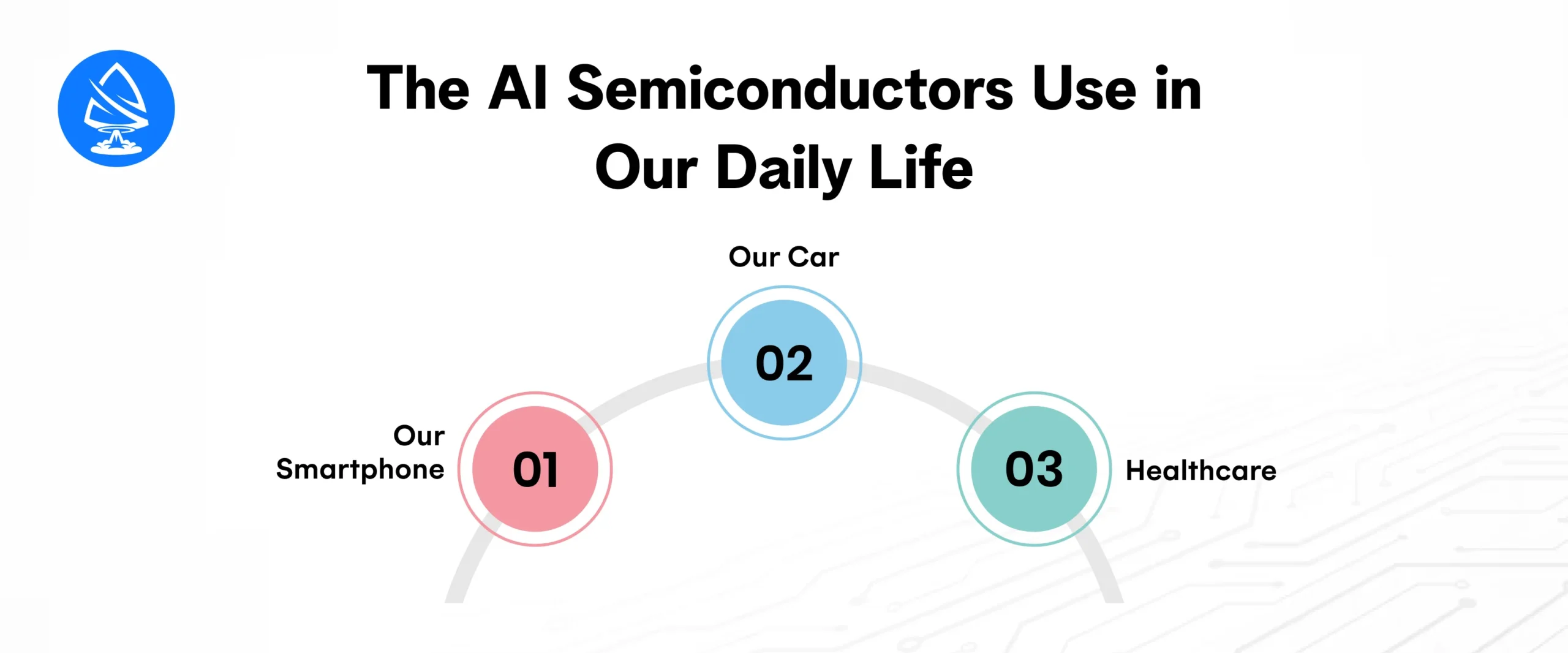
The AI in semiconductor chips is at work when we press a button on our phone to take a photo. In a matter of milliseconds, without an internet connection, they sharpen vision, correct light and focus, and eliminate noise. With the artificial intelligence semiconductor technology, we can make your pictures look beautiful in a second, whether you are shooting a sunset or a selfie of a group of people you are with.
The semiconductor AI is used in modern vehicles to ensure our safety. With the help of AI chips, individuals can avoid accidents. By employing AI-powered driver assistance systems, we can make our commute smarter in the snap of a finger.
Artificial intelligence semiconductors allowed in hospitals and clinics allow imaging devices to detect tumors and scan them at a faster rate than human radiologists, and save many minutes on the diagnosis process. Utilization of AI in semiconductor solution enable faster and more precise medical treatment.
These AI semiconductor firms are at the forefront of the industry, and it is these companies that are making the chips and tools that make the AI experiences of today possible.
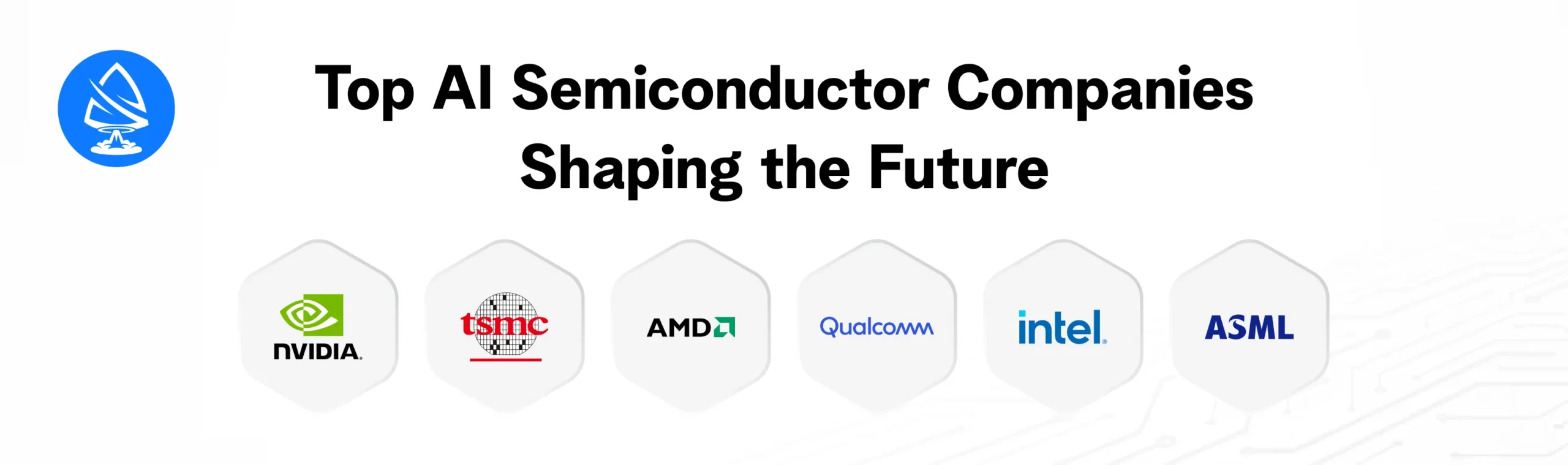
Combined, these companies influence innovation, attract huge R&D(Research and Development) investments, and control the future of semiconductor AI.
In summary, AI in semiconductor is improving the semiconductor process for the better, whether it is in a smartphone, a car, or in the medical field. It makes devices smarter, faster, and more responsive. Currently, most manufacturers partner with a well-known AI development company to integrate predictive intelligence and optimization. This ensures that the semiconductor technology advances to meet your increasing demands.
| Trend | Pre 2026 | Post 2026 | Impact |
| Custom AI Chips Companies | Mainly, large companies like NVIDIA, Google, and Amazon possess in-house-designed chips | Mid-size and enterprise companies adopt broader custom AI chips. | AI chip design became easier to do, and creating a custom chip for specific tasks, such as edge AI in factories, has become common. Self-driving delivery drones now use custom-designed chips based on their specific power and compute needs rather than generic GPU’s. |
|
Energy-Efficient |
Energy-efficient AI is still in its infancy, research continues; however, the vast majority of AI chips were energy hogs in data centres. | Low-power, standard, energy-efficient AI semiconductors are the norms from AI chips in edge devices such as Phones, sensors, and wearables without sacrificing performance. | Smartphones can perform real-time translations or enhance a video without using power from the battery. |
|
AI and 3D Chip Packaging |
There was a limited amount of 3D stacking/memory experimental work. There was low adoption due to the cost and complexity of manufacturing. | Standard practice for AI accelerators is 3D chip packaging, which enables improved AI performance and faster processing speeds through lower latency. | Cloud AI can train massive models faster and occupy a smaller amount of space. |
| Sovereign Semiconductor Initiatives
|
Governments are now starting to invest in domestic semiconductor and AI projects; however, countries are still very dependent on global supply chains. | Many nations will have significantly greater capabilities to manufacture AI semiconductors domestically beginning in 2026. | Countries such as Europe and India could develop their own AI chips to be used in smart factories, digital healthcare devices, and defence systems; therefore, they would not rely as heavily on imports for these products. |
Before 2026, the AI semiconductor market was emerging, supply-chain dependent, and dominated by a few large multinational firms.
After 2026, AI semiconductors will see widespread adoption, higher energy efficiency, local production, and stronger technology ecosystems.
You may also want to know that AI is Enhancing Authentication and Fraud Prevention
AI in semiconductor shapes our lives every day, and businesses have also become reliant on artificial intelligence to operate effectively. Without AI-driven tools, many modern businesses would struggle, as everyday products like assistants, editors, and translators rely on AI.
AI semiconductors already power daily digital experiences, supported by global infrastructure, advanced fabs, and AI-optimized chip designs.
Growing reliance on intelligent hardware is driving rapid growth in the AI semiconductor market as IT platforms evolve.
The future of AI semiconductors focuses on user-friendly, intuitive technology that improves healthcare, transportation, and sustainable manufacturing.
More businesses are searching for AI-powered solutions for their digital applications, and therefore, many companies today are engaging AI application developers to build intelligent software to be integrated with cutting-edge semiconductor technology. AI chips are definitely the driving force behind a more intelligent world.
There are many exciting opportunities on the horizon; however, the future will not be without its difficulties. AI in semiconductor chips is substantially more complex than traditional semiconductor components, and the cost of developing/designing a chip and introducing that chip to the market is high. Therefore, ongoing research and development (R&D) investment will be essential. Geopolitical tensions, export restrictions, and competition from the U.S., China, Taiwan, and South Korea will shape AI semiconductor manufacturing and supply chains.
Continued growth of AI semiconductor companies is increasing demand for specialized talent across key roles.
Furthermore, as these companies continue to scale, they will be required to focus on protecting their intellectual property (IP).
Current challenges also create opportunities for innovation, partnerships, and long-term leadership in the global semiconductor market. Companies such as Artoon Solutions assist in enabling this growth by providing intelligent AI-based applications.
AI in semiconductor industry is changing immensely. AI and semiconductors now work together to create innovative products for healthcare, data centers, and manufacturing.
Unique AI chip designs improve semiconductor performance, delivering faster processing, greater intelligence, and higher efficiency.
AI cost calculators help businesses estimate development and infrastructure costs to make informed AI investment decisions.
Artificial intelligence relies on semiconductor technology to enable a smarter, better-connected world for future generations.
1. How does AI enhance semiconductor yield and quality control?
AI in semiconductors uses machine learning to detect defects early and predict equipment failures, improving productivity.
2. What are the main applications of AI in semiconductor designs?
Key AI applications in semiconductor design include power optimization, thermal analysis, automated layout, fault prediction, and performance optimization.
3. Which AI solutions are most in use in semiconductor manufacturing?
Popular AI semiconductor solutions include AI defect inspection, yield management, digital twins, and predictive analytics.
4. Which companies offer AI software for automating chip designs?
Leading companies like Synopsys, Cadence, and Siemens EDA use AI to enhance design speed, accuracy, and efficiency.
5. Which companies provide AI platforms for optimizing semiconductor processes?
Leading AI semiconductor solution providers include Applied Materials, KLA, Lam Research, Synopsys, and Cadence.

Artoon Solutions
Artoon Solutions is a technology company that specializes in providing a wide range of IT services, including web and mobile app development, game development, and web application development. They offer custom software solutions to clients across various industries and are known for their expertise in technologies such as React.js, Angular, Node.js, and others. The company focuses on delivering high-quality, innovative solutions tailored to meet the specific needs of their clients.
 For business inquiries only