- HR:+91-879-9184-787
- Sales:+91-908-163-7774


The manufacturing industry is entering a new era, an era driven by data, automation, and intelligent decision-making. As global competition intensifies and customer demand for quality rises, manufacturers are under intense pressure to increase efficiency, reduce downtime, and improve safety across their operations. However, traditional reactive or preventive maintenance models are no longer enough. AI-Powered Solutions’ outdated methods lead to unplanned shutdowns, wasted resources, and unnecessary repair costs.
This is where AI-Powered Solutions are reshaping the future of manufacturing. By applying artificial intelligence, machine learning, and advanced analytics to industrial equipment, manufacturers can now predict failures before they occur, optimize asset lifespan, and achieve unprecedented operational reliability. Predictive maintenance, once a complex and costly concept, is now accessible to factories of all sizes thanks to advancements in sensors, real-time data processing, cloud computing, and AI-powered business solutions.
In this detailed guide, we explore how AI-powered predictive maintenance works, why it’s becoming a must-have strategy for modern factories, the technologies behind it, top use cases, challenges, benefits, and future trends. We also include internal linking suggestions, such as an artificial intelligence development company in USA and an Artificial Intelligence Developer to help businesses explore custom AI implementation.
AI-powered solutions in predictive maintenance refer to advanced technologies that use artificial intelligence, machine learning, and data analytics to monitor equipment conditions, analyze performance trends, and predict failures before they occur. Instead of relying on scheduled inspections or reacting to breakdowns, manufacturers use AI to create a proactive, intelligent maintenance system that keeps machines operational, efficient, and safe.
Traditional maintenance methods, reactive and preventive, often fall short because they depend on fixed schedules or human observation. These approaches don’t account for real-time machine behavior, subtle performance degradation, or hidden early-warning signals. AI-powered predictive maintenance changes that by continuously analyzing equipment data and identifying anomalies that humans would never detect.
You may also want to know about AI Digital Transformation
AI-powered solutions combine multiple technologies to deliver accurate, real-time insights. Here’s how they function:
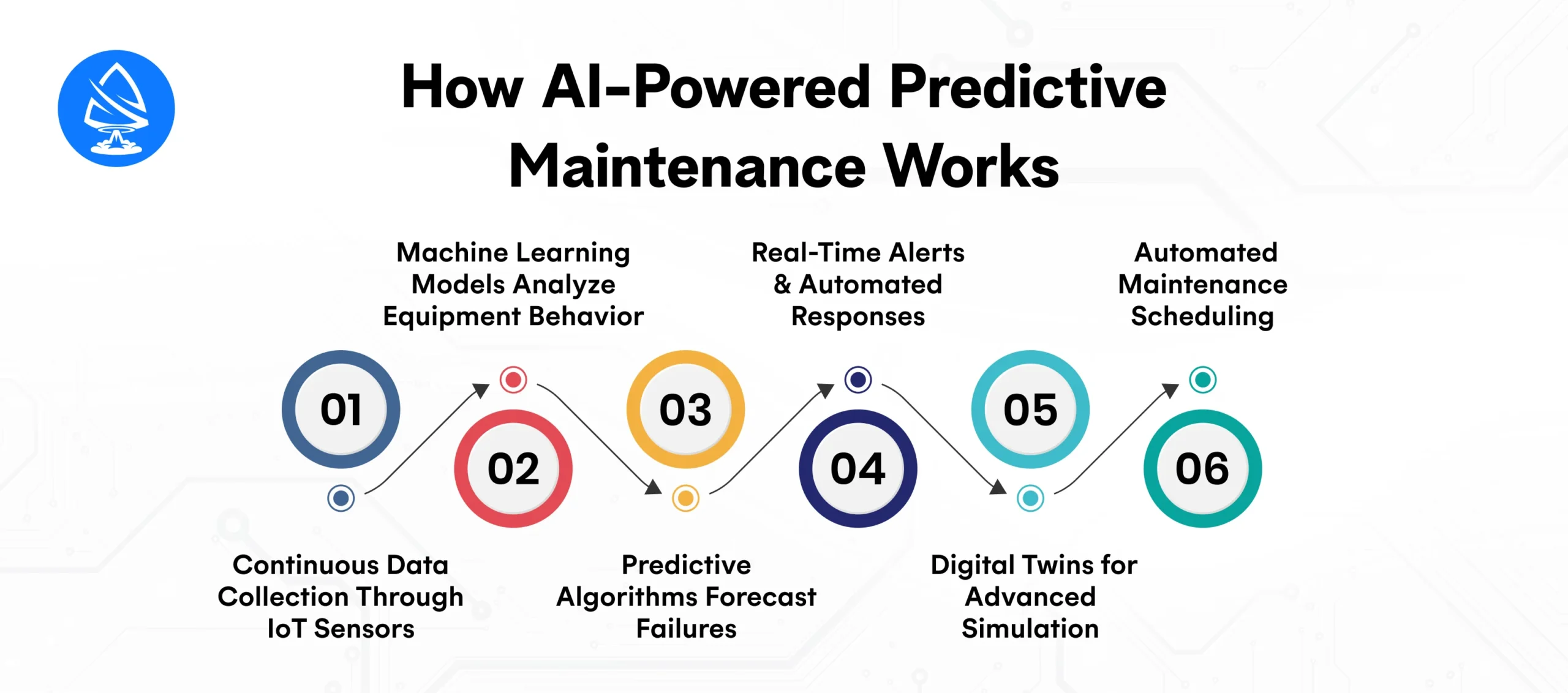
AI systems gather massive amounts of real-time data from equipment using sensors that measure:
This data becomes the foundation of predictive intelligence.
Machine learning algorithms process sensor data to identify patterns and abnormalities.
These models learn from historical equipment behavior and can predict:
After training on historical failure patterns, AI can accurately predict:
This prevents costly downtime and protects critical assets.
AI immediately notifies technicians when something isn’t right.
Alerts are sent through:
Some systems also trigger automated actions like:
A digital twin is a virtual model of a physical machine. Using AI and real-time sensor data, digital twins simulate:
This lets engineers test solutions and predict long-term equipment behavior.
Instead of relying on fixed maintenance intervals, AI systems schedule maintenance only when needed.
This ensures maximum uptime with minimum maintenance cost.
You may also want to know AI Sales Copilot
The manufacturing sector operates in a high-pressure environment where even a few minutes of downtime can cost thousands or even millions of dollars. Traditional maintenance models fail to offer the precision and speed required today.
Fixing equipment only after it breaks causes:
Maintenance on a fixed timeline leads to:
Using AI, sensors, and analytics, manufacturers can:
This positions predictive maintenance as a critical requirement, not an optional upgrade.
AI-powered solutions fundamentally redefine the way manufacturers handle maintenance. Instead of reacting to machine failures or relying on fixed maintenance schedules, businesses now use AI to create a predictive, proactive, and highly efficient maintenance ecosystem. Through advanced analytics, real-time monitoring, and intelligent automation, AI transforms maintenance from a costly burden into a strategic advantage for modern factories.
Below is a detailed breakdown of how AI-powered solutions revolutionize predictive maintenance in the manufacturing sector.
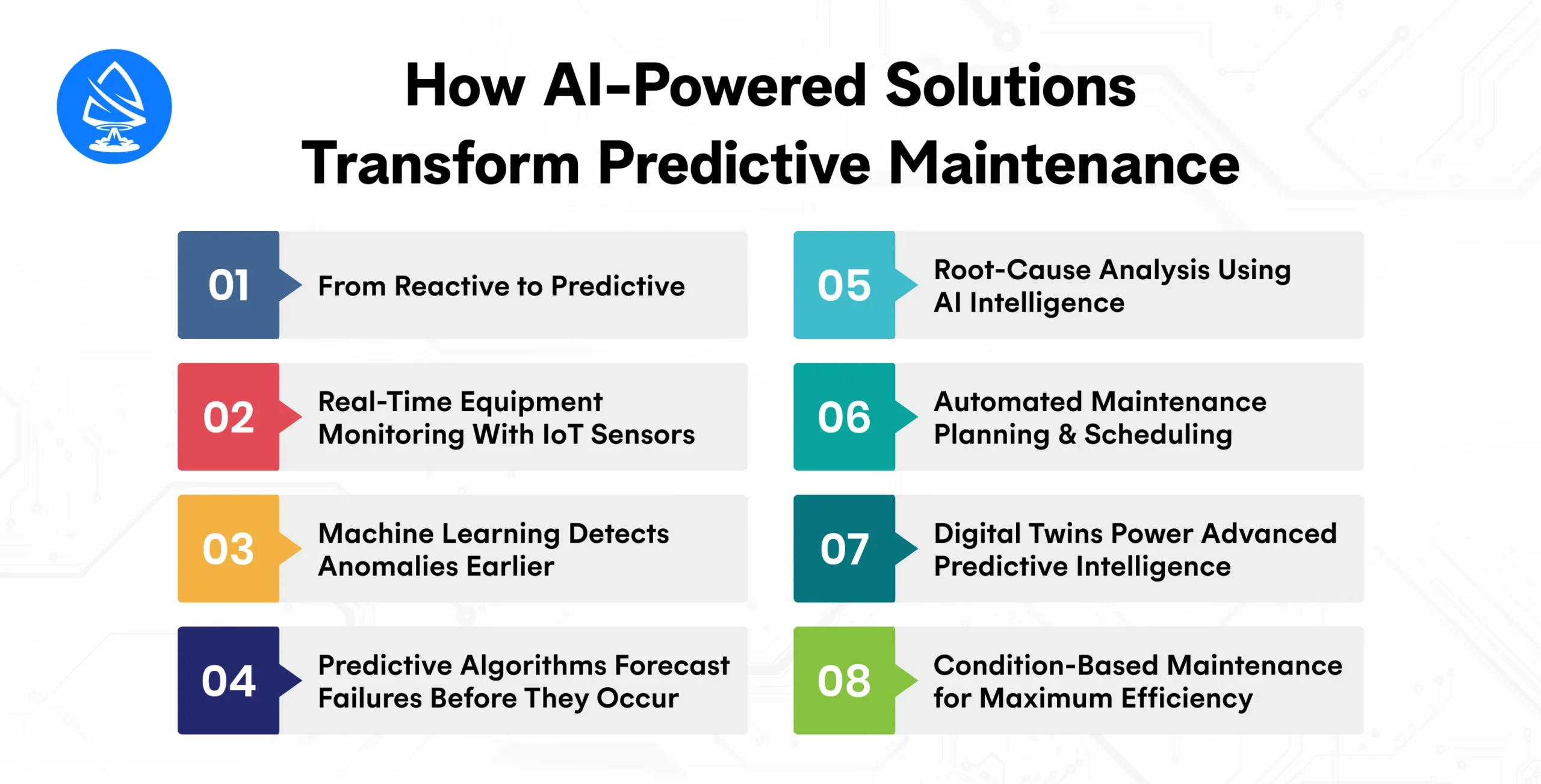
Traditional maintenance models focus on reacting after a failure occurs or performing maintenance on fixed intervals, whether needed or not.
AI-powered predictive maintenance changes the entire approach by:
This transition leads to dramatically lower downtime and reduced operational inefficiencies.
One of the biggest transformations AI brings is real-time visibility into machine conditions.
This makes maintenance predictive, not reactive.
Machine learning (ML) is the core engine behind AI-powered maintenance.
AI learns from:
AI discovers early-warning signs that would otherwise go unnoticed, often weeks before an actual failure.
Predictive models calculate:
These insights allow manufacturers to plan:
Instead of guessing, maintenance becomes data-driven and highly accurate.
AI doesn’t just point out what is wrong; it explains why it is happening.
Through this, it identifies:
Root-cause analysis leads to more effective repairs and prevents repeat issues.
AI automatically:
Digital twins, AI-powered virtual replicas of machines, take predictive maintenance to the next level.
This results in:
Digital twins provide a complete predictive ecosystem, not just isolated predictions.
AI shifts manufacturers away from scheduled servicing to condition-based maintenance.
Maintenance happens exactly when needed, no sooner, no later.
AI-powered predictive maintenance delivers a powerful competitive edge for modern manufacturers by transforming how they manage equipment, plan maintenance tasks, and sustain uptime. Instead of relying on periodic checks or waiting for breakdowns, manufacturers gain a smart, proactive system that continuously monitors machine health and accurately forecasts future failures. This shift toward intelligence-driven maintenance leads to significant improvements in cost savings, efficiency, safety, and overall operational performance.
Below are the major benefits of implementing AI-powered predictive maintenance across the manufacturing ecosystem.
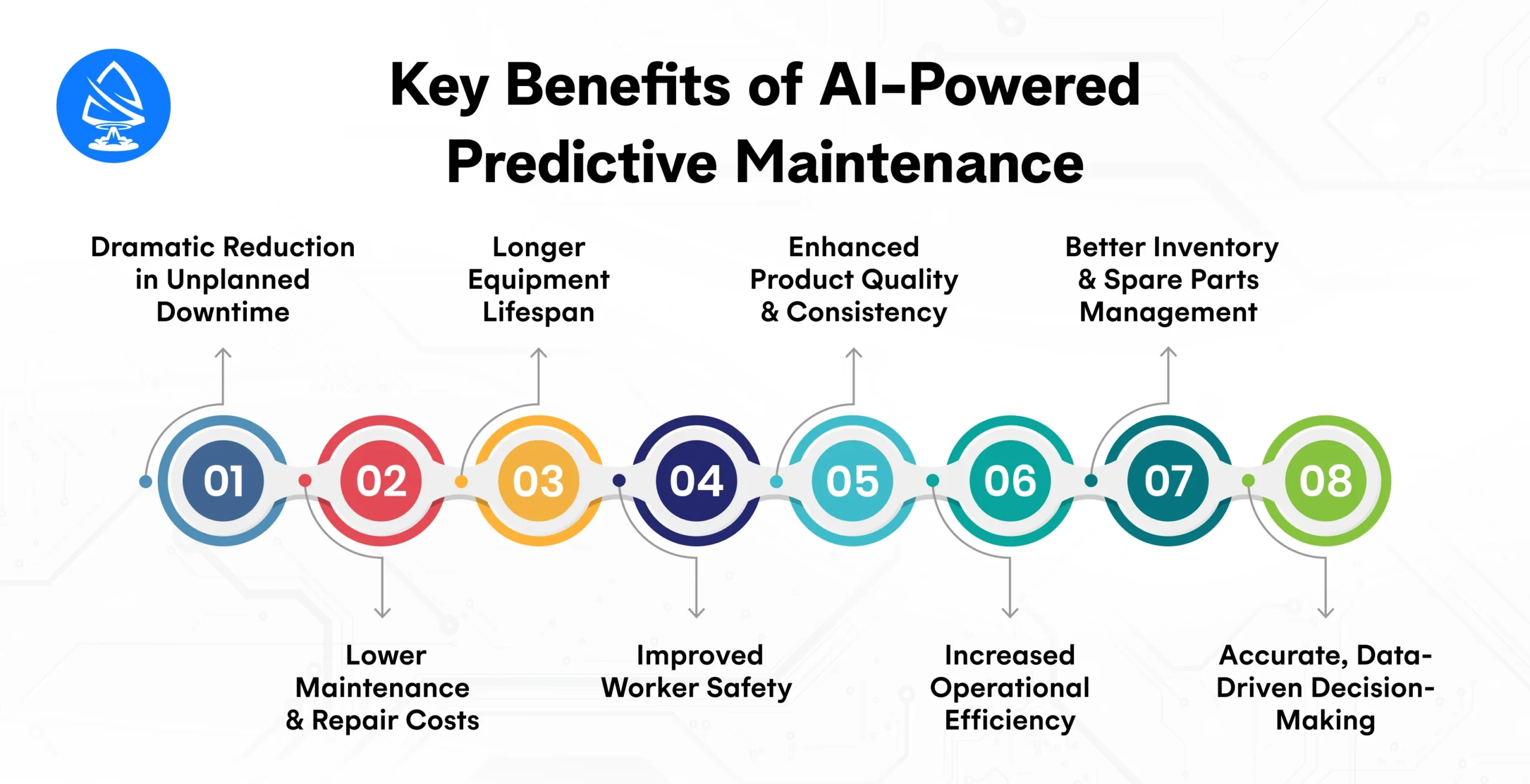
Unplanned downtime is one of the most expensive problems in manufacturing. Even a few hours of machine failure can cost thousands of dollars in lost production, delayed orders, and labor disruption.
Manufacturers achieve up to 50–80% reduction in unplanned equipment downtime, increasing productivity and maintaining consistent output.
Traditional maintenance approaches lead to unnecessary inspections and premature part replacements.
Maintenance costs decrease by 20–40%, while repair accuracy significantly improves.
Machines last longer when maintained based on actual condition rather than fixed schedules.
AI-powered systems continuously evaluate:
By addressing issues early, equipment deterioration slows down significantly.
The lifespan of industrial machines can increase by 25–30%, reducing capital expenditures.
Mechanical failures can be dangerous. AI minimizes risks by predicting:
AI becomes a powerful safety layer on the factory floor.
Equipment health directly impacts product quality.
Poorly maintained machines cause:
AI-powered monitoring ensures:
Higher-quality products and fewer rejects boost customer satisfaction.
AI streamlines both maintenance and production operations.
This leads to smoother operations and better overall plant efficiency.
Production increases by 10–20% with no additional labor or machines.
Manufacturers often struggle with either overstocking spare parts or running out at critical times.
AI predicts:
AI transforms spare parts inventory into a lean, intelligent system.
Instead of relying on technician experience or rough estimations, maintenance becomes evidence-based.
Maintenance leaders make smarter, faster, and more accurate decisions.
Predictive maintenance relies on a powerful combination of advanced technologies that work together to monitor machines, analyze performance, and forecast failures with high accuracy. These technologies form the backbone of modern AI-powered solutions, enabling manufacturers to transition from traditional maintenance methods to a smart, proactive, and data-driven maintenance strategy.
Below are the top AI-powered technologies transforming predictive maintenance in the manufacturing sector.
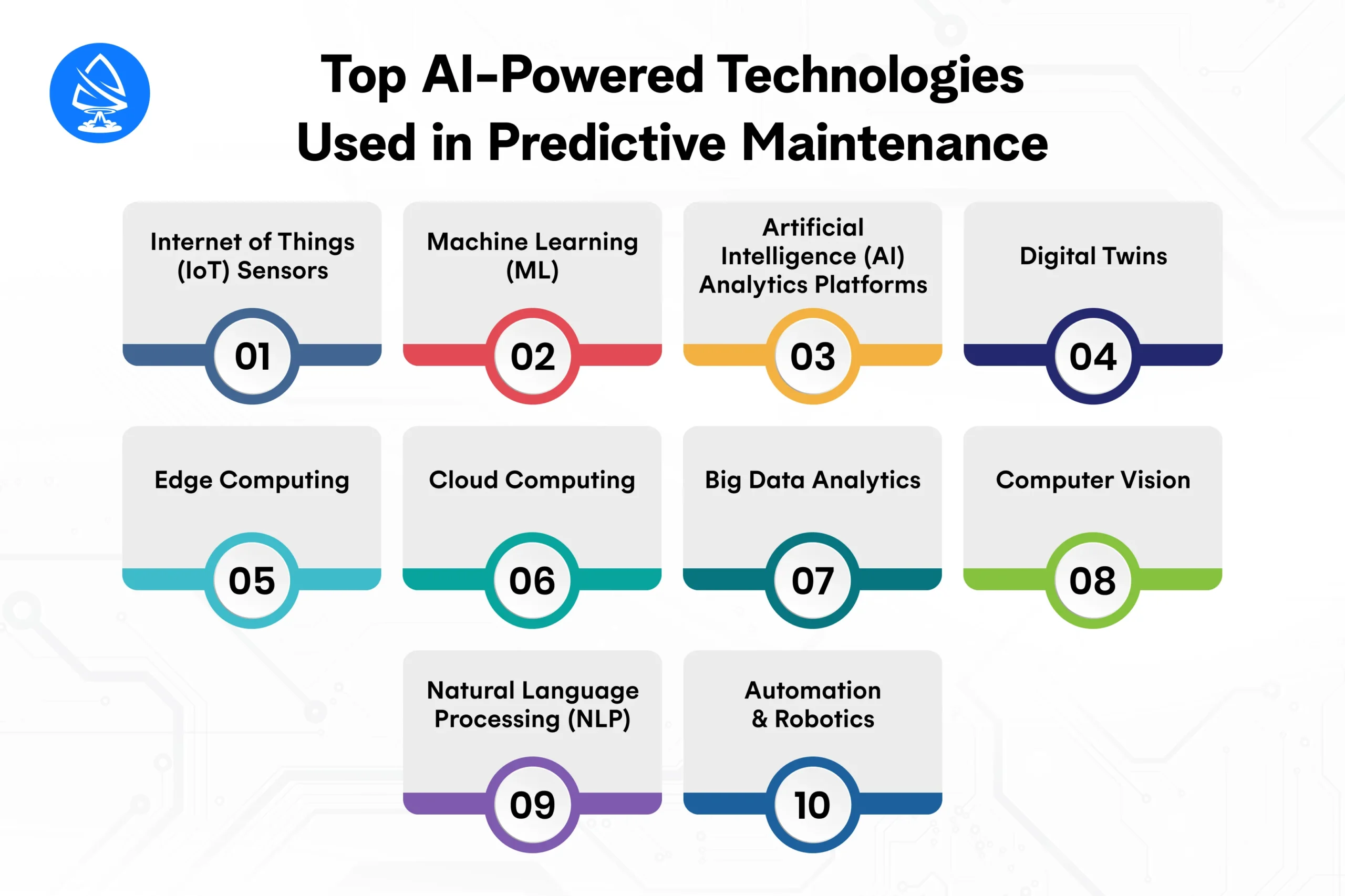
IoT sensors are the foundation of predictive maintenance. They collect real-time operational data from industrial equipment, allowing AI systems to monitor machine health continuously.
IoT provides the raw data that allows AI to “understand” machine behavior.
Machine learning is the intelligence engine behind predictive maintenance. ML models analyze thousands of data points to identify patterns, anomalies, and early signs of degradation.
Machine learning transforms data into actionable maintenance insights.
AI analytics platforms bring together sensor data, machine learning, and advanced analytics to offer a unified view of machine performance.
These platforms make AI insights accessible and actionable for engineers and operators.
A digital twin is a virtual replica of a physical machine or system. It mirrors real-time performance and simulates future behavior using AI and sensor data.
Digital twins help organizations make smarter forecasting and scheduling decisions.
Edge computing brings data processing closer to the machine instead of sending it to the cloud for analysis. This significantly reduces latency.
In manufacturing environments where milliseconds matter, edge computing is critical for timely maintenance decisions.
While edge devices handle real-time processing, cloud computing processes large volumes of historical and aggregated data.
Cloud computing offers flexibility and massive analytical power for global manufacturing operations.
Predictive maintenance generates huge amounts of data, often terabytes from thousands of sensors.
Big data analytics ensures predictive maintenance remains accurate even in large, complex factory environments.
Computer vision uses AI-powered camera systems to visually inspect machines and detect anomalies without manual intervention.
Electronics factories use computer vision to inspect PCB components for micro defects that human eyes may miss.
Maintenance teams often generate unstructured notes, logs, and reports. NLP helps interpret this textual data.
It enables AI to learn from human-generated content, improving predictive accuracy.
AI-powered automation plays a huge role in predictive maintenance by assisting technicians and reducing manual labor.
Automation ensures maintenance actions happen quickly, accurately, and consistently.
Implementing AI-powered predictive maintenance is a strategic transformation, not just a technology upgrade. It requires the right data foundation, a robust analytics ecosystem, seamless integrations, and collaboration across operations, IT, and maintenance teams. The following step-by-step guide outlines how manufacturers can successfully adopt and scale predictive maintenance using AI-powered solutions.
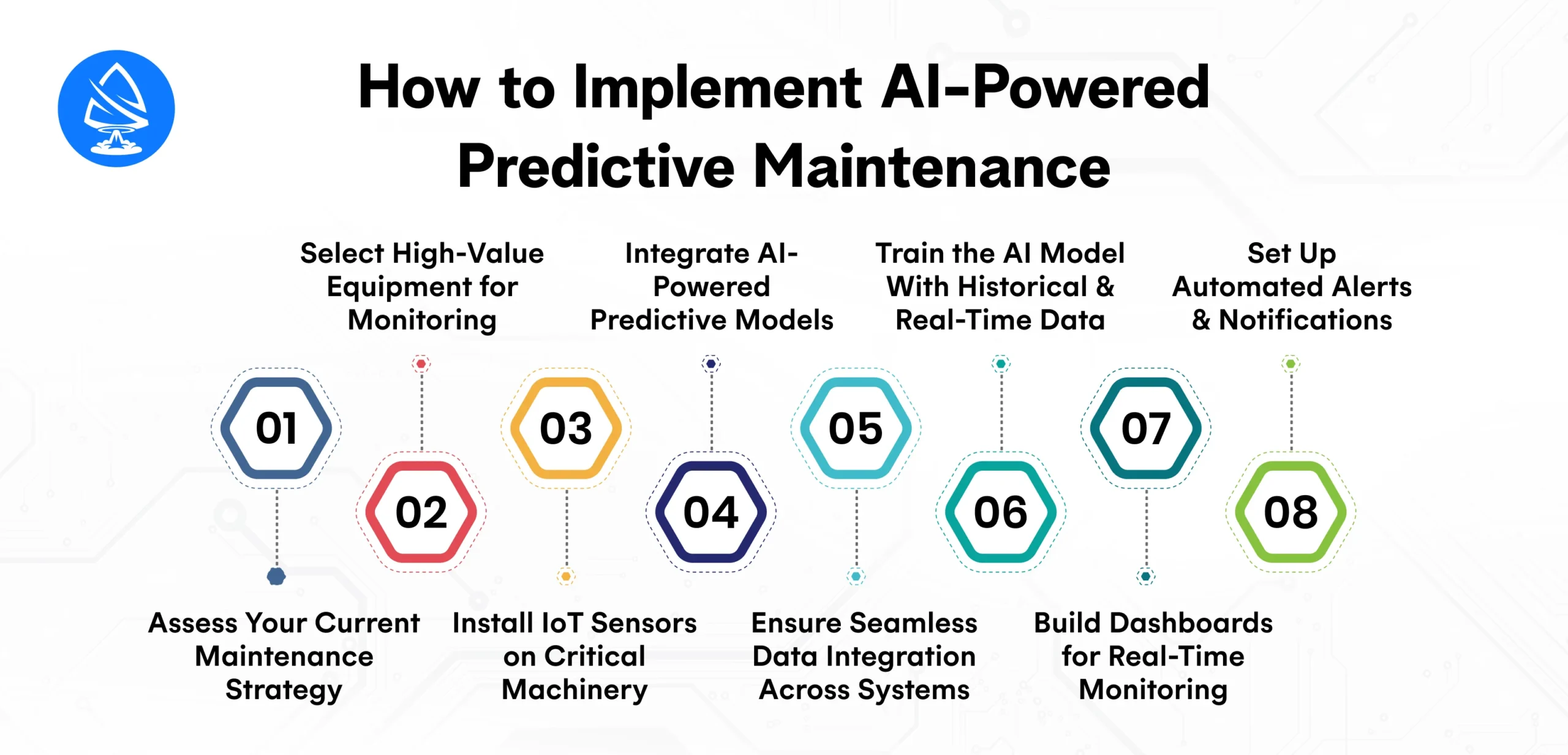
Before introducing AI, you need a clear understanding of your existing maintenance environment.
This assessment helps prioritize where AI can create the highest value.
Not all machines require advanced predictive maintenance immediately. Start with the most critical assets.
This ensures your initial implementation delivers rapid ROI.
IoT sensors are essential for capturing real-time machine health data.
This provides a strong data foundation for predictive modeling.
Once sensor data is available, the next step is to integrate AI and machine learning models that analyze equipment behavior.
To build accurate models, many companies collaborate with an Artificial Intelligence Developer or a specialized artificial intelligence development company in USA to customize predictive AI for their specific machines and environments.
Predictive maintenance requires data from:
This step ensures maintenance teams receive accurate, up-to-date insights across all equipment.
AI becomes smarter through training. The more data it receives, the more accurate its predictions will be.
Well-trained models deliver highly reliable predictions and reduce false alarms.
User-friendly dashboards help maintenance teams visualize machine performance and interact with AI insights.
These visual tools empower teams to take action quickly and effectively.
AI must notify the right people at the right time.
This automation eliminates delays and ensures rapid response.
While AI-powered predictive maintenance delivers significant advantages such as reduced downtime, lower costs, and enhanced equipment performance, its implementation is not without challenges. Manufacturers often face technological, operational, and organizational obstacles when transitioning from traditional maintenance models to AI-driven systems. Understanding these challenges helps businesses plan better, avoid pitfalls, and build a more realistic roadmap for successful adoption.
Below are the key challenges of implementing AI-powered predictive maintenance in the manufacturing sector.
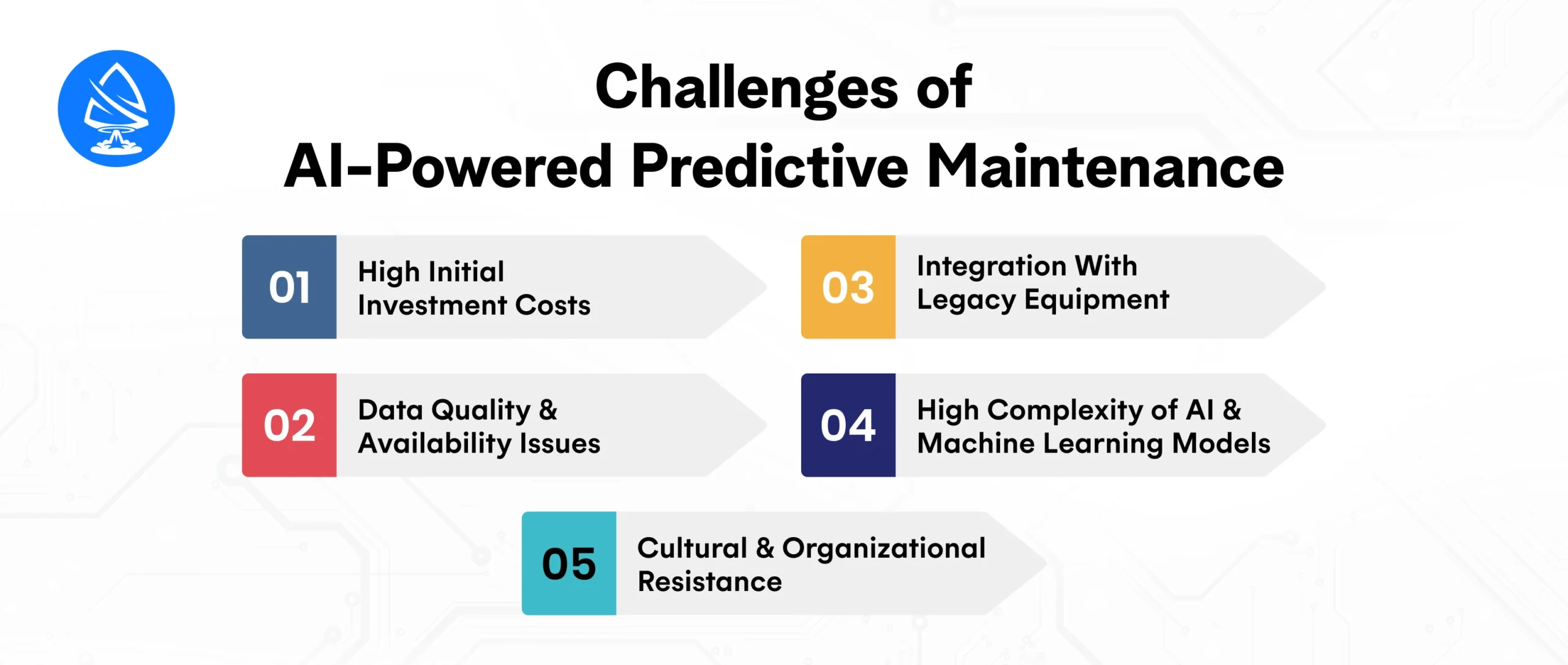
Deploying an AI-powered predictive maintenance system requires considerable upfront investment.
Small and mid-sized manufacturers may struggle with the financial commitment, especially if they lack digital transformation budgets. Although long-term ROI is strong, the initial cost can be a barrier.
Predictive maintenance depends heavily on accurate, high-quality data. However, many factories lack a proper data collection infrastructure.
Poor data leads to unreliable AI predictions, false alarms, and incorrect maintenance recommendations.
Many manufacturing plants use machines that are 20–40 years old.
These legacy systems may not support modern sensors or AI-based monitoring.
Manufacturers may need costly retrofits or new equipment to implement predictive maintenance effectively.
Building predictive models requires specialized skills and domain expertise.
Many manufacturers lack in-house expertise and must rely on an artificial intelligence development company in USA to build and manage these systems.
Maintenance teams and machine operators may resist AI adoption due to:
Resistance slows down adoption and reduces the effectiveness of predictive maintenance initiatives.
AI-powered solutions are fundamentally transforming the manufacturing industry. Predictive maintenance, once considered futuristic, is now a practical, necessary strategy for factories aiming to increase uptime, reduce operational costs, and maintain a competitive edge. By leveraging IoT sensors, machine learning, digital twins, and automated workflows, manufacturers can detect early warning signs, improve equipment health, and ensure safer and more reliable operations.
As global production demands grow, AI will continue to evolve, providing even smarter, more autonomous solutions. Manufacturers who adopt AI now will be ahead of the curve, benefiting from enhanced efficiency, improved decision-making, and significantly reduced downtime. Whether you’re a small business owner or a large manufacturing enterprise, embracing AI-powered predictive maintenance is one of the most strategic investments you can make.
If you’re planning to implement custom AI solutions for your factory, try our AI Project Cost Calculator to estimate development costs and explore the best strategy for your operations.
1. What are AI-powered solutions in manufacturing?
They use AI and IoT to monitor equipment, automate decisions, and optimize factory operations.
2. How does predictive maintenance reduce downtime?
AI detects early signs of failure, allowing technicians to fix issues before breakdowns occur.
3. Do small manufacturers benefit from AI-powered maintenance?
Yes, AI reduces cost, improves accuracy, and boosts efficiency for factories of all sizes.
4. Are AI-powered solutions expensive?
Initial investment is high, but long-term savings from reduced failures outweigh the cost.
5. What sensors are needed for AI predictive maintenance?
Vibration, temperature, pressure, acoustic, and energy sensors.
6. Can AI predict all types of machine failures?
AI predicts most failures, especially when trained with high-quality data.
7. How do digital twins improve predictive maintenance?
They simulate machine conditions to forecast performance and test scenarios.
8. Is AI-powered predictive maintenance secure?
Yes, if combined with strong AI-powered security solutions and cybersecurity protocols.

Artoon Solutions
Artoon Solutions is a technology company that specializes in providing a wide range of IT services, including web and mobile app development, game development, and web application development. They offer custom software solutions to clients across various industries and are known for their expertise in technologies such as React.js, Angular, Node.js, and others. The company focuses on delivering high-quality, innovative solutions tailored to meet the specific needs of their clients.
 For business inquiries only