- HR:+91-879-9184-787
- Sales:+91-908-163-7774


In today’s fast-evolving digital landscape, simply surviving isn’t enough; you must future-proof. For small business owners and tech professionals in the USA, staying ahead means adopting AI Platforms that drive innovation, efficiency, and competitive edge. Whether you’re building a custom product, automating internal workflows, or enhancing your customer experience, the right AI backbone can make all the difference.
In this article, we’ll dive into 8 leading AI platforms that combine scalability, flexibility, and business readiness. I’ll lay out their core strengths, ideal use cases, and caveats, helping you pick the one that fits your roadmap. And if you’re looking for an AI app development company in USA or expert AI app developers, these platform overviews can guide your technology stack discussions. Let’s get started.
Before we list names, here are the criteria you should judge any AI Platforms by:
If a platform does well across these, it’s more likely to withstand tech shifts, regulation changes, or business pivots.
Artificial Intelligence (AI) has moved beyond buzzwords; it’s now a critical growth lever for companies across every industry. Whether you’re streamlining operations, enhancing customer engagement, or building data-driven products, the right AI platform can revolutionize how you operate.
Modern AI platforms offer far more than just chatbots or analytics; they provide a full suite of tools, APIs, and automation frameworks to build, deploy, and scale AI applications efficiently. From generative AI models that create content in seconds to agent frameworks that automate multi-step workflows, the possibilities are endless.
Below are the eight best AI platforms to consider if you want to future-proof your business and stay ahead of the competition.
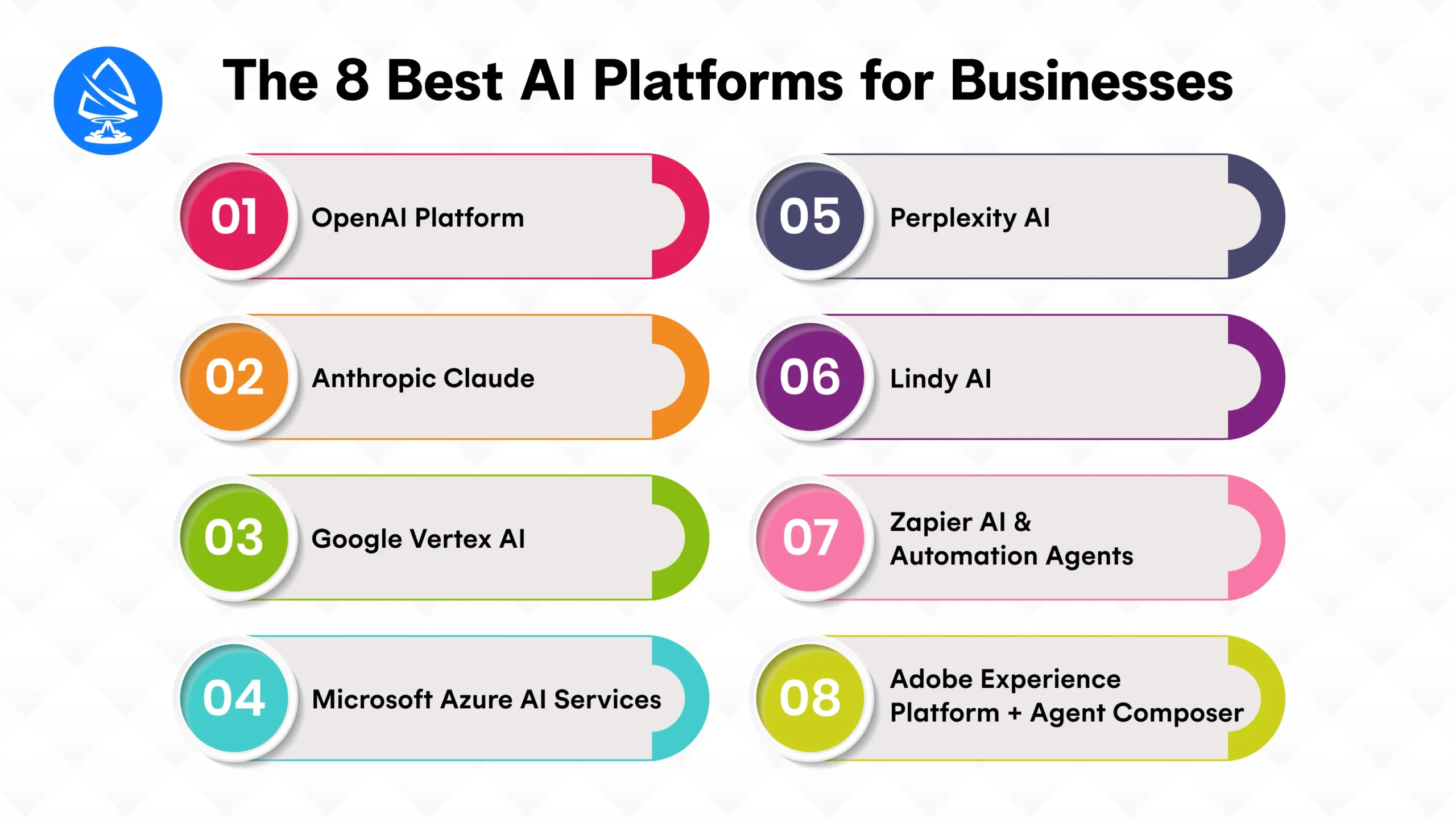
Best for: Generative AI, Chatbots, and Custom AI Solutions
OpenAI has become the gold standard for generative and conversational AI applications. With models like GPT-4, DALL·E 3, and Whisper, OpenAI empowers developers to build everything from chatbots and writing assistants to code generators and advanced data analysis tools.
If you’re working with Microsoft infrastructure, Azure OpenAI Service allows you to integrate the same models in a secure, enterprise-compliant way.
Ideal For: Businesses that want to create AI-driven customer experiences, automate workflows, or embed AI applications directly into their products.
OpenAI continuously improves its models and developer ecosystem, ensuring adaptability as technology evolves.
Best for: Safe, Reliable Conversational AI and Compliance-Sensitive Workflows
Anthropic’s Claude series is designed around AI safety, transparency, and ethical alignment, key for businesses that handle sensitive or regulated data. Claude excels at following complex instructions, summarizing documents, and performing logical reasoning with reduced hallucination rates.
Ideal For: Legal firms, financial institutions, and businesses needing accurate, explainable AI outputs.
Why It’s Future-Proof:
Claude’s architecture is designed to evolve safely with AI regulations, making it a dependable partner for long-term use.
Best for: Custom ML Models, Predictive Analytics, and Data-Driven Applications
Google Vertex AI is a full-stack machine learning (ML) platform that helps developers train, deploy, and monitor AI models at scale. It integrates tightly with other Google Cloud services like BigQuery, TensorFlow, and AutoML, enabling both beginners and experts to create AI solutions faster.
Ideal For: Enterprises with strong data pipelines or teams that want full control over their AI lifecycle.
Google’s continuous innovation in ML infrastructure and scalability ensures longevity for enterprise use.
Best for: Multi-Domain AI Integration and Enterprise Automation
Azure AI Services include Cognitive Services, Machine Learning Studio, and Azure OpenAI. Together, they offer one of the most comprehensive AI ecosystems available today. You can integrate AI for vision, speech, translation, and language understanding directly into apps and workflows.
Ideal For: Businesses already using the Microsoft ecosystem that want to extend automation and intelligence across their stack.
Azure’s hybrid cloud approach ensures adaptability for both on-premise and cloud systems, perfect for large enterprises.
Best for: Knowledge Retrieval and Real-Time AI Research
Perplexity AI bridges the gap between AI chatbots and search engines by delivering real-time, cited answers using up-to-date web data. Its Pro plan allows integration through APIs and browser extensions, making it great for knowledge-intensive industries.
Ideal For: Research firms, marketing agencies, or teams that need up-to-date factual AI responses.
By fusing search and generative AI, Perplexity ensures relevance in a world demanding both speed and accuracy.
Best for: AI Automation and Multi-Step Task Orchestration
Lindy focuses on creating AI agents that can handle complex, multi-step workflows autonomously, ideal for teams that want to automate repetitive business processes like email outreach, lead management, or HR onboarding.
Ideal For: Businesses that want to automate internal operations with minimal coding.
Agentic AI will become the backbone of future enterprise automation, and Lindy is among the pioneers in this field.
Best for: No-Code AI Workflow Automation
Zapier AI allows non-developers to connect AI tools and automate repetitive business workflows without writing a single line of code. You can combine OpenAI, Google Sheets, Slack, and hundreds of apps into intelligent automation sequences.
Ideal For: Small businesses and startups that want to quickly implement AI automation without heavy technical investment.
As AI becomes ubiquitous, no-code tools like Zapier will empower non-technical users to deploy automation on their own.
Best for: Marketing Automation and Personalized Customer Experiences
Adobe Experience Platform (AEP) integrates AI directly into digital marketing, analytics, and customer engagement workflows. Its Agent Composer feature lets you create AI-powered agents that analyze customer journeys, deliver insights, and personalize experiences across channels.
Ideal For: Marketing and CX teams looking to optimize campaigns and deliver hyper-personalized experiences.
Adobe’s integration of AI with creative and analytics tools ensures that businesses stay ahead in digital customer engagement.
You may also want to know Large Vision Models
These eight platforms stand out because they provide scalability, versatility, and long-term innovation. Each platform represents a different layer of AI maturity, from plug-and-play tools to deep ML infrastructure.
By adopting the right mix, your business can:
Whether you’re a startup experimenting with free AI tools or an enterprise building a robust AI infrastructure, these platforms can form the foundation of your digital transformation journey.
Selecting the right AI platform is one of the most strategic decisions a business can make today. With dozens of AI platforms, tools, and APIs available, each offering different levels of automation, scalability, and customization, it’s easy to get overwhelmed.
The right choice depends on your business goals, technical expertise, budget, and long-term strategy. Choosing poorly can lead to high costs, integration headaches, and poor ROI. Choosing wisely, however, can accelerate digital transformation, automate repetitive tasks, and give your company a lasting competitive advantage.
Below is a practical, step-by-step guide to help you make the best decision.
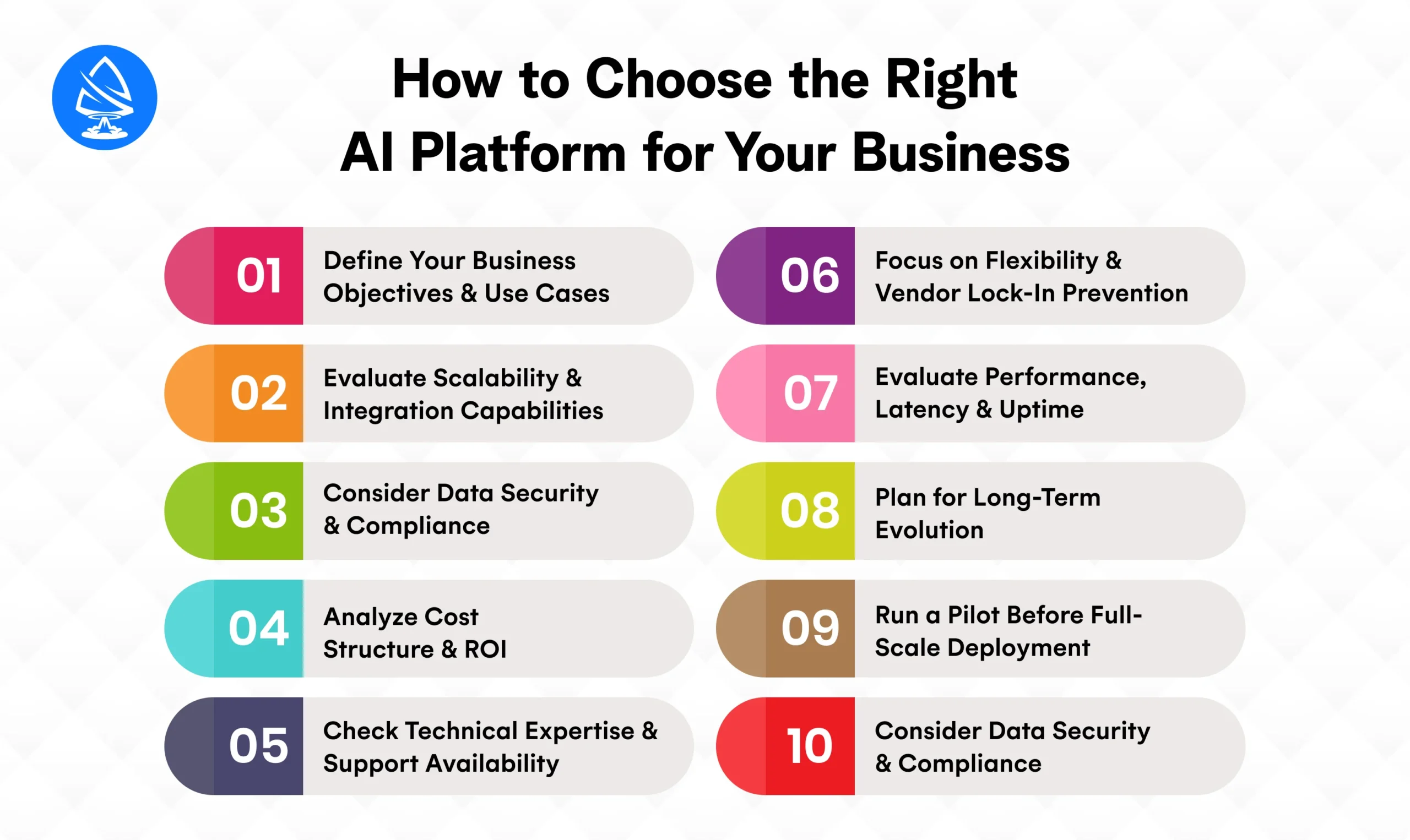
Start by asking: What do we want AI to accomplish?
Your AI strategy should be built around clear, measurable goals.
For example:
If your goal is customer interaction and automation, platforms like OpenAI or Anthropic Claude are great fits.
If your focus is on data analytics and model training, go for Google Vertex AI or Azure AI Services.
For marketing automation, Adobe Experience Platform stands out.
Pro Tip: Create a list of 3–5 AI use cases that directly align with your revenue or productivity goals before shortlisting platforms.
A powerful AI platform isn’t just about algorithms; it’s about how well it fits into your existing ecosystem.
Ask:
For instance, Zapier AI offers plug-and-play integrations for smaller teams, while Azure and Vertex AI provide enterprise-grade scaling for larger infrastructures.
Why this matters:
AI adoption usually starts small but grows quickly once you see value. Choosing a scalable platform prevents you from rebuilding systems later.
In industries like healthcare, finance, or e-commerce, data privacy is paramount. Ensure your chosen AI platform complies with:
If you handle sensitive customer data, prioritize platforms offering data encryption, role-based access control, and regional data storage.
Azure OpenAI and Google Vertex AI are strong choices here because they provide enterprise-level compliance and customizable governance policies.
Pro Tip: Never send personally identifiable information (PII) to public AI APIs unless explicitly compliant with your regional laws.
AI platforms follow various pricing models per token, per API call, or per compute hour. Understanding the cost dynamics is crucial before scaling.
Evaluate ROI not just in terms of cost savings but also value-added outcomes like increased leads, faster decision-making, and improved customer retention.
Pro Tip: Always run a pilot project with limited usage first. This helps estimate actual costs under real-world workloads before committing long-term.
Every platform has a learning curve. If your team has strong AI/ML skills, you can adopt customizable ecosystems like Vertex AI or Azure ML Studio.
However, if your team prefers low-code or no-code solutions, consider Zapier AI, Lindy, or Adobe Experience Platform.
Also, evaluate:
If you lack in-house expertise, partnering with an experienced AI app development company in USA can help you implement, fine-tune, and maintain your AI systems effectively.
AI technology evolves rapidly. To future-proof your investment, choose platforms that:
Avoid platforms that lock your data or force proprietary formats. This flexibility ensures you can switch or upgrade easily as your AI needs evolve.
Pro Tip: Use an abstraction layer, a middleware API that connects to multiple AI platforms. It helps you swap providers with minimal refactoring.
When deploying real-time AI applications like chatbots, recommendation systems, or fraud detection, you need consistent performance.
Check:
Platforms like OpenAI via Azure, Vertex AI, and Anthropic Claude maintain enterprise-grade performance with low latency and robust scaling.
Your AI strategy shouldn’t end with deployment; it should continuously evolve. Look for platforms that:
Choosing a platform backed by continuous innovation ensures your investment remains relevant for years.
Before integrating AI into your entire business, conduct a proof-of-concept (POC).
This lets you measure:
Gather feedback from employees and customers to refine your implementation plan. Once successful, scale the project gradually across departments.
Even the best AI platform won’t deliver value without the right implementation partner. A skilled AI development company in USA can help you:
Partnering with experienced AI app developers also ensures your AI systems align with long-term goals and deliver measurable ROI.
You may also want to know the Top AI Crypto Trading Bots
Here are a few illustrative scenarios to help you map the need platform:
| Scenario | Best Fit Platform(s) | Why |
| You run a SaaS tool and want to embed a smart chatbot | OpenAI / Azure | Direct access to GPT models, fine-tuning, and support |
| You’re a marketing agency automating customer journeys | Adobe Experience Platform + Agent Composer | In-built marketing, analytics, and AI orchestration |
| You want a research assistant who cites sources | Perplexity | It combines responses with up-to-date web data |
| You need internal automation across Ops, HR, and Sales | Lindy / Zapier Agents | Workflow orchestration, agent chaining |
| You’re in a regulated industry with high compliance needs | Azure OpenAI / Vertex AI with governance | Cloud providers usually offer compliance safeguards |
| You want to run custom models, experiments, or R&D | Vertex AI | Full ML lifecycle support |
These are not mutually exclusive; many firms combine two or more platforms depending on context.
Adopting AI Platforms is no longer optional; it’s strategic. The eight platforms above represent the cutting edge of what enterprises and startups alike are using to build intelligent systems, automate, and scale. But it’s not enough to pick a name off a list; you must align platform capabilities with your business goals, team readiness, and compliance requirements.
Start small: prioritize a pilot, measure ROI, and maintain architecture flexibility. As you grow, you may blend multiple platforms, for instance, using Perplexity for knowledge retrieval + OpenAI for generative tasks + Zapier Agents for orchestration.
Want to estimate how much aligning with one of these platforms will cost for your scale? Use our Cost Calculator to experiment with usage, growth scenarios, and platform tiers. That’s your next smart move.
Let me know if you’d like help designing a pilot roadmap or comparing two platforms side by side.
1. What is the difference between an AI platform and an AI tool?
An AI tool often addresses a single function. An AI platform offers a broader architecture model, training, orchestration, agent workflows, integrations, and versioning.
2. Are there good free AI platforms or tiers?
Yes. OpenAI, Google Cloud, Azure, and others offer free or trial tiers. Google Cloud even has free usage limits for translation, speech-to-text, and NLP APIs.
3. Can these platforms replace machine learning teams?
Not entirely. They greatly accelerate work, but human oversight, strategy, domain knowledge, prompt engineering, and evaluation are still crucial.
4. How do I mitigate lock-in risk?
Use abstraction layers, keep prompt libraries portable, avoid proprietary pipelines, and design your system so you can swap providers.
5. When should a business build its own custom AI stack instead of choosing a platform?
When your use case is highly differentiated, your data is proprietary, or licensing costs become prohibitive. Even then, you might combine both.
6. How do I budget for AI platform costs?
Begin with pilot budgets. Model usage and include a buffer for spikes. Monitor costs regularly.
7. Which platform is best for small businesses or startups on a budget?
Start with free or lower-cost tiers to prove ROI. Then scale or migrate as needed.
8. Can an AI platform handle multimodal tasks?
Yes. Platforms like Google Vertex AI, Azure, and some newer agents support multimodal models. Always confirm model support and APIs.

Artoon Solutions
Artoon Solutions is a technology company that specializes in providing a wide range of IT services, including web and mobile app development, game development, and web application development. They offer custom software solutions to clients across various industries and are known for their expertise in technologies such as React.js, Angular, Node.js, and others. The company focuses on delivering high-quality, innovative solutions tailored to meet the specific needs of their clients.
 For business inquiries only