- HR:+91-879-9184-787
- Sales:+91-908-163-7774


Artificial Intelligence (AI) has revolutionized industries, and the programming language you use can greatly impact the success of your AI projects. Whether you’re an experienced developer or just diving into AI development, choosing the best AI programming language is a crucial decision. The right programming language can make your project more efficient, scalable, and future-proof.
In this article, we will explore how to choose the best AI programming language based on various factors, such as AI coding tools, code generation, efficiency, and the specific needs of your project. We will also look at some of the most popular languages used in AI development, their strengths, and weaknesses, helping you make an informed decision when working with an Artificial Intelligence Development company.
An AI programming language is a programming language specifically designed or optimized to support developers in creating artificial intelligence (AI) systems, machine learning models, and other data-driven applications. These languages provide the tools, frameworks, and libraries necessary for handling complex computations, data analysis, and decision-making processes required in AI development. AI programming languages allow developers to code applications that can learn from data, perform predictive tasks, recognize patterns, and even make decisions autonomously.
AI programming languages typically come with specialized features, like machine learning algorithms, data manipulation tools, and libraries designed to make it easier to work with neural networks, natural language processing (NLP), and other AI techniques. They are used to train models, perform data analysis, and build AI-driven systems that can solve specific problems or automate complex tasks.
AI programming languages differ from general-purpose programming languages in that they are specifically optimized for the tasks involved in AI development. Here are some of the key characteristics of AI programming languages:
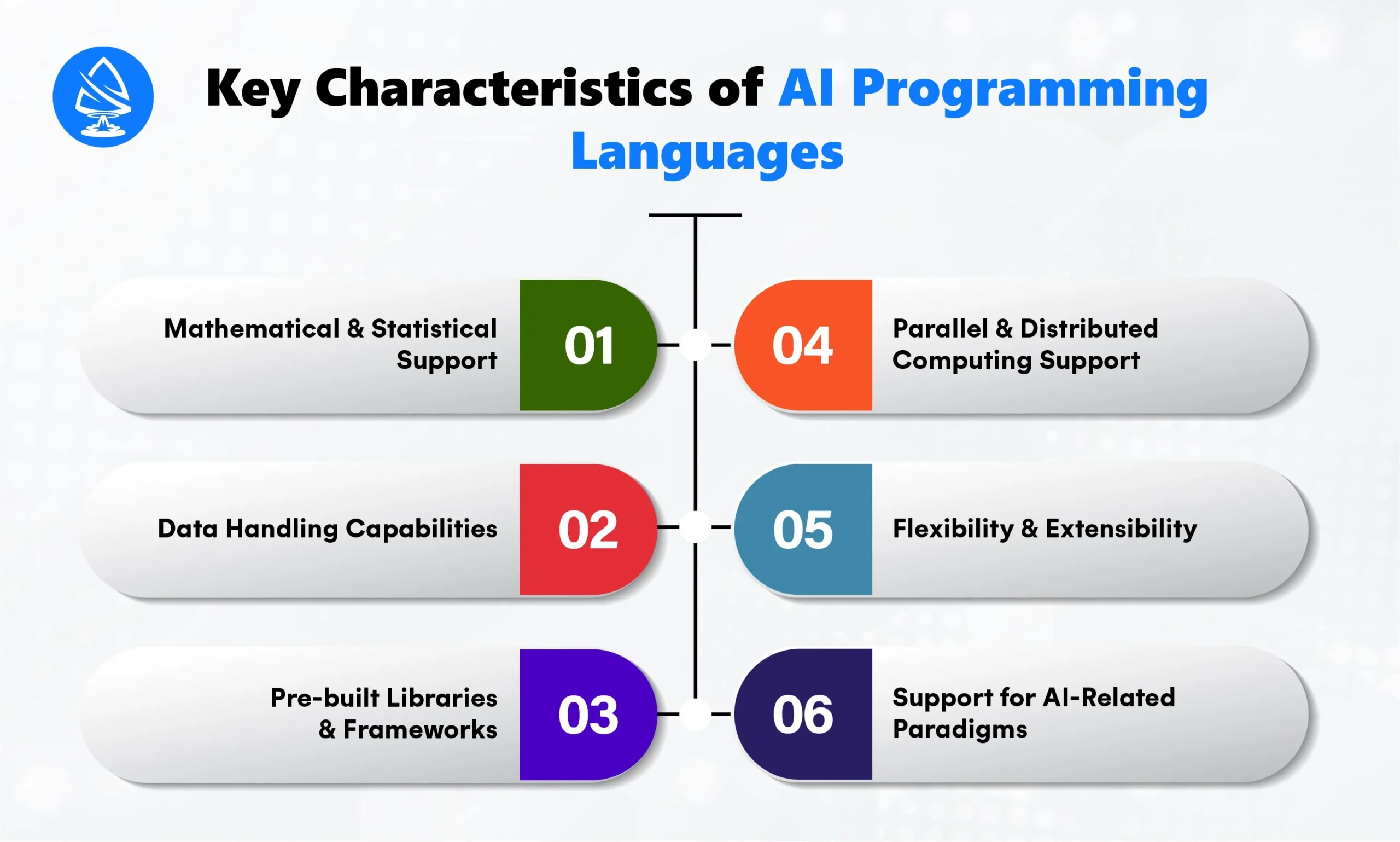
AI development often involves working with large datasets, complex mathematical models, and statistical analysis. AI programming languages typically include built-in support for handling mathematical operations, such as matrix manipulation, linear algebra, and statistics. This is particularly crucial for tasks like machine learning, deep learning, and data analysis, which rely heavily on mathematical operations.
AI projects typically require the ability to process large amounts of structured and unstructured data. AI programming languages often come with data handling libraries that allow developers to manipulate and clean data, perform analysis, and prepare data for training models. These capabilities make it easier to handle complex datasets that are commonly used in AI applications.
AI programming languages often come with a rich ecosystem of libraries and frameworks specifically designed to simplify the AI development process. These tools offer pre-built algorithms and models for various AI tasks, such as:
These libraries save time by providing optimized implementations of complex algorithms, so developers don’t need to build everything from scratch.
Many AI applications require heavy computational power, especially when training deep learning models on large datasets. AI programming languages often include support for parallel computing and distributed computing, which allows developers to speed up computations by using multiple processing units or machines simultaneously. This is important for scalability and performance, especially in the context of large-scale AI projects.
AI programming languages are typically designed to be flexible and extensible. They allow developers to modify or extend the language and its libraries to fit the unique needs of a given AI application. Whether you need to experiment with new algorithms, modify existing models, or integrate external systems, flexibility is essential for AI development.
AI programming languages often support specific paradigms relevant to AI, such as reinforcement learning, neural networks, and genetic algorithms. This is important because AI tasks often involve specific structures or decision-making processes that traditional programming paradigms cannot easily represent.
You may also want to know AI Voice Generator Platform Development
Selecting the right AI programming language is a crucial decision that can impact the efficiency, scalability, and success of your AI project. Whether you’re working on machine learning, deep learning, natural language processing (NLP), or AI-driven systems, the programming language you choose will play a significant role in determining the development speed, performance, and long-term maintainability of your application.
There are several factors you need to consider when choosing the best AI programming language for your project. Below, we’ll go over the key aspects that should guide your decision.
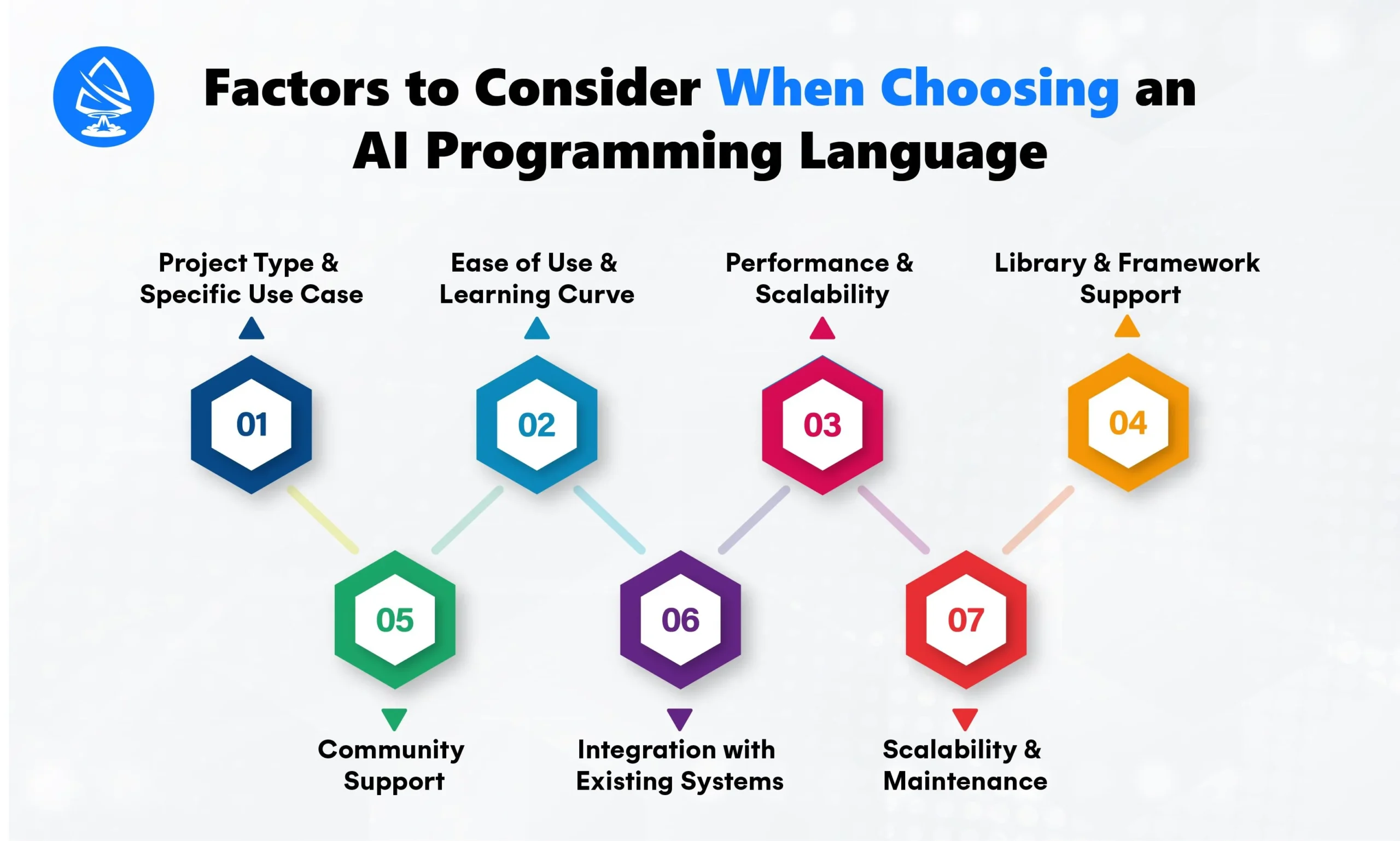
The first factor to consider is the specific type of AI project you’re working on. Different AI applications require different approaches, and some programming languages may be better suited to certain tasks. The complexity of your project, along with the kind of AI model you’re building, will influence your choice.
In summary, the specific AI task will determine whether you need a language that excels in data analysis, complex computations, or real-time processing.
The ease of use and learning curve associated with a programming language is a critical factor, especially if you’re a beginner or have a small team. Some languages are more beginner-friendly than others and provide extensive documentation, tutorials, and community support to make the learning process easier.
If speed of development and rapid prototyping are essential for your project, languages with a low learning curve, like Python, are ideal.
For many AI applications, performance is a critical factor. AI development often involves working with large datasets, performing complex calculations, and training machine learning models that can take a long time to execute. Some languages are more efficient in terms of processing speed and memory management than others.
For AI applications that need to process huge amounts of data, parallelize tasks, or work in real-time, C++ or Java might be preferred due to their performance. However, for rapid development, Python is often a reasonable choice.
The presence of robust libraries and frameworks is another essential factor to consider when choosing an AI programming language. These pre-built tools and components allow you to build complex AI applications without starting from scratch.
If you need access to advanced AI algorithms and tools, Python should be your first choice due to its rich library ecosystem. If you’re looking for high-performance, C++ or Java could be useful, although they are less beginner-friendly.
The size and activity of a programming language’s community are important considerations when choosing the right language for your AI project. A strong community can provide helpful resources, code samples, tutorials, and solutions to common problems, making the development process smoother.
For AI projects, a large, active community—like the one around Python—can make it easier to troubleshoot issues, get support, and stay updated on the latest developments in AI.
When developing AI applications, it’s important to consider how easily the language integrates with existing systems, data sources, and infrastructure. Your AI system will often need to interface with databases, web services, and other software components.
If you’re building an AI system that needs to integrate with other software or services, Python and Java are ideal choices due to their extensive integration capabilities.
Lastly, consider the scalability and long-term maintenance of your AI system. As your application grows, you’ll need to ensure that the language and framework you choose can handle increasing data volume and complexity.
For scalability, Java and C++ are often better suited for large, distributed, or real-time AI applications, while Python works well for smaller to medium-scale AI projects.
You may also want to know AI Website Builder
When it comes to building AI-powered systems, choosing the right programming language is a crucial step. The programming language you use will directly influence the performance, scalability, and maintainability of your AI application. Certain programming languages have become more popular for AI development due to their specialized libraries, frameworks, and overall support for AI-related tasks like machine learning, deep learning, natural language processing (NLP), and data manipulation.
Let’s explore the most popular AI programming languages and why they are preferred by AI developers.
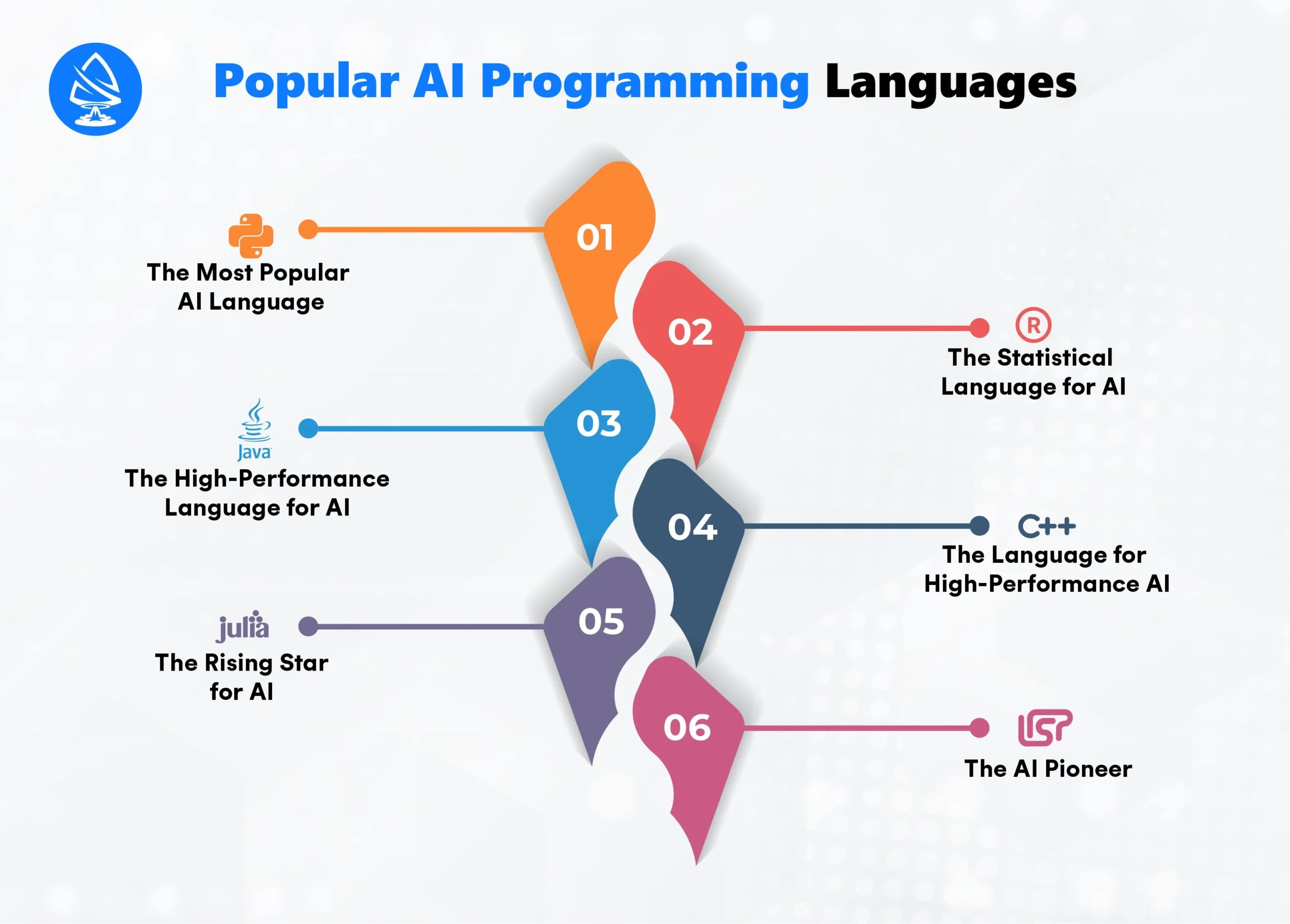
Python is, without a doubt, the most popular language for AI development. It has become the default language for machine learning, deep learning, data science, and artificial intelligence tasks, thanks to its simplicity, versatility, and a rich ecosystem of AI-focused libraries.
Simplicity and Readability: Python’s clean syntax makes it easy to learn and use, which is one of the primary reasons for its popularity in AI development. It allows developers to focus on solving problems rather than dealing with complex syntax.
Extensive Libraries and Frameworks: Python offers an abundance of powerful libraries and frameworks that are highly optimized for AI tasks. Some popular ones include:
Community Support: Python has one of the largest developer communities, which means you can find extensive resources, tutorials, and documentation to help with AI-related tasks.
Wide Adoption: Python is used by both large organizations and research institutions for cutting-edge AI research and production applications.
Best For: Machine learning, deep learning, data science, natural language processing (NLP), and robotics.
R is a language designed specifically for statistics and data analysis, making it a popular choice for AI developers focused on statistical modeling and data manipulation.
Best For: Statistical modeling, data analysis, machine learning, and data visualization.
Java is a widely used, general-purpose language that is often used for building enterprise-level AI systems due to its scalability, performance, and robustness.
Best For: Large-scale AI systems, enterprise applications, and high-performance AI tasks.
C++ is a high-performance programming language that offers low-level control over system resources. While it’s not as commonly used for AI development as Python, it remains an important language, particularly for performance-sensitive AI applications.
Best For: Real-time AI applications, robotics, and performance-sensitive AI systems.
Julia is a relatively new language, specifically designed for scientific computing and numerical analysis. It is quickly gaining traction in the AI community due to its combination of high performance and ease of use.
Best For: Scientific computing, numerical optimization, and high-performance machine learning.
Lisp is one of the oldest programming languages in the AI field, dating back to the 1950s. While it is not as commonly used today, Lisp holds historical importance in AI development due to its symbolic processing and advanced list manipulation capabilities.
Best For: AI research, symbolic AI, and automated reasoning.
In the rapidly evolving world of artificial intelligence (AI), the tools and libraries you use can significantly accelerate the development process and enhance the performance of your models. AI programming libraries provide pre-built functions, modules, and algorithms that simplify complex tasks, enabling developers to focus more on building innovative solutions and less on reinventing the wheel. These tools make tasks like data preprocessing, model training, evaluation, and deployment more efficient.
This article will explore some of the best AI tools and libraries available for AI programming, covering their features and ideal use cases.
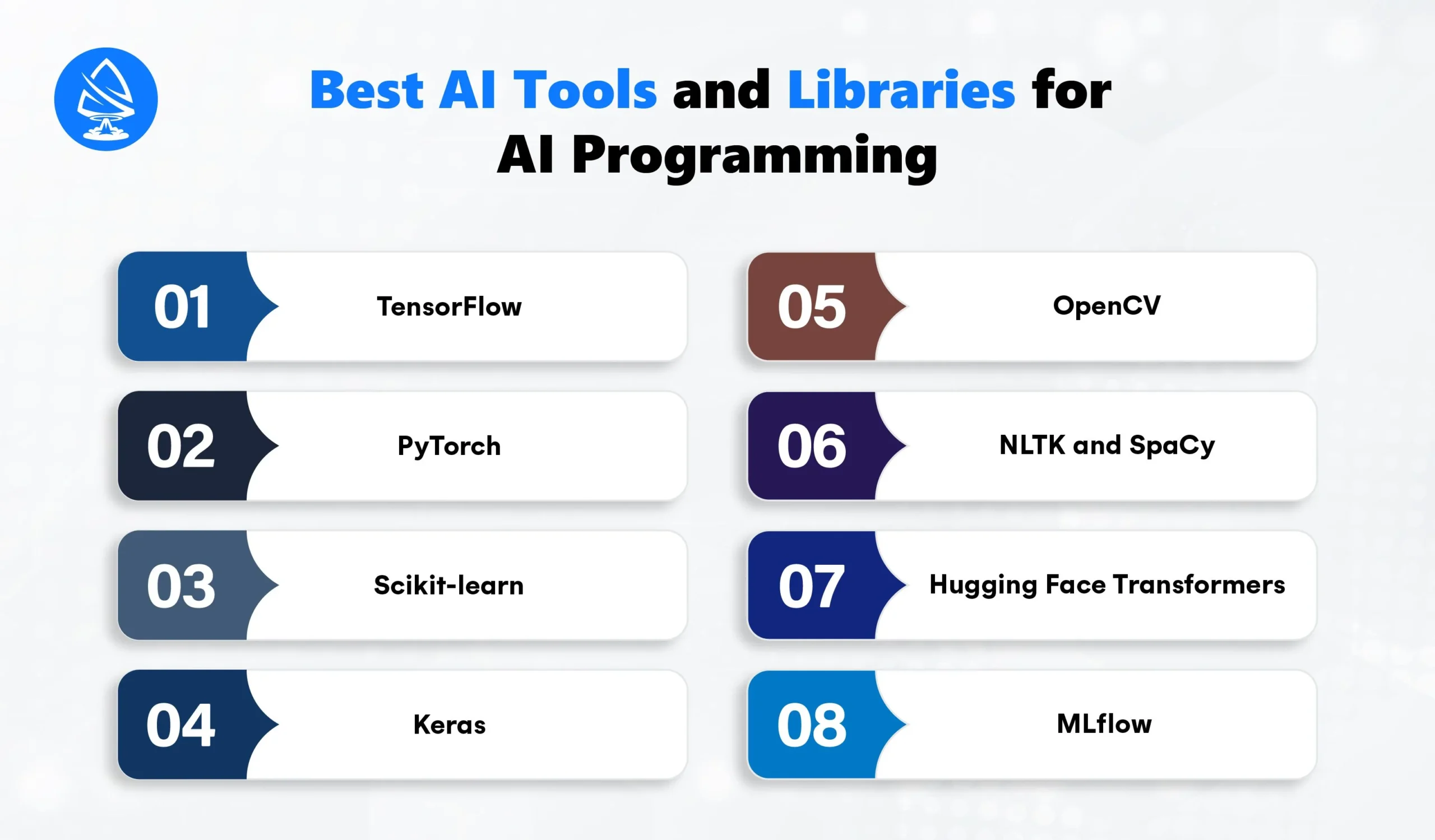
TensorFlow is one of the most popular open-source libraries for machine learning (ML) and deep learning (DL). Developed by Google, it provides a comprehensive ecosystem for building AI models and deploying them across various platforms.
PyTorch is another highly popular open-source machine learning library, known for its ease of use, dynamic computation graphs, and active community. Originally developed by Facebook, it is widely used for research and production-level AI applications.
Scikit-learn is a widely used machine learning library in Python that provides simple and efficient tools for data mining and data analysis. It builds on NumPy, SciPy, and matplotlib and primarily focuses on supervised and unsupervised learning.
Keras is an open-source deep learning library that serves as an interface for TensorFlow. While TensorFlow is powerful, it can be cumbersome to work with, especially for beginners. Keras provides a simplified, user-friendly API to easily build deep learning models.
OpenCV (Open Source Computer Vision Library) is one of the most popular libraries for computer vision tasks. It contains a vast set of tools for image processing, video analysis, and real-time computer vision.
Both NLTK (Natural Language Toolkit) and SpaCy are popular libraries for natural language processing (NLP), enabling AI developers to handle tasks like tokenization, part-of-speech tagging, named entity recognition (NER), and text classification.
NLTK:
SpaCy:
Hugging Face Transformers is a library that has become synonymous with transformer-based models, which have revolutionized the field of NLP. It provides an easy-to-use interface for pre-trained models that can be fine-tuned for various NLP tasks.
MLflow is an open-source platform that manages the end-to-end lifecycle of machine learning models, from experimentation and model development to deployment and monitoring.
Choosing the best AI programming language for your project is a critical decision that influences the development process, performance, scalability, and maintenance of your AI applications. With the growing number of programming languages available, each offering unique features and capabilities, it can be challenging to select the right one. However, understanding the core requirements of your project and evaluating the characteristics of available languages can help you make a more informed choice.
This guide breaks down the important factors you need to consider when selecting the best AI programming language, from project requirements to performance needs.
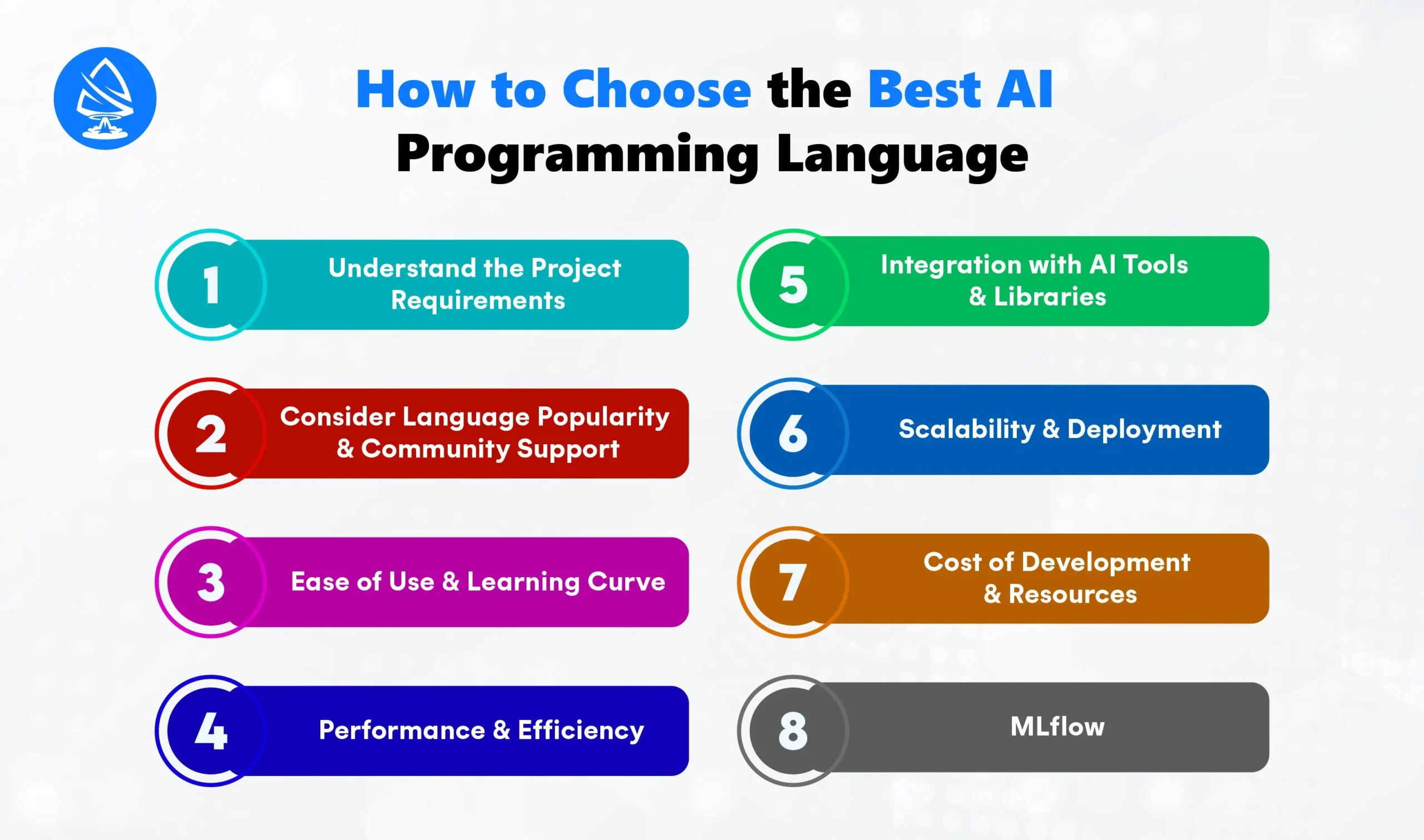
The first and most crucial step is to understand the specific needs of your AI project. Different AI applications require different types of functionalities, and selecting the language best suited for your project type is important. Consider these factors:
Are you working on machine learning, deep learning, natural language processing (NLP), or computer vision? Some languages are better suited for specific AI tasks.
Does your project involve big data? If so, you need a language that handles large datasets efficiently and supports distributed computing. Python and Java are good for handling large volumes of data, with tools like Apache Spark supporting distributed computing.
If you are working on highly complex neural networks or large-scale models, you should consider languages with optimized deep learning libraries (like Python with TensorFlow or PyTorch).
A large and active developer community can be extremely helpful during the development of an AI project. A vibrant community provides valuable resources, documentation, libraries, and frameworks. Consider the following:
Having a large community ensures that you have access to:
The ease with which you can learn and implement a programming language is another key factor. If your team lacks extensive experience with a particular language, it’s best to choose one that allows for quick prototyping and easy implementation.
For teams or individuals new to AI development, languages like Python offer the best balance between ease of use and functionality.
The performance of an AI application is critical, particularly when dealing with large datasets or real-time processing. Some programming languages are more efficient in terms of execution speed and memory usage than others.
For projects that require real-time processing and high-performance computing, C++ or Java may be more suitable. However, for most AI tasks like machine learning and data processing, Python offers a great balance of speed and ease of development.
AI programming languages must integrate well with AI tools and libraries that can simplify the development process and accelerate model training. These libraries offer pre-built machine learning algorithms, neural network models, and tools for data manipulation, model evaluation, and deployment.
Python: Python has the richest set of libraries and tools for AI, including:
R: R has its own set of powerful libraries for statistical modeling and machine learning:
Java: Java has libraries like Weka, Deeplearning4j, and MOA for machine learning, although it’s not as rich as Python’s ecosystem.
C++: While C++ is powerful for low-level control and performance, it has fewer high-level libraries compared to Python or Java. However, libraries like MLPack and Shark are used for machine learning tasks.
If your AI project requires advanced tools and libraries, Python is the best option, given its vast ecosystem for AI development.
As your AI project grows in complexity or user base, scalability becomes an important factor. The programming language you choose must be able to scale with the demands of larger datasets, more users, and increasingly complex models.
Consider how the language integrates with cloud computing platforms, such as AWS, Google Cloud, or Microsoft Azure, which offer distributed computing capabilities to scale AI applications efficiently.
The cost of development, including the need for highly skilled developers and the time spent learning a new language, can also impact your choice. Some languages are easier to learn and come with a broader community of developers, making development faster and more affordable.
If you’re working with a limited budget, Python provides a cost-effective solution due to its simplicity and widespread use in the AI community.
Choosing the right AI programming language is crucial for the success of your AI project. Whether you need to build machine learning models, create intelligent chatbots, or develop high-performance AI systems, there’s a programming language that suits your needs.
Python is the go-to language for most AI tasks due to its simplicity, versatility, and vast library support. R is perfect for data-heavy AI projects, while Java and C++ are ideal for building high-performance AI systems. For cutting-edge performance, Julia is emerging as a strong contender. Regardless of your choice, using the best AI tools and libraries, along with the right programming language, will ensure your AI project’s success.
1. What is the best programming language for AI?
Python is the most popular language for AI due to its simplicity, extensive libraries, and flexibility for machine learning and deep learning projects.
2. Which language is best for AI and machine learning?
Python and R are the most popular languages for AI and machine learning. Python offers powerful libraries like TensorFlow and Scikit-learn, while R serves for statistical analysis and data visualization.
3. Is R better than Python for AI?
R suits statistical analysis and data visualization better, while Python is more versatile and has a larger community for machine learning and deep learning.
4. Which programming language is fastest for AI?
C++ is often considered the fastest language for AI due to its low-level control and high-performance capabilities.
5. Can AI be coded in Java?
Yes, developers widely use Java for building enterprise-level AI systems, natural language processing, and real-time AI applications.
6. What is the easiest AI programming language for beginners?
Python is the easiest language for beginners due to its simple syntax and the availability of high-level libraries for AI development.
7. What is the best AI code generator tool?
Tools like OpenAI’s GPT models and GitHub Copilot are popular AI code assistants that help developers generate code snippets, algorithms, and even entire functions with ease.
8. Which programming language is best for AI in large enterprises?
Enterprises typically prefer Java and C++ for large-scale AI systems because these languages offer performance, scalability, and reliability.

Artoon Solutions
Artoon Solutions is a technology company that specializes in providing a wide range of IT services, including web and mobile app development, game development, and web application development. They offer custom software solutions to clients across various industries and are known for their expertise in technologies such as React.js, Angular, Node.js, and others. The company focuses on delivering high-quality, innovative solutions tailored to meet the specific needs of their clients.
 For business inquiries only