- HR:+91-879-9184-787
- Sales:+91-908-163-7774


Artificial Intelligence (AI) continues to evolve and transform industries worldwide. Composite AI represents a major advancement that combines various AI models, algorithms, and techniques to create more robust and accurate solutions. Traditional AI models usually perform well in specific tasks. However, Composite AI merges different AI methods to solve complex problems that demand diverse capabilities like reasoning, prediction, and decision-making.
AI technologies are becoming more complex, increasing the demand for Composite Artificial Intelligence. This approach is essential for handling diverse data types, dynamic environments, and real-time analysis. Composite AI is creating new opportunities across industries such as healthcare, business analytics, and music composition. This guide explains what Composite AI is, how it works, and its applications in different fields. It also explores its benefits, challenges, and future potential.
Composite AI combines multiple artificial intelligence (AI) techniques, models, and methods to solve complex problems that a single model cannot handle effectively. Rather than depending on one approach, it integrates systems such as machine learning (ML), natural language processing (NLP), computer vision, and reasoning algorithms. These systems work together within a unified framework to deliver more accurate, efficient, and reliable results.
In traditional AI systems, a single model may be designed to handle a specific task, like classification, prediction, or pattern recognition. However, many real-world problems require more sophisticated solutions that involve a combination of these capabilities. Composite Artificial Intelligence addresses this need by combining the strengths of various AI techniques, allowing the system to process and analyze data from multiple perspectives, leading to a more holistic understanding of the problem at hand.
The concept is inspired by the human brain, which integrates various types of sensory input to make decisions, learn from experience, and adapt to different environments. Similarly, Composite Artificial Intelligence mimics this adaptability by incorporating different AI methods that complement each other.
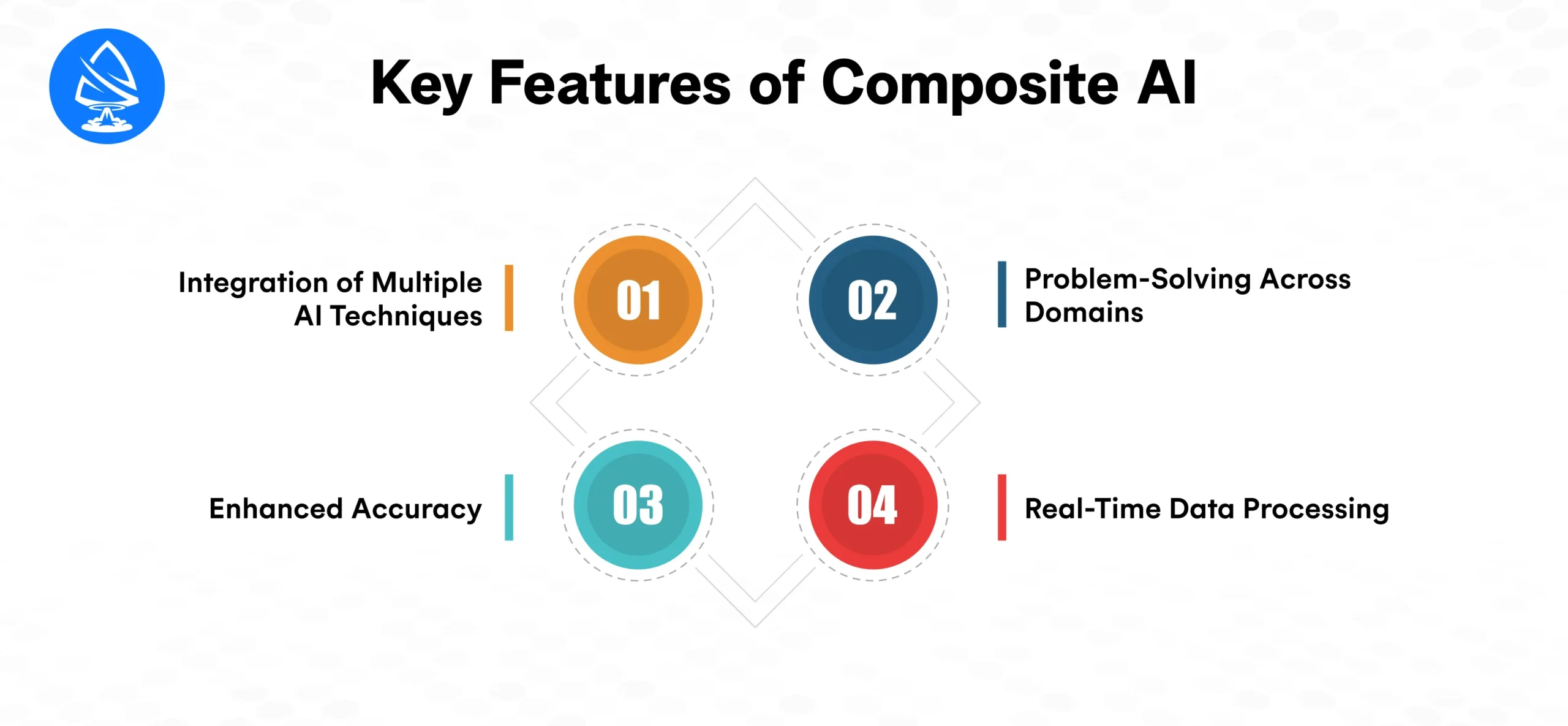
Composite AI combines different AI models, such as machine learning, NLP, computer vision, and reasoning systems, allowing them to work together. This integration enables the system to handle complex, multi-dimensional tasks.
By combining AI methods, Composite Artificial Intelligence can solve problems that span across different domains, like interpreting images, understanding language (NLP), and making decisions.
Using multiple AI techniques in conjunction allows for more accurate predictions and decisions. For example, integrating NLP with sentiment analysis can help provide more accurate feedback from text data.
Composite AI is particularly useful in environments that require real-time processing, as it can process diverse data types simultaneously and make decisions on the fly.
You may also want to know about Neural Network
The core idea of Composite Artificial Intelligence is to combine different AI methods to achieve better results than any individual model could produce. Here’s how Composite AI generally works:
The process begins with gathering data from multiple sources. This data could include images, text, time-series data, sensor readings, or other forms of structured and unstructured data. In Composite Artificial Intelligence, the system is designed to integrate this diverse data seamlessly.
Different AI models are applied to the data depending on the type of problem. For instance:
These models are combined and work together, allowing the AI system to take a multi-faceted approach to the problem.
Once the different models process their respective data, they communicate with each other to share findings and insights. This step is crucial as it enables the system to make more informed decisions based on multiple perspectives.
The final output or decision is generated by aggregating the results from the different models. This could involve a weighted voting system, an ensemble approach, or an integration strategy that considers the strengths of each AI technique involved.
Like other AI systems, Composite Artificial Intelligence can also be trained and adapted over time. The system learns from feedback, improves its models, and adjusts its decision-making processes accordingly.
As AI becomes increasingly powerful, the demand for more advanced systems that can tackle complex, multifaceted problems is growing. Here are some reasons why Composite AI is becoming a game-changer in AI development:
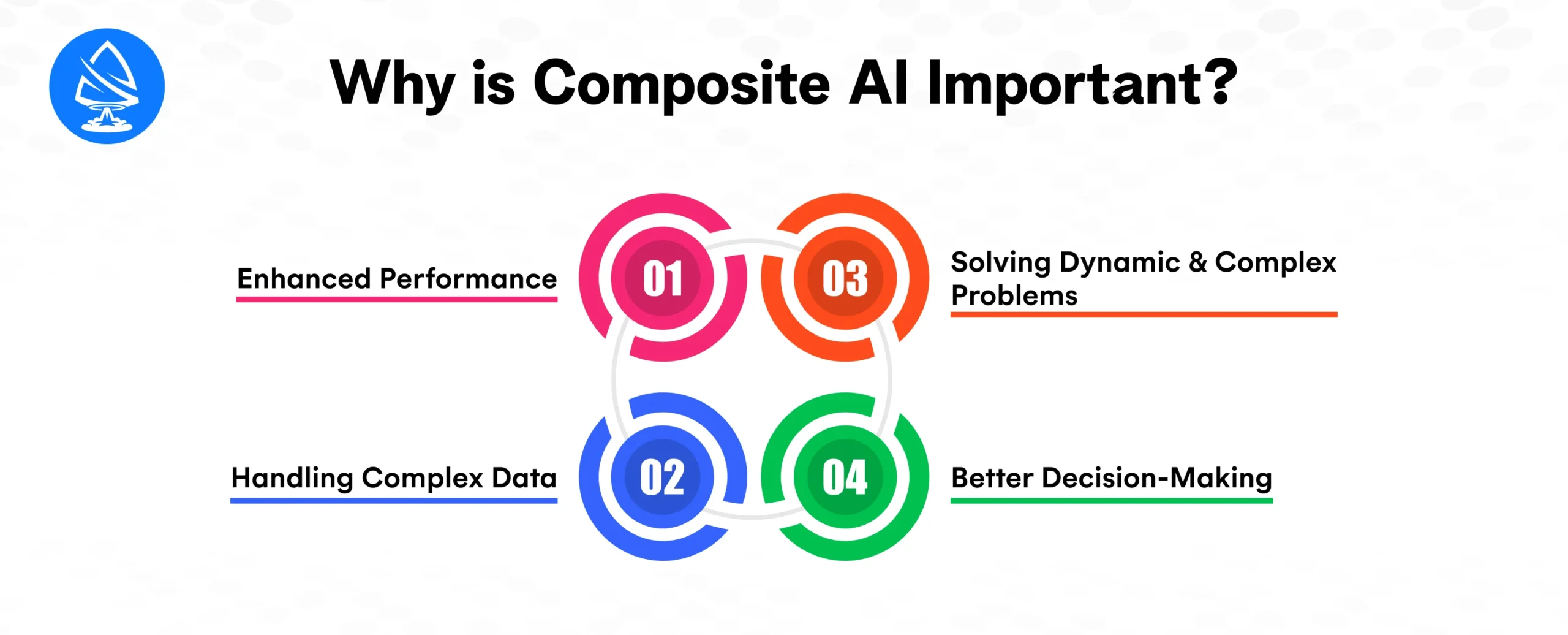
By integrating multiple AI techniques, Composite AI can achieve better performance than single-tech models. It enables the AI system to analyze data from various perspectives, providing a more comprehensive solution to a problem. For example, combining NLP with image recognition can lead to more accurate results in applications like autonomous driving or medical imaging.
In many real-world scenarios, data comes in diverse forms text, images, videos, time-series, and more. A single AI model might struggle to process all of these data types simultaneously. Composite AI can use different models to handle each data type effectively, leading to more accurate and reliable results.
Many real-world problems require constant learning and adaptation to new data. Composite Artificial Intelligence offers the flexibility to combine different learning methods to adapt to ever-changing environments.
Composite AI systems combine reasoning, data patterns, and human expertise to make complex decisions. They are highly useful in critical fields such as finance, healthcare, and autonomous systems, where precision and reliability are essential.
Composite AI integrates various types of AI models to tackle complex problems. Some of the common models used in Composite Artificial Intelligence systems include:
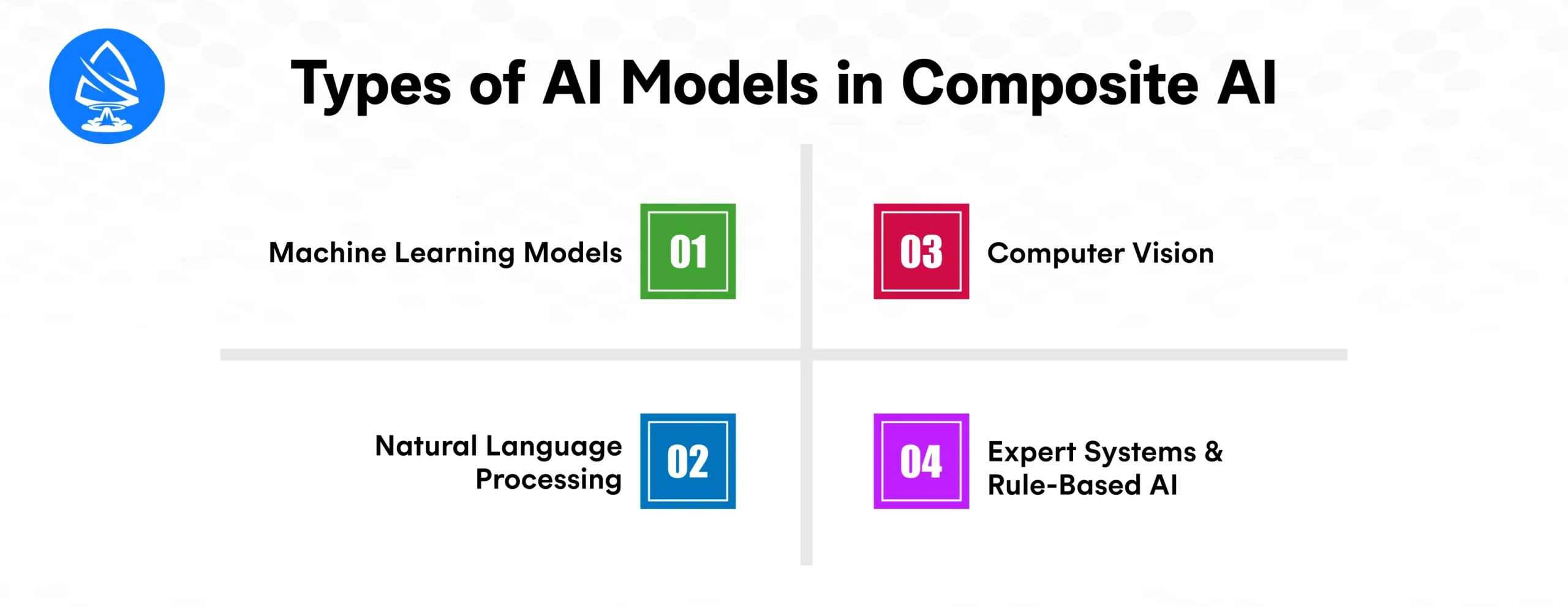
Machine learning algorithms learn from data to make predictions or classifications. In Composite Artificial Intelligence, machine learning models can be combined with other AI systems to improve accuracy or enhance decision-making processes.
Example: Combining supervised learning for structured data with unsupervised learning for unstructured data to uncover hidden patterns in datasets.
NLP enables AI to understand, interpret, and generate human language. In Composite AI, NLP models can be integrated with other techniques, such as computer vision, to process multimedia content and extract meaning from it.
Example: In customer service, Composite AI could combine NLP to understand customer queries with sentiment analysis to better understand customer emotions and intent.
Computer vision enables AI to interpret and understand visual data from the world. By integrating computer vision with other AI methods, Composite AI systems can process and interpret both visual and textual data simultaneously.
Example: In medical imaging, combining computer vision with machine learning can help diagnose diseases by analyzing images and predicting health outcomes.
Expert systems rely on a set of predefined rules and knowledge bases to simulate human decision-making. In Composite AI, expert systems can be combined with more flexible models like machine learning to handle uncertain or ambiguous data.
Example: In finance, Composite AI could combine expert systems for rules-based trading strategies with machine learning models to adapt to changing market conditions.
You may also want to know AI-Powered Fraud Detection
Composite AI has a broad range of applications across different industries. Here are some real-world examples of how Composite AI is used:
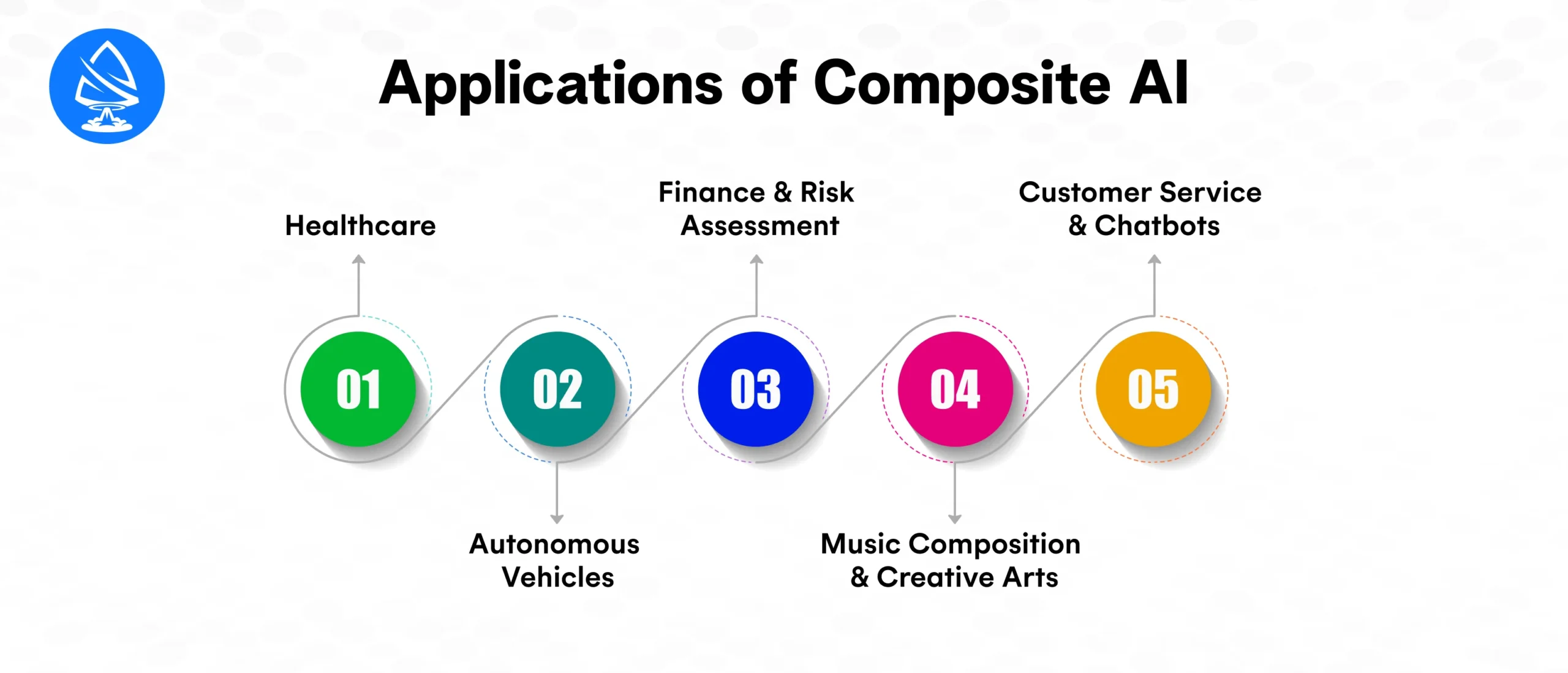
In healthcare, Composite AI can be used for personalized treatment plans, early diagnosis, and drug discovery. By combining machine learning, computer vision, and natural language processing (NLP), healthcare professionals can analyze medical images, patient records, and research papers all at once to make informed decisions.
Example: AI systems in healthcare can combine diagnostic models with natural language understanding to interpret doctors’ notes and medical records alongside medical imaging data for more accurate diagnoses.
Self-driving cars use Composite AI to interpret and make decisions based on multiple data sources, such as images, spatial data, and radar information. By combining different AI models, autonomous vehicles can make better decisions in dynamic environments.
Example: An autonomous vehicle combines computer vision to identify objects and pedestrians with machine learning to predict their movement, all while utilizing reinforcement learning to improve driving decisions.
In finance, Composite AI can analyze large datasets to detect fraud, predict market trends, and assess risks. By combining models for anomaly detection, pattern recognition, and sentiment analysis, AI can make more accurate predictions for trading, credit scoring, and investment strategies.
Example: A Composite AI system might analyze customer transaction data using machine learning, then integrate NLP to assess customer sentiment from social media to better predict market movements or credit risk.
In creative industries, Composite AI can assist in tasks like music composition, video editing, and game design. By combining AI models for composition, style recognition, and generative design, it can create original music or art based on certain inputs.
Example: AI for music composition can integrate models that understand music theory and patterns, generating new compositions that align with a given style or mood.
Composite AI improves customer service by merging natural language processing (NLP) with sentiment analysis and recommendation engines. It helps systems understand customer queries and deliver personalized responses effectively.
Example: A chatbot using Composite AI can answer technical questions, recommend products, and even understand a customer’s emotional tone, improving overall customer experience.
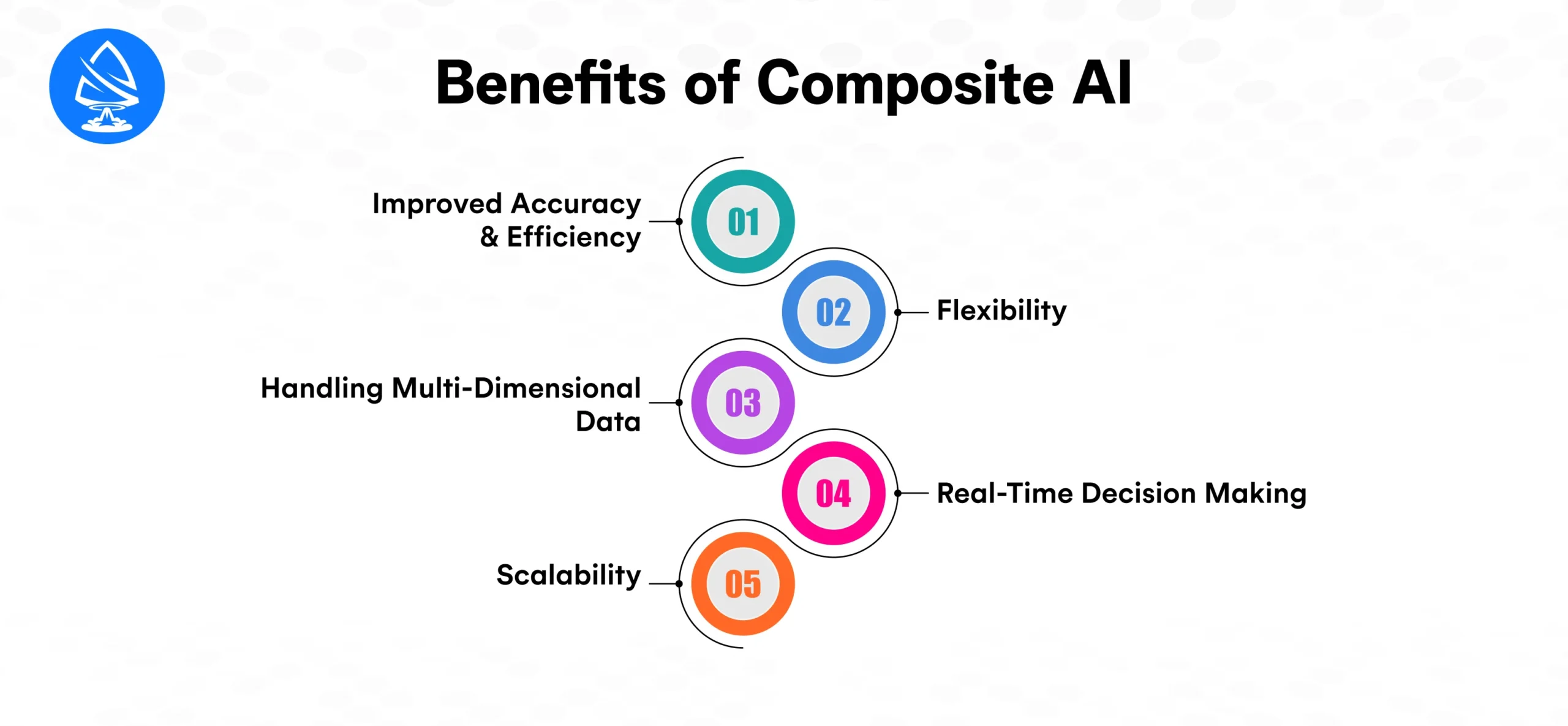
By combining multiple AI techniques, Composite AI can provide more accurate results. For example, an AI system using both machine learning for prediction and rule-based reasoning for logical decision-making will be better at handling complex tasks than a system relying solely on one method.
Composite AI is flexible and can be applied across various domains. Whether it’s analyzing medical images, processing customer feedback, or recommending products, Composite AI can adapt by combining the appropriate AI models.
In many applications, the data involved is multi-dimensional and requires different types of AI models to handle each aspect. For instance, in autonomous vehicles, Composite AI might combine computer vision to detect objects and reinforcement learning to make decisions on how to navigate the environment.
Composite AI is highly effective in situations that demand real-time decisions. By processing diverse data inputs (text, images, sensor data) in parallel, the system can quickly respond to dynamic environments. This is especially important in applications like autonomous driving or smart cities where immediate decisions can have significant consequences.
Composite AI can scale to handle increasingly complex tasks. As businesses generate more data and develop more sophisticated models, Composite AI systems can integrate new models or data sources easily, offering greater adaptability as business needs evolve.
While integrating multiple AI models and techniques gives Composite AI significant advantages, businesses must address several challenges to fully leverage its potential. These challenges can range from technical hurdles such as data integration and model compatibility to computational and resource-related concerns. Below, we explore the primary challenges faced when implementing Composite AI and discuss potential solutions to overcome them.
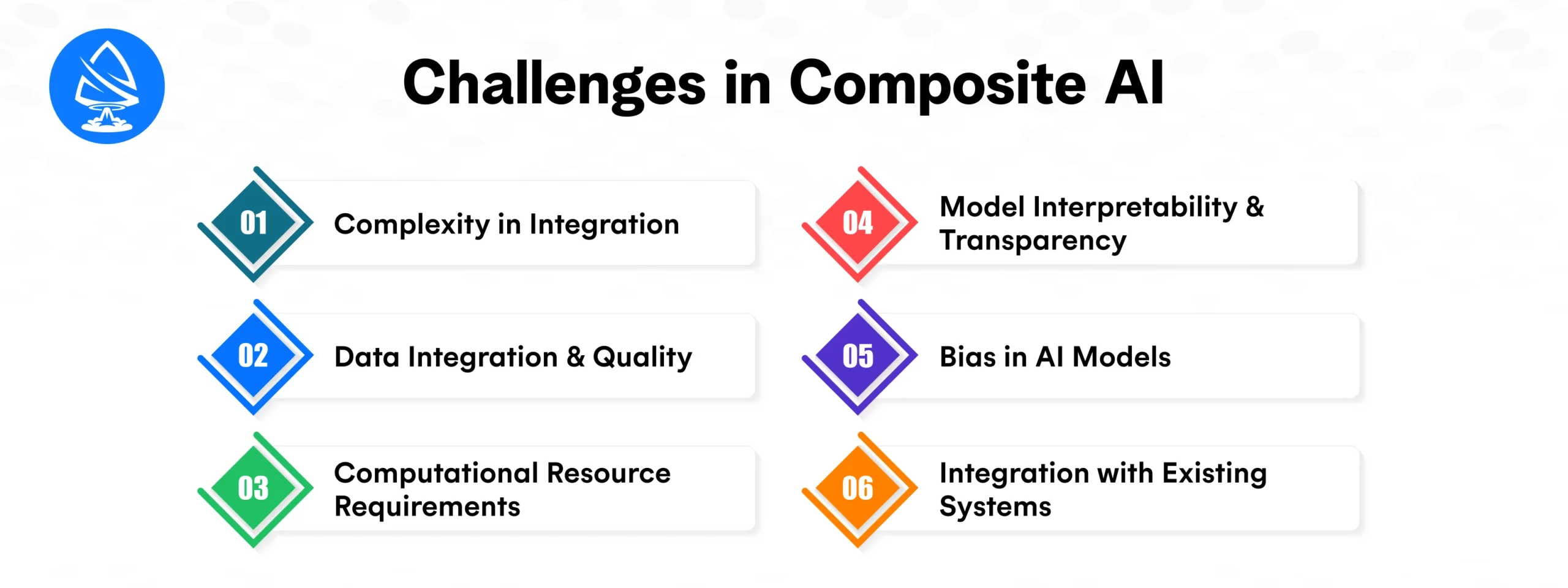
One of the most significant challenges in Composite AI is the complexity involved in integrating multiple AI techniques, models, and data sources into a cohesive system. Different AI models, such as machine learning, natural language processing (NLP), computer vision, and expert systems, each come with their own set of requirements, data structures, and algorithms. The challenge lies in combining these diverse elements effectively.
Composite AI relies on integrating diverse data types from multiple sources. Ensuring that the data is of high quality, consistent, and properly formatted is a major challenge in building effective Composite Artificial Intelligence systems.
Composite Artificial Intelligence integrates multiple AI models that often process large datasets, which significantly increases computational demands compared to single-model systems. This poses a major challenge, especially for businesses with limited infrastructure or computational resources.
One major concern with Composite Artificial Intelligence is understanding how the models work, especially when integrating multiple complex systems. Neural networks, deep learning models, and other advanced AI systems often act as “black boxes” because they do not clearly explain their decision-making process. This lack of transparency can be problematic in critical applications such as healthcare, finance, or law.
Like any AI system, Composite Artificial Intelligence is susceptible to bias in the data or the models themselves. Data collection, model training, or human error can introduce bias, which can negatively affect the fairness and accuracy of the AI’s outputs.
Integrating Composite Artificial Intelligence systems with existing legacy systems or databases can be challenging. Many businesses already use traditional, rule-based systems that are not designed to work seamlessly with newer AI technologies.
Composite AI transforms artificial intelligence by allowing businesses to combine multiple AI techniques. This approach helps them solve complex, real-world problems effectively. With applications ranging from healthcare to finance, Composite Artificial Intelligence is enabling businesses to improve decision-making, accuracy, and efficiency. Although it comes with challenges, the potential benefits make it a powerful tool for AI innovation.
Ready to harness the power of Composite Artificial Intelligence for your business? Contact Artoon Solutions today to learn how our team of AI app developers can help you create customized Composite AI solutions. Use our AI cost calculator to get a personalized estimate for your next AI project.
1. What is Composite AI?
Composite Artificial Intelligence refers to combining multiple AI models and techniques to solve complex problems that cannot be handled by a single method alone.
2. How does Composite AI improve performance?
By leveraging the strengths of different AI models, Composite Artificial Intelligence can achieve better accuracy, adaptability, and decision-making.
3. What are some applications of Composite AI?
Common applications include healthcare, autonomous vehicles, finance, customer service, and music composition.
4. Is Composite AI more powerful than traditional AI?
Yes, Composite Artificial Intelligence can solve complex problems by integrating multiple AI methods. This integration makes it more powerful and versatile than traditional AI.
5. What challenges does Composite AI face?
Challenges include complexity in model integration, data inconsistency, and high computational requirements.
6. Can Composite AI be used for real-time decision-making?
Yes, Composite Artificial Intelligence can analyze multiple data sources in real time. This capability makes it ideal for applications such as autonomous vehicles and fraud detection.
7. How does Composite AI handle different types of data?
Composite Artificial Intelligence integrates multiple models to process various data types, including text, images, and time series. This approach enhances its ability to understand complex data.
8. What are the benefits of using Composite AI in business?
The main benefits include improved decision-making, better accuracy, enhanced adaptability, and increased automation across various business processes.

Artoon Solutions
Artoon Solutions is a technology company that specializes in providing a wide range of IT services, including web and mobile app development, game development, and web application development. They offer custom software solutions to clients across various industries and are known for their expertise in technologies such as React.js, Angular, Node.js, and others. The company focuses on delivering high-quality, innovative solutions tailored to meet the specific needs of their clients.
 For business inquiries only