- HR:+91-879-9184-787
- Sales:+91-908-163-7774


In today’s fast-paced tech world, businesses of all sizes, from startups to established enterprises, are asking the same vital question: How much does it cost to develop an AI solution? Whether you’re a small business owner seeking smarter automation or a USA-based tech professional evaluating enterprise-scale build-outs, understanding the real costs of launching a viable AI solution in 2025 is essential. With the rapid rise of generative AI, advanced analytics, and specialized platforms, accurate budgeting means the difference between success and budget overruns.
In this post, we’ll take you through the full cost spectrum from modest proof-of-concepts to full-scale enterprise AI deployment and help you understand the major cost drivers, realistic budgeting ranges, and key decisions you’ll face.
Before we talk numbers, it’s crucial to clarify what we mean by an AI solution. The scope can vary dramatically, and that variation is what drives cost.
An AI solution may include:
Some typical types of AI solutions you might consider:
Each type has a different complexity and therefore different cost implications.
According to recent industry data:
In short: the phrase “AI solution” covers everything from a small rule-based module up to a full generative-AI platform. The budget shifts accordingly.
Let’s look at some actual cost ranges and benchmarks in 2025 so you can anchor expectations.
Here’s a breakdown of approximate pricing tiers based on current market data:
| Tier | Description | Estimated Cost (USD) |
| Basic prototype/chatbot | Using off-the-shelf models, minimal customisation | $10,000–$40,000 |
| Mid-scale solution | Custom features + moderate integration + data work | $50,000–$150,000 |
| Enterprise-grade solution | Custom model training, large data volumes, full deployment & monitoring | $300,000–$500,000+ |
When budgeting, consider:
You may also want to know AI for Startups
Here’s where you’ll want to dig deep. Several factors will heavily influence how much you end up spending.
When you’re planning to build an AI solution in 2025, estimating your budget accurately is not about guessing numbers; it’s about strategic breakdown and smart planning. Whether you’re a startup testing an MVP or an enterprise designing large-scale AI business solutions, this step-by-step guide will help you evaluate every cost component before writing a single line of code.
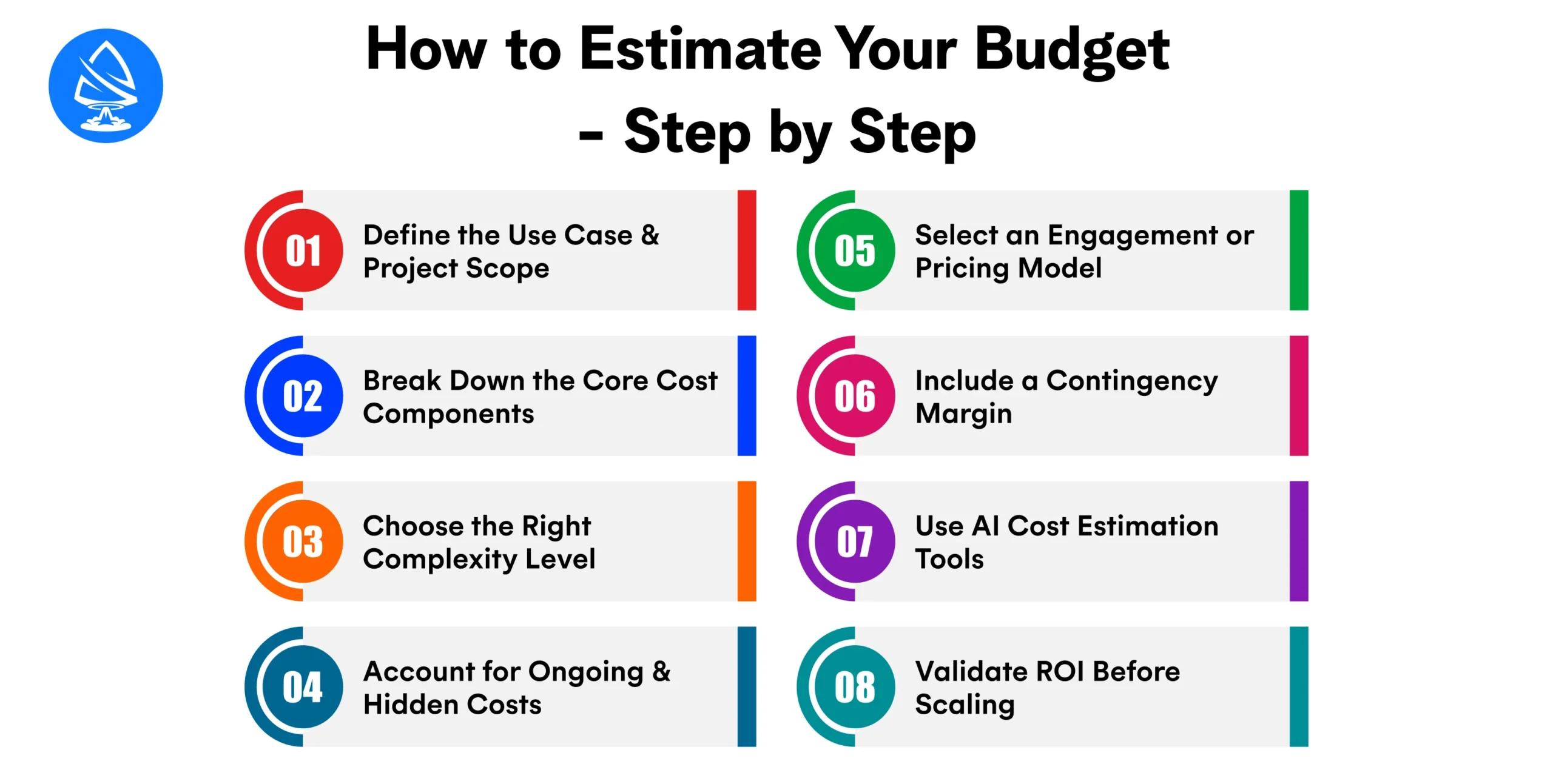
Every successful AI solution starts with a clearly defined purpose. Before you even discuss pricing, outline what problem you’re solving and why. This step prevents scope creep and ensures your investment aligns with measurable outcomes.
Ask these key questions:
Tip: Clearly defining scope helps your AI app development company in USA or internal team estimate the right amount of time, resources, and infrastructure needed.
To estimate costs realistically, break your AI project into key components. Every AI business solution typically involves seven major cost areas:
By assigning a rough percentage to each stage, you can distribute your total budget effectively:
Not all AI solutions are created equal; complexity directly impacts cost. The more custom logic, data processing, or integrations you need, the higher your budget climbs.
| Complexity Level | Features & Scope | Estimated Cost (USD) |
| Basic (MVP) | Pre-trained model, limited UI, small data | $10,000 – $40,000 |
| Moderate | Custom algorithms, cloud integration, API-based data | $50,000 – $150,000 |
| Advanced / Enterprise | Custom model training, multi-user system, data pipelines, dashboards | $300,000 – $500,000+ |
Example: A retail company developing a recommendation engine using existing data might fit into the moderate category, while a healthcare firm training a diagnostic AI from scratch would fall into advanced/enterprise AI solutions.
AI development doesn’t end at deployment. Successful solutions evolve, and so do their costs.
Here’s what to include in your ongoing operational budget:
Pro Tip: On average, post-launch costs amount to 20–30% of your initial AI solution development cost per year.
Planning for this ensures long-term scalability and stability.
Your budget estimation also depends on how you engage your development partner. The right pricing model can help manage risk and control spending.
Fixed Cost Model:
Time & Material (T&M):
Dedicated Team Model:
If you’re working with an AI solutions company, clarify deliverables and milestones early to prevent budget surprises.
AI projects often involve research, testing, and experimentation; unexpected costs are common.
Set aside 10–15% of your total budget for unforeseen challenges like:
Being financially prepared keeps your project on schedule and avoids decision bottlenecks later.
In 2025, several modern platforms and AI cost calculators can help businesses forecast development costs more accurately. These tools consider variables like project type, data size, model complexity, and infrastructure choice to generate an approximate range. Such estimates give a great starting point before contacting an AI development company for a custom quote.
| Component | Details | Cost Estimate |
| Data Preparation | Cleaning & labeling 500GB of data | $30,000 |
| Model Training | Building and tuning ML algorithms | $60,000 |
| UI & Integration | Dashboard + API connections | $40,000 |
| Infrastructure | Cloud GPU, storage, and monitoring | $20,000 |
| Maintenance | Annual retraining & updates | $15,000/year |
Total Initial Cost: ~$150,000 – $170,000
Annual Ongoing Cost: ~$15,000 – $25,000
Finally, assess your return on investment (ROI) before going enterprise-wide. Track key metrics such as:
A data-driven ROI analysis ensures that your AI investment aligns with measurable business outcomes, not just technology enthusiasm.
If your AI solution uses generative models, you’ll face extra cost layers.
While generative AI solutions carry a higher cost, they can offer high impact: improved customer engagement, automation of creative tasks, and new product lines. When you budget, make sure you map value:
Building an AI solution in 2025 doesn’t have to break your budget. While AI can deliver significant ROI, without a smart cost-control strategy, expenses can spiral quickly, especially when dealing with data-intensive or generative AI systems.
Here’s a set of proven, practical cost-optimization tips to help you maximize efficiency, maintain quality, and achieve faster time-to-value, whether you’re working with an AI app development company in USA or managing an internal team.

The biggest mistake businesses make when building an AI solution is trying to go all-in from day one. Instead, start with a focused MVP that targets one clear objective, such as automating customer queries, generating reports, or predicting sales trends.
Example: A retail startup can first deploy an AI chatbot for handling order tracking before expanding to a recommendation system or visual search, minimizing wasted spend on untested features.
Instead of building models from scratch, leverage existing AI platforms or pre-trained models to accelerate development. Modern tools like OpenAI, Hugging Face, TensorFlow Hub, or Google Vertex AI offer ready-to-use architectures for NLP, vision, and generative AI.
Pro Tip: When partnering with an AI solutions company, ensure they evaluate whether existing frameworks can meet your needs before custom model development. This alone can reduce cost by up to 40%.
Data drives every AI business solution, but poor-quality data increases rework, model inaccuracies, and ultimately costs. Invest early in data cleaning, annotation, and structuring pipelines to ensure your models learn efficiently.
Example: A logistics company using unclean shipment data will spend more on fixing prediction errors later than on preparing datasets properly up front.
Cloud providers offer flexible options for hosting enterprise AI solutions, but poor configuration can drain your budget. Evaluate pay-as-you-go vs reserved instances, and auto-scaling policies to optimize performance without paying for idle resources.
If your usage is predictable and long-term, consider hybrid or on-premise setups to control recurring expenses.
Rolling out your AI solution across multiple departments or customer segments simultaneously can spike costs. Instead, phase your integration to control implementation risk and learn from early results.
This approach helps forecast costs more accurately and ensures smoother adoption of your AI business solution.
AI models degrade over time as data patterns change. Without automation, manual retraining can become costly. Implement MLOps (Machine Learning Operations) pipelines to handle version control, retraining, and deployment efficiently.
Example: A fintech firm that automates model retraining on new transaction data can avoid fraud-detection errors while keeping maintenance costs predictable.
Hiring full-time AI experts in the USA can cost between $120K–$180K per year per engineer.
If your AI project is short-term or requires specialized expertise, consider outsourcing to a trusted AI development partner.
When outsourcing, prioritize experienced AI app developers with proven enterprise experience, not generic software agencies.
Ongoing support is often the hidden cost most businesses overlook. Your AI model will need updates, retraining, and performance monitoring regularly. Plan for this from the initial phase by setting aside a maintenance budget of 20–30% of your total project cost annually.
By budgeting early, you avoid financial shocks later and maintain long-term performance stability.
A modular AI architecture allows you to upgrade or replace specific components without disrupting the entire system. For example, you can switch to a better NLP engine or visualization tool without rewriting backend logic.
Enterprises that adopt modular systems reduce their long-term total cost of ownership by up to 25%.
Use analytics platforms like Kubecost, CloudZero, or FinOps frameworks to continuously monitor your infrastructure and compute spend. These tools provide transparency into where your AI budget is going and help you identify waste.
A data-driven cost monitoring process transforms AI budgeting from reactive to proactive, crucial for scalability.
Building a high-quality AI solution in 2025 is entirely feasible for tech professionals and small business owners, but only if you approach it with realistic budgeting, disciplined scope control, and smart partner selection. From modest chatbot prototypes to full-blown enterprise generative systems, the cost spectrum runs from tens of thousands to hundreds of thousands of dollars. The key is to define your use case clearly, plan your data, infrastructure, and talent needs, and walk in phases, starting small, proving value, then scaling up.
If you’re ready to estimate your investment with precision, consider using a Cost Calculator to map your expected build and operational costs. With the right approach, your AI solution will not just be built, it will deliver measurable business value.
Ready to get your project scoped and budgeted? Click through to our AI App Cost Calculator and start your AI journey today.
Here are common questions with short, crisp answers.
1. How much does it cost to build a simple AI chatbot?
Depending on the scope, you might spend between $10,000 – $40,000 for a small chatbot using pre-trained models and minimal integration.
2. What factors most influence the cost of an AI solution?
Key drivers are: talent or expertise, data acquisition & prep, infrastructure or compute, integration or deployment, and ongoing maintenance.
3. For a mid-scale predictive analytics solution, what budget should I expect?
For a moderate custom solution, typical budgets range between $50,000 – $150,000, depending on features and integrations.
4. Are there ongoing costs beyond the initial build?
Yes, expect annual costs for infrastructure, monitoring, retraining, and updates. Some sources suggest ~20-30% of the initial build cost annually.
5. What about enterprise-grade generative AI builds?
Enterprise generative projects, especially with custom model training and large scale, often exceed $300,000 to $500,000+ in initial cost.
6. Can I reduce cost by using off-the-shelf AI platforms instead of building from scratch?
Yes, using pre-built AI platforms or APIs means you avoid heavy model training and infrastructure cost, but you may trade off on customisation and long-term ownership.
7. How should I choose an AI development partner?
Look for partners with relevant experience, transparent pricing models, the ability to integrate data and systems, and those who help you scale beyond MVP. Using terms like an AI solutions company helps identify proper specialists.
8. What ROI should I expect from an AI solution?
ROI depends heavily on use-case and scale: cost savings, revenue uplift, and operational automation all factor. Make sure you map expected gains and measure them. The initial build cost is just half the story; impact matters.

Artoon Solutions
Artoon Solutions is a technology company that specializes in providing a wide range of IT services, including web and mobile app development, game development, and web application development. They offer custom software solutions to clients across various industries and are known for their expertise in technologies such as React.js, Angular, Node.js, and others. The company focuses on delivering high-quality, innovative solutions tailored to meet the specific needs of their clients.
 For business inquiries only