- HR:+91-879-9184-787
- Sales:+91-908-163-7774


Sustainability has shifted from a long-term vision to an urgent global priority. As climate change accelerates, organizations worldwide are seeking smarter, more efficient technologies to reduce energy consumption, cut emissions, and optimize environmental impact. One of the most promising technologies emerging in this movement is Green AI, a new approach to artificial intelligence that emphasizes energy-efficient models, eco-friendly computing infrastructure, and intelligent systems designed to support environmental sustainability.
While AI has historically been criticized for its massive computational power demands, Green AI flips the narrative by enabling businesses to adopt artificial intelligence responsibly. Through optimized algorithms, renewable-energy-powered data centers, low-carbon cloud architecture, and intelligent automation, Green artificial intelligence allows companies to innovate without increasing their environmental footprint.
In this in-depth guide, we’ll explore what Green AI is, why it matters, how it improves sustainability, and how businesses, especially in the U.S, can implement it effectively. Whether you’re a tech professional, an IT leader, or a small business owner looking to reduce operational costs, Green artificial intelligence offers significant environmental and economic advantages. Let’s dive into how Green AI applications are shaping a cleaner, smarter, and more sustainable future.
Green AI refers to the design, development, and deployment of artificial intelligence systems that prioritize energy efficiency, low carbon emissions, and environmentally responsible computing practices. It represents a major shift in how AI is built and used, focusing not only on performance and accuracy but also on the ecological cost of running advanced AI models.
Traditional AI demands enormous computational power, consuming large amounts of electricity and relying heavily on energy-intensive data centers. Training a single large AI model can emit as much carbon as several gasoline-powered cars do over their entire lifetime. Green AI emerged as a response to these challenges, aiming to reduce the environmental impact of artificial intelligence without compromising innovation.
Green artificial intelligence operates on two core principles:
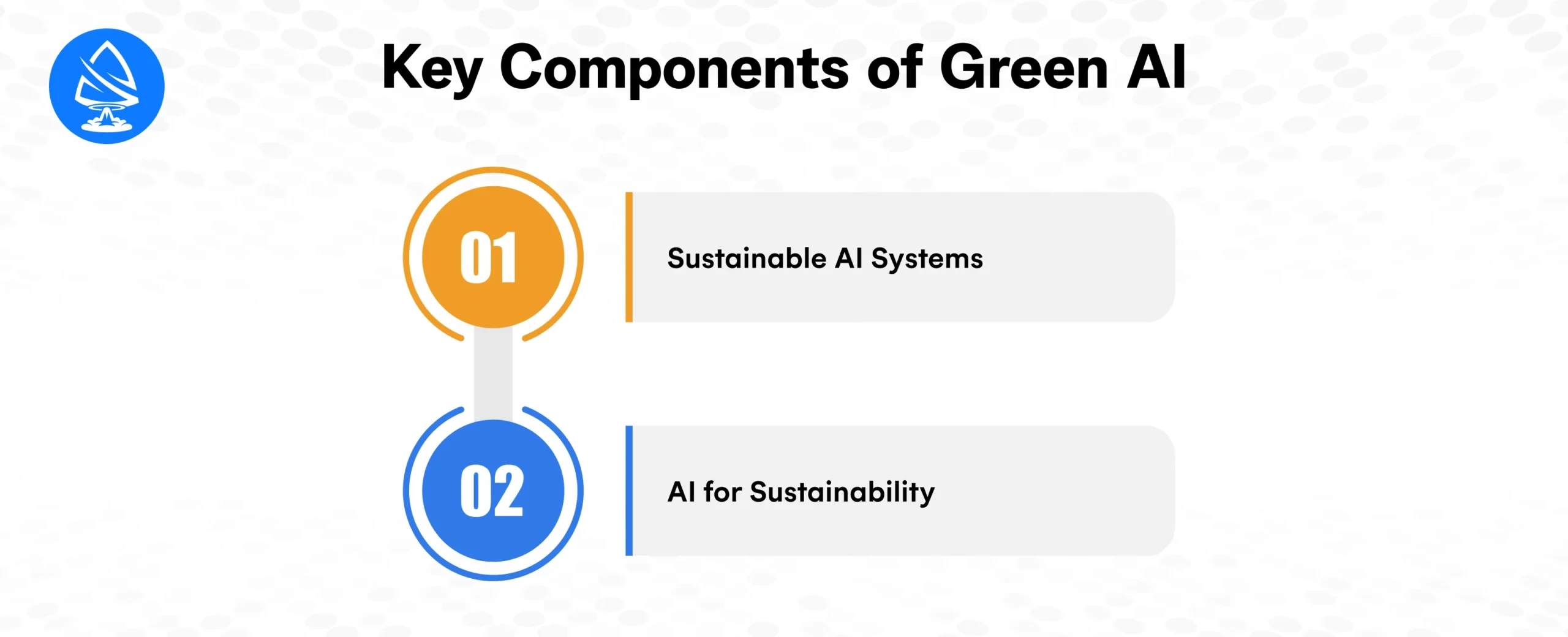
This includes creating AI models and infrastructure that consume fewer resources and produce fewer emissions.
Examples include:
These innovations help businesses and cloud providers run AI more responsibly and affordably.
Green artificial intelligence isn’t just about making AI greener; it’s also about using AI to solve environmental challenges.
Examples:
This is where sustainable artificial intelligence and sustainability artificial intelligence overlap: AI becomes a tool to help achieve global climate and ecological goals.
You may also want to know DeepSeek AI
As artificial intelligence becomes a core driver of global innovation, its environmental footprint is also rapidly expanding. AI models are growing larger, data centers are consuming more energy, and billions of AI inferences occur daily across industries. This rapid scale has created an urgent need for Green AI, a smarter, more sustainable framework that minimizes energy use while maximizing environmental benefits.
Today, Green AI matters more than ever because it sits at the intersection of technological growth, climate responsibility, and economic efficiency. It empowers businesses to innovate responsibly while aligning with global sustainability goals.
Below are the key reasons why Green artificial intelligence is essential in today’s world.
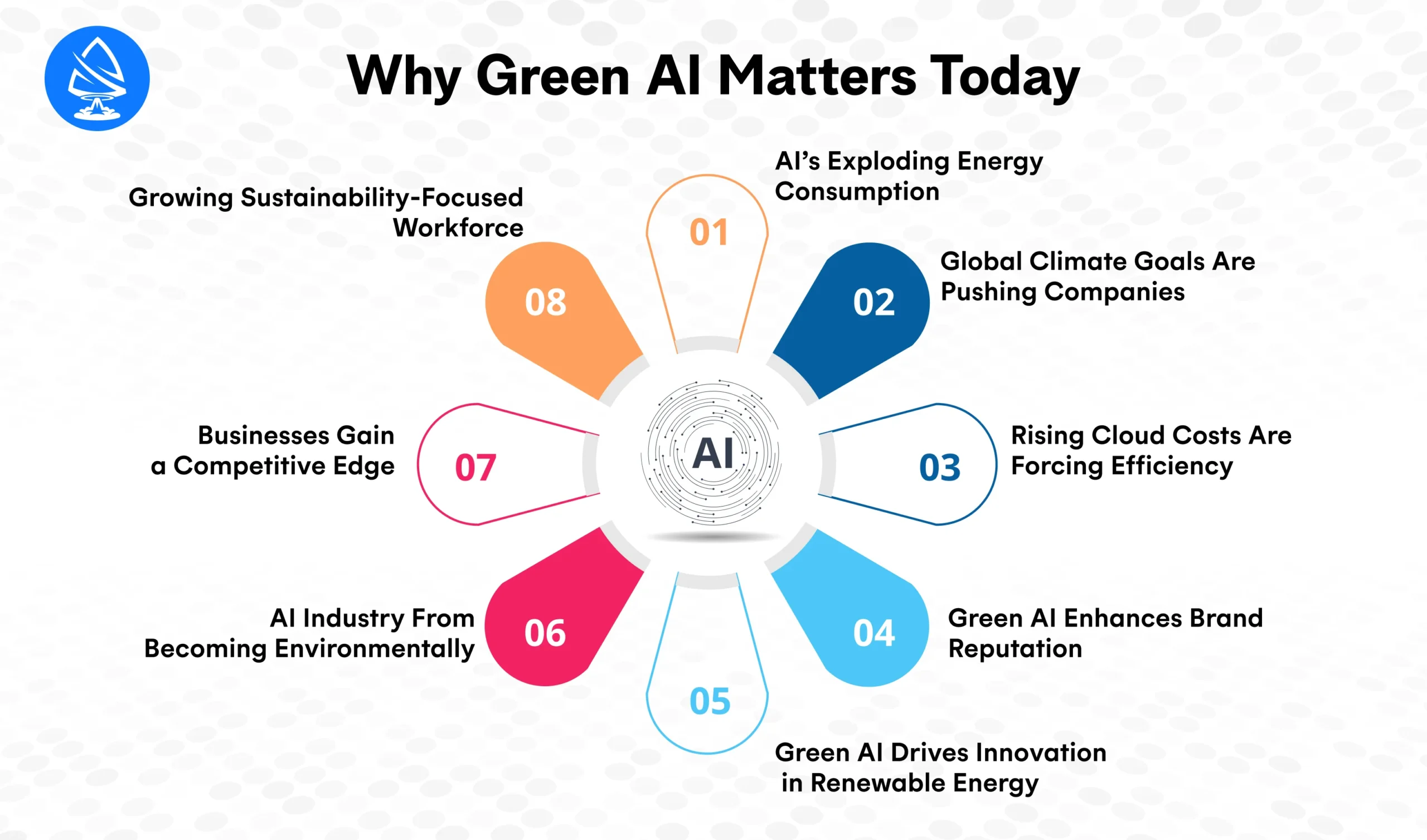
AI systems, particularly large language models and deep learning networks, require intensive computational power. Training a state-of-the-art AI model can consume:
As AI adoption accelerates, the environmental cost grows exponentially.
Green artificial intelligence addresses this challenge by promoting:
This ensures AI can scale without jeopardizing environmental stability.
Governments, enterprises, and consumers are demanding cleaner, greener operations. Sustainability is no longer optional; it’s a competitive requirement.
Businesses are being evaluated based on:
Green artificial intelligence helps organizations meet these targets by:
For companies working with AI development services, green practices make AI deployment both responsible and compliant.
Compute costs for AI workloads are skyrocketing, especially for enterprises scaling:
Green artificial intelligence reduces these costs through:
Small business owners especially benefit, as they can deploy AI without excessive spending.
Today’s consumers prefer environmentally conscious companies. According to several studies:
By adopting Green AI, organizations strengthen:
This creates long-term business value and competitive differentiation.
Green artificial intelligence isn’t only about reducing artificial intelligence’s footprint; it actively improves environmental sustainability.
AI supports renewable energy by:
Green AI also improves:
This dual benefit, reducing impact while enabling solutions, makes Green AI a cornerstone of modern sustainability strategy.
As models get bigger, AI risks becoming unsustainable unless efficiency becomes a priority.
Green artificial intelligence ensures:
Without Green AI, future AI systems could become too expensive and too harmful to operate, especially on a global scale.
Adopting Green AI unlocks:
Enterprises working with a custom AI development company can build efficient AI workflows that outperform traditional implementations while reducing energy load.
Today’s tech professionals, especially Gen Z and Millennials, prefer organizations that prioritize sustainability.
Green AI helps companies:
This alignment makes businesses more resilient and innovative in the long term.
Green AI works by redesigning how artificial intelligence is created, trained, deployed, and powered so that the entire lifecycle of AI becomes more energy-efficient, low-carbon, and environmentally responsible. Instead of relying solely on massive computational resources, Green AI focuses on smarter engineering, renewable energy integration, and eco-conscious optimization techniques that reduce both cost and environmental impact.
In simple terms, Green AI makes artificial intelligence cleaner, lighter, faster, cheaper, and more sustainable, without compromising performance. Below is a complete breakdown of how Green AI achieves this transformation.
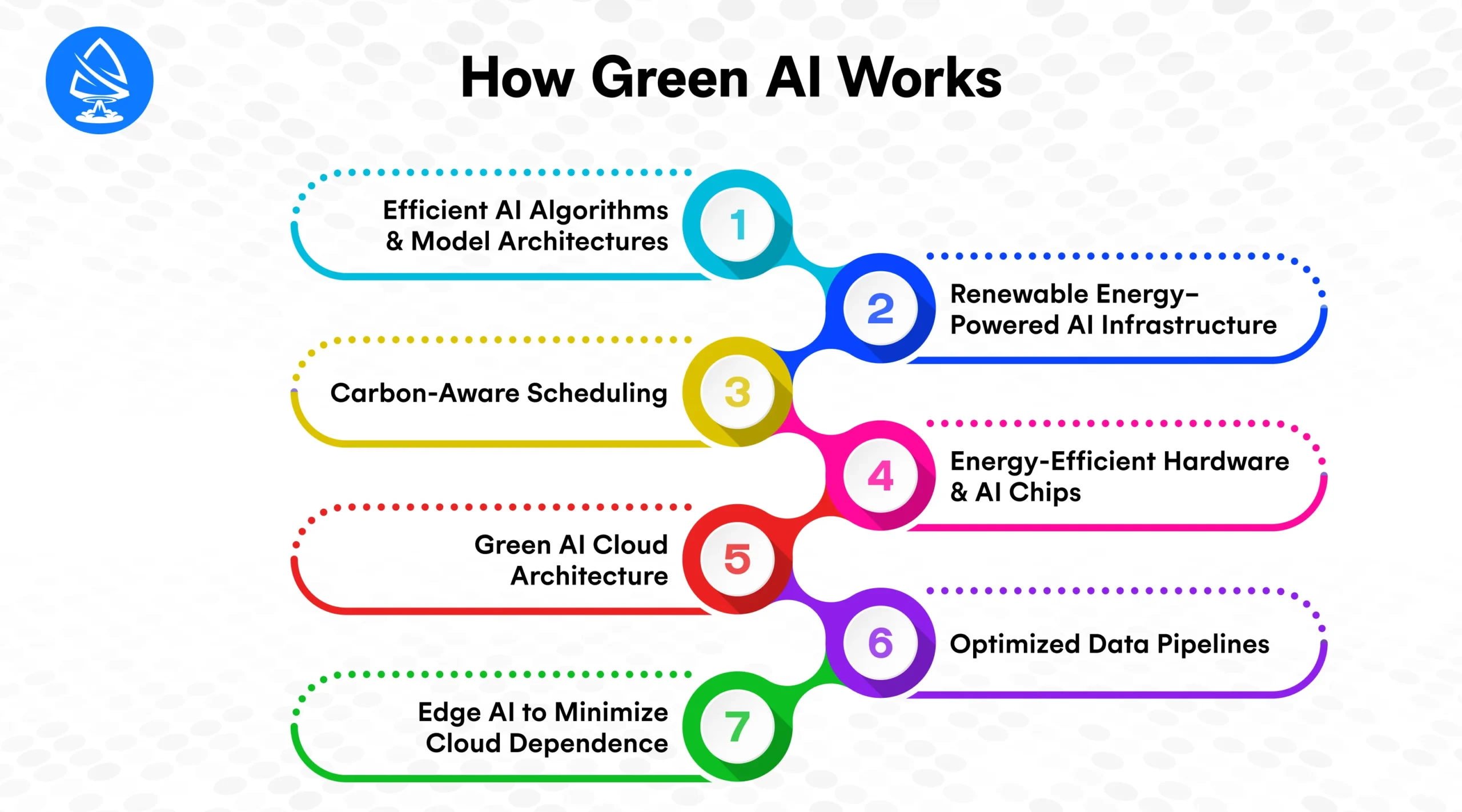
One of the core elements of Green AI is using algorithms that perform well with less computation. Traditional AI often values accuracy above all else, leading to increasingly large models that consume vast amounts of energy. Green AI flips this approach by prioritizing efficiency + accuracy, not just accuracy alone.
These techniques can reduce energy use during training and inference by 30–80% while maintaining high performance.
A major component of Green AI is transitioning away from fossil-fuel-powered data centers and moving toward AI infrastructure fueled by renewable energy.
This shift drastically reduces the carbon footprint of AI workloads, especially during energy-intensive operations like model training.
Tech giants such as Google, Microsoft, and Amazon are leading the push, offering green AI cloud options for enterprises. Businesses working with a custom AI development company can choose to deploy their models on these greener infrastructures.
Green AI uses smart scheduling systems that run training jobs or heavy compute tasks when the renewable energy supply is highest or when the grid load is lowest.
This approach reduces emissions without slowing operations. It is particularly useful for companies with large-scale data pipelines and AI development services operating across multiple regions.
Modern AI hardware is evolving to support sustainability goals.
These chips deliver high performance at a fraction of the power draw required by traditional hardware.
Green AI models often run faster and cheaper on these devices, making them ideal for:
A specialized AI application developer can help companies deploy lightweight models on optimized hardware.
Cloud providers are rapidly transitioning to low-emission AI cloud systems.
Green AI cloud architecture includes:
This ensures that every inference, training job, or automation powered by AI has a significantly reduced environmental impact.
Clean, efficient data handling is another essential part of Green AI.
Green AI focuses on using only the data needed, avoiding unnecessary resource consumption.
This is also cost-effective for businesses, as optimized data workflows reduce cloud storage and processing fees, helping SMBs work smarter without overspending.
Edge AI refers to running AI directly on:
This reduces the need to continuously send information to the cloud, lowering:
For example:
Edge AI makes sustainability more affordable for small businesses and smart infrastructure implementers.
Green AI contributes to sustainability in several direct and indirect ways. Below are the most impactful areas.
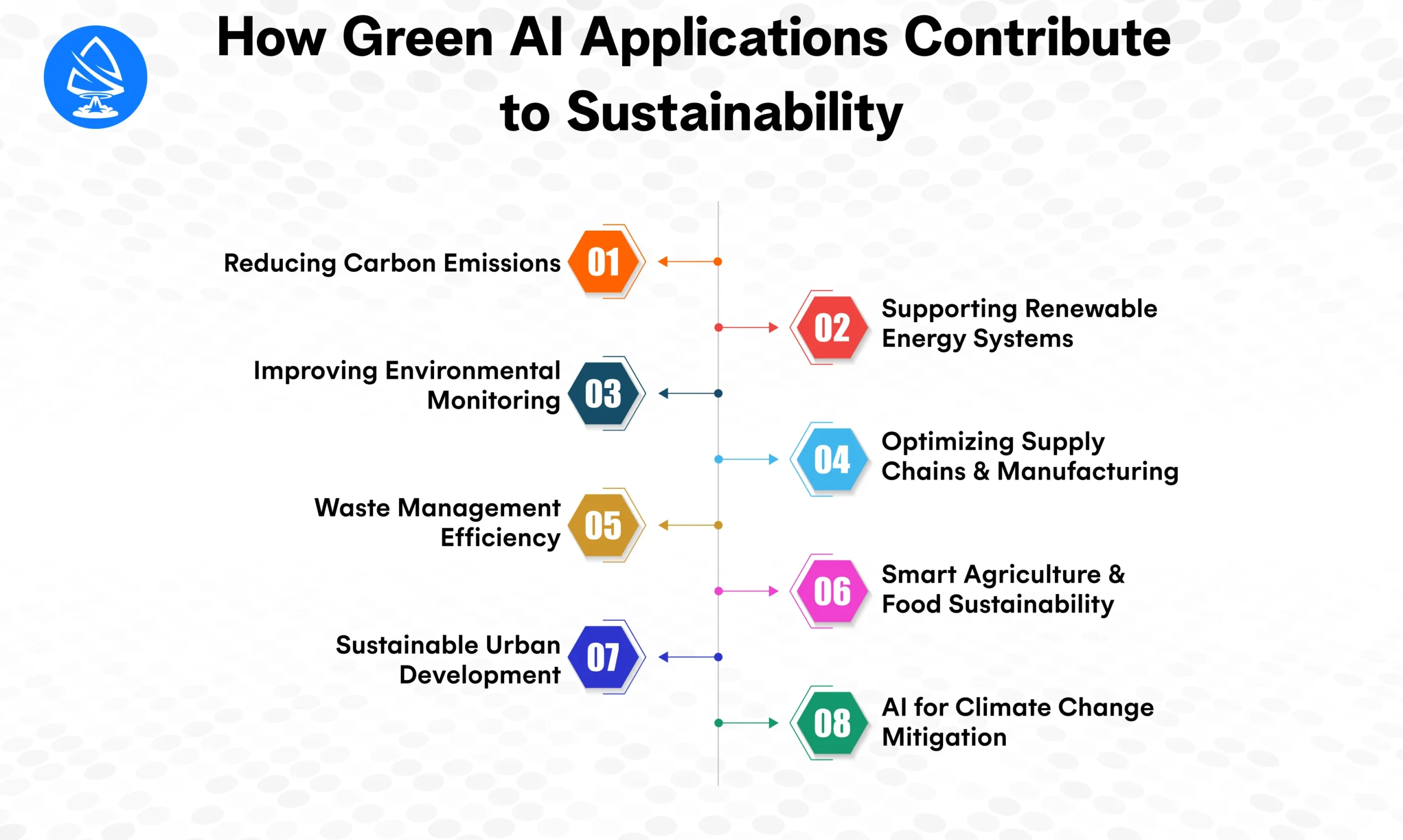
By using efficient architectures, renewable energy, and optimized data pipelines, Green AI significantly lowers carbon emissions associated with computation.
Companies adopting Green AI can reduce their carbon footprint by up to 40–70%, depending on workload.
AI plays a critical role in renewable energy and artificial intelligence optimization.
This ensures renewable power is used more efficiently and reliably.
AI for environment analysis includes:
These AI solutions help governments and organizations respond faster to environmental threats.
Green AI helps companies reduce waste through:
This results in:
AI transforms waste management through:
Cities using Green AI have reported up to:
AI-powered sustainable agriculture uses:
This leads to:
Green AI makes farming greener and more predictable.
Green AI helps develop smart, eco-friendly cities through:
This reduces energy consumption and improves city planning.
AI helps scientists model:
Such insights drive global climate action and long-term planning.
Used to forecast wind energy output with up to 36% more accuracy.
Provides emissions monitoring for enterprises.
Optimizes battery efficiency and autonomous driving.
AI regulates temperature, lighting, and electricity usage based on real-time occupancy.
AI-powered drones analyze soil and crop conditions, helping farmers reduce water and chemical use.
You may also want to know AI Play in Analyzing Trends
For many small businesses, artificial intelligence once felt out of reach, too expensive, too complex, and too energy-intensive to deploy at scale. Green AI changes the equation completely. With its focus on efficiency, lower computational demand, and reduced operational costs, Green AI makes it possible for small businesses to adopt AI solutions that are affordable, sustainable, and highly effective.
Whether you run an e-commerce store, a restaurant, a logistics company, a healthcare practice, or a professional services firm, Green AI offers practical tools to reduce costs, optimize operations, and improve business sustainability without requiring massive infrastructure.
Here’s how small businesses can take advantage of Green AI today.
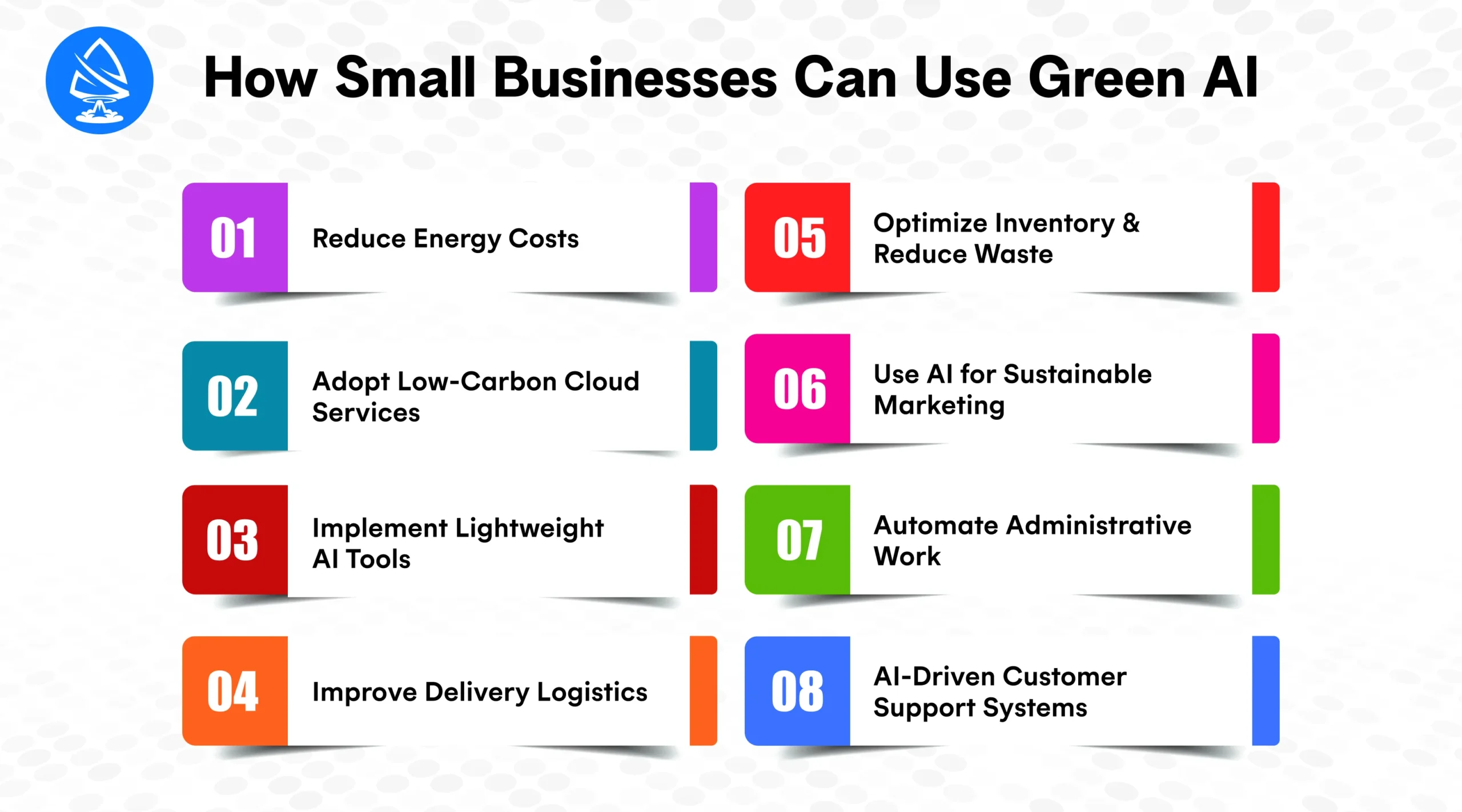
Green AI helps small businesses minimize energy use by automating and optimizing daily operations.
Small businesses often operate on tight budgets, and even a 10–20% reduction in energy usage can lead to substantial yearly savings.
Modern cloud providers offer Green AI cloud solutions, which run on renewable-powered servers and energy-efficient infrastructure.
Small businesses can migrate:
This reduces:
Working with a custom AI development company can help small businesses transition legacy systems to greener cloud infrastructure with ease.
Small businesses don’t need massive, expensive AI models. Green AI makes it possible to use lightweight, optimized, budget-friendly AI tools.
These AI models consume less energy, cost less to run, and provide immediate value without overloading servers.
Retailers, restaurants, and delivery-based businesses can use AI to optimize routing and reduce fuel usage.
With rising fuel costs, this can save small businesses thousands of dollars per year while reducing emissions.
Green AI enables small businesses to manage inventory more intelligently, reducing both waste and operating costs.
This leads to:
Industries that benefit the most include:
A professional AI application developer can create custom dashboards that integrate these predictions directly into your existing system.
Green AI can automate eco-friendly marketing strategies that:
Examples:
Green artificial intelligence makes marketing smarter and reduces wasted digital and physical resources.
Small businesses often suffer from limited staff and overloaded workflows. Green AI helps automate repetitive tasks, saving time and energy.
By automating these tasks, businesses reduce manual errors, free up employee time, and decrease unnecessary computer usage.
Traditional customer service systems require large server workloads and high operational costs. Green AI enables small businesses to use efficient, lightweight chatbots powered by distilled or compact AI models.
These chatbots:
This not only reduces energy consumption but also improves customer satisfaction and response times.
Large enterprises are increasingly adopting AI at scale across operations, customer experience, logistics, finance, HR, product development, cybersecurity, and analytics. However, this rapid expansion comes with significant energy consumption and growing environmental impact. Implementing Green AI allows enterprises to innovate faster while meeting sustainability goals, reducing operational expenses, and complying with global environmental standards.
Below is a complete, actionable roadmap covering how enterprises can successfully implement Green artificial intelligence across departments, technologies, and infrastructure.
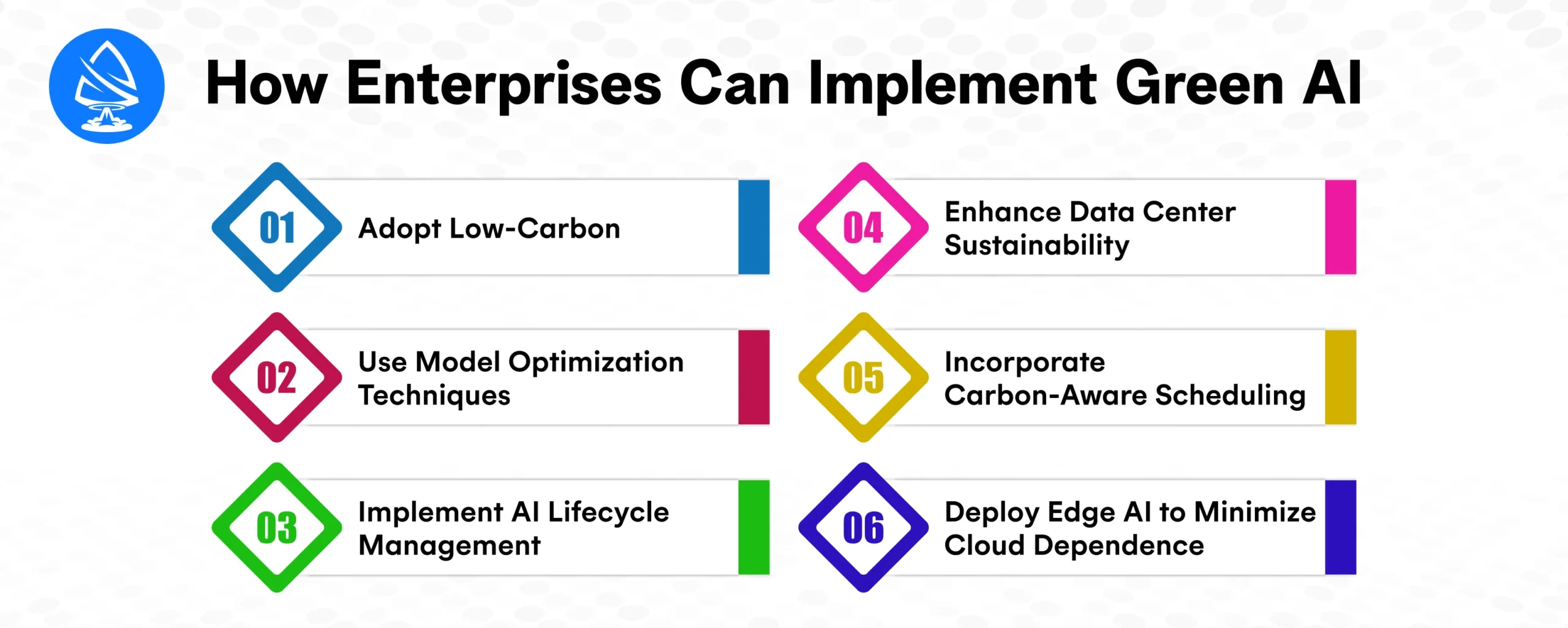
One of the most impactful steps enterprises can take is migrating AI workloads to green cloud platforms powered by renewable energy.
Enterprises should leverage:
Using a custom AI development company ensures cloud migrations and AI workload optimizations align with your technology and sustainability strategy.
Enterprises frequently train or fine-tune large models, often consuming millions of GPU hours. Green artificial intelligence emphasizes training and deploying models more efficiently.
These techniques can cut compute usage by 30–80%, resulting in lower costs and lower emissions.
Enterprises must manage AI like a lifecycle from development to deployment to decommissioning.
This holistic approach ensures AI systems stay efficient long-term.
For enterprises running on-premise infrastructure, transforming data centers is crucial.
These improvements reduce energy consumption by 25–50% across AI workloads.
Enterprises often run large compute jobs at fixed times, regardless of grid conditions. Green AI recommends carbon-aware workload scheduling.
This dramatically lowers carbon output without affecting performance.
Instead of relying solely on energy-intensive cloud models, enterprises can use Edge AI to process data locally.
Examples include:
A skilled AI application developer can deploy optimized models to run efficiently on edge devices.
Green AI represents the next major evolution in sustainable technology. As organizations worldwide push toward climate goals and environmentally friendly practices, AI is stepping into a leadership role not only by reducing its own environmental footprint but by actively driving sustainability across industries. From renewable energy optimization and climate modeling to smart agriculture, environmental monitoring, and waste reduction, Green AI is already proving its value.
Whether you’re a small business owner aiming to cut operational costs or a tech leader working toward ESG targets, Green AI offers powerful tools for smarter, cleaner, and scalable growth. With the support of a qualified custom AI development agency, you can build unique AI-powered sustainability solutions tailored to your industry.
Ready to estimate your Green AI project cost? Use our AI Cost Calculator to get an instant budget breakdown today.
1. What is Green AI?
Green AI refers to energy-efficient artificial intelligence models and systems designed to reduce environmental impact.
2. How does Green AI support sustainability?
It reduces carbon emissions, improves energy efficiency, optimizes resources, and enables smarter environmental management.
3. Why is AI energy-intensive?
Training large AI models requires massive computational power and storage, consuming significant energy.
4. What industries benefit most from Green AI?
Energy, agriculture, manufacturing, logistics, government, and smart cities.
5. Can small businesses use Green AI?
Yes. Affordable cloud tools and efficient AI models make Green AI accessible to SMBs.
6. How does Green AI help climate change?
AI models predict climate patterns, optimize renewable energy, and help reduce carbon emissions.
7. What is Green AI cloud?
Cloud infrastructure that runs on low-emission, energy-efficient, or renewable-powered servers.
8. How can I implement Green AI in my company?
Partner with an AI application developer or AI development services provider to build customized, eco-friendly AI solutions.

Artoon Solutions
Artoon Solutions is a technology company that specializes in providing a wide range of IT services, including web and mobile app development, game development, and web application development. They offer custom software solutions to clients across various industries and are known for their expertise in technologies such as React.js, Angular, Node.js, and others. The company focuses on delivering high-quality, innovative solutions tailored to meet the specific needs of their clients.
 For business inquiries only