- HR:+91-879-9184-787
- Sales:+91-908-163-7774


The U.S. retail industry is in the midst of a seismic shift by data, personalization, and automation. Traditional retail models are under pressure from online competition, rising customer expectations, and fluctuating supply chains. Amid this transformation, one solution stands out: machine learning in retail.
Machine learning enables retailers to move from reactive decision-making to predictive intelligence. Whether it’s forecasting demand, optimizing prices, or personalizing customer journeys, machine learning can directly impact your bottom line. Yet many U.S. businesses hesitate, worried about costs, technical complexity, or unclear ROI.
This guide breaks down the essentials of machine learning in retail: what it is, how it works, how much it costs, the returns you can expect, and how to implement it successfully while avoiding common pitfalls. If you’re a founder, CTO, or decision-maker seeking real competitive advantage, read on.
Machine learning in retail refers to the use of advanced algorithms and data-driven models that help retailers make smarter, faster, and more personalized decisions by learning from historical and real-time data. Unlike traditional software that follows rigid, pre-programmed rules, machine learning systems continuously improve by identifying patterns in customer behavior, product performance, and market dynamics.
At its core, machine learning (ML) helps retailers move from being reactive to predictive. It transforms large volumes of structured and unstructured data like transaction history, customer reviews, foot traffic, weather data, and social sentiment into actionable insights that drive business growth
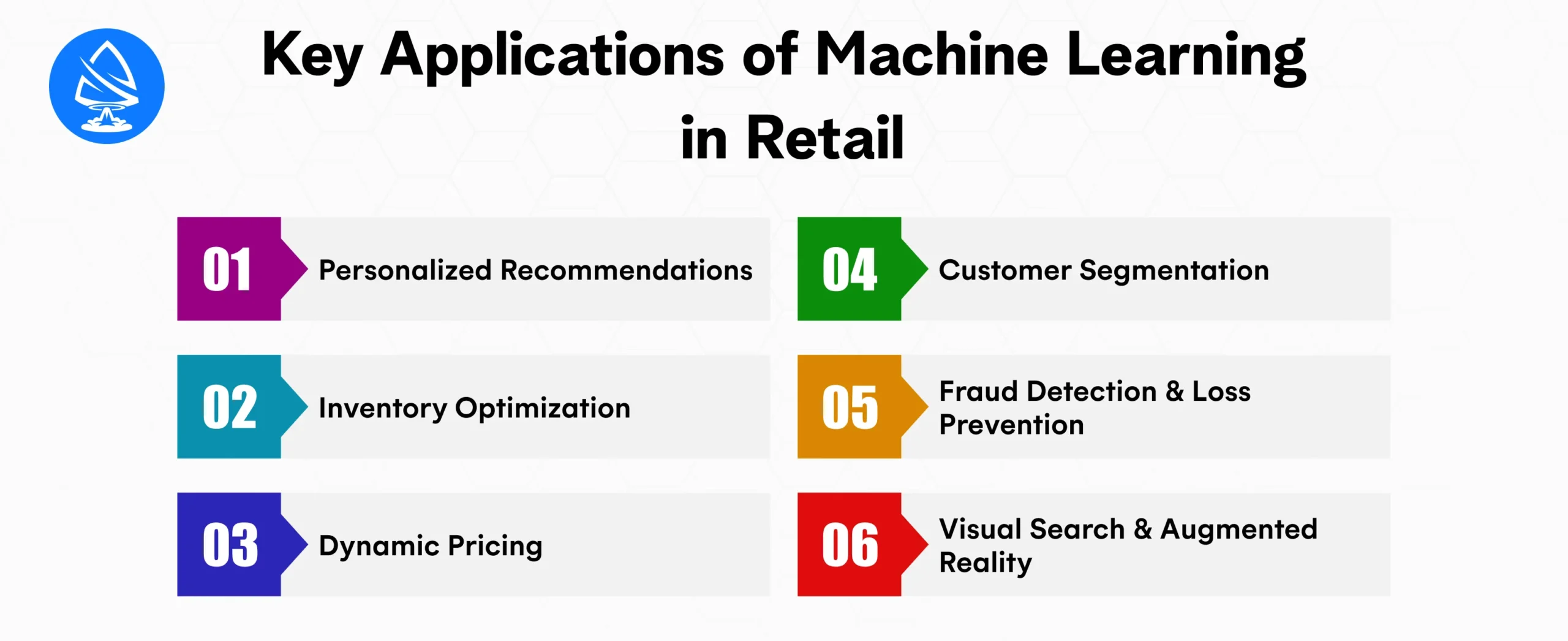
As consumer expectations rise and retail competition intensifies, machine learning gives U.S. retailers the ability to:
Retailers that invest in ML gain a significant edge in efficiency, engagement, and profitability.
Machine learning in retail isn’t just about futuristic tech; it’s about solving today’s business challenges with scalable, intelligent systems. Whether you’re a startup or an enterprise, partnering with an AI app development company or exploring AI development services can help turn your data into a competitive advantage.
Retailers across the U.S. and globally are rapidly adopting artificial intelligence and machine learning to survive and thrive in a highly competitive, data-driven market. The reasons go beyond technology trends; they stem from real business needs such as razor-thin margins, shifting consumer expectations, and the demand for speed, personalization, and operational efficiency.
Here’s why AI and machine learning are becoming core to retail transformation strategies:
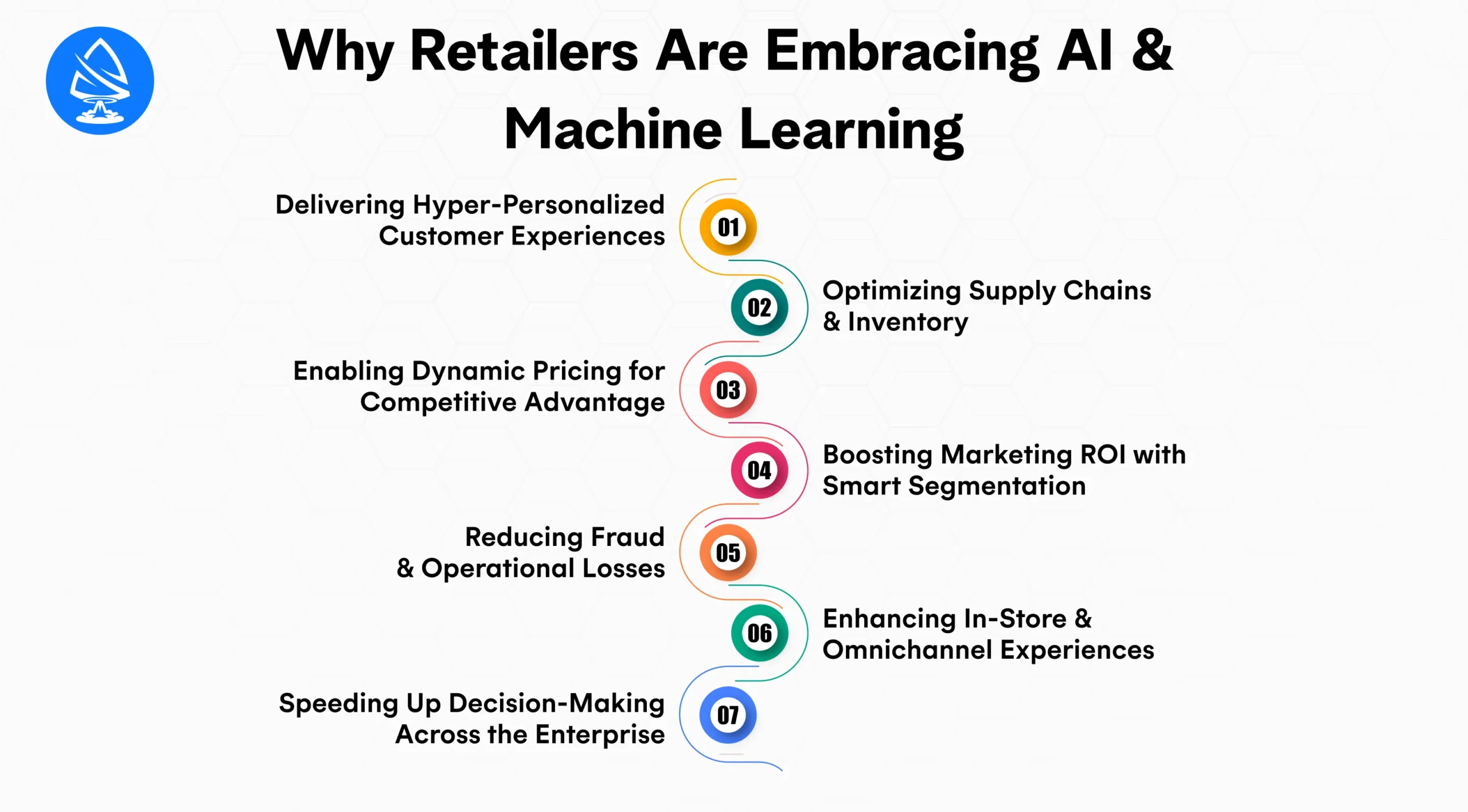
Today’s consumers expect Amazon-like personalization. Machine learning models analyze user behavior, purchase history, browsing patterns, demographics, and even sentiment to create tailored product recommendations, custom offers, and targeted content.
Example: A fashion eCommerce site uses ML to suggest outfits based on local weather, past preferences, and current inventory.
Supply chain unpredictability made worse by global disruptions demands smarter forecasting. Machine learning enables real-time demand prediction, automatic restocking decisions, and logistics route optimization.
Retailers using ML in inventory management reduce overstock and stockouts by 30–40%, boosting revenue and customer satisfaction.
AI-powered pricing engines adjust product prices based on demand trends, competitor activity, and customer behavior. This maximizes revenue while maintaining competitiveness.
Example: A retailer adjusts prices hourly during promotional events to stay ahead of competitors and protect margins.
Traditional marketing blasts are expensive and inefficient. Machine learning enables granular segmentation based on customer lifetime value, behavior, and purchase intent, and automates campaign delivery across channels.
Result: Increased conversion rates and reduced cost per acquisition.
AI in retail helps detect anomalies in transactions, returns, and payment patterns. Real-time fraud detection systems protect against loss without slowing down the customer experience.
Retailers are using AI vision systems for shelf monitoring, cashier-less checkout, and foot traffic analysis. Combined with online data, it creates a seamless omnichannel view of the customer.
Example: AI tracks product movement in physical stores to adjust digital promotions in real-time.
From assortment planning to employee scheduling, AI tools provide predictive insights that help managers make fast, informed decisions across departments.
You may also want to know Machine Learning Development
Investing in machine learning (ML) for your retail business isn’t just a tech upgrade; it’s a strategic decision that can transform operations, customer experience, and profitability. But like any major investment, business leaders need clarity around pricing, scope, and long-term value.
Here’s a detailed breakdown of what machine learning development typically costs for U.S. retail businesses and what factors influence the final price.
| Project Scope | Estimated Cost (USD) |
| ML Pilot or MVP | $15,000 – $30,000 |
| Mid-Scale Retail ML App | $35,000 – $75,000 |
| Enterprise-Grade AI Retail System | $80,000 – $150,000+ |
| Maintenance & Model Retraining | $2,000 – $10,000/month |
These figures vary based on project complexity, required integrations, real-time processing needs, and whether you build in-house or hire AI developers through a technology partner.
A solo ML engineer might suffice for a pilot, but scalable projects often require a team:
| Project Type | Average Timeline |
| Pilot or MVP | 4–8 weeks |
| Mid-scale ML Application | 2–4 months |
| Full Retail AI System | 4–6+ months |
Rushing ML projects increases the risk of poor model accuracy, bad user experience, and integration breakdowns. U.S. businesses that prioritize phased delivery see better results and fewer reworks.
A well-executed ML system for retail doesn’t just break even, it compounds value. Here’s how machine learning offsets its investment:
When evaluated over a 12–24 month window, most ML retail projects yield a positive ROI, especially when built with scalability and model retraining in mind.
Return on investment (ROI) is the ultimate metric that determines whether a technology delivers true business value,e and in retail, machine learning (ML) consistently proves its worth. From increased sales to streamlined operations, ML not only pays for itself but also becomes a growth multiplier when implemented correctly.
Here’s how retailers in the U.S. and globally are realizing substantial ROI from machine learning:
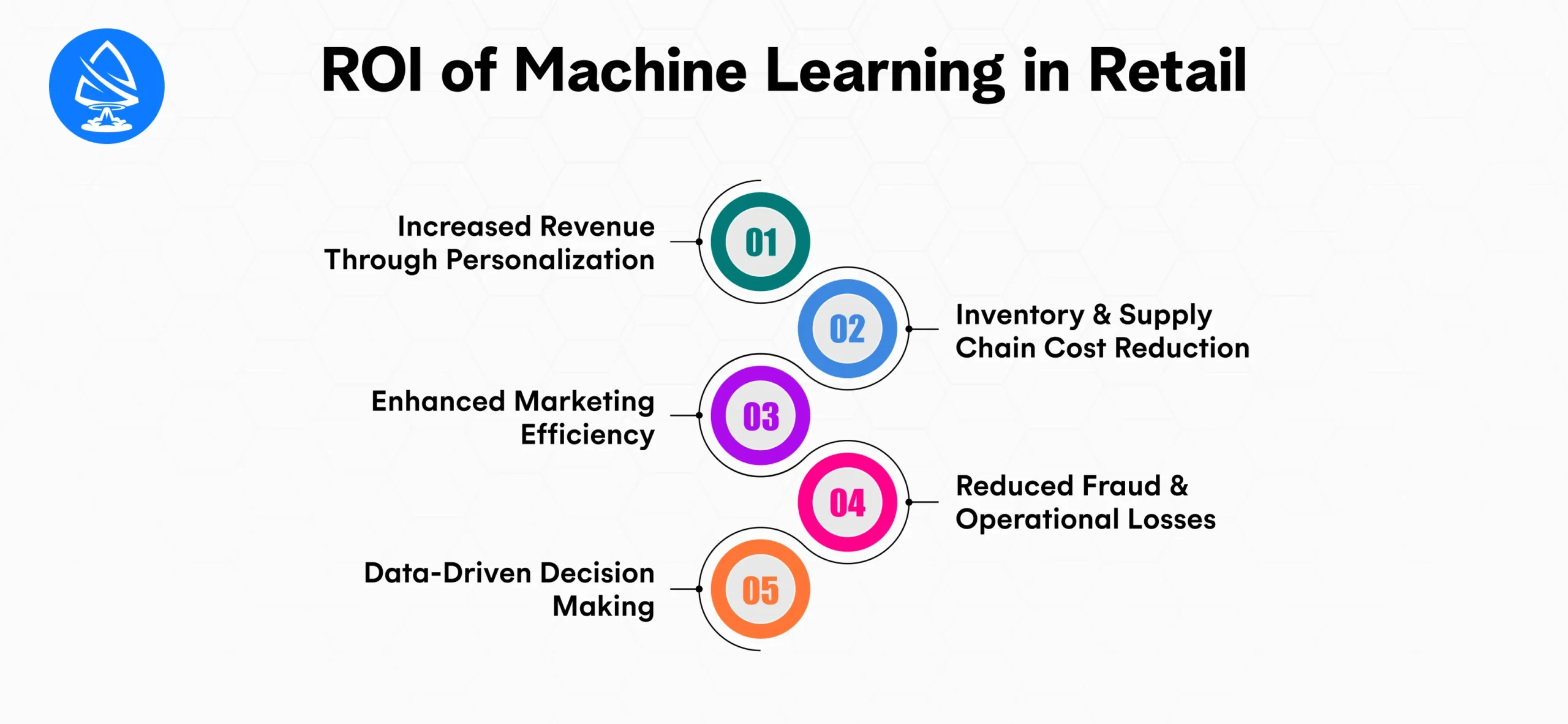
ML-powered recommendation engines analyze browsing behavior, purchase history, demographics, and even real-time signals to offer hyper-personalized suggestions.
Example: A U.S. apparel brand saw a 28% increase in cross-sells using ML-based product recommendations.
Machine learning accurately forecasts demand, optimizes stock levels, and reduces holding costs. Retailers can avoid overstocking, minimize markdowns, and reduce stockouts, especially during seasonal peaks or disruptions.
Example: A Midwest-based retailer cut warehouse waste by 22% using ML demand forecasting.
ML automates customer segmentation and ad targeting, ensuring campaigns are more relevant and better timed. Marketing spend is used more efficiently, driving higher ROI per dollar.
AI systems detect anomalies in transactions, returns, and loyalty point redemptions in real-time. This prevents fraud and improves overall operational integrity.
Example: A retail chain saved $500K annually using AI-based fraud detection models.
With machine learning analytics, retailers make faster and more accurate decisions around pricing, promotions, staffing, and product assortment.
Let’s break down a simplified ROI model:
| Metric | Baseline | Post-ML Impact | Annual Value Gain |
| AOV | $80 | $96 (20% gain) | +$500K |
| Inventory Waste | $200K/year | $140K/year | +$60K savings |
| Customer Retention Rate | 65% | 75% | +$200K LTV uplift |
| Marketing Spend Efficiency | $300K/year | 25% better ROAS | +$75K yield |
Total ROI: $800K+ in year one for a mid-market retail operation with a $5M annual revenue.
Partnering with a seasoned AI app development company helps accelerate the ROI curve while minimizing waste and misalignment.
Machine learning (ML) is transforming the retail landscape by automating complex decisions, optimizing operations, and creating personalized shopping experiences. U.S. retailers, from fast-growing eCommerce startups to legacy brick-and-mortar brands, are adopting ML to stay agile, efficient, and customer-centric.
Below are the most impactful use cases where machine learning delivers tangible business value:
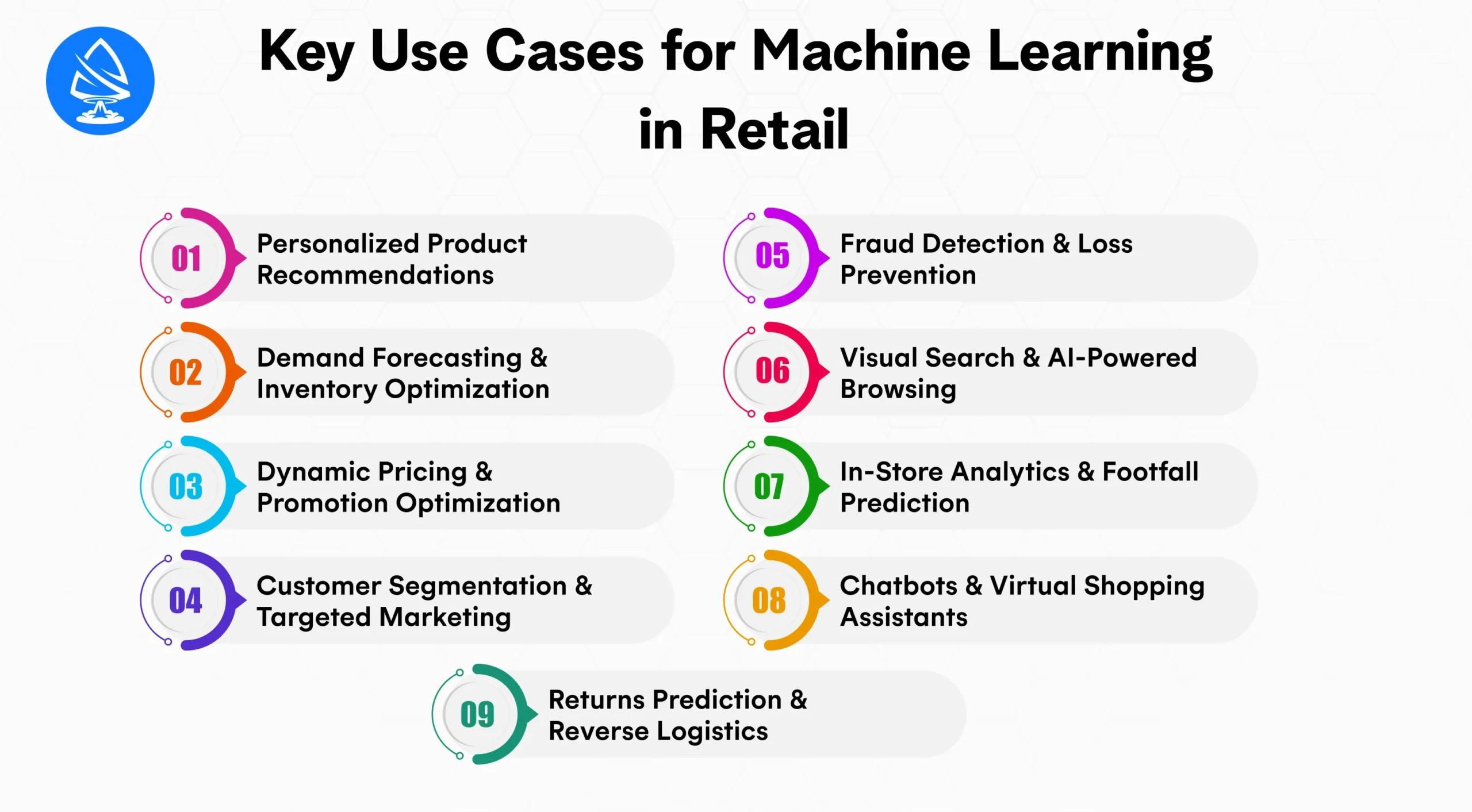
ML algorithms analyze customer behavior, browsing history, preferences, and purchase data to suggest products that are most relevant to individual users.
By analyzing sales history, seasonality, trends, and external factors, ML models accurately forecast product demand at the SKU and location level.
Machine learning adjusts prices in real-time based on demand, competitor pricing, stock levels, and customer segments, ensuring competitiveness and maximizing margin.
ML clusters customers by demographics, behavior, spend, and engagement to enable precise marketing strategies for each segment.
Anomaly detection models identify irregular transactions, fake returns, or suspicious payment activity in real-time, helping retailers mitigate fraud without compromising UX.
Computer vision enables shoppers to upload an image and get visually similar product suggestions, enhancing discovery and product discovery for fashion, furniture, and decor retailers.
ML processes camera feeds and sensor data to track customer movements, dwell time, and engagement in physical retail environments.
ML-driven chatbots provide real-time support, personalized recommendations, and post-purchase help, enhancing digital CX and reducing support costs.
By analyzing order history, product type, customer profiles, and past returns, ML predicts which orders are likely to be returned and suggests interventions.
You may also want to know about Machine Learning in Healthcare
Rolling out machine learning (ML) in retail isn’t just about plugging in an algorithm; it’s a structured transformation that requires strategy, execution, and cross-functional alignment. For U.S. retailers, the stakes are high: customers expect personalization, operations must be lean, and competition is fierce. A well-planned ML implementation roadmap ensures ROI, scalability, and long-term impact.
Here’s a detailed breakdown of how U.S. retail companies should approach ML implementation:
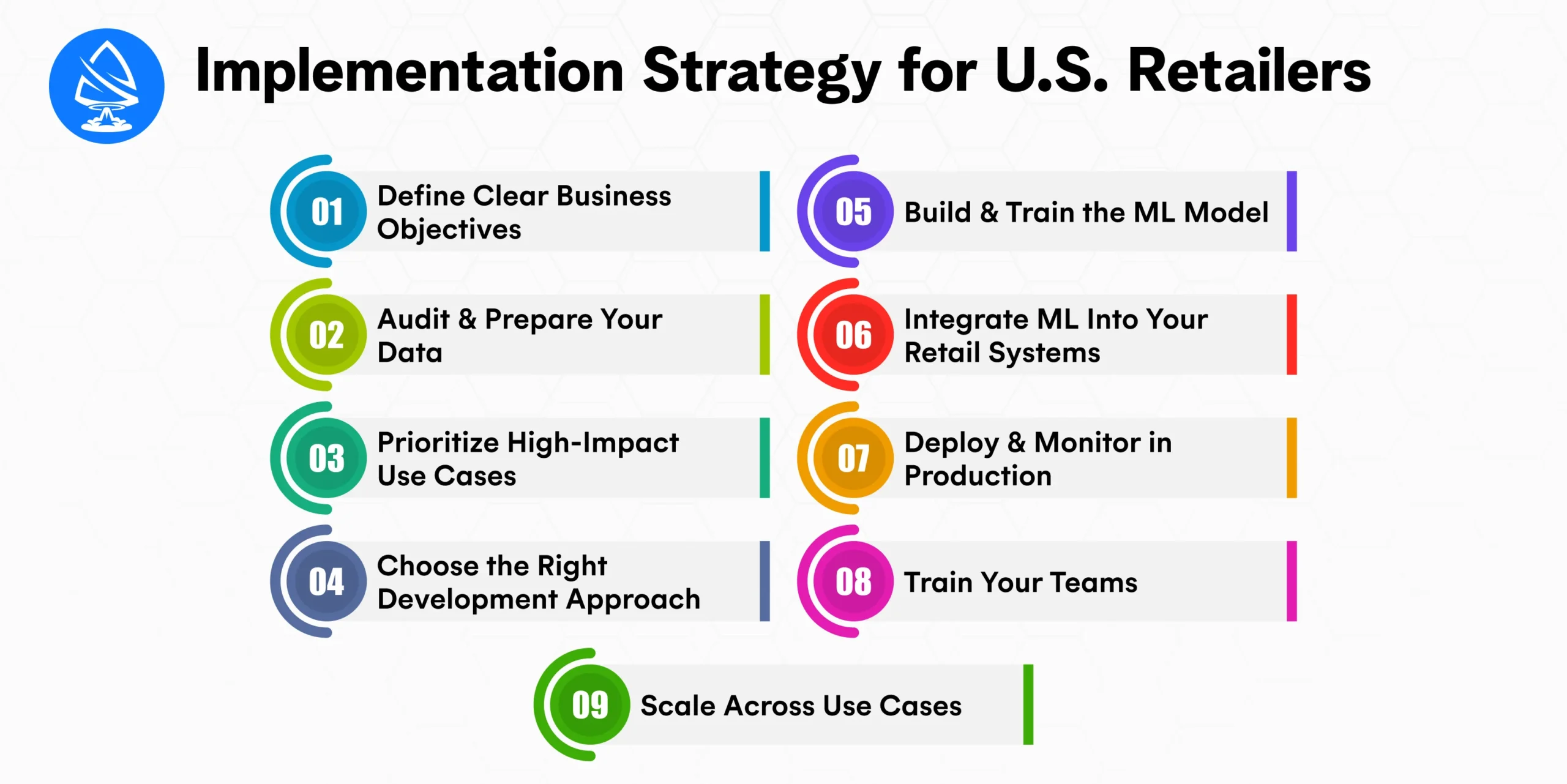
Start with problems, not technology. Machine learning must solve specific, measurable business challenges.
Tip: Align ML goals with key business metrics.
ML models are only as good as the data they’re trained on. Most retailers struggle with siloed, messy, or incomplete datasets.
Working with an AI app development company at this stage ensures your data infrastructure is ML-ready.
Avoid trying to implement ML everywhere at once. Choose 1–2 high-impact areas with clear ROI and manageable complexity.
Start small. Scale fast once results validate the model’s performance.
You have three main options:
U.S. retailers often hire AI developers through firms like Artoon Solutions to reduce risk, accelerate timelines, and access proven retail ML frameworks.
With your use case and data in place, developers and data scientists can begin model development:
Ensure models are tested against real-world datasets to prevent overfitting and false positives.
A powerful model is useless unless it’s integrated into workflows. This includes:
Your tech stack must support these integrations securely and efficiently. That’s why many retailers turn to artificial intelligence development services providers that understand retail operations end to end.
Use CI/CD pipelines and MLOps practices to deploy models into production reliably. Post-launch, set up monitoring to track:
Regular retraining is essential as customer behavior and product assortments evolve.
Internal adoption is critical. Educate stakeholders on how to interpret ML outputs and use them to drive decisions. Equip store managers, marketers, and analysts with dashboards and alerts that simplify ML insights.
Once your initial ML initiative proves successful, scale across:
Each new implementation gets faster and more accurate as your models and data pipelines mature.
Machine learning can deliver significant gains in revenue, efficiency, and customer experience, but only if implemented correctly. Many U.S. retailers jump into ML projects with excitement but falter due to avoidable missteps. Below are the most common mistakes that stall or sabotage retail machine learning initiatives:
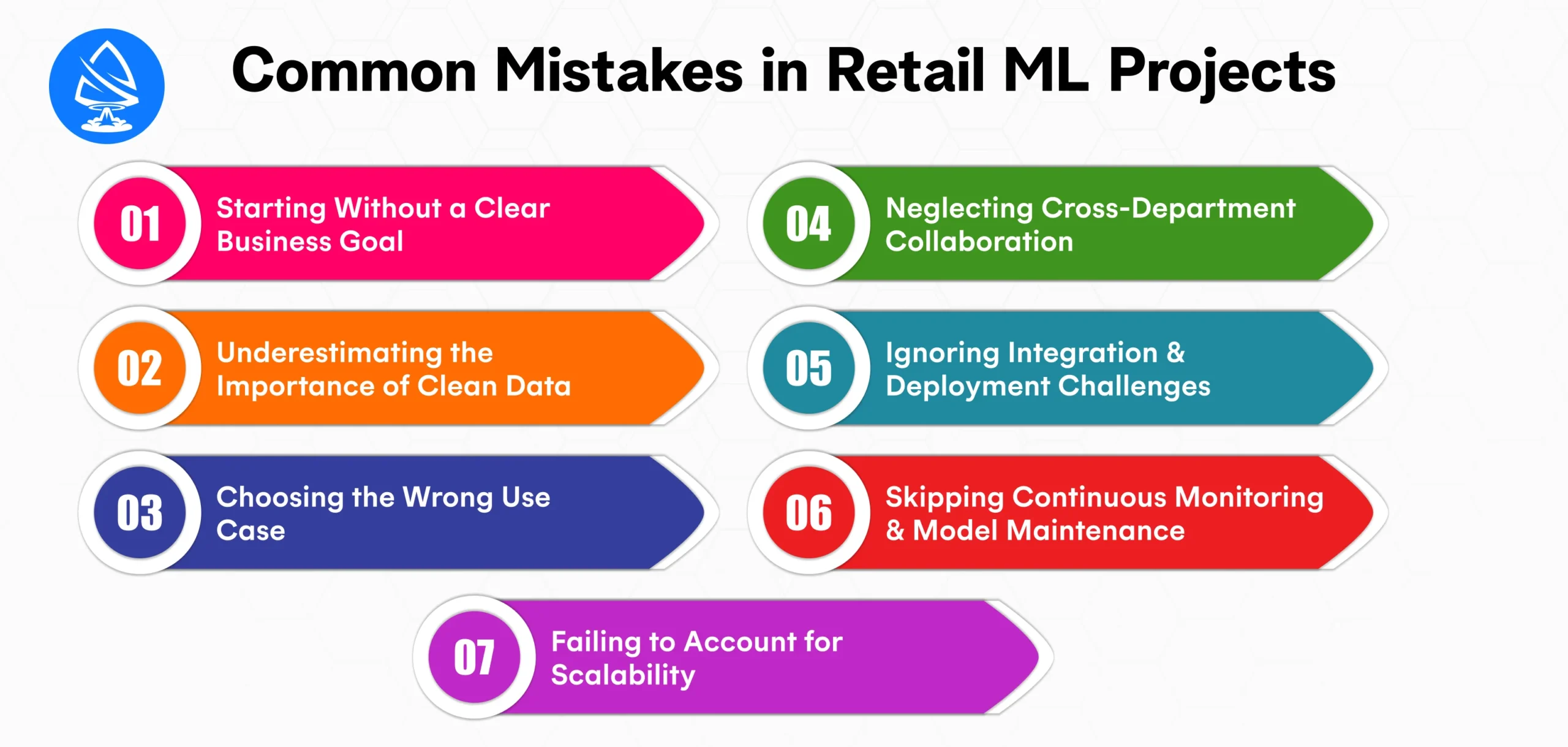
One of the biggest errors is deploying ML because it’s a trend,y not because there’s a defined problem to solve.
Retailers often overlook data readiness. ML models trained on inconsistent, incomplete, or siloed data produce unreliable results.
Trying to solve overly complex problems early on can delay success and shake internal confidence.
Machine learning projects require alignment across data science, IT, marketing, supply chain, and store operations.
Building a model is only 30% of the job. Retail ML must integrate into POS, CRM, ERP, and eCommerce systems for real value.
Retail is dynamic. Without regular model retraining, accuracy drops, and ML performance degrades over time.
An ML solution that works for 10 stores may crash when rolled out to 500 if it wasn’t designed to scale.
Avoid these pitfalls by choosing to hire AI developers with proven retail project success.
Retailers don’t just need machine learning solutions;s they need machine learning solutions that actually work in real-world, revenue-critical environments. That’s where Artoon Solutions stands apart. We’re not a generic IT vendor; we’re a strategic technology partner trusted by U.S., Middle Eastern, and Indian businesses to design, build, and scale AI systems that move the needle on retail performance.
Here’s why forward-thinking retail leaders choose Artoon Solutions:
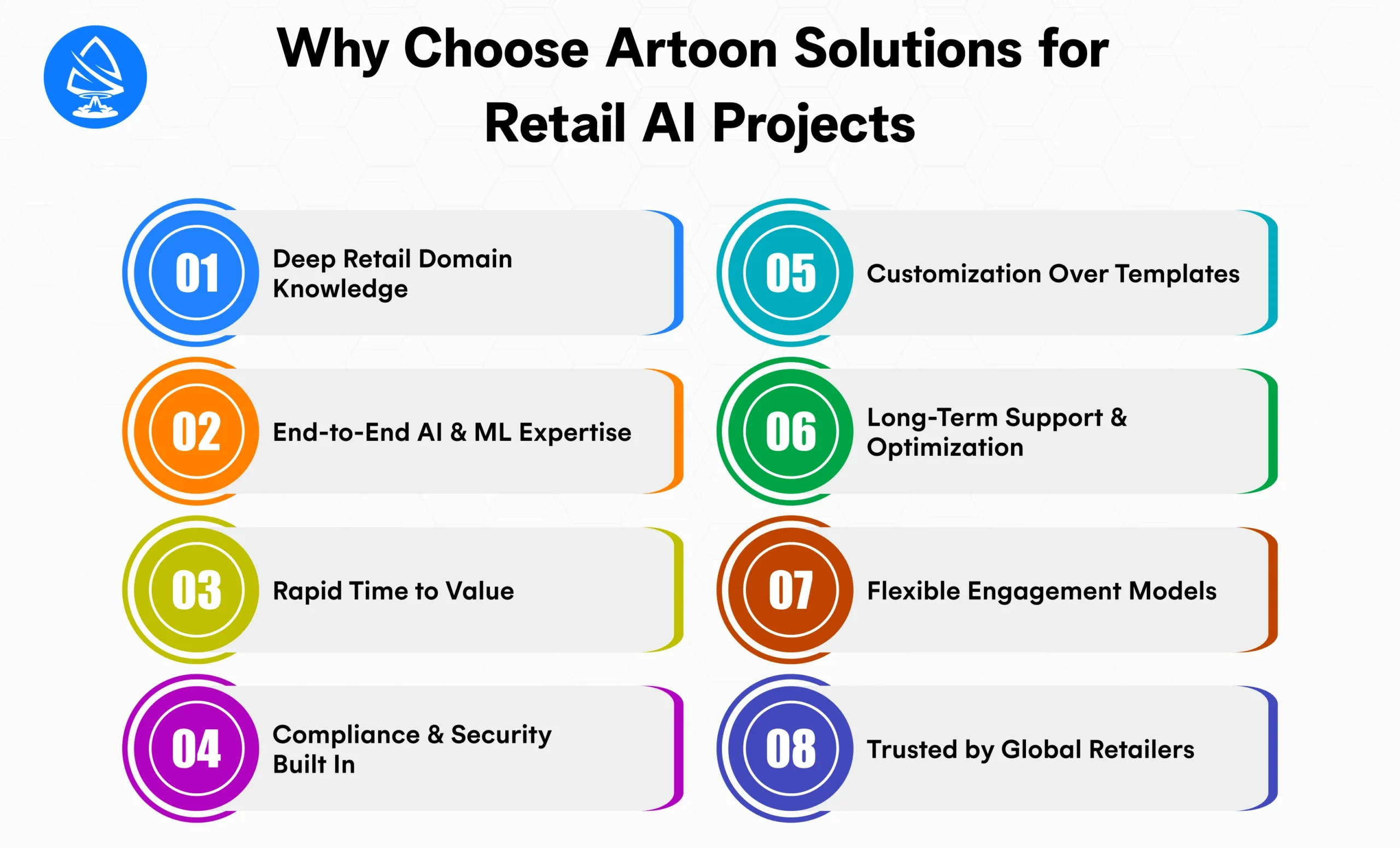
We understand the complexity of modern retail omnichannel behavior, tight margins, seasonal volatility, and evolving consumer expectations. Whether it’s brick-and-mortar optimization or eCommerce personalization, our team brings industry insights that make ML models business-aware from day one.
From data engineering to model deployment, we offer full-spectrum capabilities:
We don’t just build models, we build solutions that scale across your retail stack.
Our modular frameworks and accelerators allow faster prototyping and deployment without compromising accuracy. For U.S. businesses, this means measurable impact in weeks, not months.
We follow strict U.S. and global compliance standards,s including:
Your data and customer trust are fully protected from Day 1.
No two retail businesses are alike. Off-the-shelf models fail when faced with your unique inventory, workflows, and customer base.
Machine learning is not a one-time project; it’s a living system. We provide ongoing model tuning, feature engineering, retraining schedules, and infrastructure upgrades to ensure sustained performance.
Whether you want to start with a small proof of concept or need a dedicated offshore team, we provide flexible options to match your roadmap and budget:
Looking to hire AI developers or augment your team with AI app development company experts? We’ve got you covered.
We’ve delivered AI-powered retail solutions across the USA, the Middle East, and India for both startups and enterprise brands. From inventory forecasting platforms to real-time price optimization engines, our solutions are live, performing, and growing revenues.
Retailers who leverage machine learning don’t just compete, they dominate. In a space where margins are thin and customer loyalty is fragile, ML provides the intelligence edge needed to grow, adapt, and win.
From dynamic pricing to demand forecasting to hyper-personalization, machine learning helps retailers run leaner operations and deliver better customer experiences.
If you’re looking to explore machine learning for your retail business, Artoon Solutions is here to help from idea to ROI.
Book a Free Consultation. Use our AI Cost Calculator to plan your investment.
1. What’s the difference between AI and machine learning in retail?
AI is the broader concept of simulating human intelligence. Machine learning is a subset that learns from data to make predictions or automate tasks in retail.
2. Is machine learning only for big retailers like Amazon or Walmart?
No. Small to midsize retailers benefit greatly by using ML to optimize operations, marketing, and customer experiences, even with limited data.
3. How long does it take to deploy a retail ML solution?
Typical pilots take 4–8 weeks. Full-scale deployments range from 3–6 months, depending on complexity.
4. Do I need an in-house data science team to start?
Not necessarily. You can hire AI developers or partner with firms like Artoon Solutions to handle the technical stack.
5. What are the risks of retail ML projects?
Common risks include poor data quality, model inaccuracy, and lack of integration with existing systems.
6. Can machine learning improve my store’s conversion rate?
Yes. ML-driven personalization and recommendation engines directly boost conversions both online and in-store.
7. What are the compliance concerns with retail ML?
Ensure customer data is anonymized and stored per HIPAA, GDPR, or CCPA standards, especially if handling PII.
8. How do I measure ROI from my ML investment?
Track KPIs like uplift in sales, reduced churn, optimized inventory turnover, and improved marketing ROI.

Artoon Solutions
Artoon Solutions is a technology company that specializes in providing a wide range of IT services, including web and mobile app development, game development, and web application development. They offer custom software solutions to clients across various industries and are known for their expertise in technologies such as React.js, Angular, Node.js, and others. The company focuses on delivering high-quality, innovative solutions tailored to meet the specific needs of their clients.
 For business inquiries only