- HR:+91-879-9184-787
- Sales:+91-908-163-7774


Artificial intelligence is no longer a futuristic concept; it’s the engine powering transformation across industries. For USA tech professionals and small business owners, tracking the most innovative AI startups offers both competitive intelligence and partnership opportunities. These emerging companies often push boundaries in automation, generative models, AI infrastructure, and vertical-specific solutions.
In this post, we’ll dive deep into the Top 10 AI Startups in USA that are making waves in 2025. You’ll learn what each does, why they stand out, and what trends they illuminate. Along the way, I’ll suggest internal linking opportunities to help connect this article to your broader content strategy. Let’s explore the vanguard of U.S. AI innovation.
The American tech ecosystem is saturated with thousands of AI startups, from two-person research teams to multi-million-dollar unicorns. But only a handful manage to rise above the noise, attract global attention, and redefine industries. So, what exactly separates the best AI companies from the rest?
A truly standout AI startup combines innovation, execution, and impact, delivering real value rather than just futuristic promises. Let’s break down the key traits that make an AI startup exceptional.
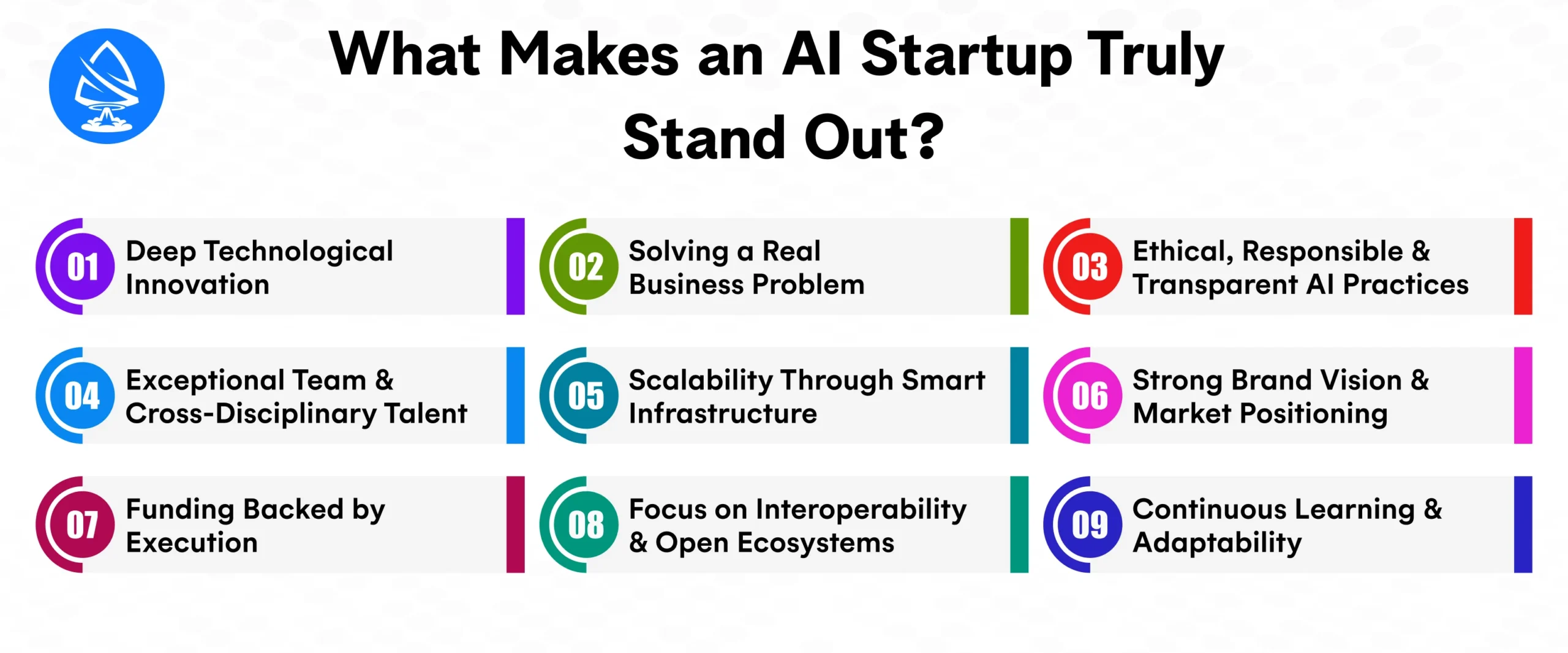
Many AI startups claim to use “machine learning” or “AI algorithms,” but what truly distinguishes leaders is deep technical originality. Standout startups push the boundaries of what’s possible in artificial intelligence either by creating new architectures, improving existing models, or applying AI to solve long-standing industry problems.
Example: Applied Intuition stands out because its AI simulation software for autonomous vehicles isn’t just “another ML product,” it’s a complex, safety-critical system that helps automakers test vehicles virtually before real-world deployment.
A successful AI startup doesn’t exist just to show technical brilliance; it creates a tangible business impact. Investors and customers alike seek startups that turn AI into measurable outcomes, not academic demos.
Example: Observe.AI revolutionized contact centers by using speech recognition and generative analytics to improve customer service operations, saving companies millions in manpower costs.
Takeaway: If your business is building solutions as an AI development company in USA, ensure your projects focus on real-world business metrics accuracy, time savings, or revenue uplift.
In an age where AI influences hiring, healthcare, and finance, ethics and transparency are essential. The best AI startups are proactive about responsible AI, not reactive after controversy.
Example: Safe Superintelligence Inc. focuses explicitly on safe, aligned AI systems, setting a precedent that other AI service companies are beginning to follow.
Behind every great AI product is an even greater team.
A standout AI startup isn’t just about brilliant coders; it’s about diverse experts who can translate algorithms into business transformation.
Example: Thinking Machines Lab was founded by Mira Murati and top AI veterans from OpenAI, proving that world-class expertise and collaboration fuel rapid innovation.
Pro Tip: If you’re hiring AI app developers, prioritize candidates who can balance research skills with a product mindset. The best talent understands both the algorithm and the user journey.
Many AI startups fail not because their models are weak, but because they can’t scale. True success depends on how efficiently the startup can move from prototype to production.
Example: Anthropic and Runway built scalable AI pipelines that serve global users in real time without performance loss, proving that infrastructure excellence is a major differentiator.
For growing AI startups, partnering with experienced AI services companies or AI solution providers can help scale efficiently without reinventing the wheel.
Technology alone doesn’t drive success brand trust and narrative do. AI can be complex and intimidating to non-technical users. Startups that communicate clearly, ethically, and purposefully stand out in a crowded market.
Example: Artisan AI built its brand around a simple idea: “AI employees that automate your work.” The clarity and confidence of this message earned them rapid traction in the automation space.
Funding is essential, but execution is what turns capital into momentum. A standout startup doesn’t just raise millions; it knows how to spend wisely on R&D, marketing, and customer success.
Example: Applied Intuition used its funding not to chase headlines but to expand real-world simulation capabilities and establish strong B2B partnerships with automotive OEMs.
Pro Tip: For startups or AI service companies scaling fast, maintain a healthy balance between innovation and profitability. AI development should enhance business value, not burn through funding.
Modern AI doesn’t thrive in isolation. The best startups make their systems interoperable and compatible with multiple tools, datasets, and platforms.
Example: Hugging Face built an open-source ecosystem that now underpins thousands of projects globally. This shows how openness can become a strategic moat.
Takeaway: If you operate as an AI development company in USA, consider offering APIs, SDKs, or plug-and-play modules that help clients integrate easily. Your openness will drive adoption.
AI without usability is a science experiment. The best AI companies obsess over user experience (UX). Their platforms simplify complex AI workflows so non-experts can benefit too.
Example: Runway ML made generative video editing accessible to creators without technical expertise, proving that simplicity scales faster than sophistication.
For small business owners adopting AI tools, usability determines ROI. Choose AI startups that make integration seamless, not a technical headache.
AI evolves weekly. Startups that stay agile, updating models, experimenting with new architectures, and responding to market feedback, will always stay ahead.
Example: Profound quickly adapted from content analytics to AI optimization for search engines as market demand shifted, proving adaptability beats rigidity.
Lesson: In AI, evolution is survival. Keep teams, technology, and strategy adaptable to rapid innovation cycles.
You may also want to know Hire Stable Diffusion Developers
Here are ten standout AI startups in the U.S. These are ones making headlines, securing large funding, or innovating with real products.
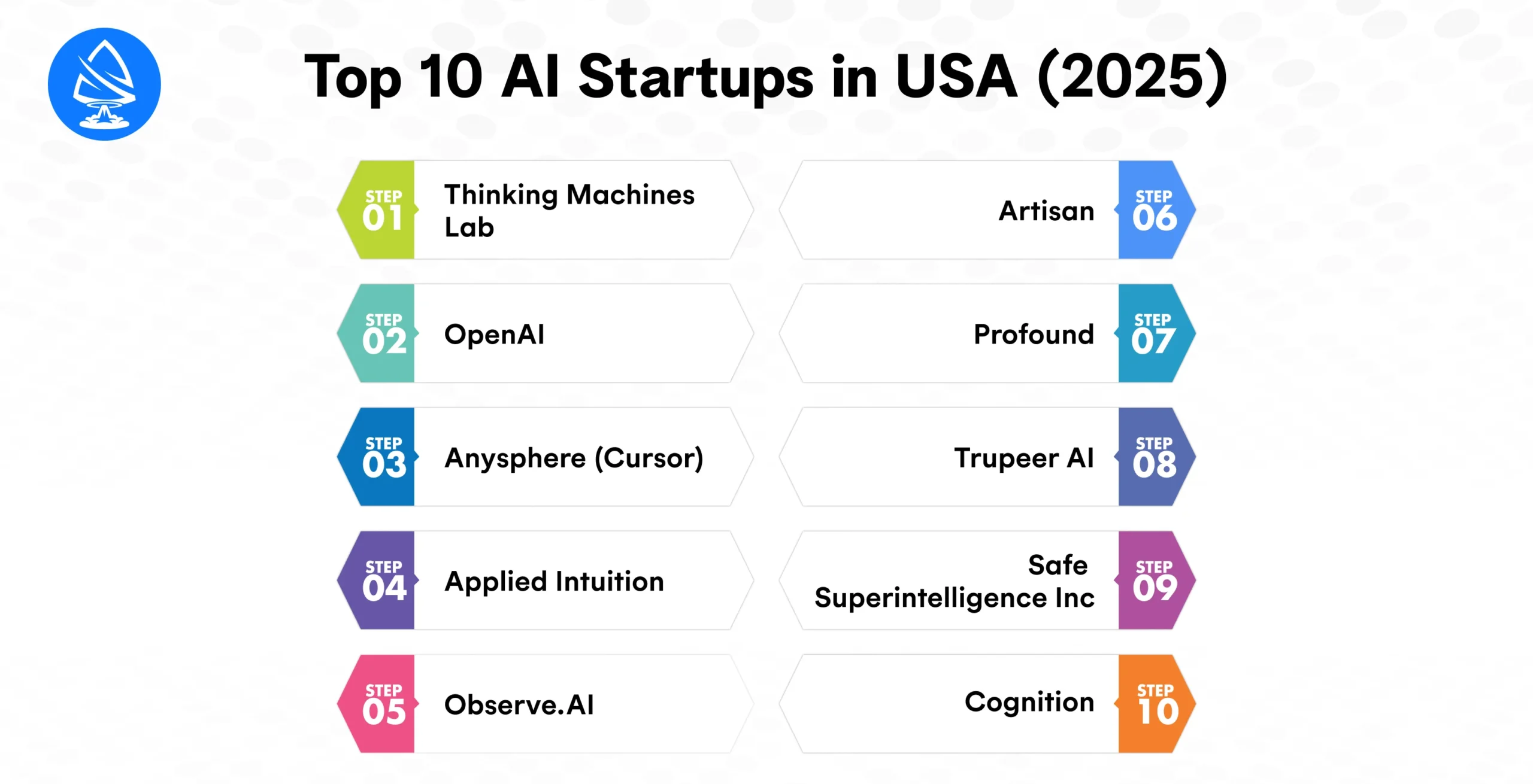
Thinking Machines Lab was founded in early 2025 by Mira Murati and has already raised $2 billion at a $12 billion valuation. They position themselves as pushing the frontier of multimodal AI, integrating vision, language, reasoning, and agentic behavior. Their team includes former OpenAI talent like John Schulman and Lilian Weng.
Why they matter: As a potential “next OpenAI” competitor, their R&D focus and capital raise make them one to watch for collaborations in generative systems, AI infrastructure, or bespoke model work.
No list is complete without OpenAI, headquartered in the U.S. Their models set the bar for what commercial AI can achieve. They also work as a platform provider, licensing models and APIs to businesses.
Why they matter: As a de facto standard, many AI startups build “on top of OpenAI.” Their model releases, API pricing, and safety decisions ripple through the industry.
Anysphere is an applied research lab in the U.S. focused on automating code writing and developer tools. It was included in Forbes 2025 AI 50 as one of the rising stars. It’s carving a niche: assistive tools for coders, integrating AI directly into IDEs and development workflows.
Why they matter: If your business is building AI tools, integrating with or learning from Anysphere’s approach may accelerate your own AI development company in USA portfolio.
Applied Intuition builds AI-driven simulation and software systems for autonomous vehicles, helping carmakers test and deploy autonomous systems safely. In 2025, it reached a valuation of $15 billion after a $600 million funding round.
Why they matter: The autonomous sector is a major frontier for AI. Their tools let engineers test edge-case scenarios that real-world testing can’t cover. For any AI startup, this kind of domain specialization is a reminder: deep vertical knowledge can be a competitive moat.
Listed among generative AI and enterprise startups, Observe.AI is an AI platform for call centers, offering voice analytics, agent assist, and quality systems. They combine speech recognition, language models, and operational analytics, a strong example of domain-specific AI.
Why they matter: Their model of being an AI services company with domain specialization is a blueprint for others.
Artisan, based in San Francisco, builds “AI agents” for business automation. The startup pushes “digital workers” for routine tasks. They’ve drawn attention with marketing campaigns and are actively raising seed/Series A capital.
Why they matter: The “agent economy” is a core trend of automation, not just of insight but action. Artisan is exploring this frontier.
Profound is a more recent startup that offers “Generative Engine Optimization” (AIO) tools that help companies manage how their content performs in AI-powered answer engines. They closed a $20 million Series A in 2025 and are positioning themselves at the intersection of content, SEO, and AI.
Why they matter: As AI-driven search becomes the new UI, optimizing for how AI “sees” your content becomes essential for small businesses and tech brands alike.
Founded in 2025, Trupeer automates video production for business workflows: training videos, process guides, documentation, etc. The AI platform supports video editing, voiceover, translations, and formatting. It raised ~$3M in seed funding.
Why they matter: Video content creation is major for marketing, onboarding, and education. Trupeer showcases how AI can transform content-heavy workflows.
Launched by Ilya Sutskever and others, SSI is focusing on safe superintelligence AI systems that go beyond human capability but within ethical guardrails. By 2025, they had attained a $30 billion valuation and secured cloud partnerships.
Why they matter: SSI represents the “safety-first” track. Any serious AI roadmap needs to consider not just capabilities, but alignment, risk, and governance.
Cognition is an applied AI lab working on reasoning, inference, and knowledge-driven AI. While less flashy than generative startups, labs like Cognition help build the next generation of hybrid symbolic-neural systems.
Why they matter: The next wave of AI will combine raw scale with structured reasoning. Startups like this explore that frontier.
Artificial Intelligence is no longer just a technological evolution; it’s an economic revolution. The Top AI startups in the USA are not merely building software; they’re reshaping industries, defining new work models, and influencing global business strategies.
By studying these startups, we can uncover patterns and strategies that drive their rapid success and the lessons that other tech professionals, founders, and AI development companies in USA can apply to build scalable, future-proof AI ventures.
Here’s a closer look at the key trends and takeaways from the most influential AI startups today.
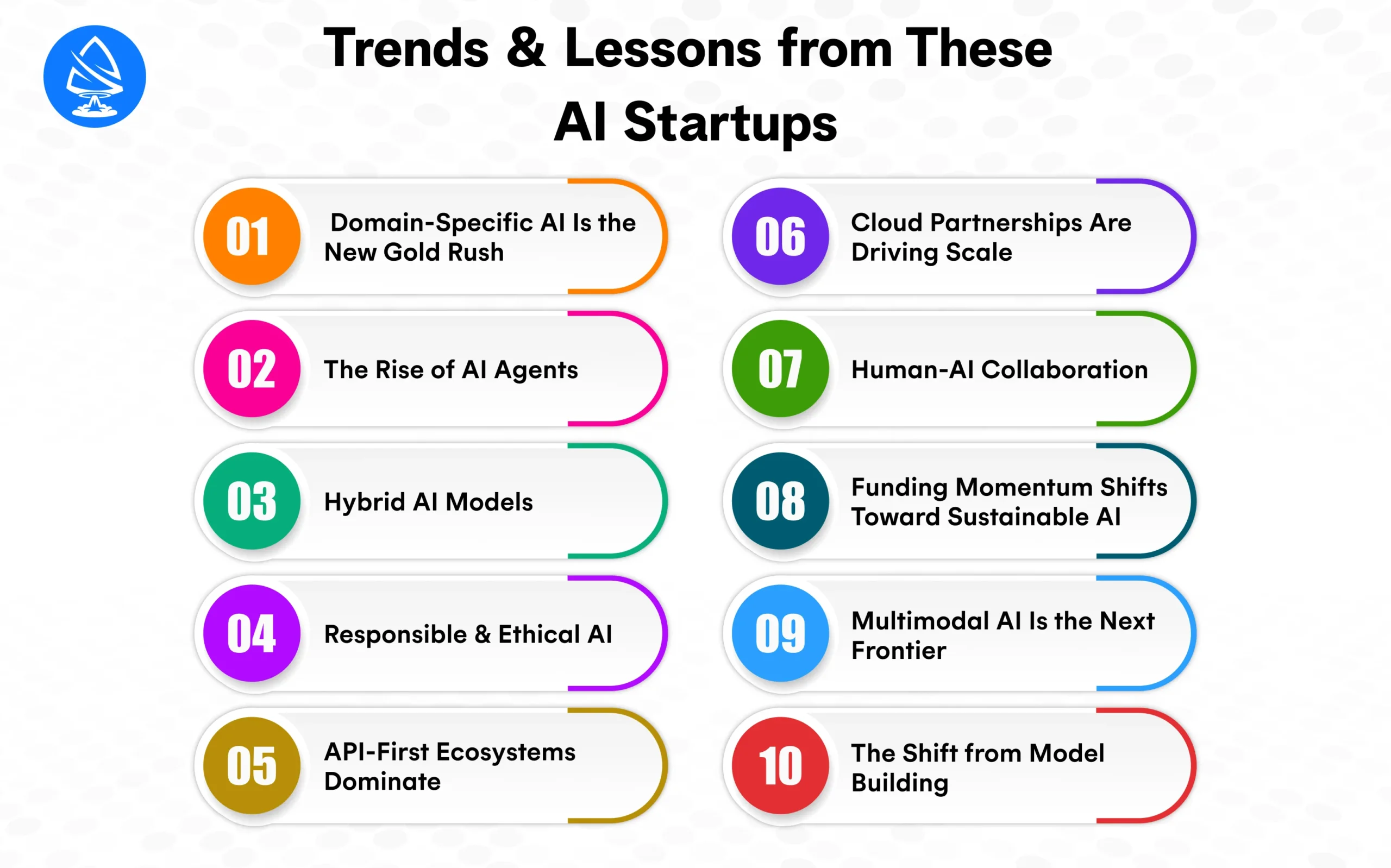
Gone are the days when AI companies tried to solve everything for everyone.
The smartest startups are now niching down, focusing on specific industries and building deep, data-driven expertise within those verticals.
Examples:
Lesson: If you run an AI services company, identify one or two verticals like healthcare, logistics, or education, and build tailored AI solutions. Deep expertise beats broad experimentation.
One of the most exciting shifts in 2025’s AI landscape is the emergence of AI agents and autonomous systems capable of making decisions, performing tasks, and improving over time with minimal human input.
These are not just chatbots; they’re digital employees that handle marketing, support, design, and even coding.
Lesson: For small business owners, investing early in agent-based tools can give you a massive edge. Automate repetitive workflows and let human teams focus on creativity and strategy.
Another trend shaping the future of AI startups is the hybrid model approach combining generative AI with analytical AI.
Example: Profound integrates generative AI with analytics to optimize content for AI-driven search results, helping businesses stay visible in an AI-first web ecosystem.
Lesson: Future AI solution providers must learn to fuse both approaches, creative + cognitive, to deliver holistic business intelligence solutions.
The debate about AI ethics isn’t optional anymore it’s a business strategy. Top AI companies are embedding trust, safety, and transparency into their model pipelines because consumers, regulators, and investors now demand accountability.
Lesson: Ethics isn’t a compliance burden, it’s a trust-building asset. Businesses that demonstrate responsibility will win enterprise contracts faster than those chasing speed alone.
Many of the best AI startups in USA are adopting an open-source or API-first model.
This trend democratizes AI access, allowing developers, researchers, and businesses to build on top of their platforms.
Examples:
Lesson: If you’re an AI app developer, think API-first. Building flexible, integrative systems allows others to extend your solution, amplifying reach and revenue.
Another strong pattern is that AI startups are partnering strategically with cloud giants like Google Cloud, AWS, and Microsoft Azure. These alliances help startups access infrastructure, GPUs, security layers, and go-to-market opportunities that would otherwise take years to build.
Lesson: For AI service companies or growing startups, aligning with a cloud ecosystem early, like Google Cloud for Startups, can be a shortcut to scale and credibility.
While automation remains central to AI progress, most top startups recognize that human creativity + AI intelligence is the winning formula. The goal is not to replace humans but to augment human capabilities.
Lesson: Businesses should view AI as a co-pilot, not a competitor. By designing AI systems that assist rather than automate entirely, startups gain higher adoption and user trust.
The AI funding landscape has matured. Investors are no longer dazzled by big language models alone; they’re now backing AI startups with sustainable revenue models, clear differentiation, and practical deployment strategies.
Example: Applied Intuition raised $600M at a $15B valuation because its AI simulations have proven enterprise utility and strong customer retention.
Lesson: If you’re building an AI development company in USA, prioritize customer value and scalability before chasing valuation. Sustainable innovation attracts smarter capital.
While early AI startups specialized in text or image generation, 2025’s leaders are mastering multimodal systems AI that understands and generates across multiple formats simultaneously.
Lesson: AI companies looking for long-term relevance must explore multimodal AI capabilities, which is where most future demand will concentrate.
Earlier AI ventures focused primarily on building the biggest or smartest models.
But the latest trend is moving toward solution building, creating integrated tools, workflows, and platforms that directly solve user pain points.
Examples:
Lesson: For AI service companies, packaging your AI models as usable products (with APIs, dashboards, or SaaS apps) can 5x adoption rates and client satisfaction.
You may also want to know Hire Remote Developers
The Top 10 AI Startups in USA we covered represent the bleeding edge of what artificial intelligence can do today, from automation agents to autonomous systems, content AI to safety-first research. For USA tech professionals and small business owners, understanding and engaging with these ventures is more than curiosity; it can be competitive leverage.
If you’re exploring which AI paths to take or want to scope out development and partnership costs, try our Cost Calculator now. Use it to estimate what it would cost to build and scale a solution like those offered by these startups and plan your next move with clarity.
1. What qualifies as an AI startup?
Typically, a startup is working on novel AI models, infrastructure, or domain-specific intelligent systems rather than purely applying existing tools.
2. Are these startups profitable now?
Most are not yet heavy R&D investments; compute and teams often precede profitability.
3. How do they get funding?
Through venture capital rounds, strategic investors, and AI-focused funds. For example, Thinking Machines raised $2B early.
4. Should my company collaborate with these startups?
Absolutely. Collaboration can accelerate your product roadmap without building everything in-house.
5. How to choose between AI infrastructure vs a vertical AI startup?
It depends on your core strength. Infrastructure needs scale and endurance; vertical startups focus on domain depth.
6. Will Google or Big Tech absorb them?
Acquisition is common in this space, but many seek to retain independence due to mission or valuation strategies.
7. Do these startups hire remote developers globally?
Yes, many have distributed engineering teams, though core R&D often remains U.S.-centric.
8. How often do AI startups pivot?
Quite often, market signals, tech breakthroughs, or funding pressures can lead to product redirection.

Artoon Solutions
Artoon Solutions is a technology company that specializes in providing a wide range of IT services, including web and mobile app development, game development, and web application development. They offer custom software solutions to clients across various industries and are known for their expertise in technologies such as React.js, Angular, Node.js, and others. The company focuses on delivering high-quality, innovative solutions tailored to meet the specific needs of their clients.
 For business inquiries only