The rapid evolution of code generation AI is transforming the way developers, startups, and small businesses approach software development. In 2025, these tools are no longer just experimental; they are essential companions for coding, debugging, and building applications faster. By leveraging artificial intelligence, developers can now generate high-quality code snippets, automate testing, and even build full applications in record time.
For USA-based tech professionals and small business owners, AI coding assistants offer a unique advantage: they save time, reduce costs, and make development accessible even for non-technical entrepreneurs. Imagine writing complex APIs in minutes or automating repetitive coding tasks without worrying about syntax errors. That’s the power of modern AI programming tools.
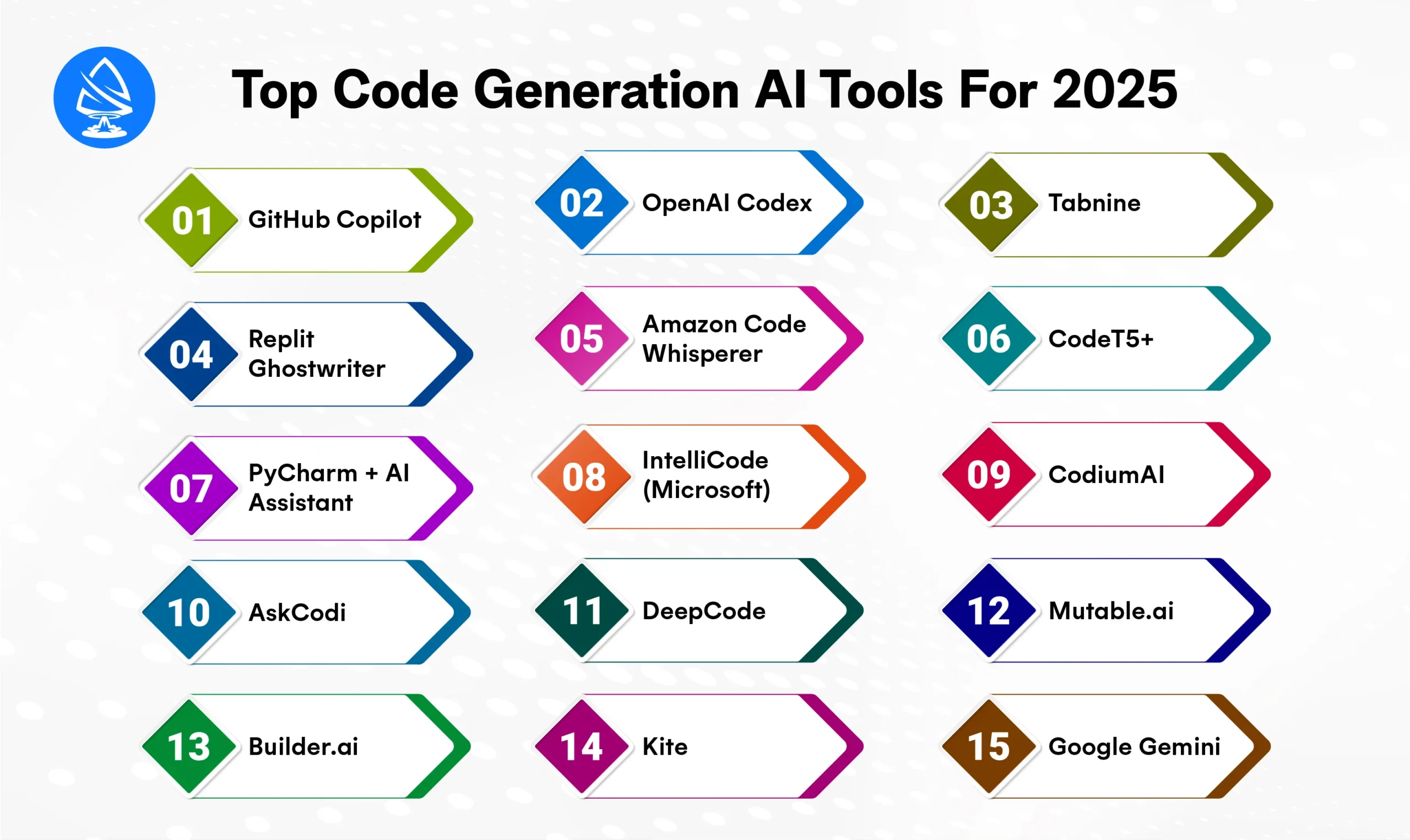
This guide highlights the top code generation AI tools in 2025 that you should know about, covering their features, benefits, and best use cases. Whether you’re a seasoned developer or a business leader looking to streamline app creation, these tools will help you harness the future of coding.
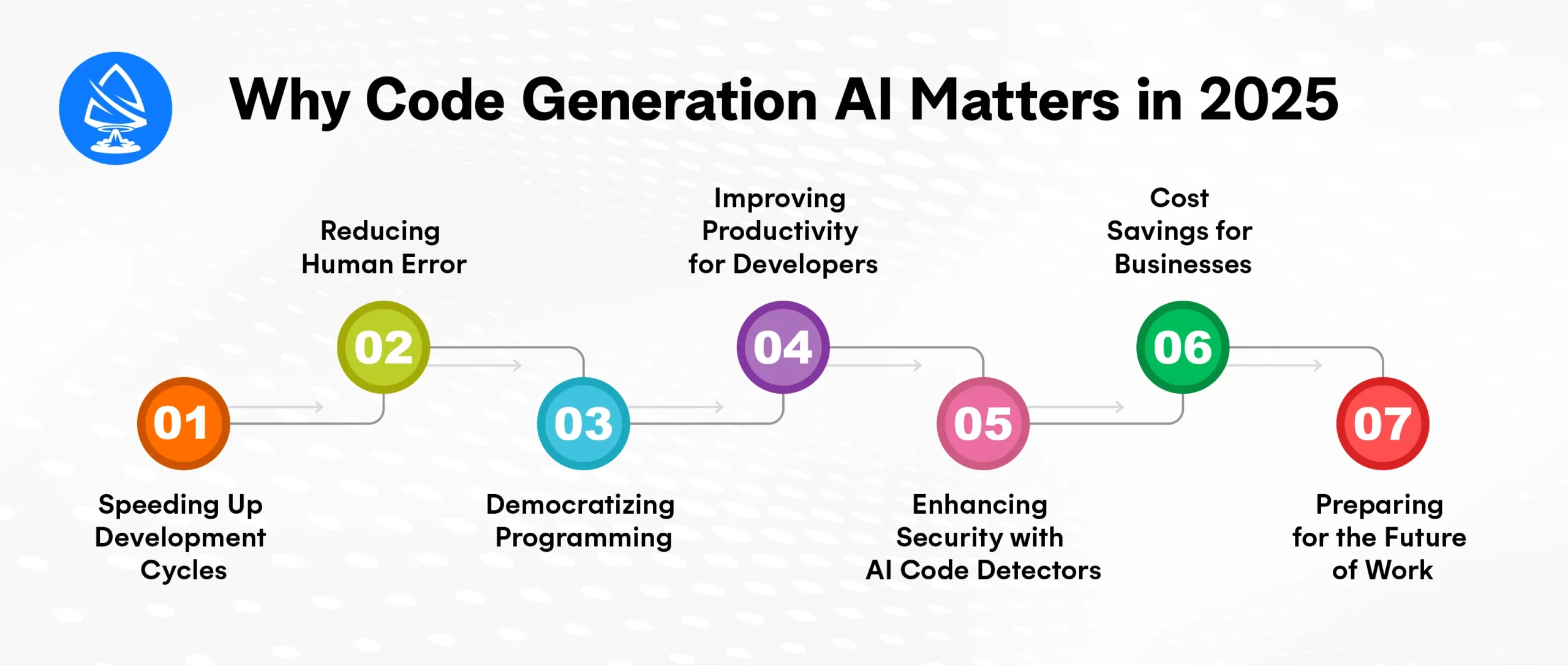
Why Code Generation AI Matters in 2025
The demand for faster, smarter, and more reliable software development is higher than ever. Businesses across industries, from startups to Fortune 500 companies, are looking for ways to innovate quickly while keeping costs under control. That’s where code generation AI comes in. By 2025, it’s no longer just an experimental technology; it’s becoming a must-have tool for developers, entrepreneurs, and IT teams.
Here’s why it matters so much today:
1. Speeding Up Development Cycles
Traditional coding is time-consuming. Developers spend hours writing repetitive functions, boilerplate code, or integrations.
AI coding tools generate these instantly, accelerating development.
Faster prototyping means startups can test products quickly and reach markets earlier.
Enterprises can cut weeks off project timelines.
2. Reducing Human Error
Even the most skilled developers make mistakes, especially with complex syntax or long codebases.
AI code generators act like real-time code reviewers, highlighting errors before they break production.
This reduces debugging time and ensures more reliable releases.
For industries like finance or healthcare, fewer errors mean fewer compliance risks.
3. Democratizing Programming
One of the biggest impacts of code generation AI is accessibility.
Non-technical entrepreneurs can now build apps using AI app builders without deep coding knowledge.
Small businesses can launch digital solutions without hiring large developer teams.
This lowers the barrier to entry for innovation.
4. Improving Productivity for Developers
Developers can focus on solving creative, complex problems instead of spending hours on repetitive tasks.
AI becomes a coding assistant, handling boilerplate, unit tests, or refactoring.
Teams ship features faster and spend more time on innovation.
5. Enhancing Security with AI Code Detectors
Security remains a top priority in 2025.
Tools with built-in AI code detectors can scan for vulnerabilities automatically.
This ensures that security checks happen alongside development, not just after deployment.
Businesses reduce risks while maintaining speed.
6. Cost Savings for Businesses
Hiring and retaining skilled developers in the USA is expensive.
Code generation AI allows leaner teams to accomplish more with fewer resources.
Startups save on development costs, while enterprises reduce overhead.
The ROI is clear: less time, fewer errors, more value delivered.
7. Preparing for the Future of Work
As AI programming becomes mainstream, companies adopting it now will stay competitive.
Developers skilled in AI coding will be in high demand.
Businesses leveraging AI tools will innovate faster than competitors.
Early adopters are positioning themselves for long-term success.
For small businesses, this means creating applications without hiring full-time teams, and for developers, it means focusing on innovation rather than boilerplate tasks.
Free tools are great for experimentation, but investing in paid plans ensures access to advanced features like private training, security scanning, and 24/7 support.
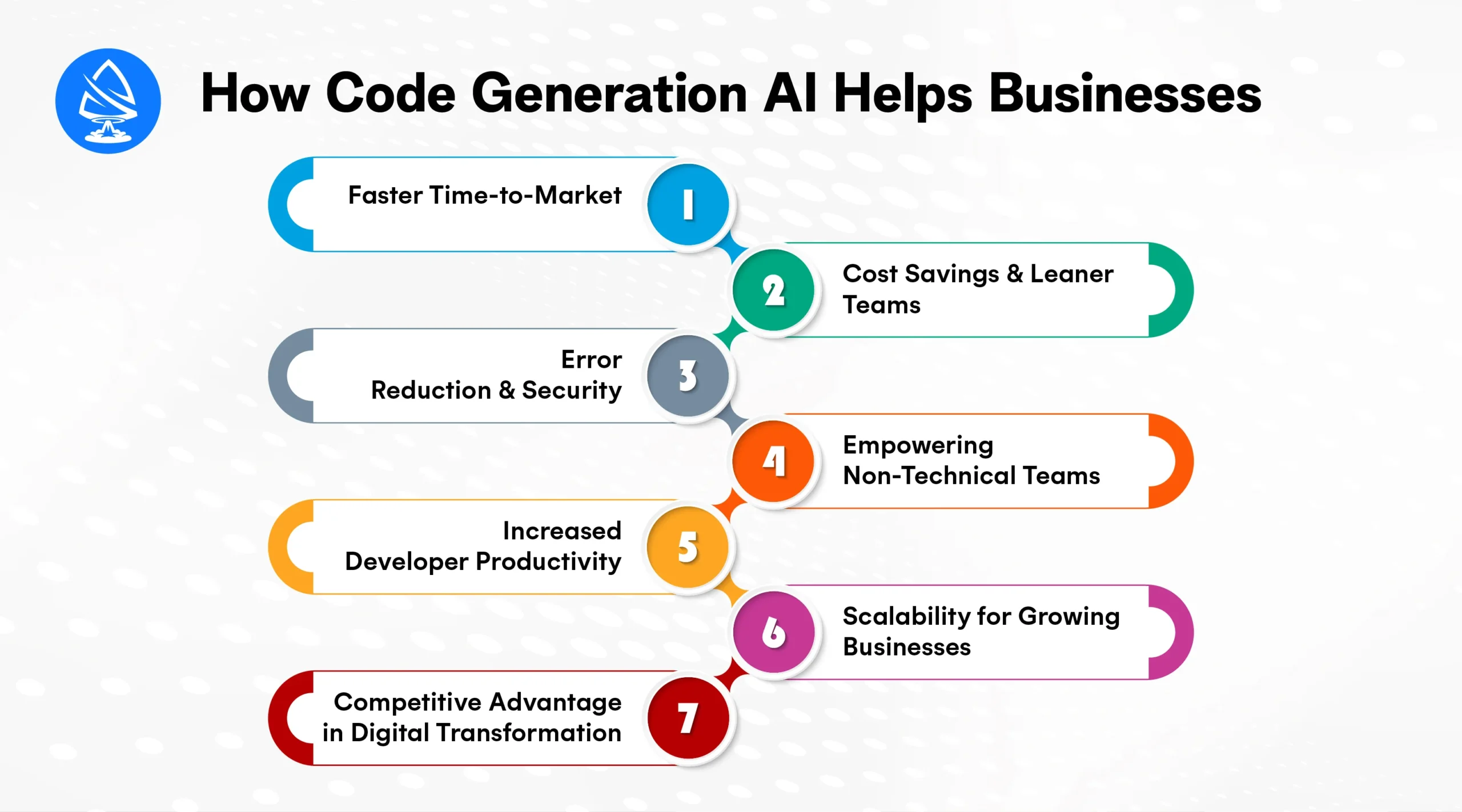
By 2025, code generation AI is more than just a tool for developers; it’s becoming a strategic asset for businesses of all sizes. Whether you’re a small business owner trying to launch an app, a startup building an MVP, or an enterprise optimizing large-scale systems, AI-powered coding assistants offer measurable value. Let’s break down the key ways they help:
1. Faster Time-to-Market
In competitive industries, speed matters.
AI coding tools can generate prototypes, APIs, and front-end components in minutes.
Startups can launch MVPs faster, validate ideas, and attract investors.
Enterprises roll out new features ahead of competitors, improving customer satisfaction.
Example: A SaaS startup uses GitHub Copilot to build a functional demo in days instead of weeks, gaining a head start on fundraising.
2. Cost Savings and Leaner Teams
Hiring developers in the USA is expensive, and maintaining large teams can strain budgets.
AI code generators reduce the need for big developer teams by handling repetitive tasks.
Small businesses can build apps with smaller in-house teams.
Enterprises lower development costs while maintaining output.
If you need fully tailored solutions, consider working with a custom AI development company to maximize ROI.
3. Error Reduction and Security
Bugs and vulnerabilities cost businesses both money and reputation.
AI tools provide real-time syntax correction and AI code detectors to catch issues early.
They automatically generate secure code snippets optimized for compliance-heavy industries.
This minimizes costly downtime and cybersecurity risks.
4. Empowering Non-Technical Teams
Not every business owner or manager is a developer, but that shouldn’t stop innovation.
Tools like Builder.ai and Replit Ghostwriter let non-technical users create applications.
Marketing teams can build automation scripts, while product teams design internal tools.
This democratization empowers everyone in the organization to contribute to innovation.
5. Increased Developer Productivity
For technical teams, AI coding assistants act as productivity boosters.
Developers spend less time writing boilerplate code and more time on creative problem-solving.
Automated unit test generation ensures quality without manual overhead.
Teams meet deadlines faster, even with limited resources.
6. Scalability for Growing Businesses
As businesses grow, so do their software needs.
AI programming tools scale effortlessly, handling larger codebases and more complex tasks.
Enterprises can integrate AI into CI/CD pipelines to automate deployments.
Startups can scale their applications without drastically increasing headcount.
7. Competitive Advantage in Digital Transformation
Businesses embracing AI development tools position themselves as future-ready.
Faster product innovation attracts customers.
Cost efficiency improves profitability.
Enhanced security builds trust with users.
To stay ahead, some companies choose to hire AI developers to build tailored integrations and advanced automation pipelines.
Future of Code Generation AI
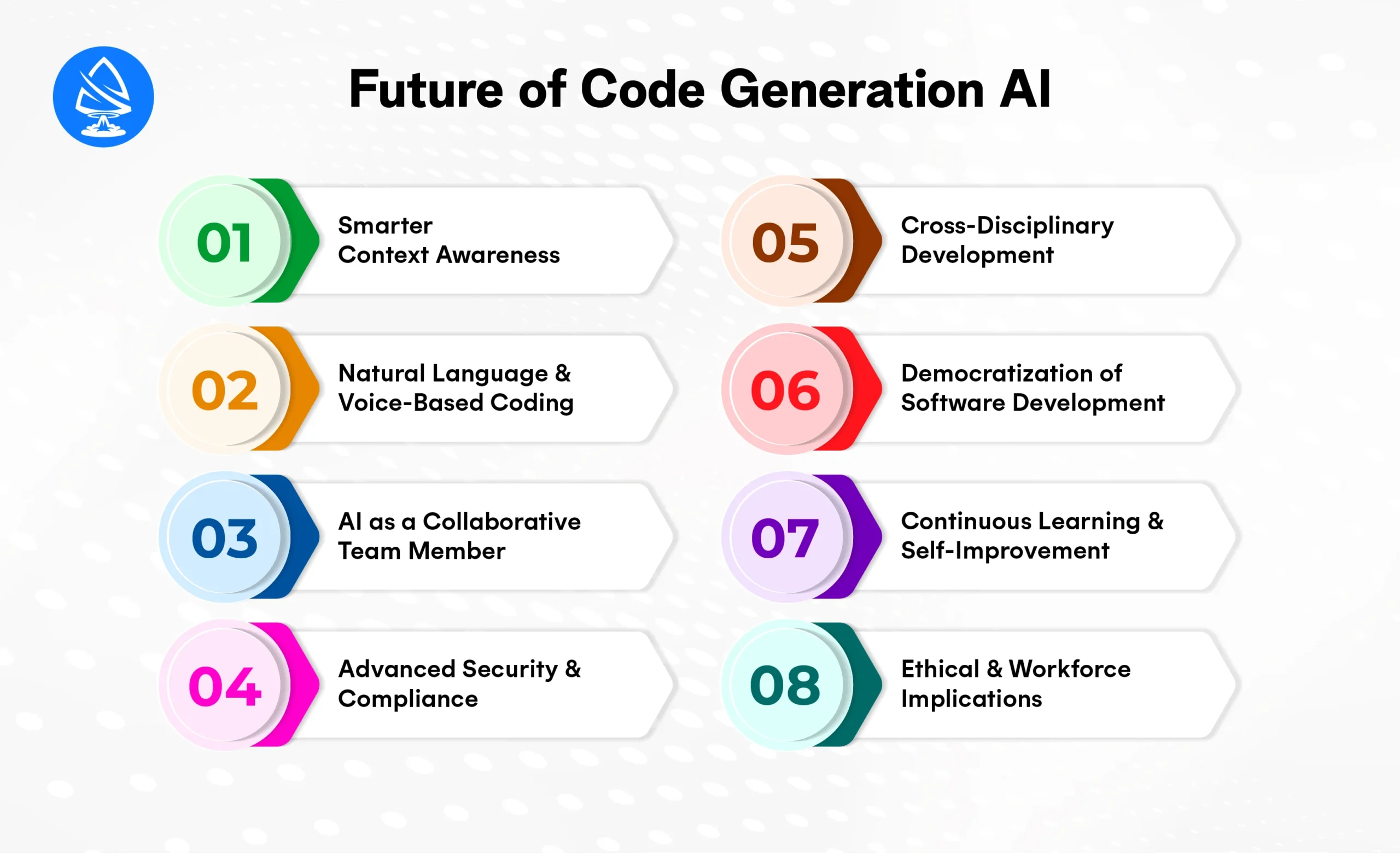
By 2025, code generation AI will already be revolutionizing software development. But this is just the beginning. As technology advances, we can expect these tools to become even more powerful, intelligent, and accessible, reshaping how businesses, startups, and developers approach coding. Let’s look at what the future holds:
1. Smarter Context Awareness
Today’s AI tools can generate code snippets, but the future will bring project-level intelligence.
AI will understand the entire codebase, not just single files.
It will maintain consistency in coding standards across projects.
Developers will be able to ask AI: “Optimize this whole module for performance” and get accurate results.
2. Natural Language and Voice-Based Coding
The future will make coding as easy as having a conversation.
Developers will describe features in plain English (or any language), and AI will write production-ready code.
Voice-enabled AI coding assistants will allow hands-free development.
This lowers barriers for entrepreneurs and non-technical professionals.
3. AI as a Collaborative Team Member
Rather than being just a suggestion tool, AI will act like a virtual developer.
AI agents will join project management tools, commit code to repositories, and participate in standups (via reports).
They’ll handle repetitive tasks while humans focus on creative, high-level design.
Teams will treat AI as a genuine member of the workforce.
4. Advanced Security and Compliance
As AI-generated code becomes widespread, so does the need for robust security.
Future AI code detectors will automatically enforce compliance standards (GDPR, HIPAA, PCI-DSS).
Vulnerability scanning will be built into every AI-generated snippet.
AI will act as both a coder and a security auditor.
5. Cross-Disciplinary Development
AI will bridge the gap between coding and other domains.
Designers will directly turn UI mockups into working applications.
Product managers will generate dashboards or prototypes without writing a line of code.
Data scientists will automate pipeline building with conversational prompts.
6. Democratization of Software Development
AI app builders will become mainstream, empowering small businesses and individuals to create sophisticated applications without technical backgrounds.
Anyone with an idea will be able to launch a product quickly and affordably.
This democratization will spark new waves of innovation, especially in underserved industries.
7. Continuous Learning and Self-Improvement
Unlike today’s tools, which require retraining, future AI models will:
Continuously learn from developer feedback.
Adapt to specific industries, company styles, and niche workflows.
Get better at anticipating developer intent with every interaction.
8. Ethical and Workforce Implications
With great power comes responsibility.
Ethical concerns around copyright, intellectual property, and originality will grow.
Developers may shift from writing raw code to supervising, auditing, and innovating with AI.
Organizations must adopt responsible AI practices to ensure fairness and transparency.
Conclusion
The rise of code generation AI tools in 2025 marks a major milestone for developers and businesses alike. From speeding up development cycles to making app creation accessible for non-coders, these tools are transforming how we approach programming.
Whether you’re looking for the best AI for coding, an AI app builder for rapid prototyping, or an AI code detector for security, the right tool can save time, reduce costs, and boost innovation.
Ready to calculate your investment in AI-driven development? Try our Cost Calculator to plan your next project with precision.
Frequently Asked Questions
1. What is code generation AI?
It’s artificial intelligence that generates or assists with writing code automatically.
2. What’s the best AI for coding in 2025?
GitHub Copilot, OpenAI Codex, and Amazon CodeWhisperer are among the leaders.
3. Can AI build apps without coding knowledge?
Yes, tools like Builder.ai and Replit Ghostwriter allow app creation with little to no coding.
4. Is there a free AI code generator?
Yes, AskCodi and basic versions of Tabnine and Replit Ghostwriter are free.
5. Can AI replace programmers?
No, AI assists programmers by automating tasks, but human creativity and oversight remain essential.
6. Are AI coding tools safe?
Most are safe, but it’s best to use AI code detectors like DeepCode for security compliance.
7. What industries benefit most from AI programming tools?
Software development, e-commerce, fintech, and startups benefit the most.
8. Should I hire AI developers for custom coding tools?
Yes, if you need advanced features or integrations beyond what off-the-shelf tools provide.
Written By :
Artoon Solutions
Artoon Solutions is a technology company that specializes in providing a wide range of IT services, including web and mobile app development, game development, and web application development. They offer custom software solutions to clients across various industries and are known for their expertise in technologies such as React.js, Angular, Node.js, and others. The company focuses on delivering high-quality, innovative solutions tailored to meet the specific needs of their clients.



 For business inquiries only