- HR:+91-879-9184-787
- Sales:+91-908-163-7774


The advancements in artificial intelligence (AI), particularly with large language models (LLMs), have revolutionized industries, powering everything from chatbots and virtual assistants to automated content generation and personalized marketing. However, as LLMs become more complex and integrated into business operations, managing their lifecycle, deployment, and performance has become a challenge—this is where LLMOps comes in.
LLMOps, short for Large Language Model Operations, is a specialized framework that builds on traditional MLOps (Machine Learning Operations) but focuses specifically on the intricacies of LLMs. Just as MLOps streamlined the development and deployment of machine learning models, LLMOps helps manage the operational complexities associated with training, fine-tuning, and scaling large language models.
In this guide, we’ll take a deep dive into Large Language Model Operations, exploring its principles, key tools, challenges, and its future trajectory. Whether you’re an AI developer, a business leader, or someone new to the AI field, this article will help you understand LLMOps and its importance in modern AI operations.
LLMOps, or Large Language Model Operations, refers to the set of practices, tools, and processes used to manage the lifecycle of large language models (LLMs). LLMs, such as GPT-3, BERT, and other state-of-the-art models, are trained on vast amounts of data to perform complex tasks like text generation, translation, summarization, question answering, and more. Due to their scale, LLMs present unique challenges in their deployment, monitoring, scaling, and ongoing management, which are addressed through LLMOps.
In essence, Large Language Model Operations is a specialized branch of MLOps (Machine Learning Operations) that focuses specifically on the operational management of large language models. It is designed to optimize the process of integrating, deploying, and maintaining LLMs in real-world applications, ensuring that they function at their best while meeting business needs and complying with ethical standards.
Large Language Model Operations is an essential part of AI development for companies that rely heavily on LLMs for various use cases, from automated customer service to complex data analysis.
While both MLOps and LLMOps share some common practices and tools, their primary difference lies in the complexity and scale of the models they handle.
While MLOps is widely used across various industries, Large Language Model Operations has emerged as a specialized extension aimed at managing the unique challenges of LLM training and deployment.
You may also want to know AI in Genomics Industry
LLMOps platforms are specialized systems designed to manage the full lifecycle of Large Language Models (LLMs), from development to deployment and monitoring. These platforms enable organizations to scale LLMs efficiently, ensure reliability, and maintain ethical AI practices. Unlike standard MLOps platforms, LLMOps platforms cater to the unique challenges of LLMs, such as their massive size, complex inference requirements, and sensitivity to prompt variations. Let’s dive into the key features that make these platforms essential for modern AI operations.
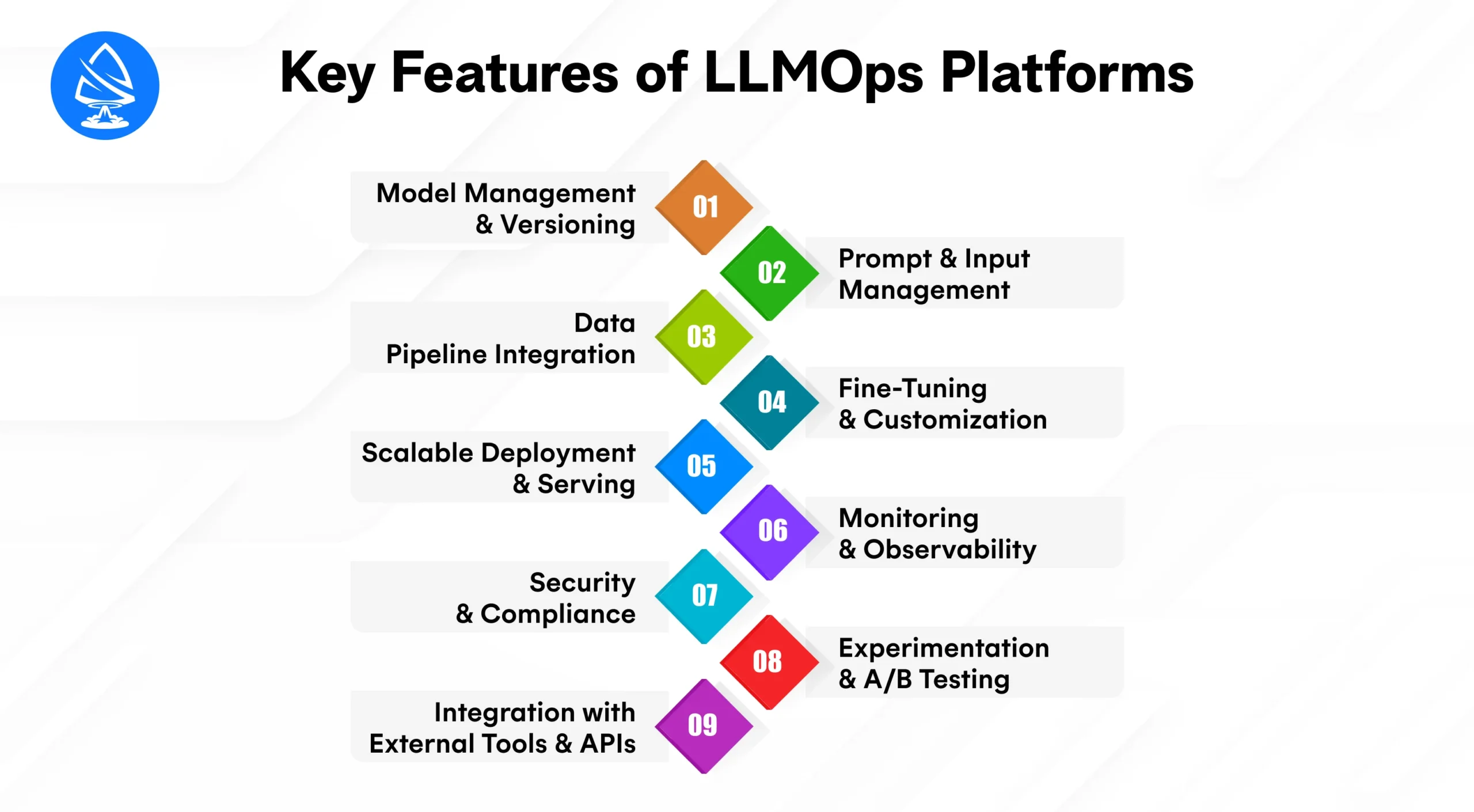
Managing LLMs involves tracking multiple versions of models, including pre-trained, fine-tuned, and domain-specific models. Large Language Model Operations platforms provide:
Example: If a company fine-tunes GPT-4 for healthcare queries, LLMOps platforms ensure that the original model, the fine-tuned version, and any experimental models are all versioned and accessible for comparison.
LLMs are highly sensitive to prompts, and slight variations can produce drastically different outputs. LLMOps platforms include:
Example: An AI-powered chatbot can use different prompts for customer support, FAQs, or troubleshooting. LLMOps platforms allow teams to manage these prompts systematically and track which versions produce the best results.
LLMs require large volumes of high-quality data for training and fine-tuning. LLMOps platforms facilitate:
Example: A legal AI application may feed contracts, case histories, and regulations into the LLM pipeline. LLMOps platforms ensure the data is preprocessed, validated, and ready for fine-tuning without manual intervention.
Fine-tuning LLMs for specific tasks is resource-intensive. LLMOps platforms provide:
Example: A company building a medical diagnosis assistant can fine-tune a general LLM with medical literature to improve accuracy and relevance in its recommendations.
LLMs are computationally heavy and require optimized serving infrastructure. Key features include:
Example: A customer support AI must respond in real-time across the globe. LLMOps platforms ensure the model runs efficiently, minimizing latency and maximizing uptime.
Monitoring LLMs goes beyond traditional metrics like accuracy; it includes:
Example: If an LLM starts producing biased or unsafe responses, the platform can trigger alerts and allow developers to intervene immediately.
LLMs often handle sensitive data, making security critical. LLMOps platforms provide:
Example: A healthcare LLM must ensure patient data is fully protected while maintaining a record of who accessed the model or datasets for accountability.
LLMOps platforms facilitate continuous improvement by supporting:
Example: A virtual tutor LLM can test different teaching styles or explanations. LLMOps platforms collect user feedback and determine which approach improves learning outcomes.
Modern LLMOps platforms are designed to integrate seamlessly with:
Example: An AI writing assistant can integrate with Google Docs or Microsoft Word via APIs, leveraging the LLM through an LLMOps-managed pipeline.
You may also want to know Multimodal AI Solutions
Implementing LLMOps within an organization offers numerous benefits that improve the performance, scalability, and efficiency of large language models. Some key advantages include:
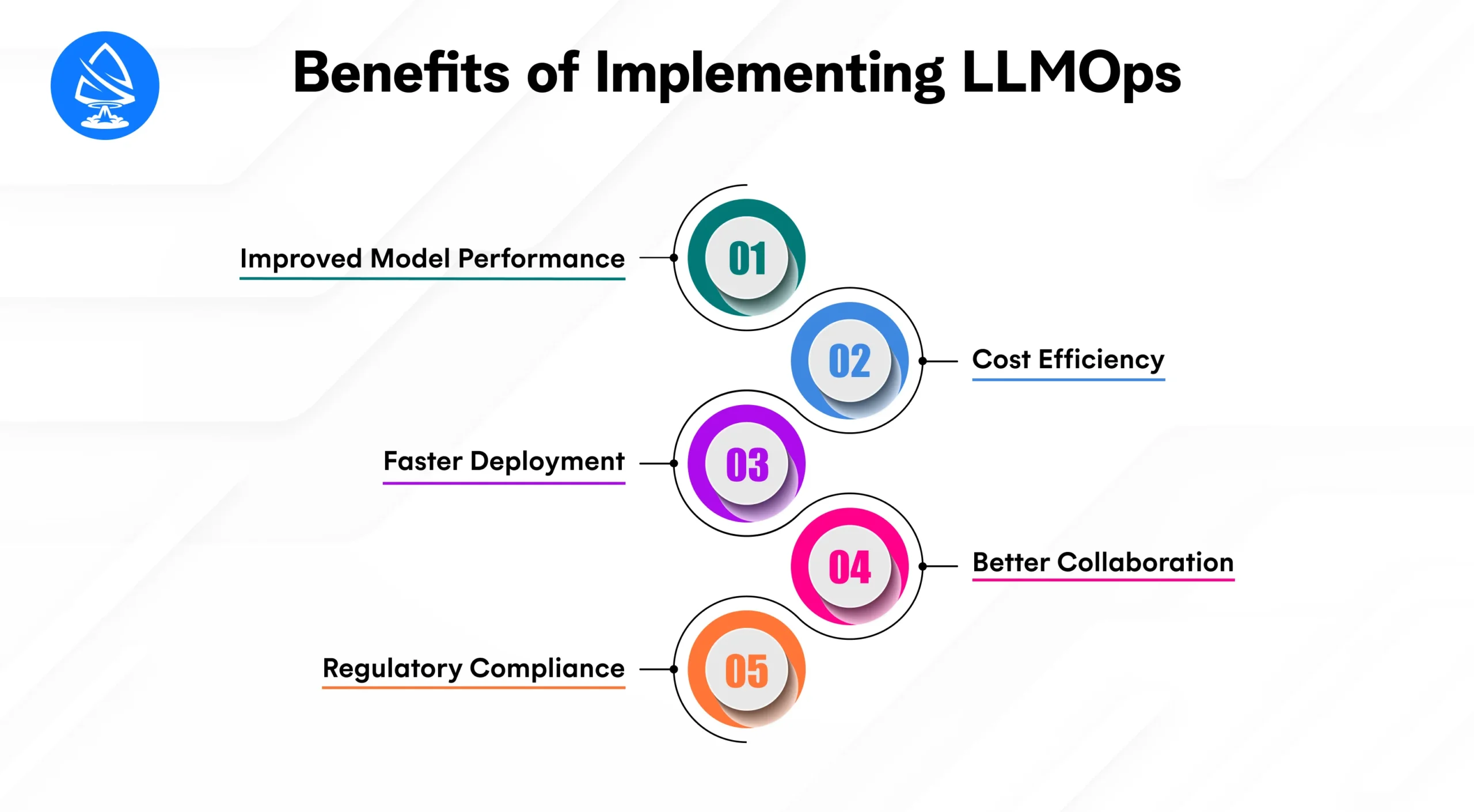
By automating repetitive tasks and incorporating real-time monitoring, LLMOps ensures that models consistently deliver optimal performance. Continuous fine-tuning based on user feedback, new data, or changing conditions ensures higher accuracy and better predictions.
Training large language models can be expensive. LLMOps platforms optimize resource usage, reducing cloud costs and compute power by making the training and inference process more efficient.
With automated workflows for training, testing, and deployment, organizations can roll out LLMs faster and stay ahead in the competitive AI landscape.
LLMOps platforms enable collaboration among teams of data scientists, engineers, and AI specialists by streamlining workflows and making version control and performance tracking easier.
By enforcing governance protocols, LLMOps ensures that the models are compliant with data privacy regulations and ethical standards, preventing misuse or bias in AI-generated content.
While LLMOps brings immense benefits, it also faces specific challenges that need to be addressed for optimal performance:
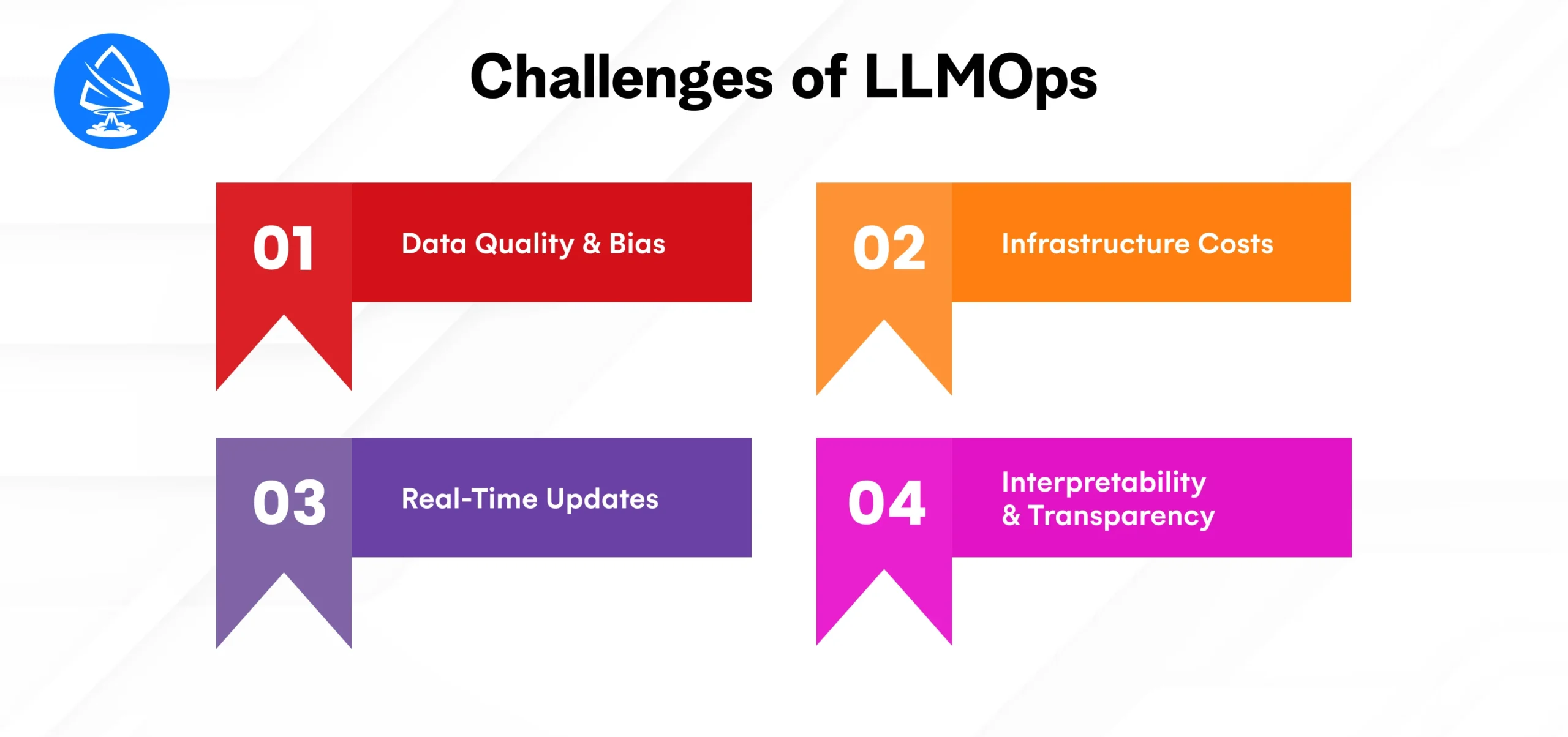
LLMs are often trained on vast amounts of data, which can contain biases. Ensuring that the models are fair and non-discriminatory is a key challenge in LLMOps.
Training and deploying large models demand substantial computational resources, leading to high infrastructure costs. Managing and optimizing cloud services and computing power effectively is crucial.
LLMs often require continuous fine-tuning, and keeping the model up to date with new data and user feedback in real-time can be complex.
Understanding and explaining why an LLM makes a certain decision is still a significant challenge. Users and developers alike require greater interpretability of AI outputs to ensure trust and transparency.
As the demand for AI-driven applications continues to rise, the role of LLMOps will only grow. Here are some emerging trends:
Future LLMOps platforms will automate not only training and deployment but also data collection, preprocessing, and model evaluation to streamline operations even further.
As ethical AI becomes a priority, LLMOps will evolve to include stronger governance frameworks that ensure compliance with evolving laws and regulations.
LLMOps will increasingly integrate with industry-specific solutions (e.g., healthcare, finance, education), allowing companies to deploy AI solutions tailored to their unique needs.
With a focus on explainable AI, future LLMOps platforms will develop improved tools for explaining how and why certain decisions are made by the AI, improving user trust and adoption.
LLMOps is set to become a cornerstone in the development and deployment of AI-driven applications, particularly for Large Language Models. With its ability to streamline model operations, enhance scalability, and ensure regulatory compliance, Large Language Model Operations will play a critical role in enabling businesses to unlock the full potential of AI.
Whether you are in the early stages of AI adoption or already working with LLMs, understanding LLMOps and leveraging the right tools will help you build smarter, more efficient, and more reliable AI solutions.
If you’re ready to develop your own LLMOps platform or integrate LLMOps into your business, consider working with an AI development company in USA or hire AI developers to guide your project to success.
Want to start building your LLMOps platform? Use our Cost Calculator to estimate the costs and get started today!
1. What is LLMOps?
LLMOps refers to the operational practices and tools used to deploy, monitor, and manage Large Language Models (LLMs) in real-world applications.
2. How does LLMOps differ from MLOps?
While both deal with machine learning models, LLMOps is specifically designed for managing the unique challenges of large language models, including high computational demand and complex training requirements.
3. Can LLMOps be used for both NLP and computer vision tasks?
LLMOps is primarily focused on natural language processing (NLP) tasks, but the underlying principles can also be applied to other AI tasks, such as computer vision, with adjustments.
4. What are some popular LLMOps platforms?
Some LLMOps platforms include TensorFlow Extended (TFX), Kubeflow, and MLflow, which provide scalable solutions for model deployment, monitoring, and lifecycle management.
5. What are the biggest challenges in LLMOps?
Challenges include data bias, high infrastructure costs, and ensuring model interpretability.
6. What industries benefit from LLMOps?
Industries such as finance, healthcare, e-commerce, and entertainment are leveraging LLMOps for enhanced customer service, data analysis, and personalized experiences.
7. How do I implement LLMOps in my organization?
To implement LLMOps, you can start by evaluating your existing machine learning infrastructure, choosing the right AI models, and integrating LLMOps frameworks for deployment, monitoring, and maintenance.
8. What is the future of LLMOps?
The future of LLMOps lies in increased automation, better governance, and enhanced AI transparency, enabling businesses to deploy large language models more efficiently and responsibly.

Artoon Solutions
Artoon Solutions is a technology company that specializes in providing a wide range of IT services, including web and mobile app development, game development, and web application development. They offer custom software solutions to clients across various industries and are known for their expertise in technologies such as React.js, Angular, Node.js, and others. The company focuses on delivering high-quality, innovative solutions tailored to meet the specific needs of their clients.
 For business inquiries only