Artificial intelligence is reshaping industries and daily life. Google AI is a leading force driving AI innovation. This article explores Google AI, Gemini, and its impact by 2025.
What is Google AI?
Google AI uses machine learning, deep learning, NLP, and advanced algorithms to analyze data. Its goal is to enable human-like decision-making and pattern recognition. Businesses can partner with AI development companies to build similar solutions.
Let’s dive deeper into what Google’s artificial intelligence is, how it works, and its far-reaching impact on both consumers and businesses worldwide.
The Core Components of Google AI
Google’s artificial intelligence encompasses a variety of technologies, frameworks, and tools. Here are some of the primary components:
1. Machine Learning (ML)
Machine learning is a subset of AI that allows systems to learn from data and improve over time without being explicitly programmed. In Google AI, ML is used for tasks like image recognition, speech-to-text conversion, and recommendation systems.
2. Deep Learning
Deep learning is a subset of machine learning that uses neural networks with multiple layers (hence “deep”) to simulate the human brain’s decision-making process.
3. Natural Language Processing (NLP)
NLP is the AI technology that enables machines to understand, interpret, and generate human language.
4. Computer Vision
Computer vision enables machines to interpret and understand visual information from the world, such as images and videos. Google’s artificial intelligence utilizes computer vision in several of its products, including Google Photos and Google Lens.
5. Generative AI
Generative AI refers to AI models that can generate new content, including text, images, or even music, based on learned patterns from existing data. Google Gemini, Google’s latest generative AI model, can create high-quality, human-like text and perform complex tasks like writing code or generating visuals. This technology powers innovations in content creation, product design, and data analysis.
Google AI impacts users and businesses in numerous ways across multiple platforms. Below are some key areas where Google’s artificial intelligence is making a significant difference:
1. Google Search
Google Search is one of the most visible examples of Google’s artificial intelligence in action. Over the years, Google has incorporated AI models to improve search accuracy, relevance, and personalization.
2. Google Assistant
Google Assistant is an AI-powered virtual assistant that helps users complete tasks using natural language commands. Powered by NLP and deep learning, Google Assistant continuously learns from user interactions to improve its responses and capabilities.
3. Google Translate
Google Translate uses NLP and machine learning to provide real-time language translation services. It supports over 100 languages, enabling seamless communication across language barriers, whether for travel, business, or personal connections.
4. Google Cloud AI
Google Cloud AI is a suite of AI tools and services that businesses and developers can integrate into their operations. It power solutions like Google Cloud Vision, Google Cloud Natural Language, and Google Cloud Translation, allowing businesses to implement AI-driven features such as image recognition, sentiment analysis, and text translation in their apps or services.
5. YouTube Recommendations
YouTube, owned by Google, uses AI to recommend videos based on a user’s watch history, preferences, and interactions. The platform’s recommendation system uses machine learning to predict what users will likely want to watch next, improving engagement and keeping users on the platform longer. The AI takes into account various factors like video metadata, viewer behavior, and trends to serve up personalized content.
The Rise of Google Gemini: A New Era of AI
In the ever-evolving landscape of artificial intelligence (AI), Google Gemini represents a pivotal development. As a generative AI framework, Google Gemini is poised to push the boundaries of what AI can achieve, setting a new standard for how businesses and developers use AI to generate creative content, solve complex problems, and accelerate innovation.
But what exactly is Google Gemini, and why is it being hailed as a transformative force in the world of AI? In this article, we’ll explore the rise of Google Gemini, its unique features, and how it marks the dawn of a new era in AI.
What is Google Gemini?
Google Gemini is a state-of-the-art generative AI model developed by Google to push the limits of machine learning and natural language processing. Unlike traditional AI models that primarily focus on classification and prediction, Gemini leverages deep learning and transformer-based architectures to generate content across various formats, such as text, images, code, and even videos.
Launched as part of Google’s AI initiative, Gemini builds on the advancements of previous AI systems like GPT-3, but it goes beyond text generation. Its unique capabilities allow it to generate high-quality, human-like responses across a wide range of applications, including content creation, business analytics, and creative design.
Key Features of Google Gemini:
Multimodal AI: Unlike other AI models that focus on one form of output (e.g., text), Google Gemini is a multimodal AI, capable of generating both text and images. This allows businesses and creators to leverage Gemini for a variety of tasks that require both visual and textual content.
Advanced Natural Language Understanding: Powered by cutting-edge natural language processing (NLP) techniques, Google Gemini can generate text that is contextually relevant and human-like. It’s capable of engaging in conversations, writing articles, and even generating code, making it ideal for various business and creative applications.
Enhanced Contextual Awareness: Google Gemini can process and understand context more deeply than previous models, making it more effective at generating responses that align with user intent, whether it’s for creative projects, technical queries, or personalized recommendations.
Customizability and Flexibility: With the help of tools like Google AI Studio, developers and businesses can fine-tune Gemini for specific use cases. This flexibility ensures that businesses can tailor AI responses to meet their unique needs.
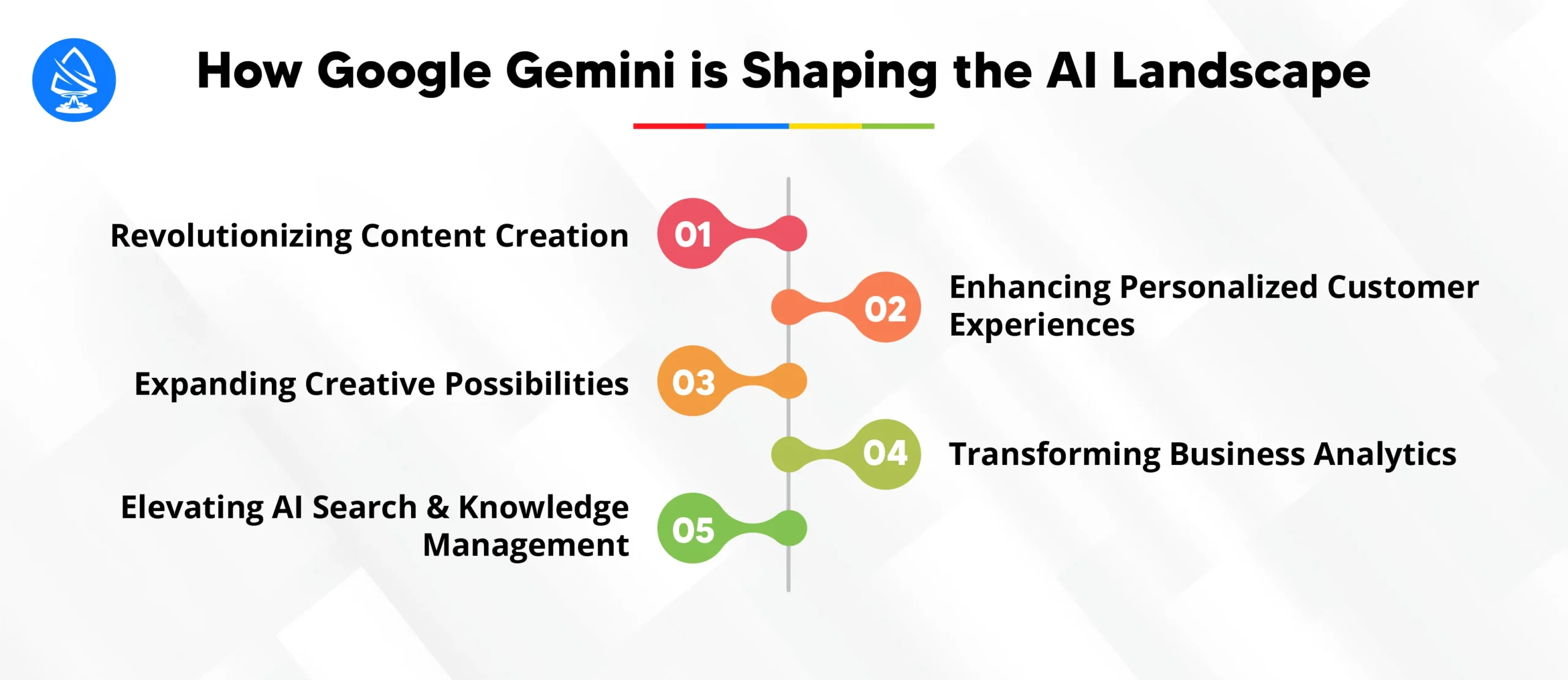
How Google Gemini is Shaping the AI Landscape
Google Gemini is more than just a powerful tool; it represents the future of AI. Its features and capabilities promise to have a lasting impact on how businesses and individuals interact with artificial intelligence. Let’s take a closer look at how Google Gemini is shaping the AI landscape:
1. Revolutionizing Content Creation
One of the most impactful applications of Google Gemini is its ability to generate high-quality content. Traditional content creation often requires significant time and resources, but with Gemini’s generative AI capabilities, businesses and individuals can automate content creation, whether it’s writing articles, generating marketing copy, or creating images and designs.
For businesses, Gemini’s multimodal capabilities allow them to generate both text-based content and visuals in one go, streamlining their content workflows. This opens up new possibilities for marketing teams, designers, and content creators, helping them produce more content faster while maintaining quality.
Marketing: AI-generated copy for ads, blogs, social media posts, and email campaigns.
Design: Automated generation of logos, website designs, product mockups, and more.
Creative Writing: Novel and script writing, poetry generation, and more.
2. Enhancing Personalized Customer Experiences
Personalization is at the core of Google Gemini’s value proposition. By leveraging the power of AI-generated content, businesses can offer highly personalized experiences to customers in real-time. For example, Google Gemini can be used to create personalized product recommendations, targeted advertising, and dynamic website content based on customer behavior, preferences, and past interactions.
AI-generated recommendations: Personalized product suggestions based on browsing history or past purchases.
Personalized customer support: AI-driven chatbots and virtual assistants that offer tailored responses to individual customers.
Dynamic content: Custom landing pages, emails, and offers based on customer profiles.
This level of personalization improves customer engagement, increases conversion rates, and ultimately leads to higher revenue for businesses.
3. Expanding Creative Possibilities
Google Gemini is a game-changer in the creative industries. Whether in entertainment, art, or product design, its ability to generate both text and visual content opens up a world of possibilities for artists, designers, and creators.
Generative Design: Gemini’s AI can be used to automatically generate design prototypes, patterns, and artwork based on initial prompts. This makes the design process faster and more efficient, enabling designers to explore different styles and iterations quickly.
Storytelling: For writers and filmmakers, Gemini offers the ability to generate storylines, scripts, and even dialogue. By simply inputting basic ideas, creators can explore new narratives and expand their creative projects without being limited by traditional brainstorming methods.
This level of creative assistance boosts productivity and sparks new forms of collaboration between humans and AI in the arts.
4. Transforming Business Analytics
Google Gemini can also be a powerful tool in business analytics. By analyzing vast amounts of data, Gemini helps businesses derive insights and make data-driven decisions faster than ever before.
Market Analysis: Using generative AI, businesses can generate reports, summaries, and insights from data, helping teams make informed decisions more quickly.
Predictive Analytics: By analyzing past data, Gemini can generate forecasts for sales, demand, and market trends, helping businesses stay ahead of the competition.
Data-Driven Innovation: With AI models capable of recognizing patterns and anomalies in data, Google Gemini allows businesses to discover new opportunities for growth and innovation.
5. Elevating AI Search and Knowledge Management
Another key area where Google Gemini is making a mark is in the search and knowledge management sectors. AI search technologies have already started to replace traditional search engines in some contexts, and Gemini takes this a step further.
With Gemini’s advanced NLP capabilities, businesses can offer hyper-intelligent search functions that understand user intent more deeply and provide more relevant results. Whether it’s for internal knowledge management systems, customer-facing search engines, or personalized recommendations, Google Gemini can enhance AI search to offer more tailored, context-aware results.
The rise of Google Gemini marks the beginning of a new chapter in the development of AI technologies. As generative AI continues to improve, Google Gemini will become an even more powerful tool, expanding its capabilities and applications. Here are some key areas where Google Gemini is expected to evolve:
1. Improved Human-AI Collaboration
As Google Gemini evolves, it is likely to provide even more intuitive collaboration between humans and AI. This could involve better natural language processing, advanced data analysis tools, and improved ability to generate creative content based on user feedback and input. The lines between human-created content and AI-generated content will blur, resulting in smoother, more synergistic workflows.
2. Expansion in Healthcare and Medicine
Google Gemini may expand healthcare use, supporting reports, diagnostics, and research. It could generate treatment plans and disease prediction models.
3. Ethical Considerations and Bias Mitigation
As with all advanced AI models, the ethical use of Google Gemini will remain a significant concern. Ensuring that Google Gemini is used responsibly and does not propagate biases in its generated content will be crucial. Google will likely continue to invest in improving AI ethics and bias mitigation efforts to ensure Gemini is used in a fair, transparent, and responsible manner.
4. Continued Integration with Google’s Ecosystem
Google Gemini will integrate deeper with Google Cloud, Ads, Search, and Assistant. Generative AI will help businesses build solutions faster and efficiently.
Google AI and Its Impact on Business
Google AI refers to the suite of artificial intelligence technologies developed and integrated into Google’s vast ecosystem of products and services. With advancements in machine learning (ML), deep learning, natural language processing (NLP), and computer vision, Google’s artificial intelligence has become a cornerstone for businesses seeking to leverage AI for operational efficiency, innovation, and growth.
In this article, we will explore how Google’s artificial intelligence is impacting businesses, its applications, and the transformative potential it offers for organizations worldwide.
1. Driving Automation in Business Operations
One of the most significant benefits of Google’s artificial intelligence is its ability to automate various business processes, reducing the need for human intervention and enhancing operational efficiency.
Key Areas of Automation:
Customer Service Automation: Google artificial intelligence powers chatbots and virtual assistants like Google Assistant, enabling businesses to provide round-the-clock customer support. These AI-powered systems can handle frequently asked questions, resolve common issues, and even guide customers through complex tasks.
Marketing Automation: Businesses can use Google’s artificial intelligence to automate marketing campaigns. Through Google Ads and Google Analytics, AI helps businesses target the right audience with personalized ads and dynamic content. AI can automatically adjust bids, target demographics, and optimize ads based on real-time data.
Document Management and Data Processing: Google’s artificial intelligence can automate data entry, process invoices, and categorize documents, reducing manual labor and enhancing productivity.
2. Personalization of Customer Experiences
Personalization is no longer just a competitive advantage but a necessity for businesses looking to stand out in a crowded market.
Applications of Personalization:
Personalized Recommendations: Google AI powers the recommendation engines of platforms like Google Search, YouTube, and Google Play.
Customized Advertising: With Google Ads, AI can deliver tailored ads to users based on their search history, online activity, and interests. This helps businesses reach the right audience at the right time, improving ad performance and conversion rates.
Dynamic Content: Google artificial intelligence can customize website content and product displays for individual users.
3. Enhancing Data Analytics and Decision-Making
In today’s data-driven world, businesses need the ability to extract meaningful insights from vast amounts of data to make informed decisions.
Key Features of Google AI in Data Analytics:
Predictive Analytics: By using machine learning algorithms, Google’s artificial intelligence helps businesses predict future trends, customer behaviors, and market demands. For example, Google Analytics offers predictive metrics that help businesses forecast sales, customer churn, and other key business outcomes.
Sentiment Analysis: With Google Cloud Natural Language, businesses can analyze customer feedback, social media posts, and reviews to understand sentiment and gauge customer satisfaction. This helps businesses adjust their products and services based on customer preferences.
Big Data Processing: Google BigQuery is a fully managed data warehouse that enables businesses to run super-fast queries on large datasets.
4. Improving Customer Insights and Engagement
Google AI helps businesses gain deeper insights into customer behavior and engagement, allowing them to optimize interactions and build stronger connections with their audience.
Applications in Customer Engagement:
Customer Journey Mapping: Google’s artificial intelligence can track a customer’s journey across different platforms, helping businesses understand how customers move from awareness to purchase. This allows companies to create targeted marketing strategies and optimize their conversion funnels.
Real-Time Interaction: Using Google artificial intelligence tools like Google Dialogflow, businesses can create interactive and intelligent chatbots that provide real-time assistance to customers. This enhances customer engagement and ensures that customers receive quick responses to their queries.
Voice Search Optimization: As voice search becomes more prevalent, businesses can use Google’s artificial intelligence to optimize their content for voice queries. With Google Assistant and Google Home, customers can search, shop, and interact with businesses via voice commands. Optimizing for voice search ensures that businesses stay competitive in the age of hands-free technology.
5. Accelerating Innovation with AI-Driven Solutions
Google’s artificial intelligence is not just about improving current processes; it’s also about driving innovation. Businesses can use Google’s artificial intelligence to create new products, develop new business models, and explore unexplored markets. The integration of AI-driven solutions allows businesses to break free from traditional constraints and push the boundaries of what’s possible.
Innovation Through Google AI:
Generative AI: Google Gemini, for instance, is a generative AI model capable of creating content, designing products, and even coding applications.
AI for Product Development: By using AI models to simulate designs, analyze customer feedback, and optimize manufacturing processes, businesses can develop better products and bring them to market faster.
AI in Research and Development: In fields like pharmaceuticals and biotechnology, Google’s artificial intelligence can speed up research by analyzing complex data sets, identifying potential treatments, and simulating clinical trials. This accelerates time-to-market for groundbreaking products and innovations.
6. Ethical AI: The Need for Responsible AI Development
As businesses increasingly rely on AI technologies, the ethical implications of AI use have come to the forefront. Google’s artificial intelligence has made strides in ethical AI development, ensuring that AI models are transparent, fair, and free from bias.
Key Ethical Considerations:
Bias Mitigation: Google’s artificial intelligence actively works on reducing biases in its models, ensuring that AI outputs do not perpetuate harmful stereotypes or discrimination. This is critical in applications like hiring, lending, and healthcare, where biased decisions can have serious consequences.
Transparency: Google AI advocates for transparency in how AI models are developed and used.
Data Privacy: Protecting user data is a key priority for Google’s artificial intelligence.
How Does AI Work in Google’s Ecosystem?
Google’s ecosystem is one of the most comprehensive and far-reaching in the world, touching everything from search engines and cloud computing to smart devices and advertising platforms.
But how does AI work within Google’s ecosystem? To answer this, let’s break down the different ways Google has integrated AI technologies across its services, products, and platforms. From improving search relevance to enhancing user interactions with Google Assistant, AI is the backbone that allows Google’s tools to become smarter, more personalized, and more efficient.
1. AI in Google Search
Google Search is one of the most well-known products in the world, and its success is heavily dependent on AI technology.
How AI Works in Google Search:
Natural Language Processing (NLP): AI-powered NLP algorithms help Google Search understand complex queries that go beyond simple keyword searches.
RankBrain: Another key AI technology, RankBrain, uses machine learning to help Google rank search results. It learns from patterns in user behavior and interactions with search results, continuously improving how Google ranks pages.
AI for Query Refinement: AI models help refine search queries and predict what users are likely to search for. This includes offering autocomplete suggestions, showing related searches, and understanding more complex, conversational queries (like those made by voice).
Personalization: Google uses AI to tailor search results based on previous searches, locations, and browsing behavior.
2. Google Assistant
Google Assistant is a powerful voice-activated virtual assistant that uses Google AI to provide real-time, context-aware responses.
How AI Works in Google Assistant:
Speech Recognition: Google’s artificial intelligence uses advanced speech recognition models to understand spoken words. This technology allows Google Assistant to accurately transcribe voice commands and turn them into actionable responses.
Natural Language Understanding (NLU): Google AI’s NLU algorithms help Google Assistant understand the meaning behind a user’s words, even when phrased in different ways.
Context Awareness: AI allows Google Assistant to hold a conversation and provide contextual responses.
Personalization: Google Assistant can also learn from a user’s preferences, behavior, and historical interactions, allowing it to offer personalized responses over time. This includes customized suggestions for music, news, travel, and much more.
3. Google Ads
Google’s advertising platform, Google Ads, is one of the world’s largest ad networks. AI plays a significant role in how Google Ads optimizes targeting, bidding, and delivery of ads to ensure businesses can reach the right audience and maximize their return on investment (ROI).
How AI Works in Google Ads:
Targeting and Personalization: AI algorithms analyze user behavior, search history, demographics, and even location data to deliver highly targeted ads. Google uses this data to show the most relevant ads to users, increasing the likelihood of engagement and conversions.
Smart Bidding: AI-powered smart bidding automatically adjusts bid amounts based on predicted outcomes.
Dynamic Search Ads: Google’s AI helps businesses create ads automatically based on their website content.
Ad Performance Insights: AI also plays a role in analyzing ad performance in real time. Through Google Ads, businesses can get insights into their campaigns and adjust them based on AI-powered recommendations, optimizing performance.
4. Google Cloud AI
Google Cloud AI offers businesses a suite of AI-powered tools to build, deploy, and scale their own AI applications. With tools like Google Cloud AutoML, TensorFlow, and Google AI Platform, businesses can integrate AI into their workflows, driving efficiencies and innovation.
How AI Works in Google Cloud:
Machine Learning and Deep Learning: Google Cloud offers a range of ML and deep learning models that businesses can use for tasks like image recognition, text analysis, and predictive modeling. These tools are built on TensorFlow, an open-source machine learning framework developed by Google.
AI Services: Google Cloud offers services such as Google Vision AI, which can analyze images and detect objects, and Google Natural Language API, which helps businesses analyze text and extract valuable insights.
Data Analytics: Through BigQuery and other analytics tools, businesses can use AI to analyze massive datasets, uncover hidden patterns, and gain insights that inform decision-making.
Automated Workflow: Google Cloud AI enables businesses to automate processes like image tagging, sentiment analysis, customer feedback analysis, and more, helping organizations save time and reduce errors.
5. Google Photos
Google Photos uses AI to help users organize, search, and manage their photos in smarter ways. Google’s image recognition technology, powered by Google’s artificial intelligence, allows the app to automatically categorize and tag photos, making them easy to search and retrieve.
How AI Works in Google Photos:
Image Recognition: Google’s artificial intelligence uses computer vision and deep learning to identify and tag objects, people, and scenes in photos.
Automatic Organization: Google AI automatically organizes photos by people, places, and events, allowing users to quickly find images without manually sorting them. The AI also detects faces and groups images together by the people in them, making it easy to create albums.
Smart Editing: With the help of AI, Google Photos offers features like automatic enhancement and object removal. AI-powered tools can automatically adjust brightness, contrast, and color saturation to improve photos.
6. AI for Translation and Multilingual Support
Google Translate is another cornerstone of Google’s AI ecosystem. By utilizing natural language processing (NLP) and machine learning, Google Translate helps break down language barriers, allowing users to translate text, speech, and even images in real-time.
How AI Works in Google Translate:
Neural Machine Translation (NMT): Google Translate uses NMT, a type of deep learning, to translate text more accurately and fluently.
Contextual Understanding: Google Translate can interpret context by analyzing entire sentences rather than translating word by word. This results in translations that are more coherent and fluent.
Speech Translation: With AI, Google Translate can now translate spoken language in real time, enabling seamless communication between people who speak different languages.
Image Translation: Using Google Lens and Google Translate’s Camera Mode, users can translate text in images. AI recognizes the text, translates it, and displays the translated version, making it incredibly useful for travel or international business.
Future of Google AI and Its Role in Innovation
This article explores the future of Google’s AI across healthcare, education, business, and entertainment. It examines how AI technologies may reshape work and digital experiences.
1. The Role of Google AI in Advancing Technological Innovation
Google AI has already made significant strides in transforming how businesses, organizations, and individuals operate. But the future holds even greater potential as AI systems become smarter, more adaptable, and more integrated into everyday life.
Key Innovations in the Future of Google AI:
Autonomous Systems: As Google’s artificial intelligence advances, it will continue to improve the performance of autonomous systems, including self-driving cars (through Waymo), robotics, and drones. AI will enable these systems to make more informed, faster decisions, enhancing their functionality and reliability.
Generative AI: Google Gemini, an example of generative AI, is poised to become a game-changer for content generation, creative projects, and automation.
AI-Driven Innovation Platforms: With tools like Google Cloud AI, Google AI Studio, and TensorFlow, developers and organizations will have access to increasingly powerful platforms for building AI-driven applications, driving innovation across industries from healthcare and finance to e-commerce and media.
2. AI in Healthcare
The future of Google’s artificial intelligence in healthcare promises to be one of the most impactful areas of innovation. As AI technologies improve, the potential for them to revolutionize diagnostics, treatment plans, and patient care becomes increasingly apparent.
AI Applications in Healthcare:
AI for Diagnostics: With AI models trained on vast datasets of medical images and patient records, Google’s artificial intelligence is making strides in improving diagnostic accuracy. The future will likely see these AI models being used in more specialized applications for faster and more accurate diagnoses.
Personalized Medicine: Google AI will enable more personalized treatment plans by analyzing a patient’s genetic data, medical history, and lifestyle.
AI in Drug Discovery: The future of Google AI also holds significant promise in the field of drug discovery.
3. The Future of AI in Business
Google AI is poised to become even more integrated into business processes in the coming years, improving efficiency, decision-making, and customer experiences.
Key AI Advancements in Business:
AI-Driven Automation: Google AI is playing a significant role in automating routine tasks across business functions.
Enhanced Data Insights: Businesses are already using Google’s artificial intelligence for advanced data analysis.
Improved Decision-Making: AI models in Google Cloud can help businesses predict outcomes, make more informed decisions, and reduce risks.
4. AI in Education
The future of Google AI in education holds significant promise.
Key AI Advancements in Education:
Personalized Learning: With tools like Google Classroom and Google AI-powered tutors, students can receive personalized learning experiences. AI-driven platforms can analyze student performance and recommend tailored lessons or exercises based on their strengths and weaknesses.
Smart Content Creation: Generative AI can assist in creating educational content, including textbooks, exercises, and even interactive simulations. Google’s artificial intelligence will help automate content creation, making it more accessible and adaptable to various learning needs.
AI for Language Learning: Google AI’s NLP capabilities can assist students in learning new languages through real-time translation, speech recognition, and context-based language exercises.
5. AI and Creativity
Artificial intelligence already impacts creative industries, and Google AI will expand its influence.
AI in Creative Industries:
Generative Art: Google Gemini, as a generative AI model, can create digital art, illustrations, and even 3D models based on text prompts.
AI in Music Creation: AI-powered platforms like Google AI’s music composition tools can help artists generate melodies, harmonies, and full compositions, saving time and offering new avenues for creativity.
AI in Film and Animation: AI tools can automate aspects of film production, from scriptwriting and character design to animation and visual effects.
6. Ethical Considerations and the Role of Responsible AI Development
As Google AI integrates into daily life, addressing ethical implications becomes increasingly important.
Key Ethical Considerations:
Bias and Fairness: One of the main challenges for Google’s artificial intelligence is ensuring that its models do not perpetuate biases or reinforce harmful stereotypes.
Transparency: As AI systems become more autonomous, users need to understand how decisions are made. Google’s artificial intelligence focuses on providing transparency and explainable AI, allowing users to comprehend how AI models reach their conclusions.
Privacy and Security: As AI systems process vast amounts of personal data, ensuring privacy and security will be paramount.
Conclusion
Google AI is at the forefront of the AI revolution, driving innovation and improving efficiency across industries. In 2025, Google AI will continue to shape the future of technology and business innovation, offering businesses a competitive edge and helping them unlock new growth opportunities. AI developers can build smarter, efficient solutions that help businesses stay competitive.
Written By :
Artoon Solutions
Artoon Solutions is a technology company that specializes in providing a wide range of IT services, including web and mobile app development, game development, and web application development. They offer custom software solutions to clients across various industries and are known for their expertise in technologies such as React.js, Angular, Node.js, and others. The company focuses on delivering high-quality, innovative solutions tailored to meet the specific needs of their clients.




 For business inquiries only