- HR:+91-879-9184-787
- Sales:+91-908-163-7774



In the fast-evolving world of web development, Next.js has emerged as one of the most powerful and popular frameworks. Built on top of React, this JavaScript framework provides developers with the tools to create fast, scalable, and SEO-friendly applications. But what is Next.js, and why should you consider using it in 2025?
Whether you’re a startup or an enterprise, partnering with a Nextjs development company can help you unlock the full potential of this framework. These companies specialize in leveraging Next.js’s features, such as server-side rendering, static site generation, and optimized performance, to build robust digital experiences tailored to your business goals.
Next.js simplifies building React-based applications by offering essential features out of the box. Whether you are developing a single-page application (SPA), a static site, or a full-fledged dynamic web app, Next.js gives you the flexibility and power to enhance performance and improve user experience.
As demand grows for faster web applications, performance and user experience become essential. This is where Next.js excels. Using SSR and SSG, Next.js delivers faster load times and improved search visibility.
2025 will see even more widespread adoption of Next.js, as its seamless integration with serverless architecture, API routes, and static generation becomes critical for both performance and scalability. With an ever-growing ecosystem and a large community of developers contributing to its growth, Next.js is positioned to dominate the landscape of modern web development.
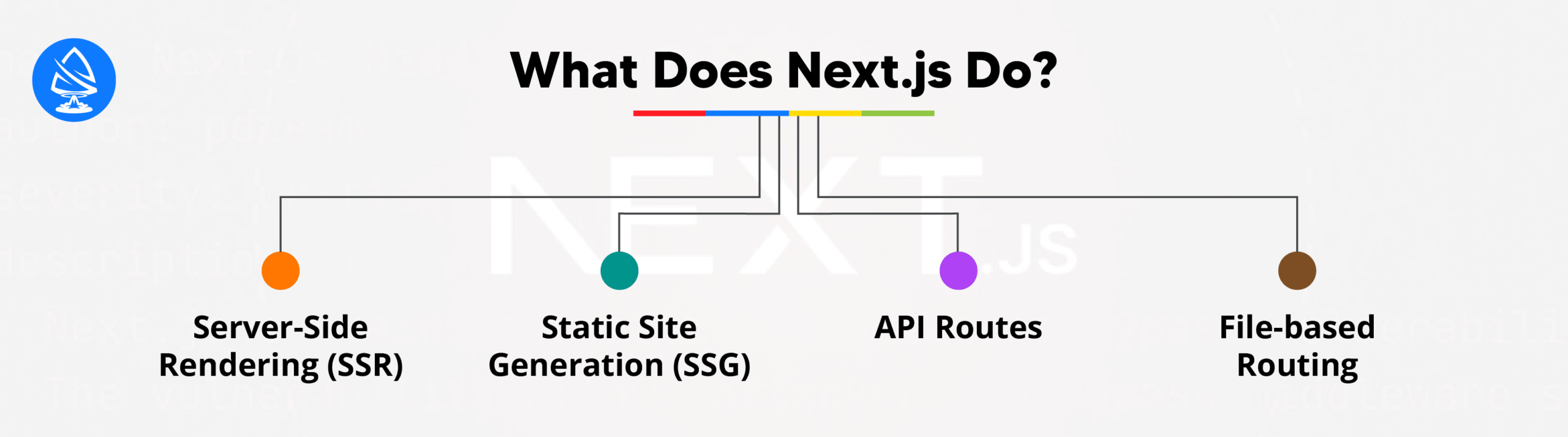
Next.js provides a range of tools and features to improve React applications, focusing on performance, scalability, and SEO-friendliness. Some of the most notable features include:

Next.js is an incredibly versatile framework designed for modern web development, and it can be used for a variety of applications ranging from simple static websites to complex dynamic web apps. Its ability to handle multiple web development needs makes it a popular choice for developers in 2025. Let’s explore the different use cases where Next.js shines.
One of the most common use cases for Next.js is building static websites. This approach has several advantages:
While static websites are great for content that doesn’t change frequently, many modern web applications require dynamic content.
Search engine optimization (SEO) is essential for driving organic traffic to websites. With traditional single-page applications (SPAs), SEO can be challenging because content is dynamically loaded via JavaScript, which search engine crawlers often have difficulty indexing. This is where Next.js excels.
Next.js is not just for the frontend. One of its standout features is the ability to handle both the frontend and backend within the same project, making it a great choice for building full-stack applications.
E-commerce websites have become increasingly complex, and Next.js is an excellent choice for building high-performance, scalable e-commerce platforms. Here’s how Next.js helps:
One of the main reasons developers turn to Next.js is its focus on performance optimization. Here’s how Next.js helps you optimize performance:
These performance optimization techniques make Next.js a go-to choice for developers who prioritize speed and efficiency.
Next.js builds on React to create applications with enhanced performance benefits. React handles UI components, while Next.js adds SSR, SSG, API routes, and built-in routing.
It enhances React with built-in performance features, making it ideal for scalable and high-performing applications.
The term “Next app” typically refers to an application created using the Next.js framework. A “Next app” can be anything from a static site to a fully dynamic web application, depending on how it’s configured. By leveraging Next.js, you can build web apps that load faster, are more SEO-friendly, and are easier to scale.
Here are a few reasons why you should consider using Next.js for your next project:
In 2025, this remains a leading framework for building fast, scalable, and SEO-friendly web applications. It supports server-side rendering, static generation, and full-stack development for modern web needs. It helps developers stay competitive in the fast-paced web development landscape.
This offers features and flexibility for building both simple static sites and complex applications. Adopting Next.js improves performance while keeping your web application future-proof.
If you’re looking to leverage the full potential of Next.js, consider partnering with experts – hire Next.js developers who specialize in custom Next.js development. With their expertise, you can build modern, high-performance web applications that deliver an exceptional user experience.
1. What is Next.js?
Next.js is a React-based framework that allows developers to build fast, scalable, and SEO-friendly web applications with features like server-side rendering and static site generation.
2. What is Next.js used for?
Next.js is used for building static websites, dynamic web applications, SEO-friendly pages, and full-stack applications.
3. Why should I use Next.js?
Next.js provides performance optimization, automatic code splitting, server-side rendering, and SEO benefits, making it a great choice for modern web development.
4. What is the difference between Next.js and React?
React is a JavaScript library for building user interfaces, while Next.js is a framework that extends React with additional features like server-side rendering, routing, and static site generation.
5. Can I use Next.js for e-commerce?
Yes, Next.js is ideal for e-commerce websites as it offers SEO optimization, fast load times, and scalability, making it suitable for handling dynamic content.
6. What is Incremental Static Regeneration (ISR)?
ISR allows you to update static pages in the background without rebuilding the entire website, which helps keep your content fresh and improves performance.
7. How does Next.js improve SEO?
By rendering pages on the server-side, Next.js makes it easier for search engines to index content, improving SEO rankings.
8. Is Next.js suitable for large-scale applications?
Yes, Next.js is built for scalability, making it an excellent choice for large, complex applications that require high performance.
9. What are the benefits of using API routes in Next.js?
API routes allow you to create serverless functions directly within your Next.js app, simplifying backend logic and reducing the need for a separate backend.
10. How does Next.js improve website performance?
Next.js optimizes performance through techniques like automatic code splitting, image optimization, and static site generation, ensuring fast load times and a better user experience.

Artoon Solutions
Artoon Solutions is a technology company that specializes in providing a wide range of IT services, including web and mobile app development, game development, and web application development. They offer custom software solutions to clients across various industries and are known for their expertise in technologies such as React.js, Angular, Node.js, and others. The company focuses on delivering high-quality, innovative solutions tailored to meet the specific needs of their clients.
 For business inquiries only