Artificial Intelligence (AI) is increasingly becoming a vital part of the legal industry, revolutionizing the way legal professionals work, interact with clients, and manage cases. From automated legal research to predictive case outcomes, AI is transforming almost every facet of legal practice. Its integration into the legal sector offers an array of benefits, including improved efficiency, cost savings, accuracy, and better client service.
Let’s explore the role of AI in the legal industry, the specific areas where it’s making the most significant impact, and the ways it’s reshaping traditional legal practices.
1. Automating Repetitive Tasks
One of the most immediate benefits of AI in the legal industry is the automation of repetitive and time-consuming tasks. Legal professionals often spend long hours on administrative work, such as reviewing documents, filling out forms, or conducting initial legal research. AI-powered tools can significantly reduce the time spent on these tasks, allowing legal professionals to focus on higher-value activities.
Key Areas of Automation:
Document Review: AI tools can scan through legal documents, contracts, and agreements to identify important clauses, inconsistencies, or errors.
Legal Research: AI-powered tools can conduct legal research much faster than a human, sifting through vast amounts of legal data to find relevant case law and precedents.
Data Entry: AI applications can automate data entry tasks, making document management and filing more efficient and error-free.
Impact:
Increased Efficiency: Automating repetitive tasks increases the productivity of legal professionals, allowing them to handle more cases in less time.
Cost Reduction: By automating tasks that would otherwise require human labor, AI helps law firms reduce their operational costs.
2. Legal AI Chatbots for Client Interaction
One of the key applications of AI in the legal industry is the development of AI chatbots that help law firms automate communication with clients. Legal AI chatbots can answer frequently asked questions, provide legal advice on simple matters, schedule appointments, and assist clients with document uploads. These chatbots are available 24/7, providing instant assistance to clients and enhancing their overall experience.
Applications:
Client Intake: AI chatbots can gather essential information from potential clients, such as their contact details and the nature of their legal issue, streamlining the initial intake process.
Automated Legal Advice: AI-driven chatbots can offer basic legal advice or guidance, such as providing information on legal rights, small claims procedures, or contract terms.
Scheduling and Reminders: AI chatbots can schedule consultations, remind clients of upcoming deadlines, and assist with payment processing.
Impact:
Enhanced Client Experience: Clients receive quick, accurate responses to their queries, improving their satisfaction.
Reduced Workload for Lawyers: AI chatbots handle the basic interactions, leaving more time for legal professionals to focus on complex legal matters.
3. AI-Powered Legal Research
AI in legal research is revolutionizing how lawyers gather and analyze legal information. In traditional legal research, lawyers and paralegals spend hours sifting through case law, statutes, and legal precedents. AI-powered research tools leverage natural language processing (NLP) and machine learning algorithms to analyze vast amounts of legal data and identify the most relevant information for a case.
Applications:
Case Law Search: AI tools help lawyers quickly find relevant case law by analyzing the facts, context, and legal principles of previous cases.
Statutory Analysis: AI can scan through statutes and legal documents to find specific sections that apply to a case, saving time and effort.
Predictive Analytics: AI can predict case outcomes based on historical data, helping lawyers assess the strengths and weaknesses of a case.
Impact:
Faster Research: AI significantly speeds up the process of legal research, allowing lawyers to focus on strategy and client consultation.
Improved Accuracy: AI tools reduce the likelihood of overlooking key case law or statutes, leading to more accurate legal arguments and decisions.
4. Contract Review and Management
AI is transforming the way lawyers handle contracts, one of the most labor-intensive aspects of legal practice. Reviewing and drafting contracts often involves manual checks for errors, inconsistencies, and compliance issues. AI-powered contract review tools can automate this process, quickly identifying missing clauses, problematic language, or potential legal risks in contracts.
Applications:
Contract Drafting: AI can help create standard contracts, such as non-disclosure agreements (NDAs) or employment contracts, by filling in predefined templates with relevant information.
Contract Review: AI systems can analyze contracts to identify discrepancies, missing terms, or clauses that may expose the client to unnecessary risk.
Contract Lifecycle Management: AI tools help track contract performance, renewals, and deadlines, ensuring compliance and efficiency throughout the contract lifecycle.
Impact:
Faster Contract Management: AI reduces the time it takes to draft, review, and manage contracts, making the entire process more efficient.
Enhanced Risk Mitigation: AI can identify hidden risks in contracts and help law firms ensure compliance with legal regulations, reducing the risk of legal disputes.
5. AI for Predicting Legal Outcomes
AI can analyze historical data and predict the likely outcomes of legal cases based on patterns and trends from past cases. These predictive analytics can help lawyers make more informed decisions about whether to proceed with litigation, settle a case, or take another legal route.
Applications:
Case Prediction: AI models predict the outcome of a case based on historical data, including case facts, judge behavior, and legal arguments.
Sentiment Analysis: AI can analyze public opinion and media sentiment related to a case, helping lawyers understand how a case might be perceived in the public eye.
Risk Assessment: AI helps assess the potential risks involved in pursuing a case, including the likelihood of success or failure.
Impact:
Informed Decision-Making: Lawyers and clients can make more informed decisions about how to handle a case, whether to settle, and what legal strategies to pursue.
Time and Cost Savings: Predictive models help reduce the time and money spent on cases with low chances of success.
6. AI in Legal Compliance
AI also plays an important role in ensuring legal compliance across various industries. In the legal industry, maintaining compliance with data protection laws and regulatory requirements is crucial. AI tools can monitor transactions, contracts, and business practices to ensure compliance with regulations like GDPR, HIPAA, and FCPA.
Applications:
Regulatory Compliance: AI can automatically check that all business operations, including contracts, data handling, and financial transactions, comply with relevant legal regulations.
Real-Time Monitoring: AI can provide real-time monitoring of financial transactions and activities to detect potential violations or discrepancies.
Document Management: AI tools ensure that documents are stored securely, tagged appropriately, and accessible only to authorized parties, maintaining legal compliance with data privacy laws.
Impact:
Reduced Risk of Violations: AI reduces the chances of non-compliance, ensuring that organizations avoid penalties or legal issues.
Cost Efficiency: Automating compliance processes saves law firms and businesses significant amounts of time and money while reducing the risk of errors.
7. AI-Driven Legal Billing and Time Tracking
AI tools can automate billing and time-tracking for lawyers, eliminating the need for manual record-keeping. These tools help track billable hours, generate invoices, and ensure transparency in client billing. By integrating with case management systems, AI can automatically track how much time is spent on various tasks.
Applications:
Time Tracking: AI-powered systems automatically track time spent on tasks and projects, reducing errors in billing.
Automated Invoicing: AI generates invoices based on tracked hours, client agreements, and fee structures, saving time and reducing billing disputes.
Impact:
Efficiency: AI ensures accurate, efficient time tracking and billing processes, allowing lawyers to focus on legal work rather than administrative tasks.
Improved Client Trust: By ensuring accurate billing, AI helps build stronger relationships with clients, fostering trust and transparency.
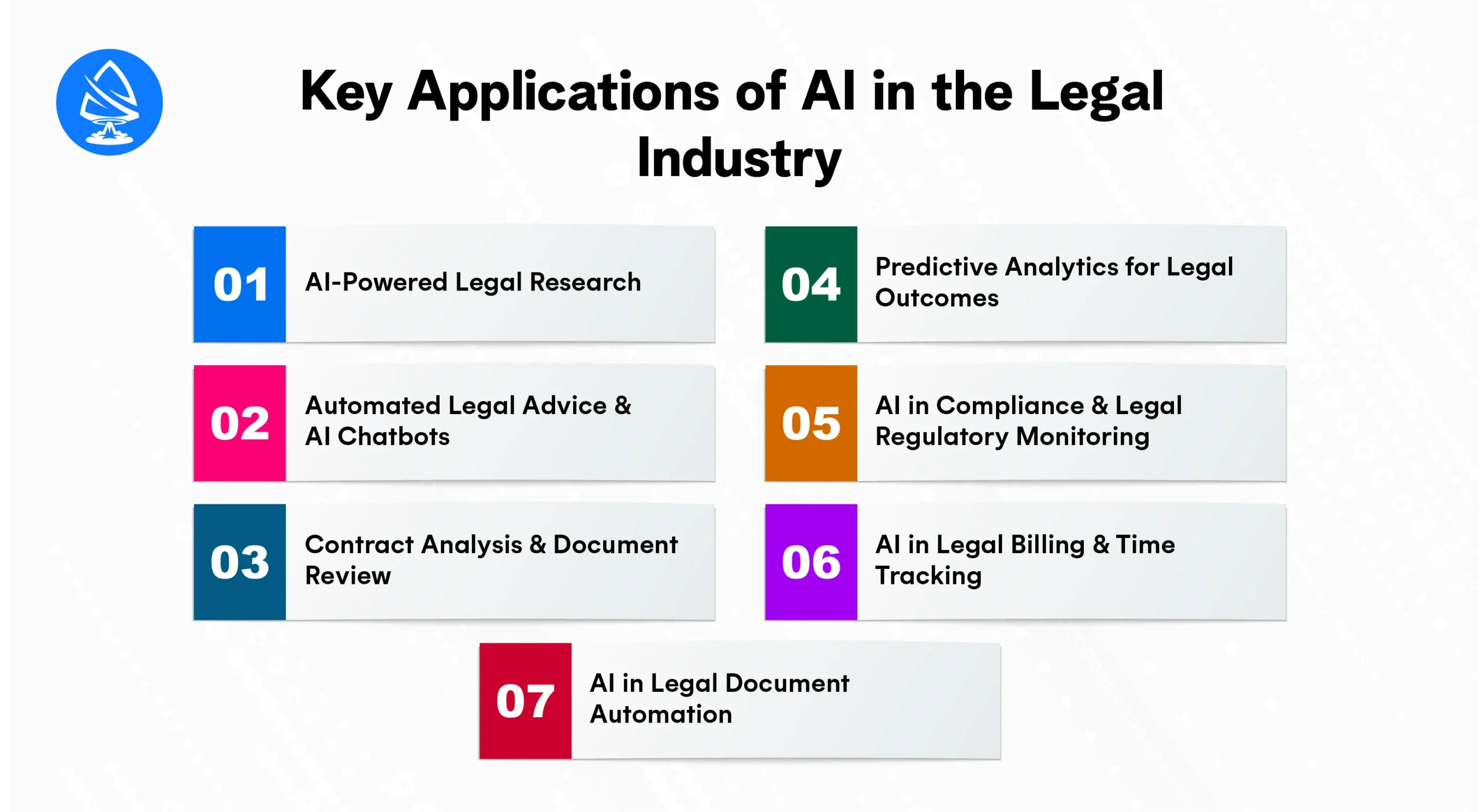
Artificial Intelligence (AI) is reshaping various industries, and the legal industry is no exception. The integration of AI tools and technologies in legal processes has significantly enhanced efficiency, accuracy, and decision-making capabilities. AI’s ability to automate routine tasks, analyze vast amounts of data, and provide insights has made it an indispensable tool for legal professionals.
In this section, we will explore the key applications of AI in the legal industry, focusing on the areas where AI is driving the most significant transformation. These applications not only improve the quality of legal services but also reduce costs and enhance client satisfaction.
1. AI-Powered Legal Research
Legal research is traditionally a labor-intensive task, often requiring lawyers to sift through vast databases of case law, statutes, and legal precedents. AI tools, such as AI legal research assistants, have streamlined this process by using natural language processing (NLP) and machine learning algorithms to identify relevant legal documents and case laws much more efficiently.
Applications:
Case Law Search: AI tools help lawyers quickly search through case law databases by understanding natural language queries and providing relevant case results.
Statutory Analysis: AI assists in finding specific statutes or legal sections within vast legislative documents, making it easier to pinpoint the right provisions for a case.
Document Summarization: AI can summarize lengthy legal documents, saving lawyers time in reviewing large volumes of information.
Impact:
Faster Research: AI can conduct legal research in a fraction of the time it would take a human, significantly speeding up the process.
Improved Accuracy: AI reduces the risk of human error in research, ensuring that all relevant case laws and statutes are considered.
2. Automated Legal Advice and AI Chatbots
One of the most groundbreaking applications of AI in the legal industry is the use of AI chatbots for providing automated legal advice. AI chatbots can interact with clients, answer basic legal queries, and provide information on a variety of legal issues. They are especially useful for handling repetitive inquiries and providing first-line support.
Applications:
Basic Legal Advice: AI-powered chatbots can give general legal advice on topics such as tenant rights, employment laws, or small claims procedures.
Client Intake: AI chatbots can conduct initial interviews with clients, gathering essential information about their case before forwarding it to a human lawyer.
Scheduling and Reminders: Chatbots can schedule consultations, provide updates on case status, and send reminders about important deadlines.
Impact:
24/7 Availability: AI chatbots are available around the clock, providing instant assistance to clients.
Increased Client Engagement: By providing immediate responses, AI chatbots improve client satisfaction and engagement.
3. Contract Analysis and Document Review
AI is revolutionizing the way lawyers review and analyze contracts. AI-powered tools can scan documents for discrepancies, flag potential issues, and ensure that contracts comply with relevant laws and regulations. They can also speed up the process of contract review, which traditionally takes a significant amount of time.
Applications:
Contract Review: AI tools can automatically identify problematic clauses or inconsistent language in contracts, ensuring that they are legally sound and in line with best practices.
Document Comparison: AI-powered systems can compare different versions of a contract or legal document, highlighting changes and identifying missing clauses.
Risk Assessment: AI models can assess the potential risks of a contract, such as terms that could expose the client to litigation or financial loss.
Impact:
Time-Saving: AI reduces the time spent on contract review and document analysis, freeing up lawyers to focus on higher-value tasks.
Improved Accuracy: AI identifies errors and risks that might be overlooked during manual reviews, improving the overall quality of legal documents.
4. Predictive Analytics for Legal Outcomes
AI’s ability to analyze vast datasets and historical information allows it to make predictions about the likely outcome of a legal case. Predictive analytics tools use machine learning models to assess past cases and predict how future cases might unfold based on similar facts and circumstances.
Applications:
Case Outcome Prediction: AI tools analyze historical case data to predict the probability of success for a particular legal strategy or outcome.
Settlement Predictions: AI can help lawyers determine whether settling a case is a viable option by evaluating past settlements and predicting the potential outcome of litigation.
Risk Assessment: Predictive AI models assess the likelihood of various risks involved in legal cases, such as financial loss or adverse judgments.
Impact:
Informed Decision-Making: Lawyers can make more informed decisions on whether to settle or pursue litigation based on AI-driven predictions.
Cost Efficiency: By predicting the likelihood of success or failure, AI helps clients and law firms allocate resources effectively, saving both time and money.
5. AI in Compliance and Legal Regulatory Monitoring
The legal industry is heavily regulated, and firms must comply with various legal and ethical standards. AI tools can monitor ongoing operations, financial transactions, and documents for compliance with local, national, and international regulations. These tools can also help identify potential violations before they become significant issues.
Applications:
Regulatory Compliance: AI monitors internal processes and transactions to ensure that they comply with industry-specific regulations, such as GDPR for data protection or FCPA for anti-bribery compliance.
Real-Time Risk Detection: AI can analyze transactions or operations in real time to flag potential compliance risks, such as fraudulent activity or breaches of financial regulations.
Audit Automation: AI can automate auditing processes, ensuring that companies remain compliant with financial, legal, and regulatory requirements.
Impact:
Reduced Risk of Non-Compliance: AI ensures that companies stay compliant with all relevant regulations, reducing the risk of penalties and legal action.
Operational Efficiency: By automating compliance monitoring, AI reduces the need for manual checks and helps firms operate more efficiently.
6. AI in Legal Billing and Time Tracking
AI can also be used to improve the efficiency of legal billing and time tracking. Lawyers spend a significant amount of time tracking billable hours, preparing invoices, and ensuring accuracy. AI tools can automate many of these processes, making them more accurate and efficient.
Applications:
Time Tracking: AI tools can track the time spent on various tasks automatically, reducing errors in billing and making the process more efficient.
Automated Invoicing: AI generates invoices based on the tracked time, agreed-upon rates, and completed tasks.
Fee Management: AI ensures that clients are billed according to their engagement terms, providing transparency and consistency.
Impact:
Efficiency and Accuracy: AI automates the time tracking and billing process, reducing human errors and saving valuable time for lawyers and clients.
Client Satisfaction: With accurate billing and transparency, clients are more likely to trust the firm and continue working with it.
7. AI in Legal Document Automation
Legal documents such as contracts, wills, deeds, and powers of attorney often require customization based on specific client requirements. AI tools are increasingly being used to automate the drafting of standard legal documents, allowing law firms to provide faster, more efficient services to their clients.
Applications:
Document Generation: AI can generate legal documents based on templates and specific input parameters, making it easy to produce contracts, agreements, and other legal documents automatically.
Form Filling: AI tools can automate the process of filling out legal forms, saving time and reducing the risk of errors.
Impact:
Speed and Accuracy: AI-powered document automation reduces the time needed to create standard legal documents and ensures accuracy by minimizing human input.
Cost Efficiency: By automating the creation of documents, law firms can lower their operating costs and pass the savings on to clients.
Key Benefits of AI in the Legal Industry
The integration of Artificial Intelligence (AI) in the legal industry is transforming traditional practices and providing legal professionals with powerful tools that enhance the quality, efficiency, and accuracy of their work. AI technologies, such as machine learning, natural language processing (NLP), and predictive analytics, have proven to be invaluable in streamlining operations, improving client service, and reducing costs.
In this section, we will explore the key benefits of AI in the legal industry, focusing on how AI is revolutionizing various aspects of legal practice, from document automation to predictive case outcomes.
1. Increased Efficiency and Time Savings
One of the most significant benefits of AI in the legal industry is its ability to automate time-consuming tasks that traditionally required extensive human effort. AI can automate routine processes, such as document review, legal research, and contract drafting, allowing legal professionals to focus on more complex and value-driven tasks.
Applications:
Document Review: AI-powered tools can scan through large volumes of legal documents to identify relevant information or flag inconsistencies, saving lawyers from manually reviewing each document.
Legal Research: AI-based legal research assistants can sift through vast databases of legal precedents, statutes, and case law to find relevant cases and laws in seconds.
Contract Generation: AI can automate the creation of standard legal documents, such as contracts and agreements, based on predefined templates and input parameters.
Impact:
Time-Saving: AI reduces the time needed to perform routine tasks, leading to faster case processing and quicker turnaround times for clients.
Enhanced Productivity: Lawyers can handle a higher volume of cases or clients, increasing overall productivity.
2. Improved Accuracy and Reduced Human Error
AI technologies, particularly machine learning and natural language processing, are designed to process and analyze vast amounts of data with high precision. In the legal industry, AI helps reduce human error in tasks such as contract review, case research, and document drafting, where even small mistakes can lead to significant legal implications.
Applications:
Contract Review: AI tools can identify missing clauses, contradictory language, or potential compliance issues that human reviewers might miss.
Legal Research: AI reduces the risk of overlooking important case laws or statutes by scanning and analyzing large databases in a fraction of the time it would take a human lawyer.
Document Generation: By using AI-driven templates, legal professionals can avoid common mistakes when drafting legal documents, ensuring compliance and consistency.
Impact:
Minimized Errors: AI helps reduce the likelihood of human mistakes in legal processes, ensuring that legal work is more accurate and reliable.
Risk Mitigation: With AI’s ability to identify discrepancies or overlooked details, law firms can avoid costly errors or legal missteps.
3. Cost Reduction
AI technologies can significantly reduce operational costs for law firms and in-house legal teams. By automating routine tasks and improving efficiency, AI minimizes the need for additional staff, allowing firms to streamline operations and allocate resources more effectively.
Applications:
Automated Workflows: AI systems automate tasks like data entry, document management, and research, freeing up lawyers to focus on higher-value activities.
Outsourcing Reduction: AI reduces the need to outsource routine legal work, such as document review or basic legal advice, resulting in cost savings.
Predictive Analytics for Cost Estimation: AI tools can help firms better estimate the cost of a case based on historical data, helping clients manage expectations and legal teams allocate resources efficiently.
Impact:
Lower Operational Costs: By automating manual processes, AI reduces the need for extensive administrative support, leading to lower overhead costs for law firms.
Affordable Legal Services: AI makes legal services more accessible to a broader audience, including small businesses and individuals who might not have been able to afford traditional legal fees.
4. Enhanced Client Service and Satisfaction
AI can significantly improve client interaction and service delivery. With AI-powered tools like legal chatbots, automated legal advice, and predictive case outcomes, clients can receive quicker responses, more personalized experiences, and better communication throughout their case.
Applications:
AI Chatbots: Legal AI chatbots are available 24/7, providing immediate responses to common client inquiries, assisting in client intake, and even answering basic legal questions.
Personalized Legal Advice: AI can provide tailored legal advice based on individual client needs and scenarios, allowing for more personalized interactions and improving the client’s experience.
Case Outcome Prediction: AI can help clients understand the likelihood of success in their legal matters by analyzing historical case data and predicting outcomes.
Impact:
Improved Client Experience: Clients benefit from quicker, more accurate responses to their legal inquiries, increasing their satisfaction with the services provided.
24/7 Availability: AI-powered chatbots and tools are always available to assist clients, ensuring that clients can get help whenever they need it.
5. Better Decision-Making and Predictive Insights
AI helps lawyers make better decisions by providing predictive insights into potential legal outcomes, helping them formulate more effective strategies.
Applications:
Predictive Analytics: AI can forecast the potential outcome of a case based on patterns in past cases with similar circumstances, such as the behavior of judges, case facts, and legal arguments.
Risk Assessment: AI models assess the risks associated with various legal strategies, helping lawyers and clients choose the best course of action.
Litigation Strategy: AI tools can suggest legal strategies based on data-driven insights, helping lawyers make more informed decisions.
Impact:
Informed Decision-Making: Lawyers can make decisions based on accurate data rather than intuition or guesswork, improving the chances of success in legal matters.
More Effective Strategies: By leveraging AI-driven insights, lawyers can optimize their legal strategies for better client outcomes.
6. Streamlined Compliance and Regulatory Monitoring
AI tools are also instrumental in ensuring compliance with legal and regulatory requirements. Compliance is critical for businesses in industries such as finance, healthcare, and real estate, where strict rules govern their operations. AI-powered systems can monitor transactions, contracts, and activities to ensure that businesses are adhering to laws and regulations.
Applications:
Regulatory Compliance: AI systems can automatically monitor and track legal compliance, ensuring that all business operations and contracts meet the required legal standards.
Real-Time Monitoring: AI can continuously analyze company data and transactions to detect potential compliance risks or regulatory breaches in real time.
Automated Auditing: AI tools streamline auditing processes by identifying compliance gaps and providing reports for legal review.
Impact:
Improved Compliance: AI helps companies avoid costly fines and legal issues by ensuring continuous adherence to regulations.
Efficiency and Accuracy: By automating compliance checks, AI reduces human error and saves time in monitoring regulatory standards.
7. Document Automation and Management
AI streamlines the process of managing and generating legal documents. Legal professionals spend a significant amount of time drafting and managing documents, such as contracts, wills, and agreements. AI-driven document automation tools help automate this process, improving efficiency and accuracy.
Applications:
Document Generation: AI can generate legal documents, such as contracts or NDAs, by using pre-set templates and filling in the necessary details based on client input.
Document Review: AI-powered systems can review documents for errors, inconsistencies, and compliance issues, ensuring that legal documents meet industry standards.
Smart Document Management: AI helps manage large volumes of legal documents by categorizing, tagging, and archiving them for easy retrieval.
Impact:
Faster Document Processing: AI automates the creation, review, and management of legal documents, allowing legal professionals to focus on high-level tasks.
Reduced Errors: AI minimizes the risk of human error when drafting and reviewing documents, ensuring that they are legally sound and compliant.
Challenges of Implementing AI in the Legal Industry
The legal industry is experiencing a transformation with the adoption of Artificial Intelligence (AI) technologies, improving processes such as legal research, contract review, and predictive analytics. However, as with any technological advancement, integrating AI into the legal field presents several challenges. These challenges can stem from ethical concerns, data privacy issues, technical limitations, and resistance to change within the legal profession.
In this section, we will explore the key challenges that law firms, legal professionals, and AI developers must navigate when implementing AI in the legal industry.
1. Data Privacy and Security Concerns
One of the most significant challenges when implementing AI in the legal industry is data privacy and security. The legal profession deals with highly sensitive information, including personal, financial, and confidential business data. The improper handling of such data or security breaches can lead to severe legal and financial consequences.
Applications:
Sensitive Client Data: AI systems require access to large volumes of client data for training and analysis, which can involve personal data protected by privacy laws like GDPR (General Data Protection Regulation) or HIPAA (Health Insurance Portability and Accountability Act).
AI and Data Breaches: AI systems are vulnerable to cyberattacks, which can compromise sensitive legal information stored in databases or cloud environments.
Impact:
Legal Compliance: Law firms must ensure that their AI tools are compliant with data protection laws. Non-compliance could lead to significant fines or damage to the firm’s reputation.
Risk of Breach: AI systems are vulnerable to cyberattacks, making it essential for firms to implement robust data security measures and encryption protocols.
Solution:
To mitigate these risks, law firms must invest in secure AI solutions, use encrypted data transmission, and work with AI development companies that specialize in data protection and compliance.
2. Ethical and Bias Concerns
AI models are not infallible, and one of the most pressing ethical concerns is the potential for bias in AI systems. AI algorithms are often trained on historical data, which may reflect existing biases in society or the legal system. These biases can inadvertently perpetuate discriminatory outcomes, especially in areas like sentencing, employment law, and credit scoring.
Applications:
Predictive Analytics: AI tools used for predicting case outcomes or sentencing may inherit the biases present in historical case data, leading to unfair outcomes for certain groups of people.
Legal Research: AI systems used for legal research may also be biased, prioritizing certain case laws or legal arguments over others based on the data it was trained on.
Impact:
Unfair Outcomes: AI tools can lead to biased judgments or legal decisions, negatively affecting clients, especially vulnerable groups.
Loss of Trust: If AI systems consistently produce biased results, they could undermine trust in the legal process and the use of AI in law.
Solution:
Bias Detection: Law firms and AI developers need to implement systems that regularly audit and test AI models for biases, using diverse and representative data sets to reduce discriminatory outcomes.
Transparency: AI algorithms should be transparent and explainable, allowing legal professionals to understand how decisions are made and ensuring accountability.
3. High Implementation Costs
Implementing AI in legal practices can be expensive, especially for small and mid-sized law firms. While AI promises significant efficiency gains, the initial investment in AI technology, infrastructure, and training can be prohibitive.
Applications:
AI Software and Infrastructure: Deploying AI requires substantial investment in software tools, cloud infrastructure, and data storage solutions to handle large datasets.
Training and Expertise: Legal professionals need to be trained on how to effectively use AI tools, which often requires specialized expertise or external consultants.
Impact:
Initial Investment: The cost of implementing AI systems can be daunting for smaller firms with limited resources.
Ongoing Maintenance: AI models require continuous updates, training, and maintenance, which adds to the ongoing costs of using these technologies.
Solution:
To manage costs, firms can consider AI-as-a-service platforms or cloud-based AI tools, which provide scalable solutions with lower upfront costs.
4. Resistance to Change and Adoption
The legal industry has traditionally been slow to embrace new technologies, and many lawyers are reluctant to adopt AI tools due to concerns about job displacement, unfamiliarity, and perceived complexity.
Applications:
Lawyer Skepticism: Lawyers may resist using AI tools in practice, fearing that these technologies will replace their roles, or that AI cannot provide the human touch required in legal proceedings.
Cultural Challenges: Law firms have established ways of working, and AI tools require changes to existing workflows, which can be difficult for employees to accept.
Impact:
Slow Adoption: The reluctance to adopt AI can delay the benefits of these technologies, preventing law firms from fully capitalizing on the efficiencies and innovations AI offers.
Ineffective Implementation: Without proper training and buy-in from legal professionals, AI systems may be underutilized or misused.
Solution:
Training and Education: Law firms need to provide comprehensive training to legal professionals on how AI can enhance their work and improve client outcomes. Clear communication about AI’s role as a tool, not a replacement, is crucial.
Gradual Implementation: Start with small-scale AI tools that complement human lawyers, allowing professionals to become familiar with the technology before fully integrating it into their practice.
5. Lack of Standardization and Regulation
As AI in the legal industry is still evolving, there is a lack of standardization and clear regulation regarding the ethical use of AI tools. Without proper regulations, it’s difficult to ensure that AI systems are being used responsibly and transparently in the legal domain.
Applications:
Legal AI Tools: Different vendors may offer AI legal software that operates under different standards, leading to inconsistencies in performance, data security, and usability.
Regulatory Compliance: As AI becomes more integrated into legal processes, regulations will need to catch up to ensure ethical use of the technology.
Impact:
Inconsistency: A lack of standardization can result in varying levels of accuracy and reliability across AI tools, which may impact the quality of legal services.
Legal Uncertainty: Without clear regulations, law firms and legal professionals may face legal challenges regarding the ethical use of AI technologies.
Solution:
Establish Industry Standards: Legal industry associations and regulatory bodies need to establish clear guidelines and standards for AI use in the legal field, focusing on transparency, ethics, and accountability.
Collaboration: AI developers and legal professionals should collaborate to create tools that meet regulatory requirements and ethical standards.
6. Limited Understanding of AI’s Capabilities and Limits
Another challenge when implementing AI in the legal industry is the limited understanding of how AI tools work and what they can or cannot do. Many law firms are unsure about how to best integrate AI into their operations and what results to expect.
Applications:
AI Tool Misuse: Without proper understanding, legal professionals may misuse AI tools or rely on them for tasks that require human judgment, leading to errors or inefficiencies.
Overreliance on AI: There is a risk that lawyers may overestimate AI’s abilities and rely too heavily on automated tools for decision-making, especially in complex cases.
Impact:
Underutilization: Firms may not be able to fully capitalize on AI’s potential if they fail to understand how the tools work and where they can provide the most value.
Quality Control Issues: Relying on AI without proper supervision could lead to errors, especially in cases where human judgment is necessary.
Solution:
Education and Awareness: Law firms should invest in educating their teams about AI tools, how they work, and their appropriate use cases. Regular training sessions can help improve understanding and ensure AI is used effectively.
Popular AI Tools in the Legal Industry
AI tools have become indispensable in the legal industry, streamlining processes, improving efficiency, and enhancing decision-making. These tools not only automate routine tasks but also enable lawyers to focus on more strategic aspects of legal practice.
In this section, we will explore some of the most popular AI tools that have been widely adopted in the legal industry, highlighting their features, applications, and benefits.
1. ROSS Intelligence
ROSS Intelligence is a well-known AI-powered legal research tool. It uses natural language processing to help lawyers research efficiently. ROSS is built on the IBM Watson platform. It understands complex legal queries. The tool returns relevant cases and statutes within seconds.
Key Features:
Natural Language Search: Users can input questions in natural language (e.g., “What are the legal precedents for breach of contract?”), and ROSS provides relevant case law and statutes.
AI-driven Insights: ROSS offers deep insights into case law and legal precedents based on vast amounts of legal data.
Continuous Learning: The tool learns from the data it processes, improving its search results over time.
Impact:
Efficiency in Legal Research: ROSS dramatically reduces the time spent on legal research by quickly providing relevant legal materials based on natural language queries.
Improved Accuracy: By leveraging AI’s deep learning capabilities, ROSS ensures more accurate and comprehensive search results compared to traditional manual research.
2. Legal Robot
Legal Robot is an AI-powered tool designed to automate the contract review process.
Key Features:
Document Analysis: Legal Robot analyzes contracts and legal documents to highlight potential risks, ambiguous language, and inconsistencies.
Compliance Checks: The tool checks for compliance with common regulations, including GDPR, HIPAA, and others.
Plain Language Explanation: Legal Robot simplifies complex legal jargon, making it easier for clients and non-lawyers to understand legal terms.
Impact:
Time-Saving: By automating the review of legal documents, Legal Robot saves lawyers time that would otherwise be spent on manual checks.
Risk Reduction: Legal Robot helps identify areas of risk in contracts, reducing the likelihood of errors or overlooked issues that could lead to legal disputes.
3. Kira Systems
Kira Systems is a leading AI platform for contract analysis and due diligence. It supports law firms and corporate legal teams. Kira uses machine learning to extract key contract information. This includes clauses, terms, and conditions. It also helps identify risks and irregularities.
Key Features:
Automated Contract Review: Kira extracts key information from contracts, helping legal teams quickly identify the most relevant clauses and obligations.
Advanced Search Capabilities: Users can search for specific terms or clauses across large sets of contracts, making due diligence much faster.
Customizable Templates: Kira can be trained on specific types of contracts and documents, tailoring its analysis to the needs of a particular client or firm.
Impact:
Faster Due Diligence: Kira accelerates the due diligence process by automating contract review, allowing law firms to analyze large volumes of contracts quickly and accurately.
Enhanced Accuracy: The tool minimizes the risk of human error in contract analysis, helping legal professionals catch potential issues that may be overlooked during manual reviews.
4. Luminance
Luminance is an AI-powered document review tool used in the legal industry. It is widely used for M&A, due diligence, and compliance checks. Luminance analyzes legal documents using AI algorithms. It helps law firms identify key terms, patterns, and risks efficiently.
Key Features:
Pattern Recognition: Luminance’s machine learning algorithms analyze vast amounts of legal data and identify patterns and anomalies that could be important for case analysis.
Real-Time Document Review: Luminance’s tools process large volumes of documents in real-time, providing instant insights to lawyers.
Self-Learning: The system learns from the documents it analyzes, making it more accurate over time.
Impact:
Accelerated Review Processes: Luminance speeds up the document review process, particularly in large-scale transactions, by automating the identification of key terms and potential risks.
Efficient Compliance Checks: Luminance’s AI is used to ensure that legal documents comply with applicable laws and regulations, which is especially valuable in industries like finance, real estate, and healthcare.
5. DoNotPay
DoNotPay is often referred to as the “world’s first robot lawyer.”
Key Features:
Consumer Advocacy: DoNotPay helps individuals contest parking fines, file complaints against businesses, and even provide assistance in small claims court.
Automated Legal Forms: The platform generates legal documents and files them on behalf of the user, simplifying the process of seeking legal redress.
Wide Range of Legal Services: DoNotPay provides support for various legal issues, from immigration and consumer rights to privacy and warranty claims.
Impact:
Affordable Legal Help: DoNotPay allows individuals to access legal services without the high costs associated with hiring a traditional lawyer.
Accessible to the Masses: By providing low-cost and easy-to-use legal services, DoNotPay makes legal assistance available to a broader population, especially those who cannot afford traditional legal representation.
6. Relativity
Relativity is a widely used AI tool in the e-discovery process, which is crucial in litigation. It helps legal teams quickly find relevant evidence by analyzing large volumes of digital documents, emails, and other electronic records. Relativity’s AI-powered tools assist in identifying key evidence and organizing it for review.
Key Features:
Document Review and Classification: Relativity’s AI can classify and tag documents based on relevance to a specific case, making the e-discovery process more efficient.
Predictive Coding: The system uses machine learning to predict which documents are most important to the case based on the data reviewed by the legal team.
Real-Time Collaboration: Relativity allows multiple legal professionals to work together in real-time, reviewing and analyzing evidence from a centralized system.
Impact:
Time Efficiency: By automating much of the e-discovery process, Relativity helps legal teams reduce the time it takes to review and analyze evidence.
Cost Savings: The tool reduces the need for human reviewers, lowering the costs associated with document review in large-scale litigation.
7. CaseText
CaseText uses AI to enhance legal research and case analysis. The AI can quickly analyze a brief and suggest the most relevant legal precedents for a case.
Key Features:
Natural Language Processing (NLP): CaseText uses NLP to help lawyers search for relevant case law and statutes in a way that mimics how they would naturally phrase their queries.
Document Comparison: The tool allows users to compare case briefs with similar cases to find the best precedents or supporting legal arguments.
Tailored Recommendations: CARA provides lawyers with personalized, relevant case law recommendations based on the specifics of their legal arguments.
Impact:
Increased Efficiency: CaseText enables faster legal research by recommending relevant case law and legal materials based on user input.
More Accurate Research: The AI-driven recommendations ensure that lawyers are working with the most relevant legal precedents, improving the quality of legal arguments.
Conclusion
AI is increasingly becoming an integral part of the legal industry, enhancing efficiency, accuracy, and cost-effectiveness. From automated legal advice to AI-powered legal research assistants, the potential for AI to transform legal practices is immense.
For law firms seeking to stay competitive in the digital age, adopting AI technologies is no longer optional; it’s essential. Partnering with an AI development company or hiring AI developers can help ensure your firm leverages AI as effectively and securely as possible, allowing you to provide better services to your clients, improve operational efficiency, and stay ahead in the legal industry.
Frequently Asked Questions
1. How does AI improve the legal industry?
AI in the legal industry enhances efficiency by automating routine tasks, improves accuracy through legal AI software, and reduces costs while improving client satisfaction.
2. What is an AI legal chatbot?
An AI legal chatbot is an automated tool that provides basic legal advice and answers common legal questions, helping clients access legal information quickly.
3. How can AI assist with legal research?
AI legal research assistants help lawyers by analyzing large volumes of legal documents and case law, providing relevant results much faster than traditional methods.
4. What are the key applications of AI in the legal sector?
AI applications in the legal sector include automated legal advice, contract review, predictive case analysis, and AI-driven legal research.
5. What are the challenges of implementing AI in the legal industry?
Data privacy, security concerns, and bias are major challenges when integrating AI tools into legal practices.
6. How does AI help with contract analysis?
AI in contract analysis helps by reviewing contracts for errors, inconsistencies, and compliance issues, improving accuracy and saving time.
7. Can AI replace lawyers in the future?
While AI can automate many tasks, it is unlikely to fully replace lawyers, as complex legal reasoning and human judgment are still required in most cases.
8. What AI tools are most popular in the legal industry?
Popular AI tools in the legal field include ROSS Intelligence, Legal Robot, and DoNotPay, which streamline tasks like legal research and contract analysis.
Written By :
Artoon Solutions
Artoon Solutions is a technology company that specializes in providing a wide range of IT services, including web and mobile app development, game development, and web application development. They offer custom software solutions to clients across various industries and are known for their expertise in technologies such as React.js, Angular, Node.js, and others. The company focuses on delivering high-quality, innovative solutions tailored to meet the specific needs of their clients.




 For business inquiries only