- HR:+91-879-9184-787
- Sales:+91-908-163-7774


The future battlefield isn’t about soldiers charging ahead. It’s algorithms mapping the quickest routes, drones reacting in an instant, and machines running through mountains of data before you can even blink. This is AI in defense, front and center.
Now, think about a war zone where choices get made in the time it takes to snap your fingers. Drones sweep across the sky on their own, and armies know what the enemy’s planning before things even kick off. Sounds like sci-fi, right? But this is happening now. This is just how the modern military operates with AI in defense, shaping every move.
AI has wedged itself deep into defense and intelligence. It’s not just helping with strategies; it’s changing how wars are fought and how countries stay safe. Whether it’s making calls on the fly or spotting threats before they show up, AI in defense technologies is flipping old rules on their head. And every major nation is sprinting to master them.
AI in defense isn’t just a buzzword anymore; it’s front and center. Governments are rewriting playbooks, shifting budgets, and reworking training to keep up in a world where conflicts change quickly. AI in defense handles everything from crunching intelligence to running battlefield tech, and its role just keeps growing.
If you take a look at how AI in defense industry works, you’ll notice things move at breakneck speed. Threats evolve overnight, so the tech has to keep up. Speed, accuracy, and scale, those are the big three for AI in defense industry. Military systems need to react instantly, no second-guessing.
Across Europe and Asia, AI in defence is changing how countries watch their borders and protect against cyberattacks. These AI defence programs spot threats early and let militaries react with real precision.
On the policy side, governments are setting up artificial intelligence defence frameworks to ensure AI in defence follows ethical rules while still getting the job done. Artificial Intelligence defense investments keep pouring into drones, logistics, command systems, you name it. Most experts now see artificial intelligence defense as vital as any traditional weapon, and strategies get updated every year to tackle new challenges.
Military planners depend on artificial intelligence in defense to connect the dots across land, air, sea, space, and cyberspace. Instead of staring at scattered data, commanders get a clear picture of the whole battlefield with the help of artificial intelligence in defense. That kind of insight makes AI in defense quick and coordinated action possible.
In the U.S., the artificial intelligence department of defense takes charge of getting AI right across the military. The artificial intelligence department of defence makes sure the tech meets security standards and always keeps a human in the loop. AI’s not just support anymore, it’s the backbone holding everything together.
AI is shaking up the way wars are fought, and AI in defense investment is surging. The global defense industry is pouring money into it, and by 2027, spending on AI in the military will blow past $30 billion. That’s almost 12% growth each year, which is a lot when you think about the scale. Armies everywhere, especially in NATO (North Atlantic Treaty Organization), are jumping in. Right now, about two-thirds of military groups have already woven AI in defense into their regular operations.
You see it everywhere: autonomous drones, vehicles, and real-time intelligence tools are crunching data way faster than old-school systems, sometimes a thousand times quicker. By 2023, developed countries made AI a top priority. Nearly 60% of their new military tech projects involved AI in defense in some way, whether research or actual deployment. It’s pretty clear: AI isn’t just a side project anymore. It’s front and center in military strategy.
So, what does AI really mean for defense? Basically, it’s about using things like machine learning, neural networks, computer vision, and autonomous decision-making to give the military an edge. Here’s how it actually shows up:
In a nutshell, AI takes what the military can already do and makes it sharper, quicker, and safer. It’s not just a “maybe” for the future anymore. It’s right at the heart of how modern defense works.
You may also want to know AI in Maritime
AI in defense isn’t just a sci-fi idea anymore; it’s changing how militaries operate today. Everything from defense to intelligence gathering to split-second decisions looks different because of AI in defense. It’s making things faster, safer, and honestly, just more effective across the board.
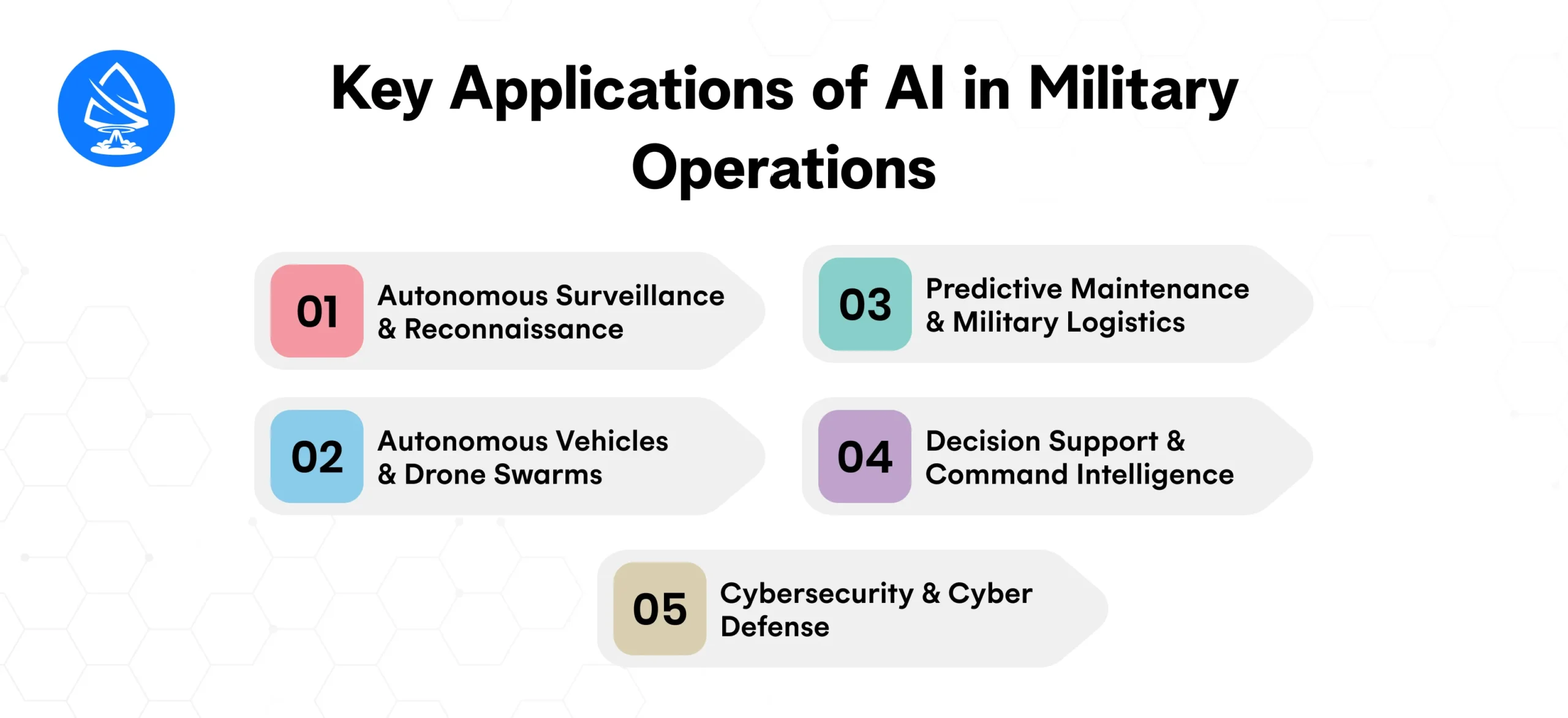
Surveillance and reconnaissance were among the first areas where AI made a real difference. Instead of teams of people spending days combing through drone videos, satellite images, or sensor data, AI can sort through all of it in seconds.
Take Project Maven, for example. The U.S. military uses it to scan drone footage and flag threats quickly and with more accuracy than humans alone. If you’re in command, you don’t have to drown in hours of video anymore. AI hands you a clear, real-time snapshot of what’s happening, so you can make tough calls faster and know you’re not missing anything important.
AI in defense companies keeps pushing what’s possible with drones and self-driving vehicles. Now, you’ve got drone swarms that talk to each other, share what they see, and react fast, even when someone tries to jam their signals. Humans barely have to step in.
It’s not just flying drones, either. Self-driving trucks and ships are taking on some of the toughest jobs, from hauling supplies to scouting enemy positions to clearing mines. What does that mean for you? Fewer troops at risk and smoother missions, start to finish.
Honestly, it’s a bit like running a strategy game, only this time the AI in defense isn’t just following orders. It’s out there making real decisions, staying sharp, and bouncing back when plans go sideways.
AI in defense isn’t just about fighting battles. It’s about keeping everything running when it matters most. In the military, artificial intelligence helps teams spot equipment problems before anything breaks down and keeps the supply chain flowing so troops have what they need, right on time.
Take the U.S. Navy. They use AI to catch parts that are about to fail and make ship maintenance a lot smoother. With advanced AI development services, crews jump in early, cut down on repairs, and dodge expensive delays. For anyone running military operations, this means you plan better, spend less, and your gear is ready when you need it.
AI in defense has totally changed the game when it comes to making decisions in defense. These systems sift through mountains of data, satellite images, troop movements, you name it, and hand commanders the kind of insights that really shape what happens next.
On the ground, especially in the thick of things, AI tools send real-time updates straight to leaders at the front. That speed means they can act fast, with a lot more confidence. And let’s be real: most of these platforms don’t just pop up out of nowhere. There’s usually a dedicated AI development company behind the scenes, building tools that actually work under the pressure of defense and intelligence missions. The right team takes ideas that once felt experimental and turns them into tech you can rely on, even in the chaos of battle.
These days, a lot of battles don’t happen on the ground; they play out online. AI defense tools give us a real edge here. They spot threats way faster than people can, jump in right away, and even see trouble coming before it hits.
In defense and intelligence circles, this kind of protection isn’t optional. One slip-up, and the whole game changes; national security can be at risk. AI-driven cybersecurity reacts fast and helps soften the blow from even the most advanced attacks. That’s why it’s become such a key part of how we defend ourselves now.
AI in defense has become a core part of military strategy. These days, soldiers train with AI in defense-driven simulations that drop them into messy, unpredictable situations, just like what they’ll face in real life. Logistics teams use AI in defense to spot supply issues before they turn into real problems.
Out in the field, AI in defense helps spot threats the moment they appear. Intelligence analysts lean on AI to sift through mountains of data in no time. In command centers, decisions that used to take minutes now happen in seconds, thanks to smart systems.
As more countries adopt these AI in defense tools, alliances get stronger. Shared AI in defense standards makes it easier for different militaries to work together without hiccups. If you ask the experts, they’ll tell you, AI in defense is quickly becoming the real measure of military strength, even more than the size of an army.
AI in defense isn’t just about one big company taking over the field. It’s a mix, some giants with decades of defense experience, and some newer tech players who move fast and aren’t afraid to take risks. Each company brings something different to the table. Some are deep into building autonomous drones or smart weapons. Others focus on crunching data and turning it into real-time intelligence or decision tools for commanders. When you look at how these companies work, side by side, you get a better sense of how AI in defense is actually changing the way militaries think and fight today.
Here’s a quick look at some of the top AI defense companies and what they really bring to the table.
| Company | Core Focus Area | Key AI Capabilities | Major Strength | Best Use Case |
| Lockheed Martin | Advanced military platforms | Build autonomous systems, AI-driven intelligence, and decision support tools. | Large-scale integration of AI into fighter jets, missiles, and big defense networks | When you want cutting-edge AI inside high-end aircraft or space defence systems |
| Northrop Grumman | Unmanned and autonomous tech | Autonomous aircraft, mission planning, and fusing data from different sensors. | Run complicated missions with barely any human help | Perfect if your goal is long-range surveillance or running autonomous combat ops, |
| Raytheon Technologies | Defense electronics and weapons | AI-powered radar, targeting, and missile defense systems | Precision detection and threat tracking to boost situational awareness | Ideal for sharper detection and better missile defense, especially in contested areas, |
| Shield AI | Autonomous drone technology | Self-navigating drones, denied-environment AI | Agile autonomy without GPS or communications | Stands out when you need drones that work in hostile or denied environments, |
| Palantir | Defense data and analytics | AI data integration, logistics optimization, predictive insights | Turn mountains of data into clear, actionable intelligence | Ideal if you need better planning, logistics, and command-level decision support |
AI isn’t just a tech upgrade for the military; it’s changing the whole game, and not always in ways people are ready for. The more AI shows up in defense, the more we have to think about ethics and strategy, not just cool new gadgets. It’s a balancing act: push for new advances, but don’t forget what’s right.
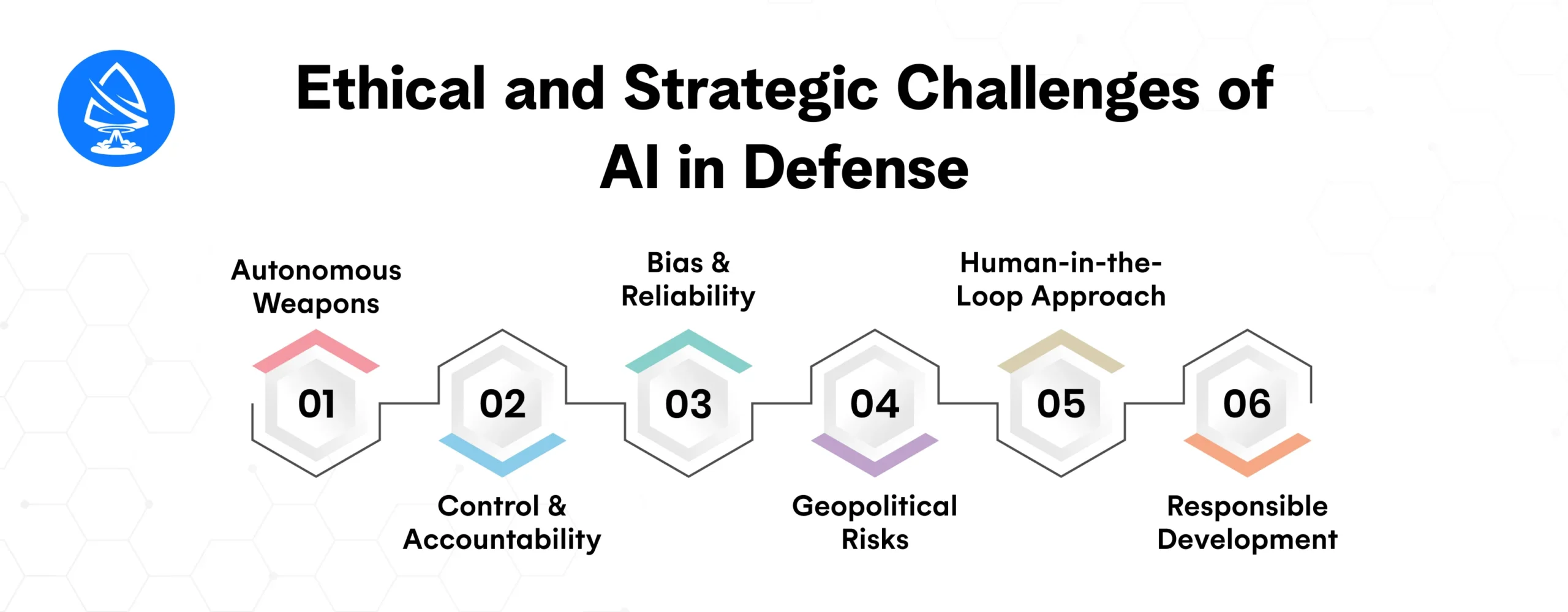
Take autonomous weapons, for example. Here’s the big question: Should we let AI pull the trigger without a human saying “yes”? That idea makes a lot of people uneasy, and honestly, the world can’t agree on it. The debate just keeps going.
Then there’s the issue of control and accountability. When an AI system messes up, who’s to blame? It gets tricky, fast. If a biased dataset or some unpredictable glitch leads to a bad call in a high-stakes mission, trust starts to crumble. And in defense, trust is everything.
AI in defense isn’t foolproof. These systems pick up whatever’s in the data, so if the data’s biased or sloppy, the AI can make some bad calls. That’s why you need people keeping a close eye on things, checking and testing constantly.
Then there’s the bigger picture. When countries start building up their AI defense tech, it’s easy to see how things could spiral into an arms race. Without some rules or limits, global security gets shaky.
Because of all this, most militaries still keep a human in charge, especially when it comes to the big stuff like combat decisions. Computers can help, but people make the final call.
Whether governments build these systems themselves or hire AI app developers, they have to stick to ethical principles. That means being open about how things work, designing with care, and keeping real oversight so AI in defense actually helps, not hurts decision-making.
At the end of the day, AI only makes defense stronger if we use it responsibly, with people steering the ship. Done right, it’s a game-changer for safer, smarter defense choices. But we can’t lose sight of good judgment and accountability along the way.
You may also want to know AI in Semiconductor
AI isn’t just a sidekick in defense anymore. It’s starting to take center stage, shaping how militaries plan, act, and adapt. Some countries aren’t waiting around; they’re already putting together strategies where AI calls the shots, not just in combat, but in everything from moving supplies to training troops. What does that mean for you? Operations get a lot faster. Smarter, too. Decisions come from real data, not just gut feelings.
There’s also this push for multi-domain operations. Basically, AI ties together everything, land, air, sea, space, and even cyberspace, all at once. You end up with a military that’s more connected and quicker on its feet.
Then there’s generative AI. Intelligence work won’t look the same. Instead of people slogging through endless reports, AI handles the heavy lifting, summarizing, spotting trends, and even suggesting what to do next. Leaders get the information they need, right when they need it, and can stay way ahead of the curve.
Of course, as AI in defense gets more power, everyone’s realizing you need some ground rules. Ethical frameworks and international standards are starting to take shape. The goal? Make sure AI pushes security forward but never loses sight of basic human values.
Companies like Artoon Solutions are right in the thick of this. They’re building AI tools that are secure, scalable, and responsible, always with an eye on keeping people in control. It’s a sign of where the whole industries headed: smarter AI, but never at the expense of good judgment.
So, here’s the bottom line: the future of defense isn’t about robots taking over. It’s about people and machines working together, combining human judgment with cutting-edge tech to make better decisions, faster.
AI isn’t some far-off idea in defense anymore; it’s already changing the game. You see it in autonomous drones, smarter maintenance, tighter cybersecurity, and faster decision-making. AI in defense lets you process information in a snap, spot threats sooner, and make calls with more confidence. Still, these systems exist to back up human judgment, not take over. That’s why keeping people accountable and watching the ethics side matters so much as things get more automated.
Companies keep pushing what’s possible, but governments have to set the rules and make sure everyone uses this tech responsibly. If you’re thinking about jumping in, something like an AI cost calculator gives you a real sense of what you’re getting into, upfront costs, how well it’ll scale, and whether it’ll actually pay off down the road. That way, you plan better and skip the nasty surprises.
1. Who’s leading in AI security?
There’s no single company at the very top, but Lockheed Martin, Raytheon, and Palantir stand out in AI for defense. They’re especially strong when it comes to cybersecurity and protecting intelligence.
2. What’s defense AI all about?
Defense AI is really just artificial intelligence built for the military and security world. It helps people sift through mountains of data, spot threats, and make quicker, smarter decisions. It’s not about replacing humans, just helping them do the job better.
3. Which companies are ahead in defense AI?
The main players are Lockheed Martin, Northrop Grumman, Raytheon Technologies, Palantir, and Shield AI. These companies pour serious resources into AI for defense.
4. Who are the big three in defense?
Lockheed Martin, Raytheon Technologies, and Northrop Grumman. They’re all in deep with AI and push a lot of innovation in defense.
5. Who’s winning the AI race?
No one’s really winning here. The U.S. and China are both charging ahead in defense AI, but in the end, it’s less about who gets there first and more about who uses AI wisely and effectively.
6. Which company is strongest in AI overall?
It really depends on what kind of AI you’re talking about. The big tech companies rule general-purpose AI, but when it comes to military and defense systems, it’s the defense contractors who lead the way.
7. What AI does the CIA use?
The CIA keeps things close to the chest, but they do use AI for crunching data, translating languages, and spotting threats. All of it makes their intelligence work sharper and faster.

Artoon Solutions
Artoon Solutions is a technology company that specializes in providing a wide range of IT services, including web and mobile app development, game development, and web application development. They offer custom software solutions to clients across various industries and are known for their expertise in technologies such as React.js, Angular, Node.js, and others. The company focuses on delivering high-quality, innovative solutions tailored to meet the specific needs of their clients.
 For business inquiries only