- HR:+91-879-9184-787
- Sales:+91-908-163-7774


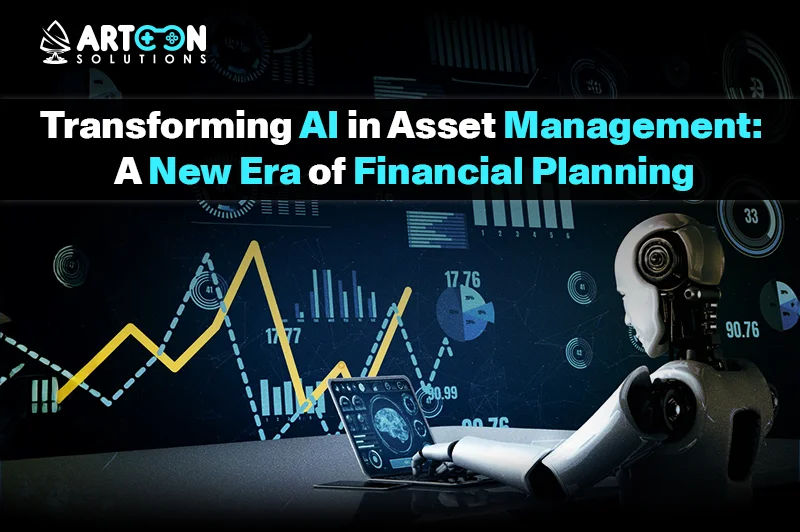
The world of asset management is undergoing a revolutionary transformation with the integration of Artificial Intelligence (AI). Risk management is a critical part of asset management, strengthened by machine learning techniques. Machine learning analyzes historical data to identify patterns and assess investment risks.
AI optimizes asset management through portfolio automation, scalability, and data-driven decision-making. Many firms hire AI developers to build intelligent financial solutions. This blog explores AI benefits, applications, and the future of AI-powered financial planning.
AI in asset management uses AI and machine learning to automate investment analysis, portfolio optimization, risk management, and operations. Asset management involves managing a client’s investments, including stocks, bonds, real estate, and other assets, to achieve specific financial goals. Traditionally, asset managers rely on human expertise and analysis to make decisions about these investments. However, with the integration of AI, asset managers can now leverage advanced algorithms, data analytics, and machine learning to optimize decision-making, reduce human error, and enhance the efficiency of investment strategies.
By harnessing the power of AI, financial institutions, hedge funds, and wealth management firms can analyze vast datasets, identify patterns, forecast market trends, and deliver more personalized investment strategies. AI technologies allow asset managers to make data-driven decisions faster and more accurately, improving overall investment performance and risk management.
Let’s explore in more detail how AI in asset management is reshaping the industry and providing greater opportunities for improved financial decision-making.
AI in asset management incorporates several key components that work together to enhance the performance of asset management practices. These include machine learning, predictive analytics, natural language processing (NLP), and data analysis.
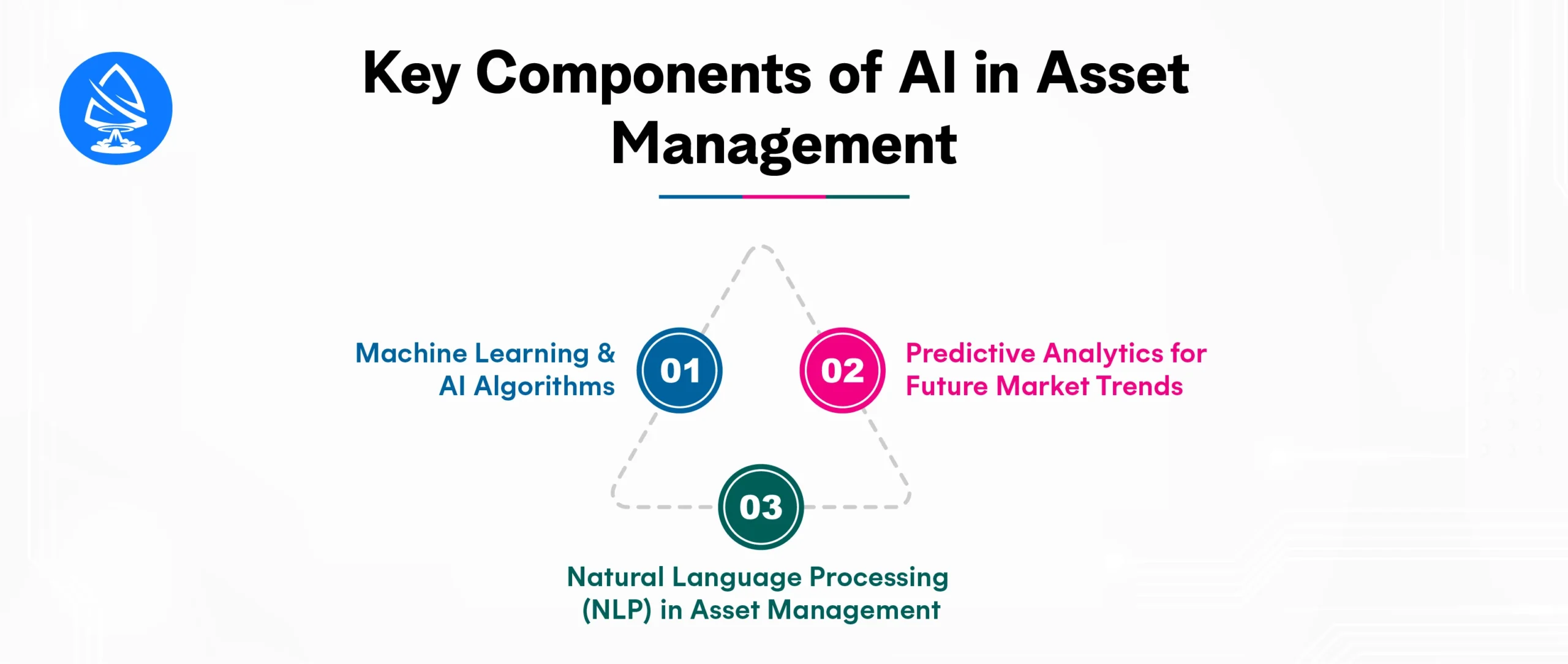
At the core of AI in asset management is machine learning (ML), a type of AI that enables systems to learn and improve from experience without explicit programming. In asset management, ML algorithms analyze historical data, such as stock prices, economic indicators, and corporate performance, to identify patterns and make predictions about future asset movements.
Predictive analytics powered by AI is a major driver of AI in asset management. This technology uses historical data, statistical algorithms, and machine learning to predict future market trends, asset price movements, and potential investment opportunities.
Natural language processing (NLP) is another critical AI technology that enables asset managers to analyze and interpret large amounts of unstructured data, such as news articles, financial reports, earnings calls, and social media posts.
You may also want to know about AI in Education
The application of AI in asset management spans several key areas, including portfolio management, risk management, investment strategies, and automated operations. Let’s explore how AI is applied in each of these areas.
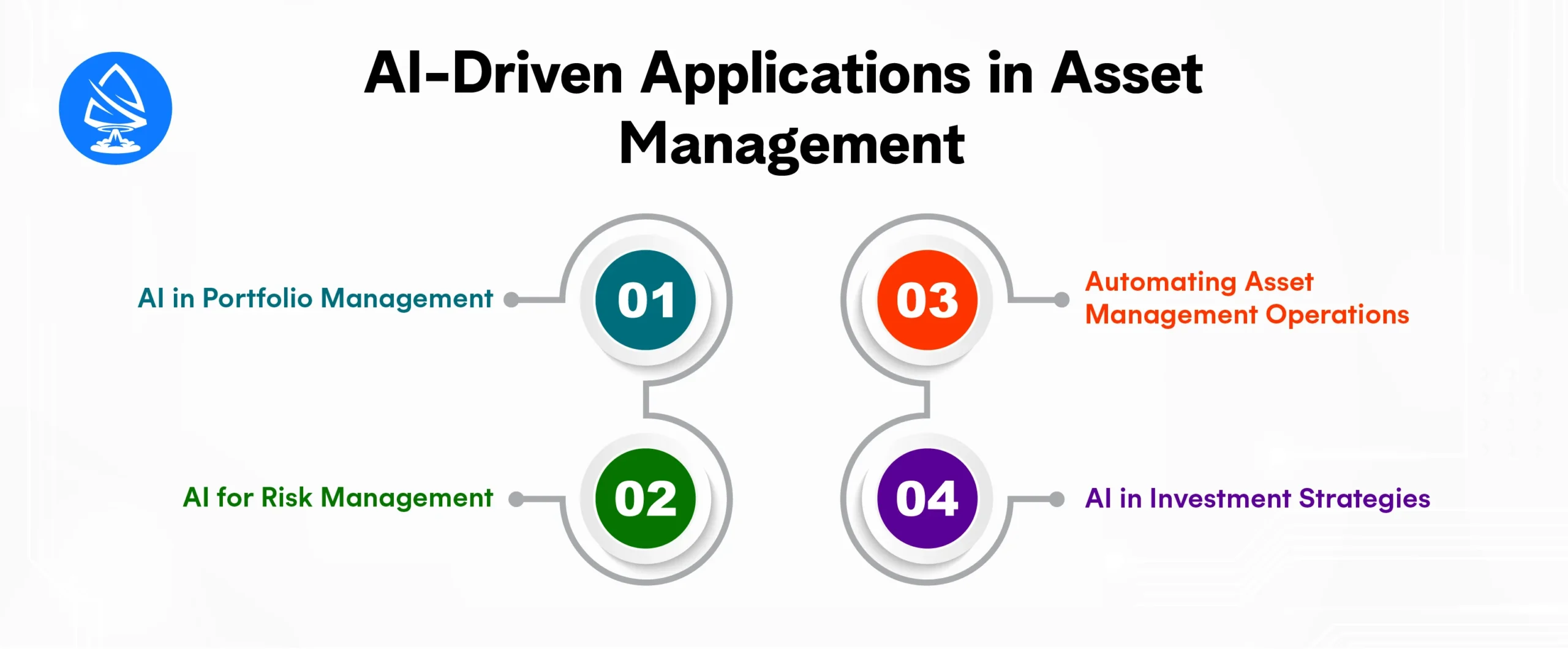
AI is particularly transformative in portfolio management, where it assists in optimizing asset allocations and diversifying investment portfolios to meet specific financial goals while minimizing risk.
Managing risk is an essential part of asset management. AI helps asset managers identify and mitigate potential risks by analyzing vast amounts of data and generating real-time insights.
AI is also transforming asset management operations by automating repetitive tasks, such as data entry, trade execution, and compliance checks. This increases efficiency, reduces human error, and lowers operational costs.
AI is revolutionizing how investment strategies are developed by analyzing large datasets, predicting market trends, and identifying potential investment opportunities. These AI-powered systems can find correlations and patterns that human analysts might miss.
The integration of AI in asset management offers several benefits, including:
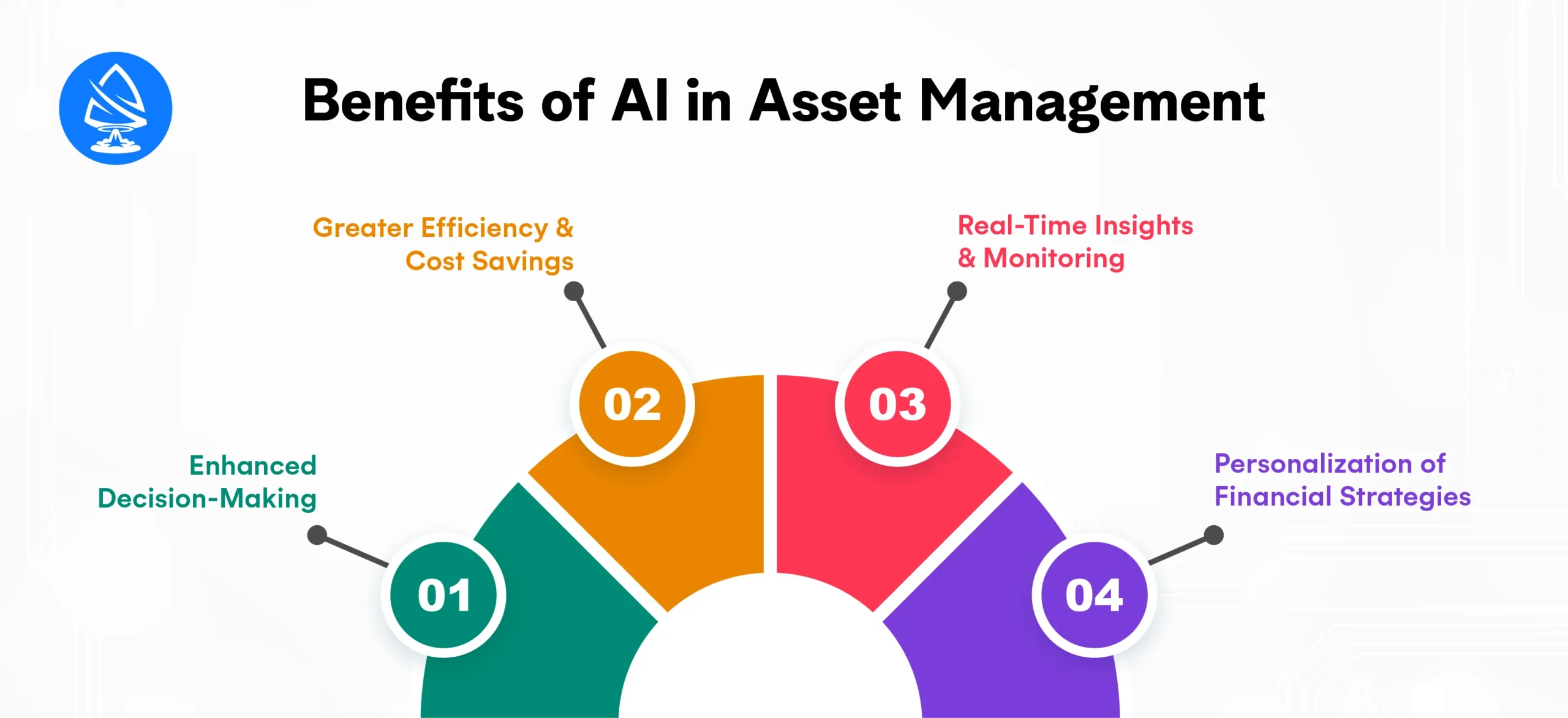
AI’s ability to process and analyze vast datasets allows asset managers to make more informed, data-driven decisions, improving portfolio management, risk assessments, and investment strategies.
By automating routine tasks like data entry, trading, and report generation, AI increases operational efficiency and reduces the cost of manual labor, helping asset managers allocate resources more effectively.
AI tools provide real-time insights into market trends, asset performance, and potential risks, enabling asset managers to adjust portfolios and strategies promptly in response to market fluctuations.
AI-driven platforms offer personalized financial advice, creating customized investment portfolios based on individual investor preferences, risk tolerance, and financial goals.
AI in asset management is enabling firms to leverage vast amounts of financial data, uncover patterns, and make better decisions in real-time. By automating traditional processes and offering advanced analytical tools, AI is improving decision-making and driving operational efficiencies.
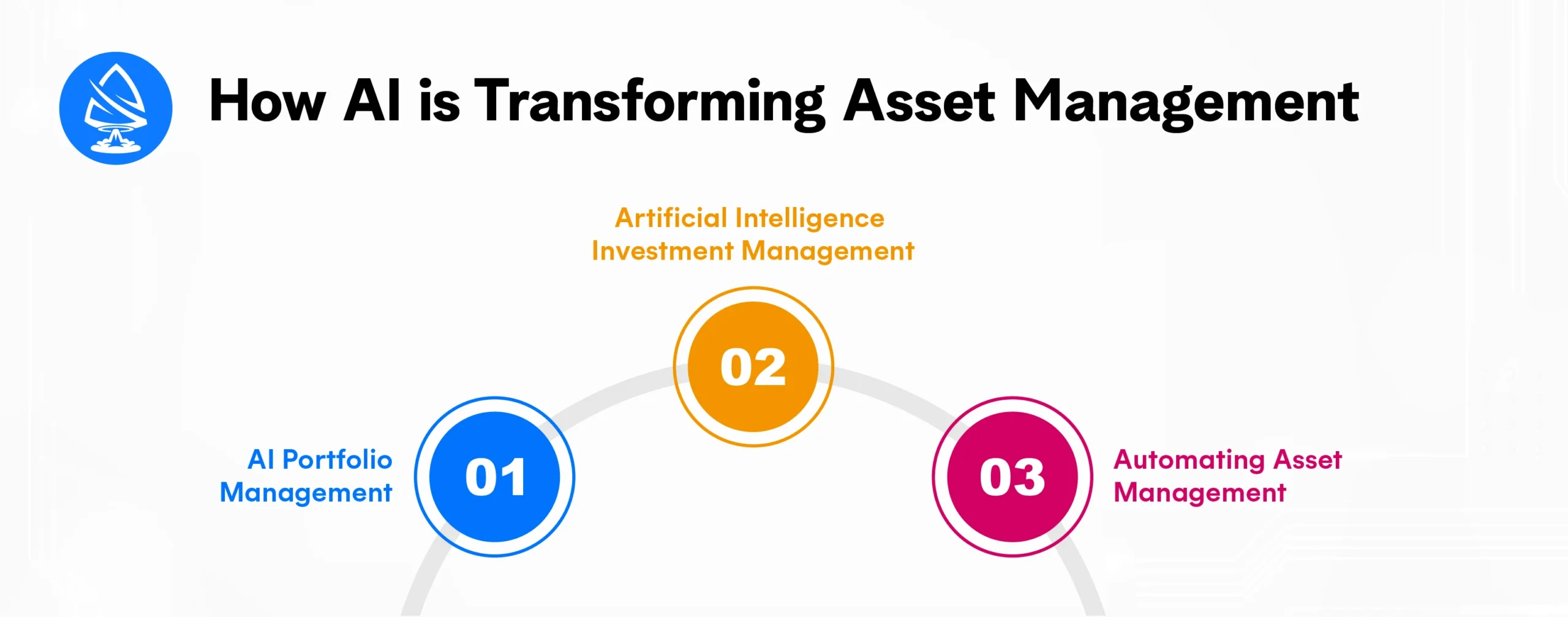
One of the most significant applications of AI in asset management is in portfolio management. Traditional asset managers rely on historical data, market analysis, and expert insights to create diversified portfolios. However, AI-powered systems bring a new level of intelligence and automation, enabling real-time insights and decision-making.
AI is transforming investment management by improving decision-making and minimizing human biases. Traditional investment strategies are based on historical analysis, economic forecasts, and expert judgment. However, AI systems can assess a much broader array of variables, including market trends, social media sentiment, geopolitical developments, and more.
Automating asset management processes is one of the key benefits of AI. Traditionally, asset managers spend considerable time on manual tasks such as data entry, trade execution, compliance checks, and performance reporting. AI is helping streamline these workflows, reducing errors and saving time.
You may also want to know the Best AI Coding Tools
Machine learning (ML), a subset of artificial intelligence (AI), has emerged as a key technology driving innovation and efficiency in the field of asset management. Machine learning enables algorithms to analyze vast amounts of financial data, identify patterns, make predictions, and optimize decision-making processes without explicit programming. In asset management, this translates into improved portfolio management, risk assessment, investment strategies, and operational efficiency.
Machine learning in asset management helps automate processes, enhance decision-making, and uncover hidden insights that traditional methods might miss. As the financial landscape becomes more complex and data-driven, the role of machine learning will continue to grow in importance. Let’s explore in more detail how machine learning is transforming asset management and how it benefits financial institutions and investors alike.
At its core, machine learning involves training algorithms on large datasets to recognize patterns and make predictions. In asset management, these datasets include historical price data, economic indicators, trading volumes, company financials, and even alternative data like social media sentiment. The more data the machine learning algorithms are exposed to, the more accurate their predictions become.
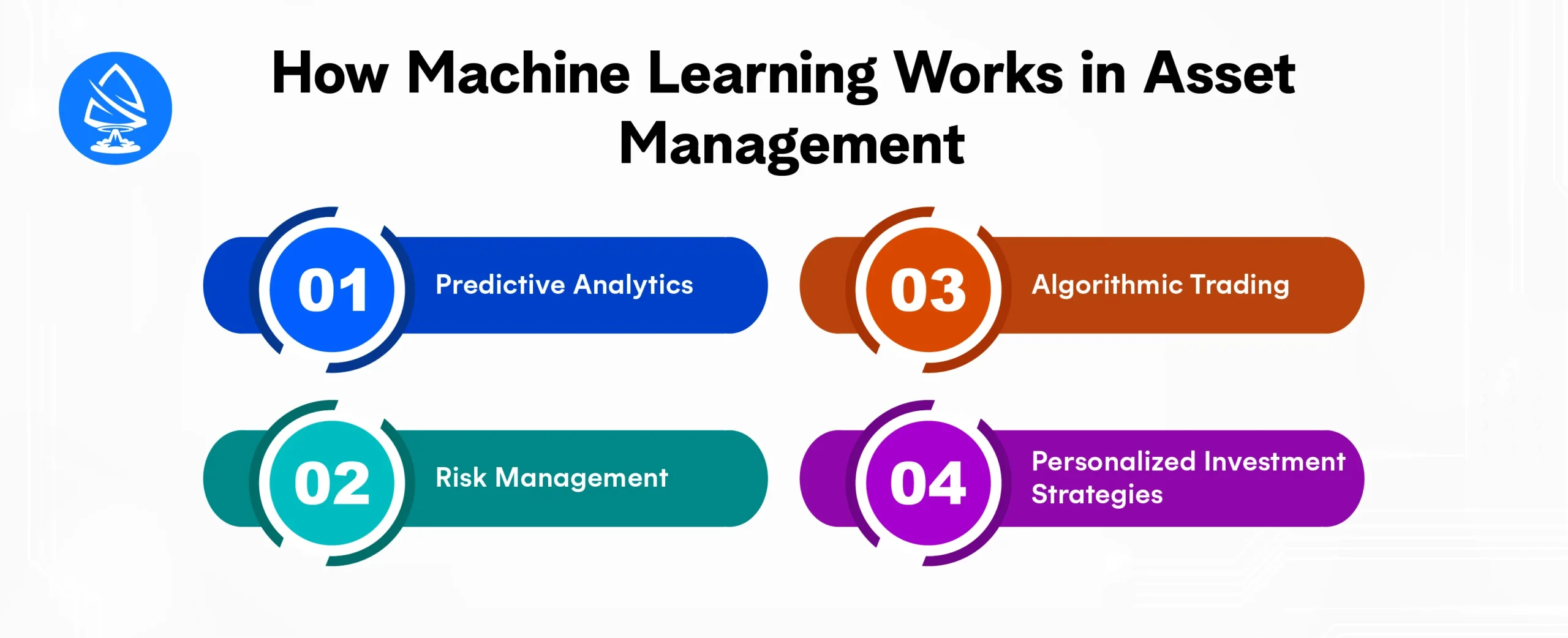
Machine learning is widely used in predictive analytics to forecast the future performance of assets, such as stocks, bonds, commodities, and real estate. Traditional methods often rely on historical trends and human judgment, which can be slow and error-prone. Machine learning, however, can analyze massive datasets in real-time, helping asset managers make quicker and more accurate predictions.
Risk management is a critical part of asset management, strengthened by machine learning techniques. Machine learning analyzes historical data to identify patterns and assess investment risks.
Algorithmic trading uses machine learning models to execute trades automatically based on predefined rules or signals. These models process large data volumes, execute timely trades, and adjust strategies to market conditions.
Machine learning is also revolutionizing the way asset managers create personalized investment strategies for clients. Traditionally, investment strategies were based on broad asset classes and risk profiles, but machine learning enables much more tailored approaches based on individual preferences, goals, and financial situations.
Machine learning brings several key benefits to asset management, enhancing performance, decision-making, and operational efficiency. Here are some of the major advantages:
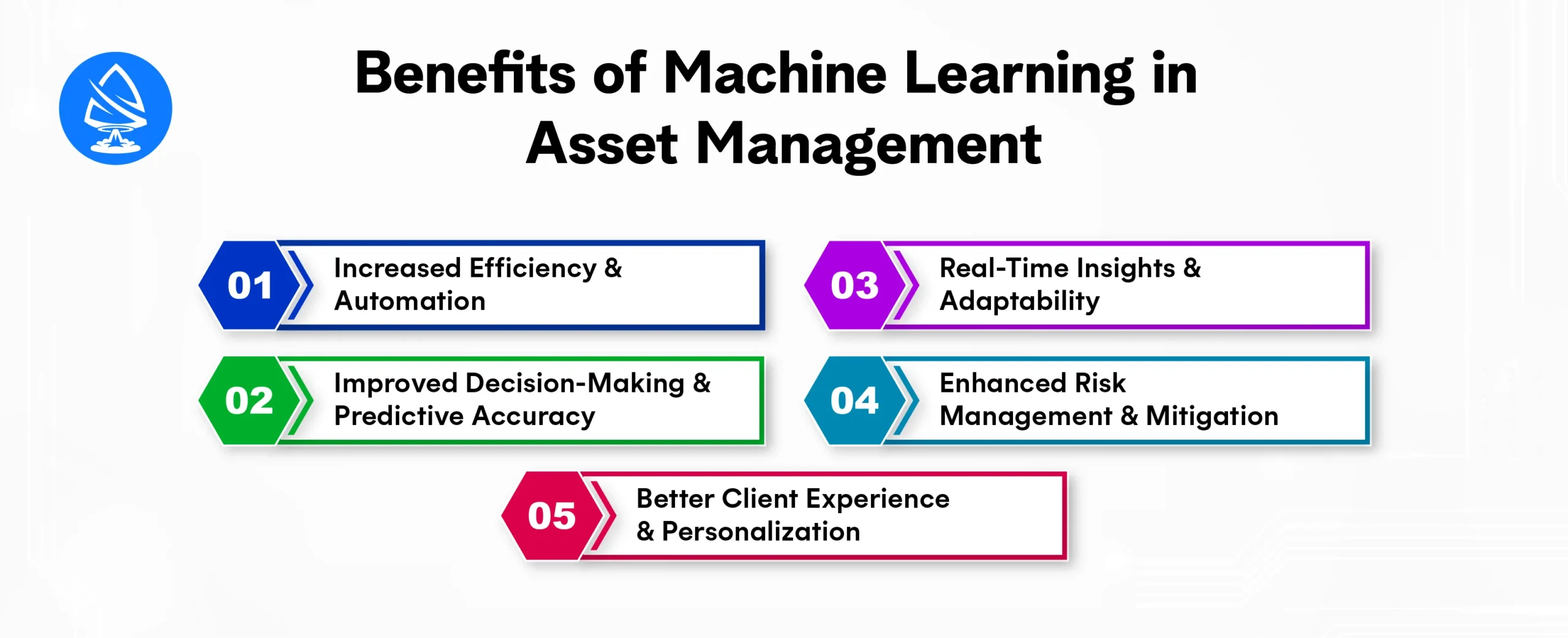
Machine learning automates routine tasks, such as data analysis, trading execution, and reporting. This reduces the burden on asset managers, allowing them to focus on more strategic decisions and reducing the likelihood of human errors.
Machine learning models can analyze vast amounts of data and recognize complex patterns that would be difficult for humans to detect. This leads to more accurate predictions and more informed decision-making, especially in areas like risk management and asset allocation.
Machine learning models continuously learn from new data, adapting in real-time to market changes. This ability to process large volumes of data and make quick adjustments is invaluable in the fast-paced world of asset management.
Machine learning algorithms can assess risks from various angles, including market volatility, economic shifts, and geopolitical factors. By simulating multiple scenarios, machine learning models can predict potential risks and recommend actions to mitigate them.
By using machine learning to analyze individual client data, asset managers can provide more personalized investment strategies. These strategies are continually optimized to reflect the client’s changing financial situation and market conditions.
The future of machine learning in asset management is promising, with new advancements on the horizon. Some of the future trends include:
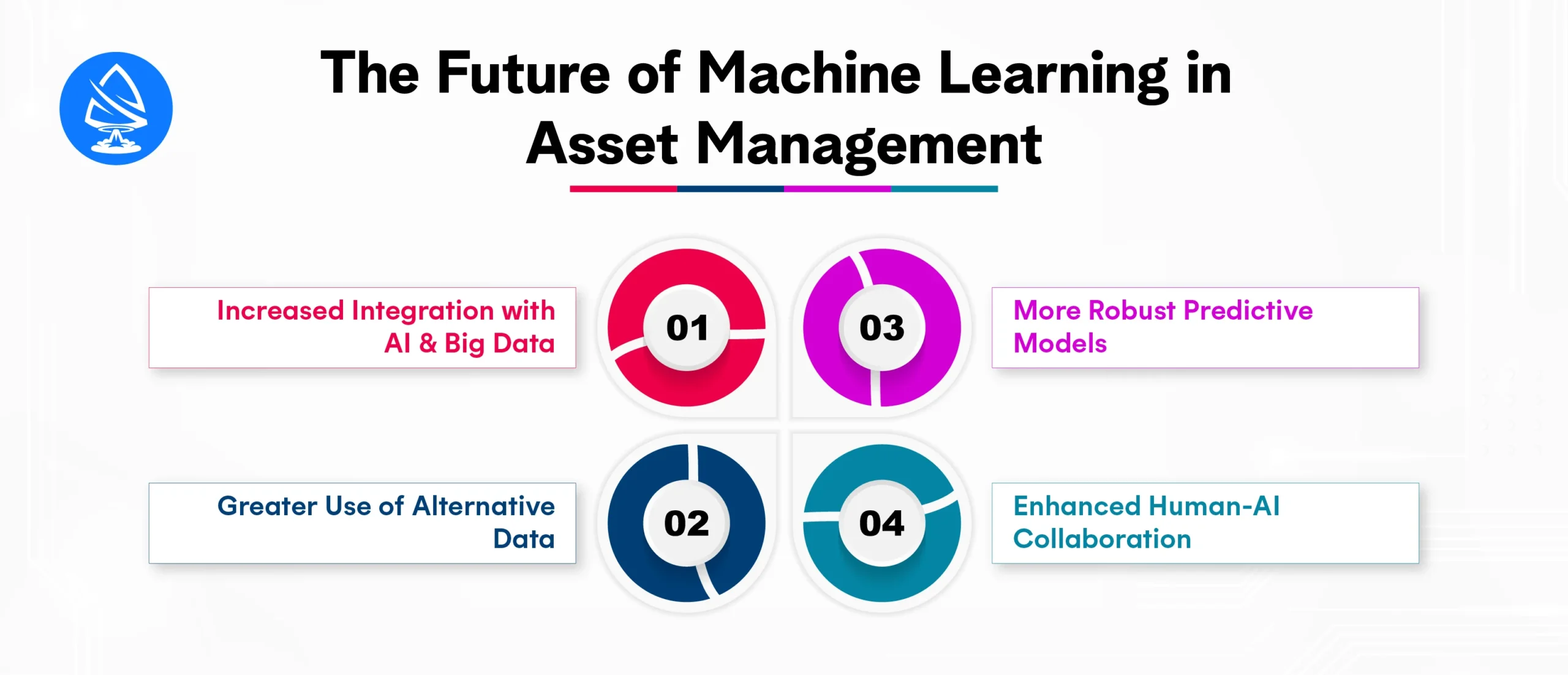
As machine learning models become more sophisticated, they will integrate with other AI technologies and big data tools to provide deeper insights and more accurate predictions. This will allow asset managers to make even more informed decisions and optimize strategies at an unprecedented scale.
Machine learning will increasingly use alternative data, such as social media sentiment, satellite images, or weather patterns, to predict market movements and uncover new investment opportunities. This type of data is often overlooked but can provide unique insights into asset performance.
The future will see more robust and accurate predictive models that can anticipate market changes with greater precision.
Rather than replacing asset managers, machine learning will empower them by providing advanced insights and recommendations.
The future of AI in asset management is promising as AI, ML, and data analytics advance. AI is transforming portfolio management, risk assessment, and investment decision-making. Its industry impact will continue to grow as technology evolves. The integration of AI promises to increase efficiency, improve decision-making accuracy, and offer more personalized financial strategies.
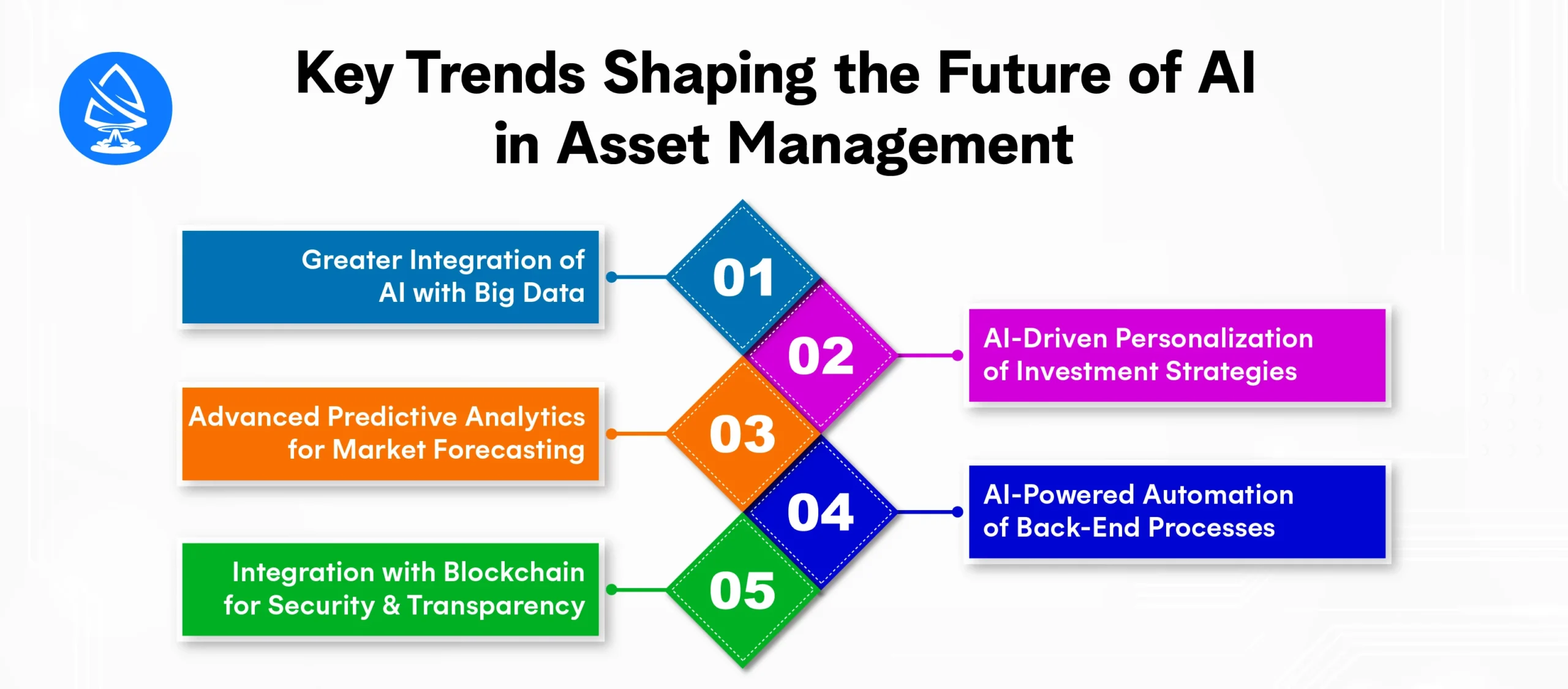
As financial data grows, AI and big data integration will become central to asset management. Asset managers will increasingly rely on AI algorithms. These algorithms process structured and unstructured data. They identify patterns, forecast trends, and uncover investment opportunities.
The future of AI in asset management will see a growing emphasis on personalization.
One of the most powerful aspects of AI in asset management is its ability to perform predictive analytics.
In the future, AI will increasingly automate back-end asset management operations. These include trade execution, compliance monitoring, and reporting. AI automation reduces time spent on administrative tasks. This allows asset managers to focus on high-level decision-making.
As AI evolves, its integration with blockchain technology will become increasingly important.
Several emerging AI technologies will play an even larger role in asset management in the coming years:

Natural language processing (NLP) will continue to evolve, enabling AI to extract valuable insights from unstructured data, such as news articles, financial reports, social media, and earnings calls. These insights will be used to improve decision-making, forecast market movements, and understand market sentiment.
Environmental, Social, and Governance (ESG) investing is gaining momentum, and AI will play a crucial role in evaluating companies based on ESG criteria. AI will automate the process of assessing ESG performance and integrating it into investment strategies.
The integration of AI in asset management is ushering in a new era of financial planning and decision-making.
For financial institutions and individual investors seeking to leverage the power of AI, partnering with an AI development company or artificial intelligence development company in USA can provide the necessary tools and expertise to stay ahead in this rapidly evolving industry.
1. What is AI in asset management?
AI in asset management uses artificial intelligence and machine learning to analyze data and optimize investment strategies.
2. How does AI help in portfolio management?
AI supports portfolio management by analyzing market data, predicting trends, and optimizing asset allocations.
3. What are some AI use cases in wealth management?
AI in wealth management includes personalized investment strategies, real-time monitoring, automated rebalancing, and data-driven insights to optimize clients’ portfolios.
4. Can AI predict stock market trends?
Yes, AI-powered predictive analytics can analyze historical data and identify patterns to forecast future market trends and asset prices.
5. How does AI reduce human biases in investment decisions?
AI reduces human bias by using data-driven algorithms. It makes objective investment decisions without emotional influence.
6. What is machine learning for asset management?
Machine learning in asset management analyzes large datasets to identify patterns. It predicts future market movements. This improves investment decision-making.
7. How can AI automate asset management?
AI can automate tasks like trade execution and portfolio rebalancing. It also handles data analysis and report generation. This increases efficiency and reduces human errors.

Artoon Solutions
Artoon Solutions is a technology company that specializes in providing a wide range of IT services, including web and mobile app development, game development, and web application development. They offer custom software solutions to clients across various industries and are known for their expertise in technologies such as React.js, Angular, Node.js, and others. The company focuses on delivering high-quality, innovative solutions tailored to meet the specific needs of their clients.
 For business inquiries only