The finance industry is no stranger to disruption. AI has become a transformative force in finance, improving analysis, risk management, fraud detection, and personalized banking. As AI evolves, it continues reshaping the financial industry with new opportunities and challenges. This guide explains AI applications in finance and their key benefits. It also shows how institutions can use AI to drive innovation and remain competitive.
Understanding AI in Finance
AI in finance involves the integration of machine learning (ML), natural language processing (NLP), and other AI technologies to automate, optimize, and enhance various financial processes. AI is being used across many sectors within finance, from banking and investment management to insurance and regulatory compliance. By processing large volumes of data, AI models can identify patterns, make predictions, and provide insights that were previously impossible to achieve using traditional methods.
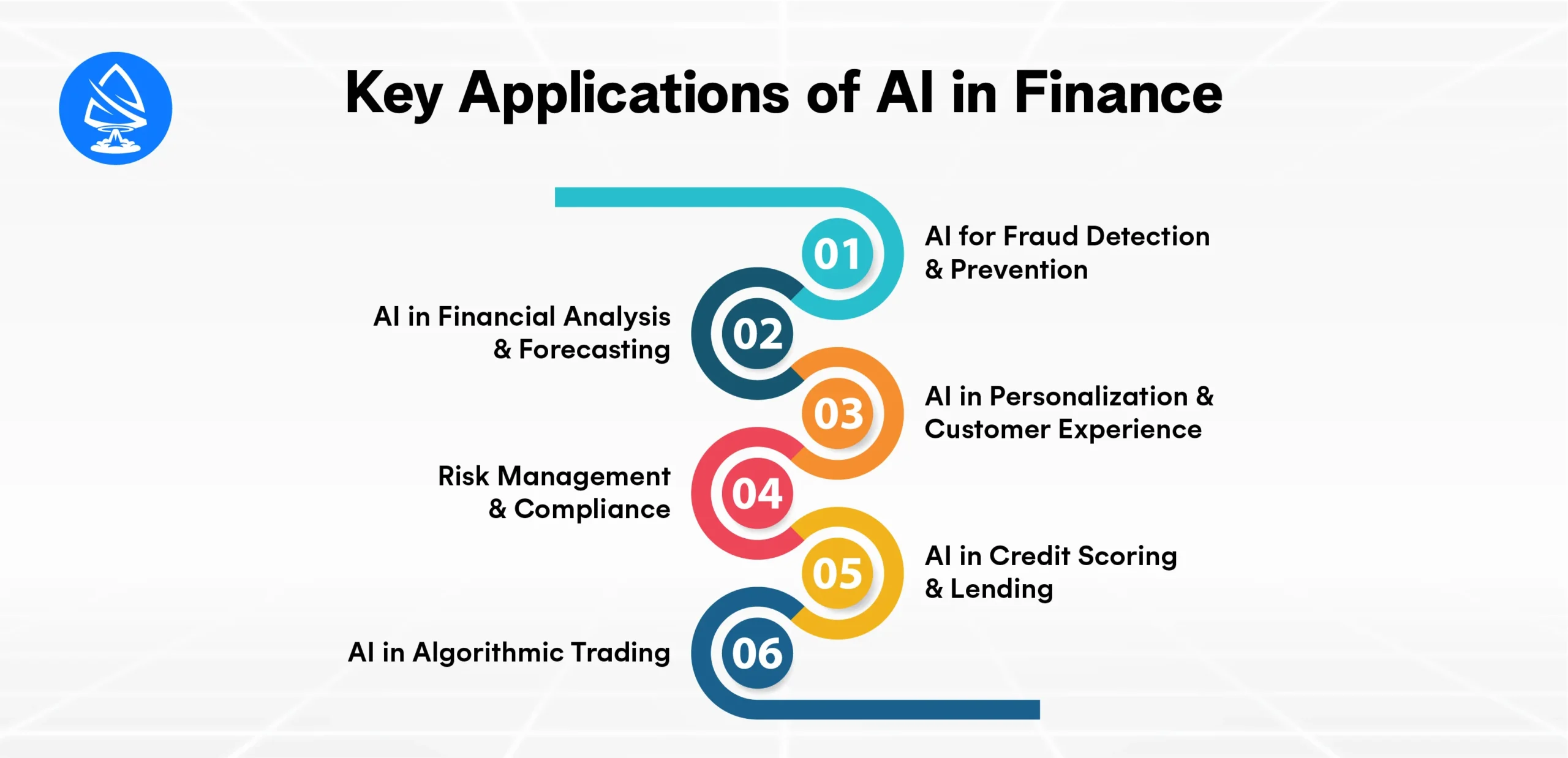
Key Applications of AI in Finance
AI’s applications in finance are broad and diverse. Let’s dive into the key areas where AI is making a significant impact:
1. AI for Fraud Detection and Prevention
One of the most significant uses of AI in finance is in fraud detection and prevention. Financial institutions process millions of transactions daily, making it challenging to manually identify fraudulent activities. AI algorithms are designed to detect anomalies and patterns in transaction data that may indicate fraudulent behavior.
Machine Learning Algorithms: AI models are trained to recognize common fraud patterns and can instantly flag suspicious activity, allowing for quicker response times and reduced fraud risk.
Real-Time Monitoring: AI enables real-time transaction monitoring, ensuring that fraudulent activities are identified and stopped before they can cause significant harm.
By leveraging AI for fraud detection, financial institutions can significantly reduce the risk of fraud and improve customer trust.
2. AI in Financial Analysis and Forecasting
In the realm of financial analysis, AI is a game-changer. Financial analysts are increasingly relying on AI-powered tools to process large amounts of data and generate insights that would be time-consuming for humans to identify.
Predictive Analytics: AI in financial analysis allows businesses to make data-driven predictions based on historical trends and market conditions. This enables better investment decisions and improved risk management.
Automation of Data Analysis: AI can automatically analyze financial statements, stock prices, market trends, and economic indicators to provide valuable insights that guide investment strategies.
With AI’s ability to analyze vast datasets quickly, financial institutions can make faster and more accurate decisions, driving efficiency and profitability.
3. AI in Personalization and Customer Experience
AI is revolutionizing customer service in finance. Personalized experiences are increasingly becoming the norm in the industry, with AI enabling tailored financial services based on individual customer needs and behaviors.
Chatbots and Virtual Assistants: AI-powered chatbots assist customers in handling simple queries, managing accounts, and providing financial advice. Virtual assistants can offer personalized recommendations based on customer data and preferences.
Personalized Financial Products: AI helps financial institutions create personalized offers, from loan products to investment opportunities, based on the unique profiles of each customer.
By integrating AI, financial institutions can deliver exceptional customer experiences and increase customer satisfaction, loyalty, and retention.
4. Risk Management and Compliance
AI plays a crucial role in helping financial organizations meet regulatory requirements and manage risks efficiently.
Regulatory Compliance: AI can automate the process of monitoring and interpreting new regulations, ensuring that financial institutions stay compliant with ever-changing laws and regulations.
Risk Management: AI models are used to assess and predict financial risks, including market fluctuations, credit risks, and operational risks. These tools help financial institutions make more informed decisions to mitigate risks and prevent financial crises.
By utilizing AI for risk management, financial institutions can navigate a complex regulatory landscape while minimizing exposure to financial risks.
5. AI in Credit Scoring and Lending
AI is transforming the lending industry by providing more accurate credit scores and improving the efficiency of the loan approval process. Traditional credit scoring methods often rely on limited data, which can lead to biased decisions.
Alternative Data for Credit Scoring: AI can analyze non-traditional data sources, such as social media activity, payment behavior, and even personal financial history, to provide a more comprehensive picture of a borrower’s creditworthiness.
Faster Loan Approvals: AI automates the loan application process, making it faster and more accurate by analyzing the applicant’s financial history and providing instant loan decisions.
AI in credit scoring and lending reduces bias, increases efficiency, and provides better access to credit for customers who may have been underserved by traditional systems.
6. AI in Algorithmic Trading
AI in algorithmic trading uses machine learning models to predict market movements and execute trades at optimal times. It can analyze vast amounts of historical data, economic indicators, and real-time market conditions to generate trading strategies that outperform human decision-making.
High-Frequency Trading: AI algorithms can execute thousands of trades in a fraction of a second, taking advantage of minute market fluctuations to generate profits.
Enhanced Market Predictions: By analyzing market trends and news sentiment, Artificial Intelligence can predict potential price movements and identify investment opportunities faster than traditional methods.
Artificial Intelligence has become indispensable in the world of trading, enabling more efficient and profitable strategies for institutional investors and hedge funds.
Artificial Intelligence (AI) is increasingly becoming a cornerstone of the finance industry. As financial markets grow more complex and customer demands evolve, AI offers innovative solutions that can significantly improve the efficiency, accuracy, and security of financial operations. The integration of AI in finance is no longer just a trend; it is a vital tool for organizations striving to stay competitive in an ever-changing landscape.
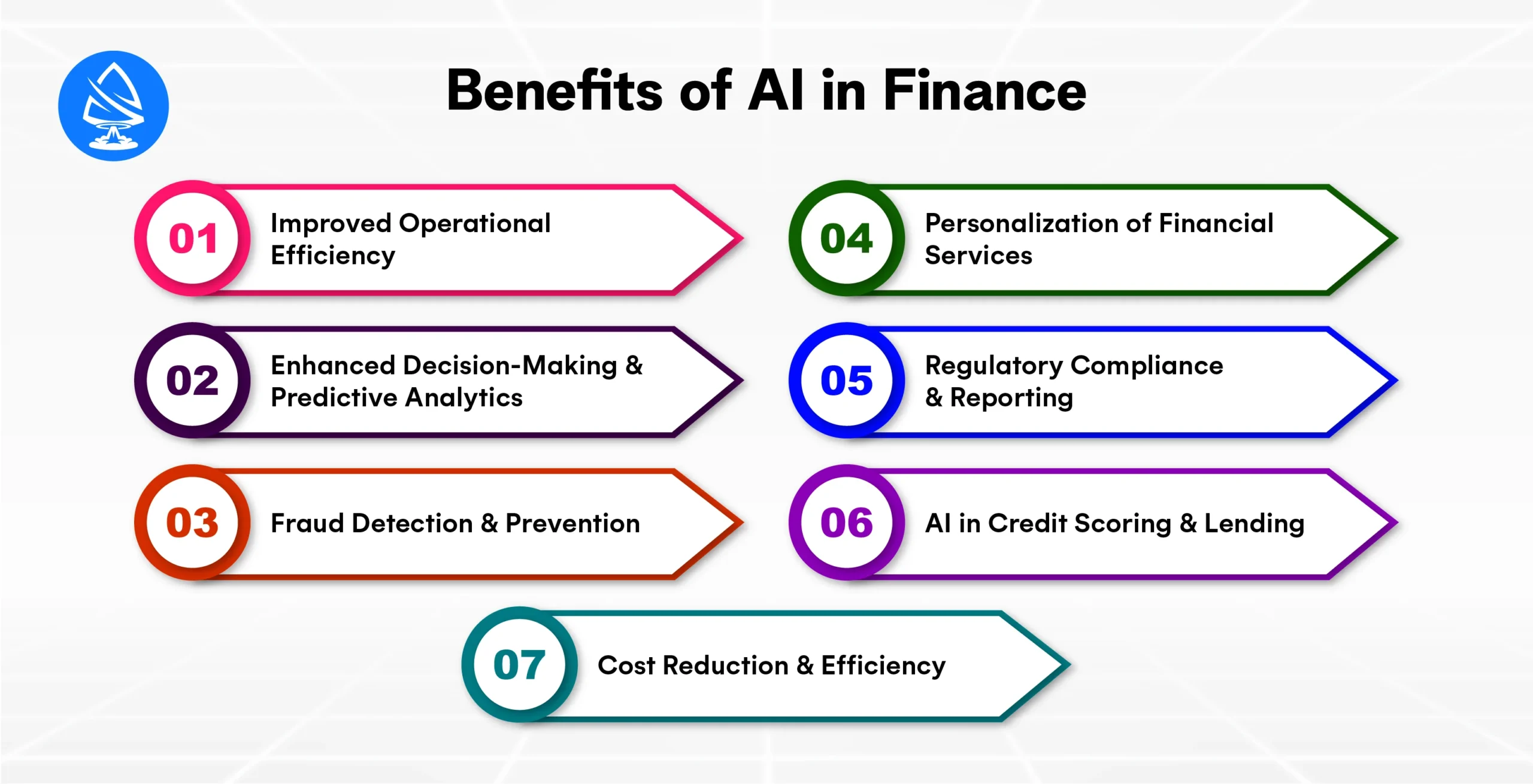
Here are the key benefits of AI in finance:
1. Improved Operational Efficiency
One of the most significant benefits of AI in finance is the ability to automate a wide range of tasks. By automating repetitive and time-consuming processes, financial institutions can free up human resources to focus on more strategic and higher-value activities.
Key Applications:
Automated Data Entry and Processing: AI can handle data entry tasks, such as updating transaction records, processing invoices, and managing financial statements, with minimal human intervention.
Customer Support Automation: AI-powered chatbots can handle common customer queries, such as checking account balances, transaction histories, and providing general banking information.
Impact:
Reduced Operational Costs: Automation leads to lower costs by reducing the need for manual labor.
Faster Service Delivery: Processes like loan approvals, transactions, and even financial advice can be provided to customers in real time.
By improving efficiency, AI helps financial organizations reduce costs, boost productivity, and improve the overall customer experience.
2. Enhanced Decision-Making and Predictive Analytics
AI’s ability to analyze large amounts of data in real-time gives financial institutions an unprecedented ability to make more informed and data-driven decisions. Predictive analytics, powered by AI, helps financial leaders forecast trends, identify risks, and find opportunities.
Key Applications:
Predictive Risk Management: AI algorithms analyze historical data to predict market fluctuations, credit risks, and potential loan defaults, enabling more informed risk management decisions.
Investment Predictions: AI helps investors and institutions predict stock price movements, interest rates, and other market conditions, enhancing their investment strategies.
Impact:
Better Financial Forecasting: By predicting future market trends, AI improves the accuracy of financial forecasts, making it easier to plan and allocate resources.
Improved Risk Mitigation: AI can identify patterns that indicate potential risks, allowing businesses to act quickly and reduce losses.
AI gives financial institutions the tools they need to make smarter, more data-driven decisions, which ultimately enhances their bottom line.
3. Fraud Detection and Prevention
Fraud prevention is one of the most vital aspects of finance, and AI is revolutionizing how financial institutions detect and prevent fraud. AI can quickly analyze vast amounts of transaction data and identify suspicious activities in real-time, drastically reducing the chances of fraud.
Key Applications:
Real-Time Transaction Monitoring: AI algorithms continuously monitor transactions, flagging any that seem suspicious, such as transactions from unusual locations or inconsistent amounts.
Pattern Recognition: AI can learn from past fraud cases and recognize new, emerging patterns in transaction data that may indicate fraudulent activities.
Impact:
Reduced Fraud Losses: AI’s ability to detect and prevent fraudulent transactions in real-time minimizes financial losses due to fraud.
Improved Customer Trust: By preventing fraud, AI helps maintain customer confidence in financial institutions, fostering loyalty and trust.
AI-powered fraud detection systems allow financial institutions to combat fraud effectively and proactively.
4. Personalization of Financial Services
AI allows financial institutions to deliver personalized experiences to customers by analyzing large datasets to understand individual preferences, behaviors, and financial habits. This personalization leads to better customer satisfaction and loyalty.
Key Applications:
Personalized Financial Advice: AI can analyze a customer’s spending habits and financial goals to offer tailored recommendations, such as savings plans, investment opportunities, or credit card options.
Targeted Marketing: AI can help banks and financial firms create customized marketing campaigns based on customers’ transaction data and preferences.
Impact:
Enhanced Customer Experience: Personalized recommendations and services cater to individual needs, making customers feel valued and understood.
Increased Retention Rates: Customers who receive personalized financial advice are more likely to stay with the institution, leading to better long-term relationships.
AI makes it easier for financial institutions to build strong, personalized relationships with their customers, driving customer satisfaction and retention.
5. Regulatory Compliance and Reporting
The financial industry is heavily regulated, and compliance can be costly and complex. AI helps businesses stay compliant by automating the monitoring and reporting processes, ensuring that financial institutions meet regulatory requirements more effectively and efficiently.
Key Applications:
Automated Compliance Checks: AI can automatically monitor transactions and flag any activities that may violate regulations, helping financial institutions avoid penalties.
Regulatory Reporting: AI can help generate reports required by regulatory bodies, reducing the manual effort and the risk of errors in the compliance process.
Impact:
Cost Savings: Automating compliance checks and reports reduces the need for human intervention, saving on legal and administrative costs.
Faster Response to Regulatory Changes: AI can quickly adapt to changes in regulatory requirements, ensuring that institutions remain compliant with the latest standards.
AI helps streamline the compliance process, making it more efficient while reducing the risk of errors or missed deadlines.
6. AI in Credit Scoring and Lending
AI is transforming the way financial institutions assess creditworthiness. Traditional credit scoring models often rely on limited data, which can exclude potential borrowers who don’t fit the conventional profile. AI can evaluate a broader range of factors to provide a more accurate assessment of creditworthiness.
Key Applications:
Alternative Data Sources: AI uses alternative data, such as utility payments, social media activity, and online behavior, to build a more comprehensive credit profile.
Dynamic Lending Decisions: AI systems can adjust lending decisions based on real-time data, including macroeconomic trends and individual customer behavior.
Impact:
More Inclusive Lending: AI allows financial institutions to extend credit to a wider range of individuals, including those with little or no credit history.
Improved Accuracy in Credit Scoring: AI’s use of diverse data points leads to more accurate credit assessments, reducing the risk of defaults.
AI enables financial institutions to make more informed and equitable lending decisions, benefiting both lenders and borrowers.
7. Cost Reduction and Efficiency
Implementing AI technologies in finance helps organizations reduce operational costs and streamline their workflows, ultimately boosting efficiency. From automating mundane tasks to enhancing back-office operations, AI offers significant cost-saving opportunities.
Key Applications:
Automating Back-Office Functions: AI can automate routine administrative tasks such as account reconciliation, transaction monitoring, and reporting.
Optimizing Resource Allocation: AI-driven tools can analyze resource utilization and suggest adjustments to optimize operations and reduce waste.
Impact:
Lower Operational Costs: Automation reduces the need for manual labor, saving on staffing costs and minimizing errors.
Increased Productivity: AI systems perform tasks much faster than humans, improving overall productivity and reducing turnaround times.
AI enhances efficiency and cost-effectiveness, making it a valuable tool for businesses looking to optimize their operations.
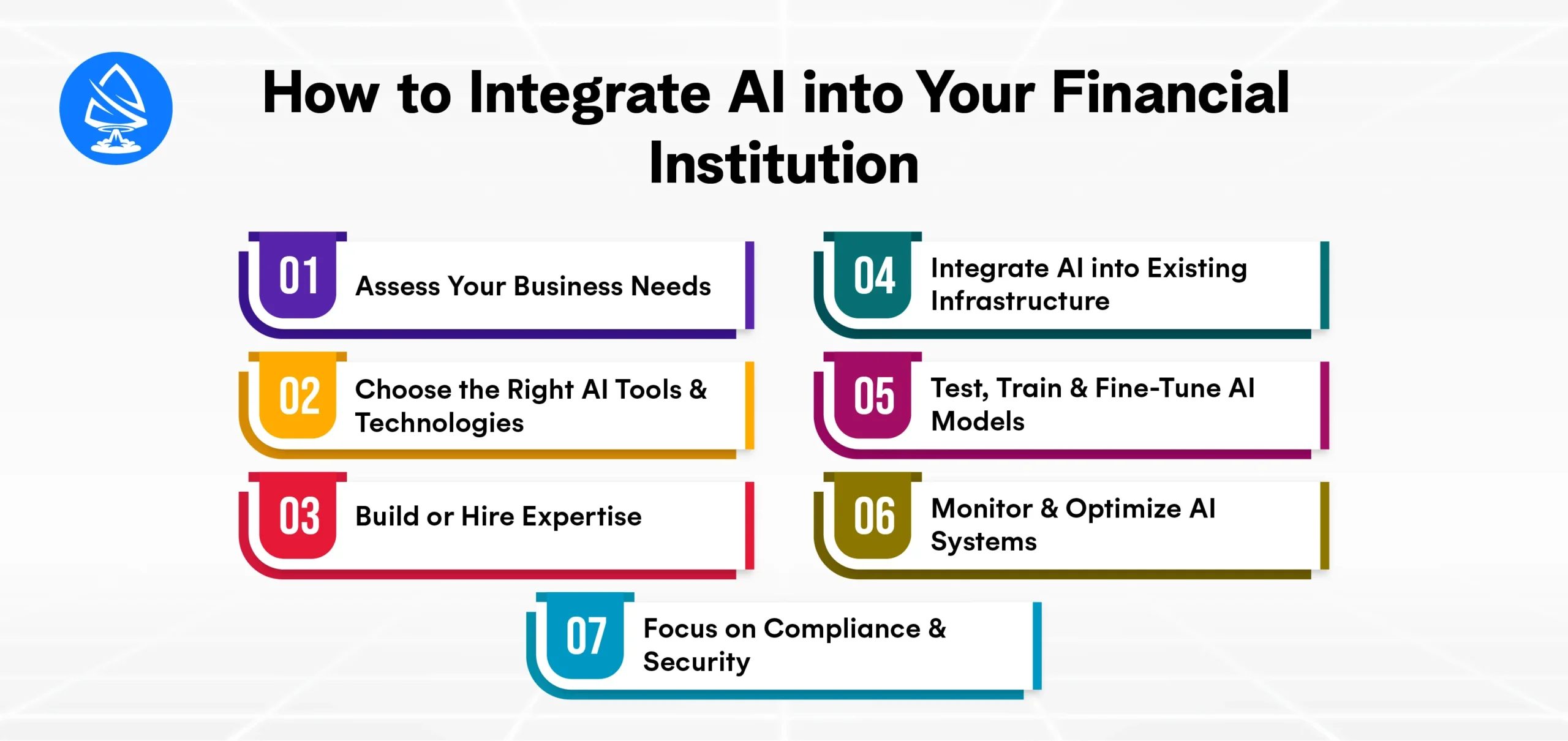
How to Integrate AI into Your Financial Institution
Integrating AI into financial operations enhances efficiency, reduces costs, and improves decision-making. It also delivers better customer experiences across financial services. Effective AI implementation requires a clear and strategic approach. Institutions must assess needs, select suitable tools, and integrate AI with existing systems.
Step 1: Assess Your Business Needs
Before implementing AI, it’s crucial to assess your financial institution’s needs. AI in finance is a broad field, and its applications vary depending on your specific goals. To identify the right areas to apply AI, consider the following factors:
Key Areas for AI Application:
Fraud Detection: If your institution deals with a large number of transactions, AI can help detect fraudulent activities by analyzing patterns and anomalies.
Customer Service: AI can be used to improve customer interactions via chatbots and virtual assistants, reducing response times and enhancing user experience.
Risk Management: AI-powered tools can analyze historical data and predict financial risks, helping your institution to proactively manage credit risk, market fluctuations, and operational risks.
Personalized Services: AI can analyze customer data to offer tailored financial products, such as customized loan options or investment advice.
Operational Efficiency: Automating back-office tasks, such as data entry and transaction monitoring, can help reduce costs and human error.
Impact:
Alignment with Goals: AI solutions should align with your strategic goals, whether it’s improving customer satisfaction, reducing operational costs, or enhancing security.
Maximizing ROI: Prioritizing AI applications that have the most potential to improve efficiency or generate revenue will lead to the highest return on investment.
Step 2: Choose the Right AI Tools and Technologies
Once you have identified the areas that would benefit from AI, the next step is selecting the appropriate AI tools and platforms for your financial institution. The right choice will depend on the nature of your operations, available resources, and specific use cases.
Popular AI Technologies in Finance:
Machine Learning (ML): Used for predictive analytics, fraud detection, and risk management. ML models can learn from large datasets and improve over time.
Natural Language Processing (NLP): Essential for chatbots, virtual assistants, and automated compliance reporting. NLP helps computers understand and process human language.
Robotic Process Automation (RPA): Ideal for automating routine, rule-based tasks like data entry and transaction processing.
Predictive Analytics: Uses AI algorithms to forecast market trends, assess credit risk, and predict customer behavior.
Selecting the Right Tools:
Custom AI Solutions: If your institution has unique needs, you may consider working with an AI development company to build a custom AI solution.
Off-the-Shelf AI Platforms: Many AI platforms are available that provide solutions for common banking needs, such as fraud detection, risk assessment, and customer service.
Cloud vs. On-Premise: You’ll also need to decide whether to adopt cloud-based AI solutions, which offer scalability and lower upfront costs, or opt for on-premise solutions for greater control and security.
Impact:
Scalability: Choose AI tools that can scale with your institution’s growth and future technological advancements.
Security: Ensure that the selected AI tools comply with industry standards and regulations related to data security and privacy, especially in the financial sector.
Step 3: Build or Hire Expertise
Implementing AI effectively requires the right talent. Financial institutions must have access to skilled AI developers, data scientists, and machine learning engineers to integrate AI solutions into their operations.
Ways to Gain AI Expertise:
In-House Team: Build an internal AI development team that includes machine learning experts, data scientists, and AI engineers. This provides more control over the development and implementation of AI systems.
Outsource to Experts: If building an internal team is not feasible, consider partnering with an AI development company or hiring AI developers for project-specific needs.
Training Existing Employees: If you already have an IT team, invest in training programs that upskill them in AI and machine learning technologies.
Impact:
Internal Knowledge: Having in-house expertise enables your financial institution to customize AI solutions to your needs, while also ensuring the long-term sustainability of AI adoption.
Outsourcing Flexibility: By partnering with AI development experts, you can expedite the implementation process without needing to develop an in-house team from scratch.
Step 4: Integrate AI into Existing Infrastructure
Integrating AI into your current IT infrastructure is one of the most critical steps. It’s essential that AI systems can communicate seamlessly with your existing core banking systems, customer relationship management (CRM) platforms, and other operational software.
Key Integration Steps:
API Integration: Use APIs to connect AI tools with your existing systems. AI tools should be able to pull and push data from existing databases, ensuring smooth workflow automation.
Data Management: AI systems require access to large volumes of high-quality data. Implement data governance practices to ensure data is clean, consistent, and accessible for AI models.
Security and Compliance: Ensure that AI solutions comply with financial industry regulations, especially around data privacy (such as GDPR) and security (such as PCI-DSS for payment data).
Impact:
Smooth Operations: Proper integration allows AI to enhance operations without disrupting existing processes.
Data-Driven Decisions: With accurate and real-time data, AI systems can generate better insights, enhancing decision-making across the organization.
Step 5: Test, Train, and Fine-Tune AI Models
Before fully deploying AI systems, it’s crucial to test and fine-tune the models to ensure they work effectively and accurately.
Key Steps for Training and Testing:
Data Preparation: The quality and quantity of data are essential for training AI models. Clean, labeled data is needed to teach the models the patterns they should look for.
Model Evaluation: Regularly evaluate the AI model’s performance against real-world scenarios and adjust it accordingly. This can involve measuring accuracy, precision, recall, and other key performance metrics.
Fine-Tuning: Continuous feedback loops allow AI models to refine their predictions over time, improving their overall accuracy.
Impact:
Accuracy: Proper training ensures that AI systems make accurate predictions, such as detecting fraud, assessing credit risk, or recommending personalized products.
Continuous Improvement: AI models that are regularly tested and fine-tuned adapt more effectively to changing market conditions and customer behaviors.
Step 6: Monitor and Optimize AI Systems
Once the AI system is deployed, it’s important to continuously monitor its performance and make necessary adjustments. AI systems need regular updates to stay relevant and efficient.
Key Monitoring Actions:
Real-Time Monitoring: Keep an eye on how AI systems are functioning in real-time to ensure they are producing accurate results.
Performance Metrics: Track key performance indicators (KPIs) such as transaction speed, fraud detection rate, and customer satisfaction to gauge the effectiveness of AI.
Feedback Loops: Establish mechanisms to gather feedback from users and other systems, so that the AI models can be continuously refined.
Impact:
Adaptability: AI systems that are regularly monitored can adapt to new challenges, such as changes in customer behavior, evolving fraud patterns, or new regulatory requirements.
Optimization: By optimizing AI systems over time, financial institutions can continuously improve their efficiency, customer experience, and decision-making processes.
Step 7: Focus on Compliance and Security
AI systems in the financial sector must adhere to strict regulatory standards and ensure the security of sensitive financial data. Compliance and security should be a core focus during the integration process.
Key Compliance Considerations:
Regulatory Compliance: Ensure that AI models are compliant with financial regulations such as GDPR, PCI DSS, and MiFID II.
Data Security: Protect customer and financial data using encryption, secure cloud storage, and other advanced security measures to prevent data breaches.
Impact:
Regulatory Adherence: Compliant AI systems prevent potential legal issues and penalties related to data privacy and security.
Trust and Security: Ensuring the security of customer data builds trust and confidence in your AI-powered financial services.
Conclusion
AI in finance is now a reality, transforming how financial institutions operate. It enhances fraud detection, credit scoring, personalized banking, and algorithmic trading. As businesses continue to adopt AI technologies, they will see improvements in operational efficiency, decision-making, customer satisfaction, and overall profitability.
Financial leaders can unlock growth and long-term success by investing in AI development and partnerships.
Frequently Asked Questions
1. What is AI in finance?
AI in finance uses machine learning, NLP, and analytics to automate fraud detection, risk management, and customer service.
2. How can AI improve fraud detection in finance?
AI algorithms analyze transaction data to detect anomalies and prevent fraud in real time.
3. What is algorithmic trading in AI?
Algorithmic trading uses AI and machine learning to analyze markets and execute optimal trades.
4. Can AI improve financial analysis?
Yes, AI automates analysis, identifies trends, and delivers predictive insights for better financial decisions.
5. What are the main benefits of AI in finance?
The benefits of AI in finance include improved operational efficiency, enhanced decision-making, better customer service, and cost reduction.
6. How does AI assist in credit scoring and lending?
AI analyzes alternative data and customer behavior to assess creditworthiness, enabling more accurate credit scoring and faster loan approvals.
7. What industries use AI in finance?
AI in finance is used in sectors like banking, insurance, investment management, and credit scoring, among others.
8. How can I integrate AI into my financial institution?
To integrate AI, assess your needs, choose the right AI tools, collaborate with experts, pilot AI solutions, and ensure compliance and security.
Written By :
Artoon Solutions
Artoon Solutions is a technology company that specializes in providing a wide range of IT services, including web and mobile app development, game development, and web application development. They offer custom software solutions to clients across various industries and are known for their expertise in technologies such as React.js, Angular, Node.js, and others. The company focuses on delivering high-quality, innovative solutions tailored to meet the specific needs of their clients.



 For business inquiries only