- HR:+91-879-9184-787
- Sales:+91-908-163-7774


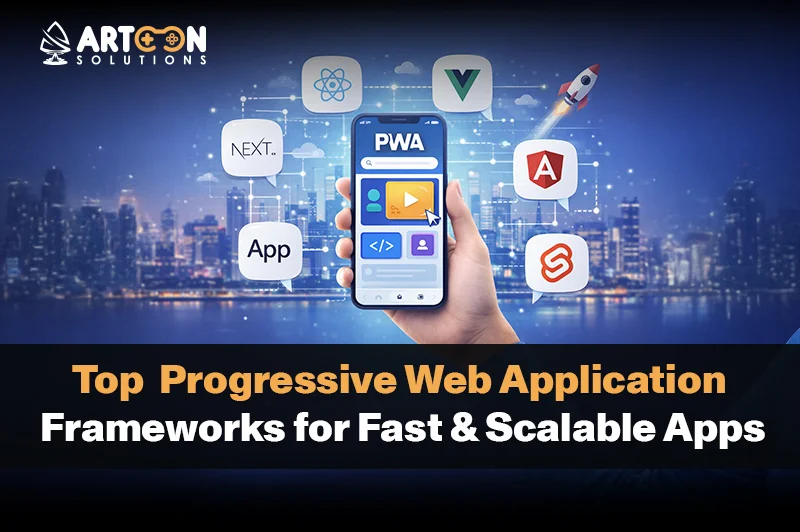
When you open a website, it is like using an app. The website loads fast, it even works when your internet connection is slow, and you can put it on your phone’s home screen without going to an app store. There are no delays. You do not get frustrated. You just get an experience that feels like you are using an app. The website is like an app. It is fast and easy to use. This is made possible by using a progressive web application framework, which ensures your web app behaves like a native app while running in a browser.
Progressive Web Applications, or PWAs, make this possible. Users today want to be able to quickly, reliably, and easily access websites and applications. Users may stop using a web application if it is unresponsive or slow because of internet problems. It essentially explains why selecting a progressive web application framework is essential.
When you have the tools to make progressive web apps, you can make apps that feel like they were made for your phone or computer. These apps work well and can be used on any device. The best part is that you only need to write the code once. This is not a new strategy, but it is an enhanced way to create things with progressive web apps.
Let’s look at how a progressive web application framework enables this and why choosing the best one can impact your app’s success.
It is crucial to take a step back and consider what is really important in your project before making specific decisions about frameworks.
All of these requirements should be met by a dependable progressive web application framework. No single “best PWA framework” is appropriate for every project. What you’re building and your priorities will determine which option is best for you.
In light of this, let’s examine some of the best PWA frameworks currently on the market.

When it comes to developing progressive web applications, it’s difficult to overlook React. It is among the most popular choices for progressive web applications. It ranks among the most-used frontend frameworks in the world.
One reason React is special is that it is component-based. You make small pieces of the UI and then use those pieces over and over again in your application. This is very organized and easy to handle.
Nevertheless, React is quite versatile because its environment is very supportive of progressive web apps.
Popular applications such as Twitter Lite and Uber have developed fast, installable, and reliable applications using the React Progressive Web App approach. This could be the main reason why several companies involved in the development of Progressive Web Applications choose to develop client applications using React.
Although React will initially present a learning curve for those not familiar with component-based programming, it will soon become second nature and very flexible.
React offers flexibility, while Angular offers structure.
Angular is more than a library. It’s a full-fledged, comprehensive framework for creating a progressive web app with everything from tools to architecture and good conventions. This is particularly attractive when dealing with large or complex applications.
And finally, many enterprise teams continue to rely on Angular for large-scale applications. In fact, many developer surveys show strong Angular adoption in enterprise environments where stability and long-term maintenance matter, making it a preferred choice among progressive web application development companies.
Angular works especially well in the following scenarios:
Angular is well-suited for use in enterprise dashboards and internal tools, as well as customer portals, due to its principled approach and the clarity and scalability that come with it.
When it comes to the choice of framework for progressive web applications, Vue.js is always considered one of the friendliest to developers. It strikes a perfect balance by offering the clarity of structure you would get with Angular and the freedom you have with React, but none of the extra hassle.
This balance is what makes Vue especially appealing, should you wish to build modern PWAs while keeping development simple and manageable.
Vue is different from the other progressive web frameworks in regard to how comfortable and productive one feels while working with it.
Vue can be particularly well-suited for:
Features like server-side rendering and static site generation further extend the capabilities of Vue through frameworks like Nuxt.js. This improves performance and SEO while staying aligned with progressive web app principles.
Svelte works differently from most modern frameworks. Rather than running a lot of your code in the browser, Svelte compiles your app into extremely optimized vanilla JavaScript during the build process. For you, that means quicker load times and lighter apps right out the gate. That makes Svelte especially interesting when performance is at the top of your requirements for a progressive web app.
Indeed, many web app developers consistently rate Svelte among their favorite frameworks and prefer to stay with it after they have once tried it.
Svelte works well if:
Though Svelte’s ecosystem is smaller compared to React or Angular, it is a strong option to go for in case you want a lightweight and efficient PWA.
Ionic offers a positioning between web development, making it an optimal choice for apps you would like to use on a variety of platforms. This relies on web development standards. The platform embraces Progressive Web Apps, in addition to mobile apps.
Ionic does have its use when you want your PWA to be based on the same structure as your mobile app, rather than being a distinct project.
In some cases, you may need more or different capabilities from a frontend framework. If that is so, performance optimization, SEO capabilities, or advanced routing may be required. Meta frameworks like Next.js or Nuxt.js could be used for that as a PWA development framework.
Are you already using React and want:
Next.js offers all these features while allowing you to maintain the existing React workflow. It is a very capable choice for developing scalable, speedy PWAs.
Nuxt.js provides the following benefits to Vue developers:
Next.js and Nuxt.js assist you in developing a high-performance, scalable application, albeit a progressive web application.
You may also want to know AI in Hotel Industry
| Your Priority | Best Framework Choice | Why It Fits You
|
| High Performance & Fast Loading | Svelte / Next.js | Smaller Bundles, Optimized Build, and Fast Runtime Performance
|
| Large community & strong support | React / Angular | Large community with good documentation & many plugins, and stability over time
|
| Enterprise-level applications | Angular/React | Robust tooling and scalable architecture to handle large teams and enterprise-level projects
|
| Learning & easy onboarding | Vue.js/Svelte | Learning is simple, with a friendly learning curve and clean code organization
|
| Web & Mobile with One Codebase | ionic + React/Vue | Reusable UI components & Native device access
|
| SEO-friendly PWAs | Next.js/Nuxt.js | Includes server rendering and static site generation
|
| Lightweight, minimal apps | Svelte | No virtual DOM (Document Object Model), and apps are very lightweight
|
Selecting a good framework is very important when it comes to designing a web application that is fast, scalable, and enjoyable for users. Ensure that the tool you select matches your goals seamlessly.
You may also want to know Build an App for Free
Selecting the progressive web application framework is just like choosing the vehicle for a long road trip. Some frameworks are fast, some are stable and collaborative, and some provide flexibility. It all depends on how well the chosen framework matches the project.
Your decision should be driven by your users’ expectations, your team members’ competencies, and your long-term goals. When you consider these three, development will be easier, and you will end up with a good result.
There is no perfect fit for everyone, but a right fit for your project. You now have the knowledge and comparisons you need to make an educated and confident decision.
If you are in need of professional assistance, progressive web applications development organizations such as Artoon will be able to assist in the development of your project. The experts believe in developing scalable and highly performing progressive web applications.
For better budget planning, a cost calculator for progressive web apps can provide you with an early approximation of the cost factors, such as features, complexity, and scope of work.
1. What is the strongest framework?
The strongest tool, based on your requirements, could be a progressive web application tool like React, Angular, or Vue for speed, scalability, and multi-platform support.
2. What are the 5 golden rules of web design?
Simplicity, consistency, rapid loading times, mobile-first design, and good navigation are essential in every progressive web app framework.
3. Will PWAs replace native apps?
PWAs will not entirely replace native applications. However, PWAs can completely replace native apps in business applications using a good PWA development framework.
4. Is PWA a native mobile app?
It is not true. A PWA is developed using a progressive web framework and works within a browser, and also provides features like applications.
5. What is the negative aspect of using WhatsApp?
The WhatsApp service is less customizable than is possible with applications developed using a progressive web application framework.
6. Can I learn React in 7 days?
In 7 days, you will be able to learn the fundamentals of React and begin using a progressive web app framework.

Artoon Solutions
Artoon Solutions is a technology company that specializes in providing a wide range of IT services, including web and mobile app development, game development, and web application development. They offer custom software solutions to clients across various industries and are known for their expertise in technologies such as React.js, Angular, Node.js, and others. The company focuses on delivering high-quality, innovative solutions tailored to meet the specific needs of their clients.
 For business inquiries only